
Enterprise sales prep intelligence equips sales reps with account-specific context, competitive signals, and live market data before every call. This blog explores how marketing teams can close the gap between competitor monitoring and sales prep and how Rocket.new's Intelligence feature serves both functions from one shared source.
What does your competitor's sales team know right now that yours doesn't?
That question used to have no good answer. Today, it's the one that separates enterprise teams closing deals from those losing them to rivals who showed up better prepared.
Enterprise sales prep intelligence is the practice of equipping sales reps with account-specific context, competitive signals, and live market data before every call, meeting, and follow-up.
According to Salesforce's State of Sales research, reps spend only 28% of their week actually selling. The rest disappears into manual research, CRM updates, and prep work that rarely produces sharp, account-specific talking points worth the hours invested.
The good news? That gap is closeable - and marketing teams are sitting on the data that can close it.
Why Enterprise Sales Reps Are Still Winging It?
The Manual Research Problem
Most enterprise sales teams rely on a patchwork of tools to get ready for meetings. LinkedIn. Google News. The company website. Earnings transcripts. CRM data that may or may not be current.
For a single enterprise deal, a conscientious rep can spend over 90 minutes preparing for one meeting. Multiply that across a full territory of accounts and the math gets painful fast. A 10-person sales team spending five hours per week each on manual research costs over $130,000 annually in lost selling time.
That's not a motivation problem. That's a structural one.
What CRM Data Misses?
Most enterprise teams treat their CRM as the source of truth for account intelligence.
It isn't.
RM data captures what reps log - and only 29% of sales professionals rate their CRM data as "very accurate." The other 71% are working with intelligence they can't fully trust.
Leadership changes at target accounts rarely make it into CRM notes in real time. New enterprise priorities surfaced on an earnings call, but don't automatically update the deal record. And competitive activity at an account - a rival running a big push on LinkedIn, a competitor appearing on a review platform with glowing comments from a shared prospect - seldom makes it into the rep's prep materials at all.
The result is enterprise AEs walking into executive meetings missing half the context that could change the conversation.
What Enterprise Sales Prep Intelligence Actually Means in 2025
Three Layers That Actually Matter
Enterprise sales prep intelligence isn't just knowing what a target account does. It's three layers working together:
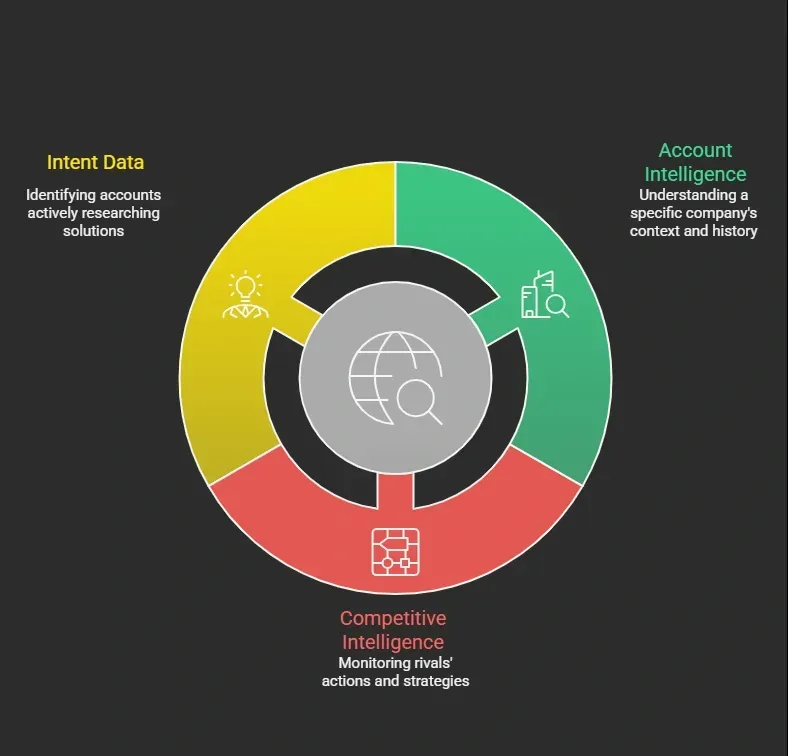 Account intelligence - the context on a specific company: current leadership, recent hiring patterns, strategic priorities, financial signals, and open CRM history with your team.
Competitive intelligence - what your rivals are doing right now, across the same accounts you're selling into, including their messaging, their ad spend, their social positioning, and any product announcements that change the comparison.
Intent data - behavioral signals that tell you when accounts are actively researching solutions in your category, so sales teams can time outreach to match real buying intent rather than guesswork.
When these three layers come together, enterprise teams stop reacting and start anticipating. They enter discovery calls with sharper questions. They build talking points that match the account's actual priorities. They know objections before they surface.
The Gap Between Data and Preparation
Most sales intelligence platforms cover one or two of these layers. A contact database gives you names and titles. An intent data provider shows which accounts are searching certain keywords. A CRM sync keeps records cleaner. But none of them read across the full surface of what's happening with an account right now, in real time.
That's the gap enterprise teams are struggling to close - and it's exactly where marketing's role becomes critical.
| Prep Layer | What Most Teams Do | What High-Performing Teams Do |
|---|---|---|
| Account intelligence | Manual LinkedIn/Google research | Automated briefs with live signals |
| Competitive intelligence | Quarterly battlecard updates | Daily monitoring of competitor activity |
| Intent data | Ad-hoc checking of intent platforms | Real time alerts tied to account lists |
| CRM updates | Manual logging after calls | Automated enrichment from call transcripts |
| Talking points | Rep improvises from memory | Pre-built from signal clusters per account |
Why Marketing Holds the Keys to Enterprise Sales Success
The Campaign and Sales Prep Connection
Most enterprise organizations treat marketing and sales intelligence as separate functions. Marketing runs competitive analysis to inform campaign strategy. Sales uses battlecards to handle objections. The two rarely share a live data source.
But consider what marketing teams actually see: competitor ad activity across LinkedIn, Meta, and TikTok. Changes to competitor landing pages. Shifts in messaging on pricing pages. New G2 reviews that signal where rivals are winning and losing customer perception battles. Executive announcements on social media that hint at a competitor's next strategic move.
That data is gold for enterprise sales prep. A rep walking into a deal against a rival who just ran a major push on enterprise accounts for the same category needs to know about it before the meeting, not weeks later.
Live Competitor Spend Data Changes the Sales Narrative
When marketing teams have access to live competitor spend data, the impact on sales prep is direct.
If a competitor is running high-volume LinkedIn ads targeting CFOs at the same accounts your AEs are working, that signals where they're prioritizing. Your reps can adjust their outreach, focus their talking points, and anticipate the messaging the prospect has already been exposed to.
If a rival just revised its pricing page to surface enterprise tiers more prominently, that's a signal worth having before a pricing discussion in an active deal. If a competitor's review scores on G2 dropped in the past 30 days, that's a concrete competitive positioning angle a well-prepared rep can use naturally in conversation.
This is the intelligence gap between marketing and sales that enterprise teams rarely close fully - and the one that Rocket.new was built to close.
What Enterprise AEs Are Saying About the Prep Problem
The challenge isn't abstract. Ian Koniak, a well-known enterprise sales leader, shared this in a widely circulated LinkedIn post:
"I used to spend weeks building a custom POV to crack into the C-suite. Now it takes me 10 minutes. And it's more effective. Most reps think AI is a shortcut. But it's not. It's a multiplier - for reps who already know how to sell."
That shift from weeks to minutes isn't about cutting corners. It's about getting the same quality of prep at a fraction of the time cost - so sellers can spend their hours on what actually moves deals forward: conversations with buyers, executives, and buying committees.
The Account Intelligence Platform Problem
Why More Tools Create More Noise
Most enterprise teams respond to the intelligence gap by adding tools. A contact database. An intent platform. A news monitoring tool. A dedicated competitive intelligence feed. Each tool adds a login, a workflow, and another data format for reps to reconcile before their next call.
Only 29% of sales professionals report that their data is "very accurate" across systems. The rest spend extra time verifying what their tools tell them - which is the exact research burden the tools were supposed to eliminate.
The problem isn't the tools individually. It's that they don't connect. CRM data doesn't talk to competitive intelligence feeds. Intent data doesn't automatically surface into account briefs. Conversation intelligence from calls doesn't update the account's strategic context in a shared place. Enterprise AEs end up being the integration layer between all of it - manually.
What an Account Intelligence Platform Needs to Do Differently
An account intelligence platform that actually helps enterprise teams prepare faster needs to do three things differently:
-
Interpret, not just alert. A pricing page change in isolation is noise. That same change alongside enterprise-focused social posts, defensive review responses, and new enterprise sales job openings is a clear competitive signal. Good account intelligence reads signal clusters.
-
Surface into the workflow. Briefs that live in a separate tool don't get read. Intelligence needs to arrive before the first meeting of the day, in the format the team already uses, without requiring a separate login.
-
Connect sales and marketing. The competitive signals that marketing teams monitor need to flow directly into the talking points and prep materials that sales teams rely on. One source. Four functions.
How Rocket.new Shapes Enterprise Sales Prep from Live Competitor Data
Intelligence That Watches Every Surface Simultaneously
Rocket.new's Intelligence feature was built to solve exactly this problem. It monitors every public platform a competitor operates on - continuously - and interprets what those signals mean for your specific business and your specific deals.
Rather than checking a dozen sources manually before each sales meeting, enterprise teams set up Rocket.new Intelligence once. From that point, it tracks six signal categories across every competitor simultaneously:
-
Website - every page change, messaging shift, pricing update, new feature announcement, and positioning pivot - with before/after context and strategic interpretation
-
Social Media - every post, campaign, and engagement pattern across LinkedIn, X, Instagram, Facebook, YouTube, TikTok, and Reddit
-
News and Web Presence - press coverage, blog posts, partnership announcements, executive interviews, and media mentions with volume tracked over time
-
Reviews and Reputation - G2, Glassdoor, Capterra, and other review platforms, with sentiment tracked over time and impact tags applied
-
People - employee count, new hires, exits, hiring velocity, and key executive profiles with active social accounts linked. Hiring concentration reveals where competitors are investing before any product announcement confirms it.
-
Performance Marketing - ad activity across LinkedIn, Meta, and TikTok, so sales teams know exactly what messaging their prospects have already been exposed to before a meeting
The Daily Brief That Replaces Manual Prep
Every day, Rocket.new Intelligence produces a structured brief for every competitor your team is tracking. Each brief covers three things: signals and insight (a synthesized paragraph connecting everything that moved), what to watch (emerging patterns worth tracking), and a recommendation (what your team should do, consider, or adjust).
This brief lands before the first meeting of the day. Not weekly. Not after a manual review of a dozen feeds. Every morning, automatically, with interpretation already applied.
For enterprise AEs preparing for calls, this shifts the prep workflow from 90 minutes of fragmented research to a 10-minute review of a brief that already has the competitive context, account signals, and recommended talking points ready to go.
One Source, Four Functions - No Duplication
What makes Rocket.new's approach different from stacking multiple sales intelligence platforms is the shared source architecture. One project, four functions running simultaneously from the same signal feed:
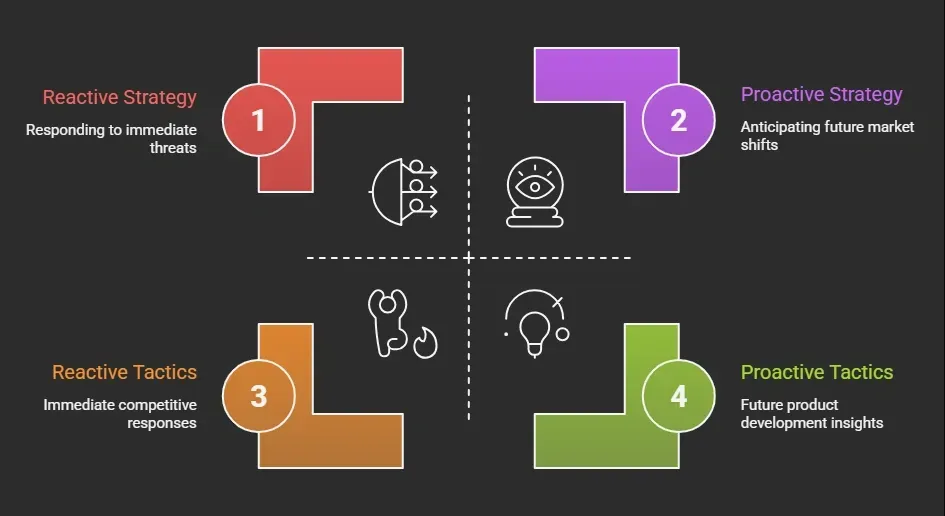 Sales intelligence - deal-specific competitive briefs and weekly updates that give reps the context they need to position against active competitors in their accounts.
Marketing intelligence - campaign differentiation against current competitor activity, so marketing teams can adjust messaging in real time rather than relying on quarterly battlecard reviews.
Product intelligence - what competitors shipped in the past 90 days and what their job postings signal they're building next, so product teams can anticipate and respond.
Strategic intelligence - M&A signals, market entry moves, enterprise positioning shifts, and pattern detection months before formal announcements.
Most enterprise teams run four separate intelligence setups to cover these functions - one for sales, one for marketing, one for product, one for strategy. Rocket replaces all four with one shared source and four lenses. Zero duplication of monitoring effort.
Where Competitors Fall Short
Traditional account intelligence platforms and sales tools like Gong and Salesforce do parts of this well. Gong excels at conversation intelligence - capturing call transcripts and surfacing coaching insights from completed calls. Salesforce centralizes CRM data and pipeline management. Both are valuable for enterprise teams.
But neither monitors live competitor spend data across paid channels. Neither produces daily competitive briefs that connect social activity to pricing changes to hiring patterns into a single signal cluster. Neither gives marketing teams and sales teams the same live intelligence source in the same workspace.
That's the gap Rocket.new closes - not by replacing CRM systems or conversation intelligence tools, but by adding the layer that most enterprise teams are missing: continuous, interpreted competitive monitoring that feeds directly into sales prep.
Closing the Loop on Enterprise Sales Prep Intelligence
A Smarter Prep Workflow for Enterprise Teams
When enterprise sales prep intelligence works the way it should, the workflow changes in a way that compounds over time:
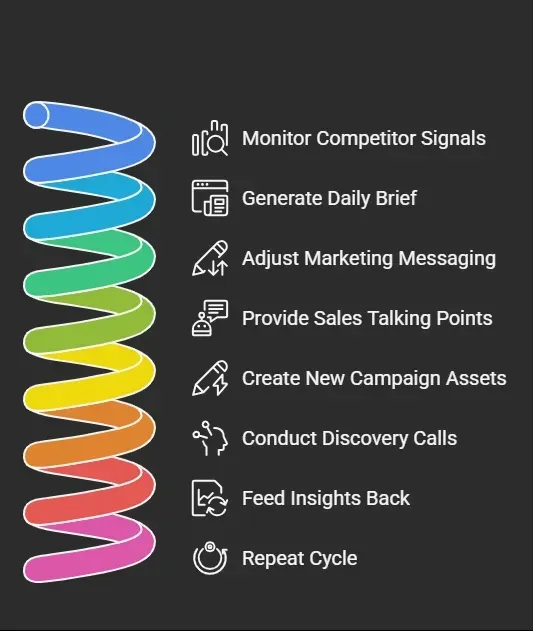 Each cycle makes the next one more accurate. The competitive brief from Monday shapes the campaign asset built on Tuesday. The call insight from Thursday updates the account's context before the follow-up on Friday. Intelligence compounds - it doesn't reset between sessions.
What Enterprise Teams See in Practice
Enterprise sales teams using this kind of account intelligence platform report specific shifts in how they work:
-
Reps enter discovery calls already knowing the three accounts the competitor recently won in the same vertical - and why
-
Sales leaders can coach around competitive positioning using live data rather than last quarter's battlecard
-
Marketing teams can time campaign pushes to respond to competitor activity rather than running on a fixed content calendar
-
Buying committees receive follow-up materials that reflect the most current competitive landscape, not a static comparison document from three months ago
The measurable outcomes are: higher forecast accuracy, stronger pipeline quality, and faster deal execution because the groundwork was properly laid before the first conversation.
Enterprise Sales Prep Intelligence
Enterprise sales success has always depended on preparation. What's changed is the volume and speed of signals that preparation needs to account for. Long sales cycles, expanded buying committees, and a competitive environment where rivals can change their messaging, pricing, and ad spend overnight all raise the stakes of walking into a meeting without current intelligence.
The teams closing enterprise deals consistently in 2025 aren't working harder at manual research. They're building systems where the research arrives before they need it interpreted, prioritized, and connected to the accounts they're actively working.
Rocket's Intelligence feature gives both marketing and sales teams the live competitor data they need in one place, without the tool sprawl that often comes from covering six signal types across multiple platforms. One setup. Daily briefs. Four functions. That's enterprise sales prep intelligence done right.
Table of contents
- -Why Enterprise Sales Reps Are Still Winging It?
- -The Manual Research Problem
- -What CRM Data Misses?
- -What Enterprise Sales Prep Intelligence Actually Means in 2025
- -Three Layers That Actually Matter
- -The Gap Between Data and Preparation
- -Why Marketing Holds the Keys to Enterprise Sales Success
- -The Campaign and Sales Prep Connection
- -Live Competitor Spend Data Changes the Sales Narrative
- -What Enterprise AEs Are Saying About the Prep Problem
- -The Account Intelligence Platform Problem
- -Why More Tools Create More Noise
- -What an Account Intelligence Platform Needs to Do Differently
- -How Rocket.new Shapes Enterprise Sales Prep from Live Competitor Data
- -Intelligence That Watches Every Surface Simultaneously
- -The Daily Brief That Replaces Manual Prep
- -One Source, Four Functions - No Duplication
- -Where Competitors Fall Short
- -Closing the Loop on Enterprise Sales Prep Intelligence
- -A Smarter Prep Workflow for Enterprise Teams
- -What Enterprise Teams See in Practice
- -Enterprise Sales Prep Intelligence