Build a customer loyalty app with stamp cards, points tracking, and SMS alerts using Rocket.new. Generate a production Flutter app with a Supabase backend in hours to days, no dev team needed. Keep customers coming back with automated re-engagement.
A points-based loyalty app with digital stamp cards, SMS alerts, and a rewards redemption screen keeps customers returning. Rocket lets you build a customer loyalty app in Flutter with a Supabase backend in hours to days, no dev team required. This guide covers every feature, cost comparison, and reward structure you need to launch a program that drives repeat visits.
Why Small Businesses Need a Dedicated Rewards App
A points-based loyalty app increases repeat visits by replacing forgettable paper cards with an always-on digital experience that tracks customer behavior automatically. According to SAP Engagement Cloud research, 65% of a company's revenue comes from repeat buyers who already trust the brand.
That single data point tells you retention is the game worth playing. Acquiring new customers costs five to 25 times more than keeping existing ones happy (Bain and Company). For small businesses running on tight margins, a customer loyalty program changes the math completely.
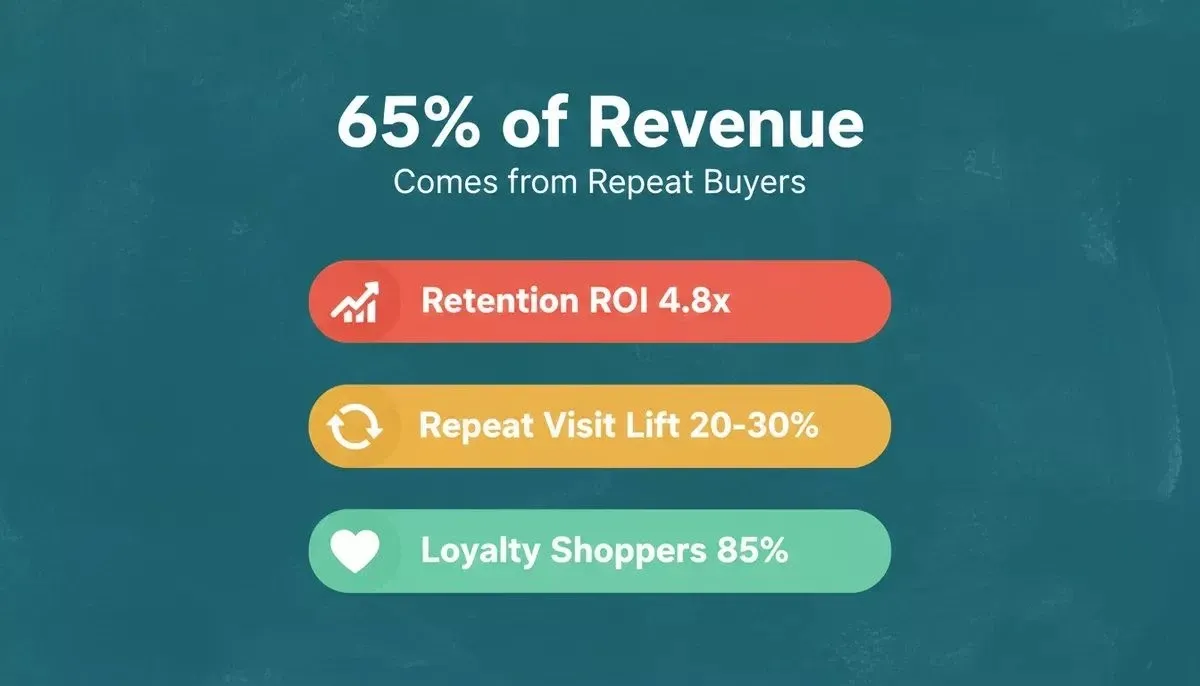
Key loyalty program statistics: repeat buyer revenue share, average ROI, and customer preference data.
So what makes a dedicated loyalty app different from a paper punch card tossed into a wallet?
-
It never gets lost or forgotten - digital cards live on the phone customers carry everywhere
-
It collects data automatically - customer databases grow with every scan, every purchase, every visit
-
It creates long-term relationships - rewarding customers consistently builds brand loyalty that competitors cannot easily break
-
It drives repeat visits with minimal friction - SMS notifications bring people back before they forget about you
-
A well-designed loyalty program pays for itself: 90% of program owners report a positive ROI averaging 4.8x their initial spend (Emarsys)
For coffee shops, salons, restaurants, and retail brands, the choice is clear. The businesses using AI-powered tools for small businesses to create their own app are winning the retention race, while others still hand out paper cards that end up in the trash.
What Features Should a Points-Based Loyalty App Include?
A customer loyalty app needs six core features to drive consistent engagement: digital stamp cards, points tracking, tiered rewards, SMS notifications, QR code scanning, and an admin dashboard. Before you start building, you need a clear picture of what goes into a loyalty program app that customers actually use.
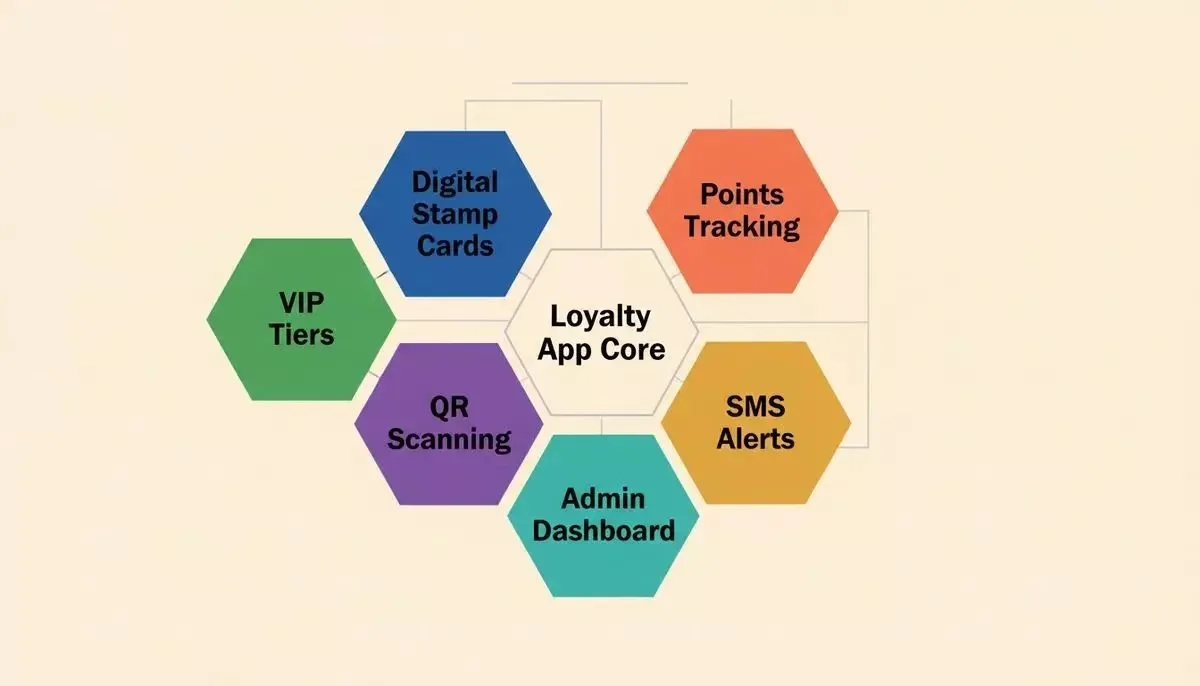
The six essential features every customer loyalty app needs to drive consistent member engagement.
-
Digital punch cards and stamps - customers scan a QR code at checkout and collect stamps toward a free item or discount
-
Points tracking and balance display - let members see exactly how many loyalty points they have accumulated
-
Tiered rewards and VIP tiers - create Bronze, Silver, Gold levels where higher tiers get better rewards
-
SMS notifications for offers - send birthday rewards, bonus points promotions, and limited-time deals directly to the phone via Twilio
-
In-app payments and checkout - let customers pay, earn points, and redeem rewards all in one transaction
-
QR code scanning at point of sale - quick scanning at the register means no app downloads needed for staff
-
Referral programs - reward members for referring friends with bonus points or free items
-
Admin dashboard for the business owner - track redemption rate, active members, revenue per loyalty member, and program performance
| Feature | Best For | Customer Benefit |
|---|---|---|
| Digital punch cards | Cafes, bakeries, and quick service | Earn stamps toward free items |
| Points-based rewards | Retail, salons, and service businesses | Accumulate points, choose rewards |
| Tiered VIP program | Medium-sized businesses with repeat buyers | Access higher tiers for better rewards |
| SMS notifications | All business types | Receive personalized offers on the phone |
| In-app payments | Retail, restaurants, food stores | Pay and earn in one tap |
| Referral program | Service businesses, salons, gyms | Earn rewards for referring friends |
According to SellersCommerce 2026 data, 85% of customers say they are more likely to shop with brands that offer loyalty rewards.
How Does a Digital Stamp Card Work for Cafes and Salons?
A digital stamp card works by issuing one stamp per qualifying purchase via QR code scan, tracking progress visually in the app, and automatically unlocking a reward when the threshold is reached.
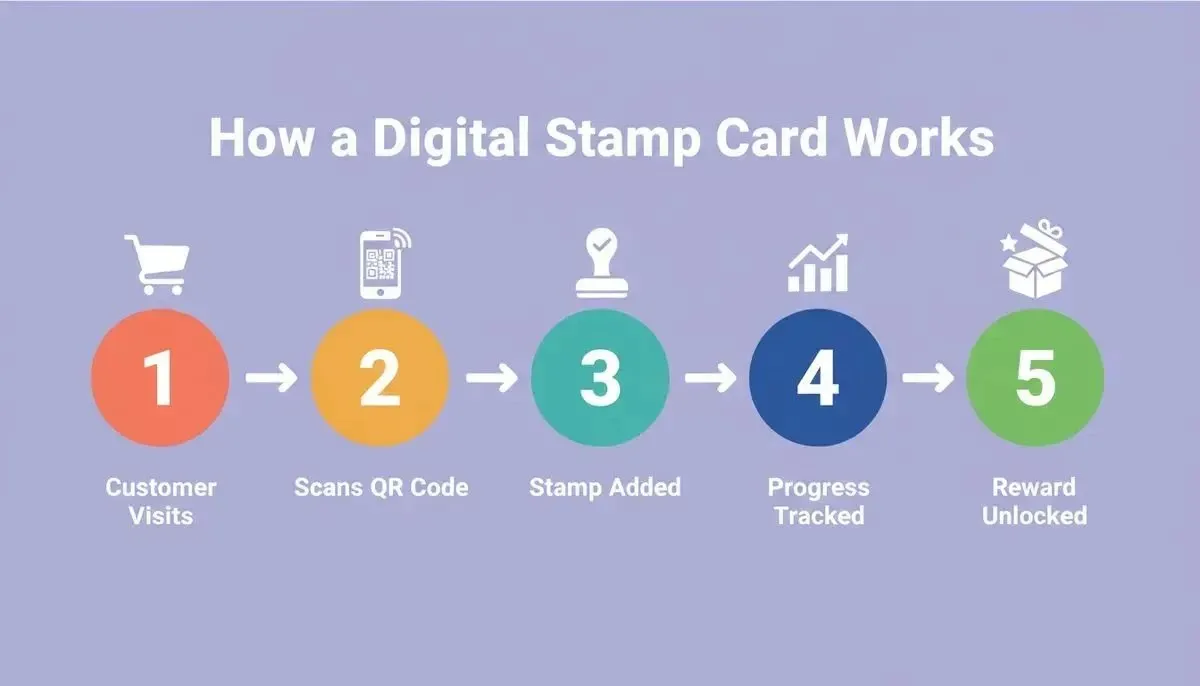
How a digital stamp card works in five steps, from customer visit to reward unlock.
-
A customer walks into your cafe and orders a latte
-
They scan a QR code at the register - the app stamps their digital card automatically
-
After collecting a set number of stamps (say ten), they earn a free drink or service
-
The app tracks their progress visually, so they see how many stamps remain until the next reward
-
Loyalty members at higher tiers might earn stamps faster, like two stamps per visit instead of one
Coffee shops using digital punch cards report 20-30% more repeat visits than those relying on paper. For salons, the same model works with a twist - instead of stamps per purchase, you reward per visit frequency or per dollar spent.
Every scan gives you information about visit frequency, spending patterns, and which reward types drive the most engagement. Paper cards never told you any of that.
Rocket's Flutter mobile app builder generates the full stamp card UI, QR scanning logic, and Supabase backend from a single prompt, with no manual coding required.
How Much Does It Cost to Create a Custom Loyalty Program App?
Building a custom loyalty app costs between $0 (SaaS trial) and $100,000+ (agency development), but an AI app builder like Rocket delivers full code ownership in hours to days at a fraction of agency cost.
-
SaaS platforms (Square Loyalty, CandyBar, Loopy Loyalty) - monthly fees range from $15 to $300 depending on features and member count. You get quick setup but limited customization and no code ownership
-
Custom development agency - expect $25,000 to $100,000 for a cross-platform loyalty program app with an admin dashboard. Takes three to six months, requires an ongoing maintenance budget
-
AI app builder (Rocket.new) - describe what you want, get a working Flutter app with a Supabase backend in hours to days. You own the code, publish to Google Play and Apple App Store, and pay a fraction of agency costs
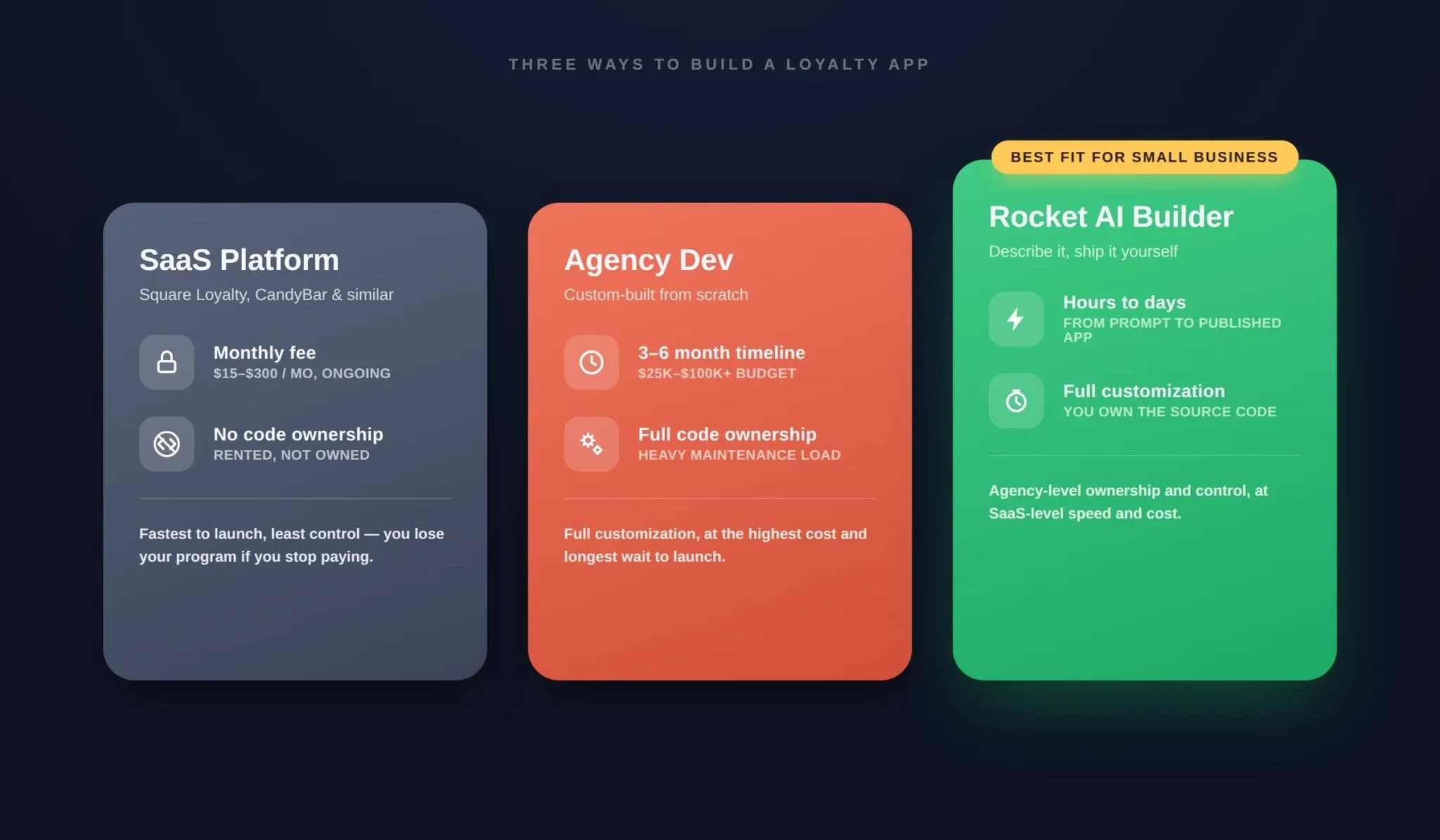
Build an approach comparison: SaaS subscription vs. agency development vs. Rocket AI builder for a customer loyalty program.
| Approach | Cost Range | Timeline | Code Ownership | Customization |
|---|---|---|---|---|
| SaaS subscription | $15-300/month ongoing | Same day | No | Limited templates |
| Agency development | $25,000-$100,000+ | 3-6 months | Yes (usually) | Full but costly |
| Rocket (AI builder) | Platform subscription | Hours to days | Yes, download source | Full, iterate anytime |
| Square Loyalty | $60+/month | Same day | No | Square ecosystem only |
| CandyBar | $45+/month | Same day | No | Limited |
According to Zoho Thrive findings, 79% of companies plan to revamp their loyalty programs within three years. That means flexibility matters.
For small businesses that want a branded app they can own forever, the no-code app builder for startups category has changed dramatically. If you want to understand how AI builders compare on cost and ROI before committing, the AI app builder vs hiring a developer ROI breakdown is worth reading first.
Ship Your Loyalty App on Rocket in Hours to Days
Rocket generates production-grade Flutter mobile apps from a plain-language description, connected to a Supabase database that handles your customer data, authentication, and real-time analytics - no dev team required.
-
Describe your loyalty app in plain English - tell Rocket you want a stamp card system, points tracker, reward redemption screen, SMS notifications via Twilio, and an admin dashboard. It builds the whole thing
-
Flutter means cross-platform from day one - a single codebase produces both iOS and Android apps, ready for app stores. No separate teams, no duplicated effort
-
Supabase powers the backend - your customer databases, point balances, transaction history, and program rules all live in a database you control. Not locked inside someone else's platform
-
SMS notifications through Twilio - Rocket's documented Twilio connector lets you wire up automated SMS messages for birthday rewards, dormant member re-engagement, and weekly deals
-
You own the code forever - download the full source, host it anywhere, modify anything. Your branded app belongs to you, not a vendor who can raise prices or shut down
Those platforms rent you access - the moment you stop paying, your program disappears along with all your member data. With Rocket, every customer profile, every point balance, and every redemption record belong to your business.
One Reddit user in r/smallbusiness put it well: "Customer acquisition costs 5 times more than customer retention, so I think this is an important question to ask." That math is exactly why building your own app, rather than renting one, makes sense long term.
Rocket also handles the full backend automatically - learn more about how Supabase integration works inside Rocket to understand what gets scaffolded for you.
How to Design a Reward Structure That Drives Engagement
The best reward structure for a loyalty app matches your purchase frequency: points-per-dollar for daily buyers, stamps-per-visit for weekly service customers, and tiered levels for any business that wants to reward its highest spenders differently.
-
Points-based rewards work best for frequent purchases - cafes, grocery stores, and quick-service restaurants where customers visit multiple times per week. One point per dollar spent, redeem at thresholds
-
Stamp-based programs suit service businesses - salons, car washes, pet groomers. Count visits rather than dollars. After ten visits, the eleventh is free or discounted
-
Tiered programs reward your best customers differently - Bronze gets basic rewards, Silver gets bonus points days, and Gold gets exclusive access
-
Surprise and delight rewards build emotional connection - members who receive surprise rewards spend 4.3x more than those getting generic offers (Emarsys)
-
Gamification adds excitement: leaderboards, challenges, and streak rewards create fun around routine purchasing behavior
The biggest mistake small businesses make is setting rewards too far away. Set achievable milestones: a small reward at 50 points, a better one at 150, and the big payoff at 300.
A step-by-step AI mobile app creation guide can walk you through mapping these reward tiers into actual app screens and logic. For businesses looking to add in-app payments alongside rewards, the AI app builder with Stripe payment integration guide shows how to wire up checkout and points earning in a single flow.
SMS Notifications and Marketing Automation for Retention
SMS notifications drive loyalty app retention by delivering the right message at the right moment - birthday rewards, points expiration alerts, and re-engagement offers - without becoming spam.
Rocket's Twilio connector lets you wire up SMS flows directly from chat, without a separate marketing platform:
-
Birthday rewards drive guaranteed visits - send a notification three days before their birthday with a free item or discount. Redemption rates for birthday offers run 2-3x higher than standard promotions
-
Dormant member re-engagement - if someone has not visited in 30 days, trigger a "we miss you" SMS with bonus points or a special offer
-
Points expiration reminders - notify members when their points balance is about to expire. Creates urgency and drives repeat visits on a schedule you control
-
Flash sale alerts - send opted-in members a time-limited deal. Twilio's SMS delivery is near-instant, making it ideal for same-day promotions
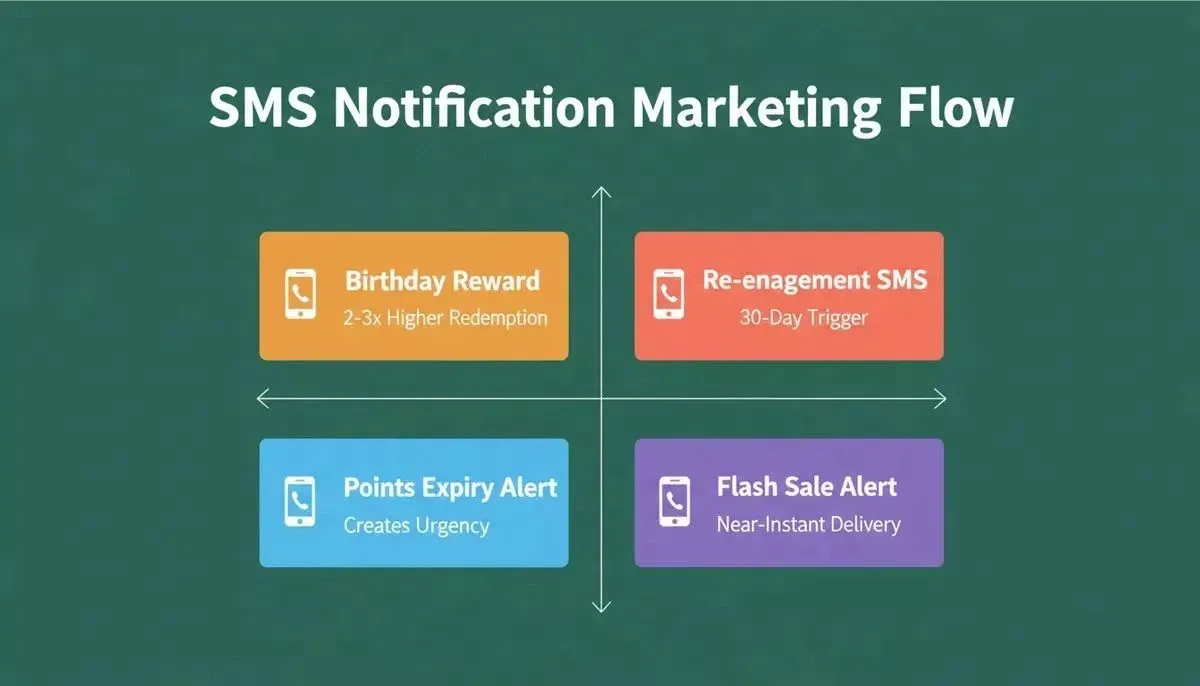
Four high-performing SMS notification types for loyalty app retention, wired through Rocket's Twilio connector.
The customer experience improves when notifications feel personal rather than generic. Using data from your Supabase customer database, you can segment members by spending level, visit frequency, and reward preferences. A loyal customer who always orders espresso does not need notifications about tea promotions.
The user engagement loop becomes: purchase, earn, notify, return, redeem, repeat.
Loyalty engagement loop: purchases trigger Supabase points tracking, Twilio SMS fires on key events, and customers return to redeem.
For businesses wanting to go further with marketing automation, the best marketing automation platforms for small businesses guide covers how to layer additional channels on top of your loyalty app.
Table of contents
- -Why Small Businesses Need a Dedicated Rewards App
- -What Features Should a Points-Based Loyalty App Include?
- -How Does a Digital Stamp Card Work for Cafes and Salons?
- -How Much Does It Cost to Create a Custom Loyalty Program App?
- -Ship Your Loyalty App on Rocket in Hours to Days
- -How to Design a Reward Structure That Drives Engagement
- -SMS Notifications and Marketing Automation for Retention