
42% of startups fail because they build the wrong thing. This blog breaks down the 2026 founder validation stack and shows how Rocket.new replaces expensive Forrester research with AI-powered market validation, full-stack app generation, and continuous competitive tracking.
What if the biggest risk to your startup is not the code you write but the problem you pick?
That is exactly what kills most startups. Research from CB Insights consistently shows that 42% of startups fail because of no market need - they built something real users simply did not want.
Expensive analyst firms like Forrester were never built to help solo founders catch that problem before it costs them everything.
In 2026, the best founder validation stack looks very different. This blog breaks down what that stack looks like and where Rocket.new fits into it.
Why Forrester Does Not Work for Early-Stage Founders
Forrester Research is one of the most recognized names in market analysis - but it was never built for early-stage startup founders.
-
Price: A traditional market research project costs between $15,000 and $50,000 when outsourced to a consulting firm, with Forrester annual subscriptions running well into the tens of thousands (Qualtrics, 2025)
-
Speed: The full research cycle takes 4 to 8 weeks - a timeline that simply does not fit a startup burning runway while it waits
-
Audience: Forrester is built for technology executives and enterprise teams with dedicated analyst relationships and quarterly planning cycles
-
Fit: Solo founders and early-stage startup founders are not who this model was designed for - the reports are thorough, but they are written for very different problems
-
Gap: Most founder tools force a choice between expensive-and-slow or cheap-and-shallow - neither option actually helps at the idea stage
The result is a real gap that most startup founders never fully solve before they start building.
The Real Cost of Skipping Validation
Failory's 2026 analysis shows that ninety percent of startups fail and the reason is almost always the same.
-
Root cause: 42% of startup failures trace back to no market need founders built something real users simply did not want
-
Pattern: Startup founders spend months designing beautiful front end screens, writing backend logic, and connecting Stripe billing before confirming anyone will pay for what they are building
-
Vulnerability: Early-stage startup founders carry this risk more than anyone there is no customer success team to surface problems early and no buffer if the idea turns out to be wrong
-
Research trap: Solo founders skip validation not because they are careless, but because research tools either cost too much or return results too slowly to matter before the build starts
-
End result: A polished app built on top of the wrong idea still produces a failed product
Solo founders who skip validation pay for it later usually after months of work and most of their runway are already gone.
What Most AI App Builders Get Wrong
The rise of the AI app builder has genuinely changed what startup founders can do on their own - but most of these tools start at the wrong place.
-
Scale: No-code development now delivers up to 90% faster launch times and 65% of apps are now built without traditional coding (Adalo, 2026)
-
Lovable: Generates a beautiful front end from a text prompt in minutes - strong for investor demos and rapid visual prototyping, but backend support is limited to Supabase only
-
Bolt.new: Writes code and deploys a working app almost instantly - useful for fast experiments, but most teams using Bolt rebuild in a different ai app builder when real users arrive
-
Bubble: Lets non-technical solo founders configure entire products through a visual editor - but the learning curve is steep and complexity walls appear quickly without developer support
-
Cursor: Gives developers an AI layer inside their IDE - built for engineering teams, not non-technical startup founders
-
The shared gap: Every one of these ai app builders starts at the build phase - Lovable generates a UI immediately, Bolt writes code immediately, Cursor starts editing immediately - none of them stop to ask whether you are building the right thing first
That is the problem at the center of the current stack - speed without direction - and it is what leaves most solo founders building the wrong product faster than before.
What the 2026 Founder Validation Stack Actually Looks Like
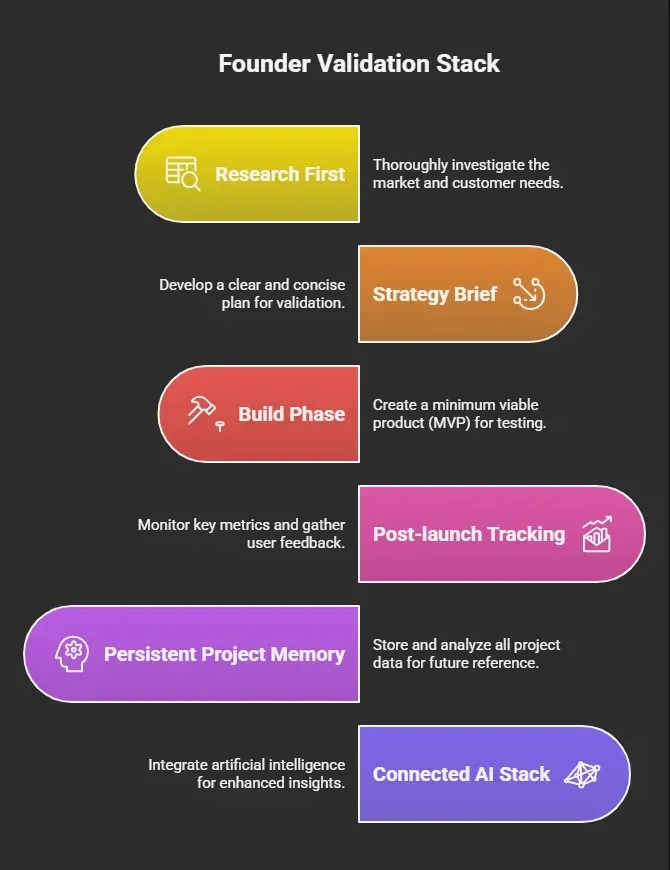
The strongest validation stacks in 2026 are not long lists of disconnected tools - they are tight, connected systems where each layer feeds directly into the next.
-
Research first: Market context, competitor positioning, and demand signals come before a single prompt is typed into an ai app builder
-
Strategy brief: The research output feeds directly into the build phase as structured direction - not guesswork or instinct
-
Build phase: A production-ready app is generated from validated direction, not a demo that needs a rebuild when real users arrive
-
Post-launch tracking: Competitive monitoring runs continuously not as a one-time research project done before launch
-
Persistent project memory: Context is never lost between sessions every build decision stays grounded in the research that came before
-
Connected ai stack: The ai stack that wins in 2026 ties all three phases together in one system with one shared context
Validation is not a one-time step before building - it is a continuous loop that runs through the life of the startup, and the best ai stack in 2026 reflects that.
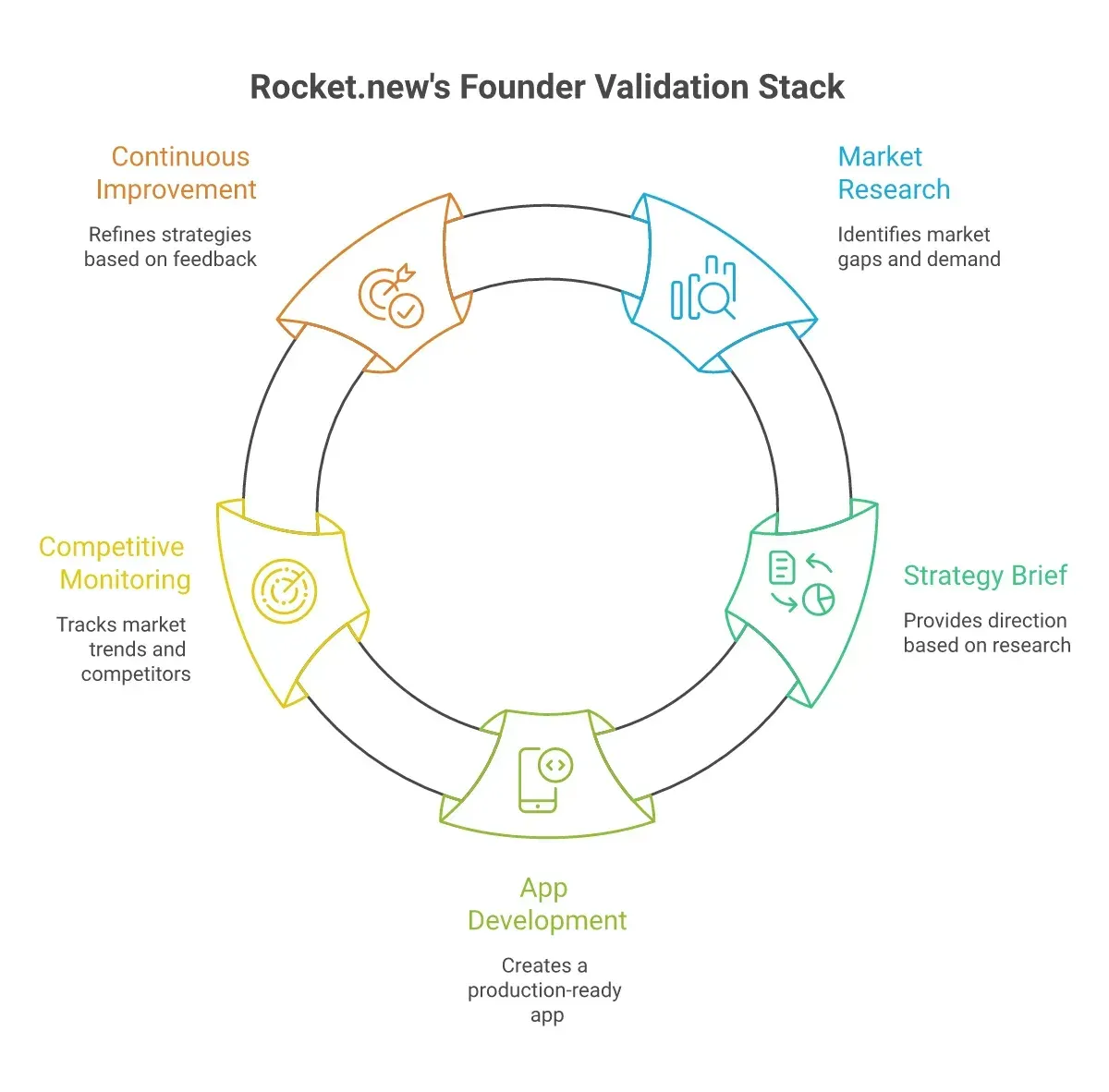 The 2026 Founder Validation Stack
Launching the Rocket: How Rocket.new Anchors the New Stack
Rocket.new is the world's first Vibe Solutioning platform and where most other ai app builders start at what to build, Rocket.new starts before it.
-
Reach: 1.5 million founders across 180 countries have tried Rocket.new
-
Scope: The platform covers the full founder journey in one connected system market research, full-stack build, and competitive tracking
-
Advantage: Most other ai app builders hand founders a tool for one phase of the journey - Rocket.new handles all three without switching platforms or losing context
That connected approach is what separates Rocket.new from the rest of the best ai app builder field in 2026.
Solve: The Strategy Brief Before Any Build
Rocket.new's Solve feature is the part most AI app builders skip entirely and the practical Forrester alternative that actually fits solo founders and their budgets.
-
Input: A founder types their business idea or problem in plain language no templates, no forms, no analyst briefings
-
Output: Solve researches the market, studies competitors, surfaces demand signals, and returns a strategy brief before a single line of app code is written
-
Cost comparison: No $40,000 report or eight-week wait grounded market intelligence ready in minutes, tied directly to what comes next
-
What it surfaces: Market gaps, competitor weaknesses, and the right problem worth solving first
Solve is what stops startup founders from spending months building the wrong thing.
Build: Full-Stack AI App Generation from One Prompt
Once direction is confirmed, Rocket.new's Build feature handles execution and it goes much further than a beautiful front end.
-
Output: Build produces a complete, production-ready application: backend logic, database structure, authentication, and deployment from one comprehensive prompt
-
vs. Lovable: Lovable generates a beautiful front end well but backend support requires Supabase only, and production-ready output comes after multiple refactoring cycles
-
vs. Bolt.new: Bolt is fast but unreliable for production workloads most teams using Bolt rebuild in a different ai app builder when real users arrive
-
vs. Bubble: Bubble requires significant time in the visual editor before anything is production-ready solo founders hit complexity walls quickly
-
vs. Cursor: Cursor is purpose-built for developers non-technical startup founders should start elsewhere
-
Visual editor: Enables component level editing after generation layout, colors, and structure are all adjustable without writing code
-
Persistent project memory: Carries full context across sessions so the AI remembers what was built and why
Rocket.new generates the entire stack in one pass - the first build is production-ready, not a starting point for rounds of refactoring.
Connect and Launch: Stripe, Supabase, and 25+ Connectors
Rocket.new is designed to connect to the tools startup founders actually use - without plugin configuration or separate setup steps.
-
Stripe billing: Built into the platform as a first-class option not bolted on later via plugin configuration
-
Core connectors: Connect Stripe, Supabase, GitHub, Resend, Twilio, and Google Analytics directly inside Rocket.new
-
AI providers: Anthropic, OpenAI, and Gemini are all available as direct connectors from the same workspace
-
Email notifications: Wired in from the first build session no separate configuration needed
-
Breadth: 25+ connectors available without additional platform setup steps
For solo founders, having all of this in one session rather than stitching together five separate tools is the practical difference between shipping in days and spending weeks on setup.
Intelligence: Track the Competition Without Manual Work
Most startup founders launch their product and then go quiet - but the market keeps moving.
-
The gap: Competitors ship new features, pricing changes, and new entrants appear while most founders are focused entirely on their own product
-
How it works: Rocket.news Intelligence feature monitors the competitive environment continuously after launch
-
What it catches: Pricing updates, new feature releases, and messaging shifts - all surfaced without manual checking
-
Analytics layer: Founders get a real-time view of what their competition is doing, tied back to the same context as the original build
Knowing what the competition does next is not a luxury - it is the difference between staying relevant and losing ground founders did not know they were losing.
Rocket.new vs the Other AI App Builders: A Direct Comparison
Here is how the main options stack up for startup founders evaluating the best ai app builder for their needs in 2026.
| Feature | Rocket.new | Lovable | Bolt.new | Bubble | Cursor |
|---|---|---|---|---|---|
| Pre-build market validation | Solve feature | None | None | None | None |
| Full-stack output | Yes - first generation | Front end + Supabase | Partial | After configuration | Developer only |
| Beautiful front end | Yes | Yes | Yes | Yes | Manual |
| Visual editor | Yes | Strong | Limited | Strong | No |
| Component level editing | Yes | Yes | No | Yes | No |
| Connect Stripe | Native | Via plugin | Via plugin | Via plugin | Manual |
| Stripe billing | Built-in | Plugin config needed | Plugin config needed | Plugin config needed | Manual |
| Persistent project memory | Yes | Limited | Limited | No | Limited |
| Competitive monitoring | Intelligence feature | No | No | No | No |
| Pricing from | Free / $25/mo | Free tier | Free tier | Free tier | Free trial |
-
Lovable: The best ai app builder for quick investor demos and visual prototyping - fast and polished - but startup founders needing production-ready code with real backend logic tend to move on
-
Bubble: Capable but complex - it takes weeks to learn the visual editor well, and most ai app builders in Bubble's category work better for larger teams than solo founders
-
Bolt: Great for fast experiments but not the best ai app builder for startups planning to scale past the demo stage
-
Cursor: Purpose-built for developers - non-technical solo founders should start elsewhere
-
Rocket.new: The only platform in this group that starts before the build - validation, build, and competitive tracking in one connected ai stack
The gap across all these tools is not speed all of them are fast. The gap is direction, and only one platform validates the idea before the code is written.
What Real Founders Are Saying
The clearest signal on which platform suits which founder comes from people already building with these tools.
-
AI productivity data: A survey of 1,750 tech workers found 78% of founders say AI has exceeded their expectations, with half reporting it saves them over 6 hours per week - the highest rate of any role surveyed (Lenny's Newsletter, December 2025)
-
Community pattern: Discussions on Reddit's r/vibecoding and the Rocket.new Discord show solo founders starting with Lovable or Bolt for early demos, then moving to Rocket.new when production-ready output becomes the priority
-
The wall: Startup founders who stay in Lovable or Bolt for production apps consistently hit the same point - backend limitations, scaling problems, or market assumptions that were never validated before building began
"Rocket.new is surprisingly smooth for creating internal tools. The AI agent setup saves me hours of boilerplate work, and the vibe coding interface is pretty addictive."- Reddit user, r/vibecoding
Rocket.new does not just build apps - it builds the right apps, validated before a single line of code is written and tracked continuously after launch.
Building the Right Stack: What 2026 Founders Actually Need
The problem with Forrester is not the quality of their research. It is the fit.
Enterprise-grade analyst reports do not serve solo founders and early-stage startups. The timeline is too long. The cost is too high. And the output is not connected to anything that helps a founder actually build or ship.
The Forrester Alternative + Rocket.new: the 2026 founder's validation stack closes that gap. Rocket.new’s Solve feature delivers grounded market intelligence in minutes. Build ships a production-ready app from that validated direction. Intelligence tracks what the competition does next.
Ninety percent of startup founders fail. The ones who make it validate first, build right, and track constantly. That is the stack worth building in 2026.
Table of contents
- -Why Forrester Does Not Work for Early-Stage Founders
- -The Real Cost of Skipping Validation
- -What Most AI App Builders Get Wrong
- -What the 2026 Founder Validation Stack Actually Looks Like
- -Launching the Rocket: How Rocket.new Anchors the New Stack
- -Solve: The Strategy Brief Before Any Build
- -Build: Full-Stack AI App Generation from One Prompt
- -Connect and Launch: Stripe, Supabase, and 25+ Connectors
- -Intelligence: Track the Competition Without Manual Work
- -Rocket.new vs the Other AI App Builders: A Direct Comparison
- -What Real Founders Are Saying
- -Building the Right Stack: What 2026 Founders Actually Need