Airtable is great for structured data and team workflows. If you need a deployable app with custom UI and code ownership, an AI app builder like Rocket.new is the right Airtable alternative. This guide covers use cases, pricing, the Bending Spoons acquisition, and how to migrate.
If you are searching for an Airtable alternative, the answer depends entirely on what you are building. For structured data workflows and team collaboration, Airtable remains a strong fit.
For standalone products with their own UI, authentication, and deployment, an AI app builder like Rocket.new generates production-ready web and mobile apps from a plain-language description.
Quick Answer: Which Project Management Tools Fit Your Project?
Use Airtable if your project is a structured data workflow: tracking inventory, managing content calendars, or coordinating tasks across a team. Airtable does this well, and its collaboration features are genuine strengths.
Use an AI app builder like Rocket.new if you need a standalone product: a customer-facing web app, a mobile app for the App Store, a SaaS dashboard, or an MVP you can deploy to a custom domain with full code ownership.
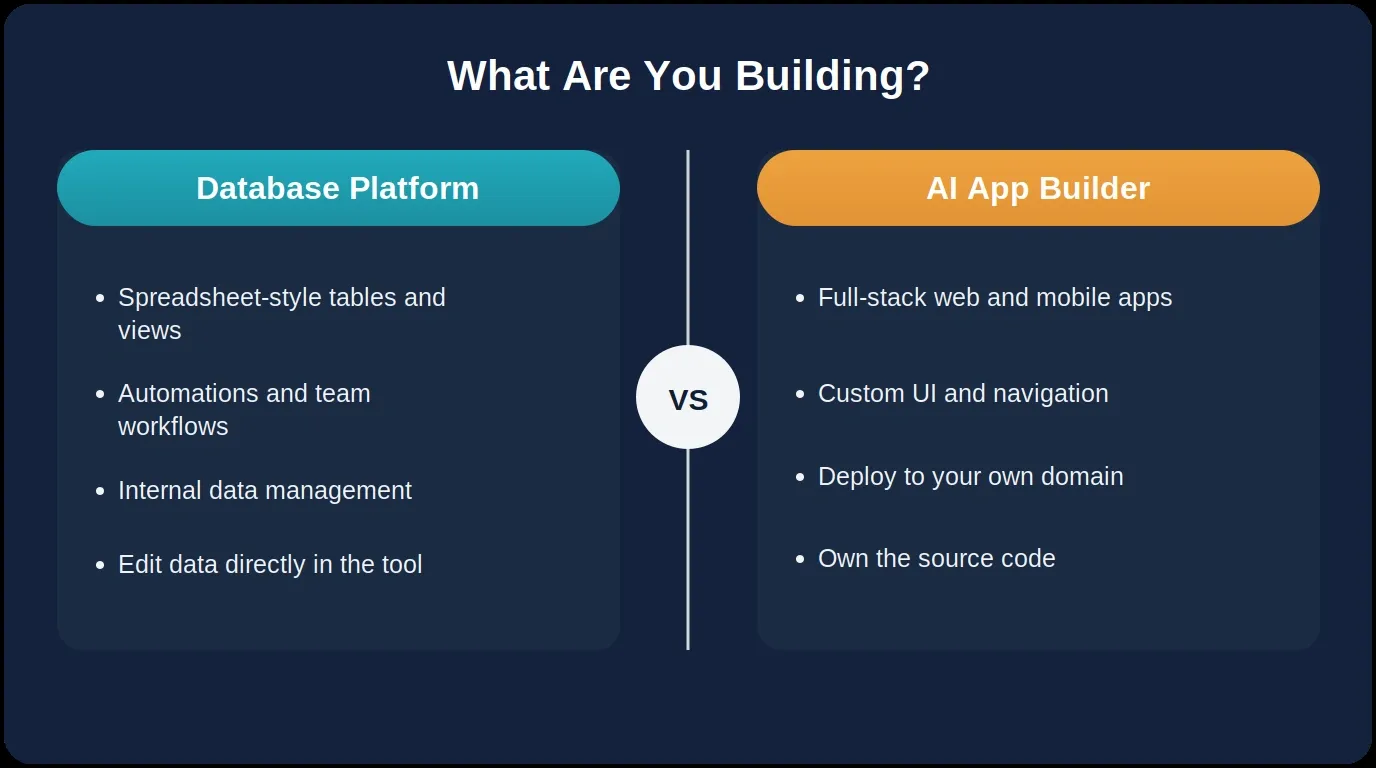
Database platforms organize data. AI app builders ship products. Know which one you need before you choose.
| Dimension | Airtable | Rocket.new |
|---|---|---|
| Approach | Database-first, spreadsheet-like interface | AI code-first, describe in plain language |
| What you get | Configured database with views and interfaces | Deployed web or mobile app with source code |
| Code ownership | No code export; interfaces and logic stay in Airtable | Full Next.js/Flutter source code, downloadable |
| Data export | Data exports as CSV; automations and views do not | Full source code download on paid plans |
| UI and design freedom | Interface Designer with pre-set components | Custom UI per project; production-grade design |
| Data and collaboration | Strong: real-time co-editing, granular permissions, audit logs | Project-level shared context, team roles (Owner, Editor, Viewer) |
| Automations and AI | Built-in automations, Omni AI, AI Field Agents | AI-powered generation + 25+ integrations wired into the build |
| Security and governance | SSO, audit logs, DLP, HIPAA (Enterprise Scale) | Automated WCAG 2.1 AA audits, GDPR/CCPA consent banners; SSO available through Sales |
| Pricing model (Sept 2026) | Per seat: $20-$45/mo billed annually; Enterprise custom | Credit-based: $25-$250/mo; unlimited team members on all paid plans |
| Best for | Structured data workflows, team coordination | Standalone products, customer-facing apps, MVPs |
Why is "Airtable or Something Else?" Such a Common Question?
The low-code platform market has grown rapidly alongside a new wave of AI-powered app builders that let teams describe what they want and get a working product back in minutes.
That shift has changed the decision for teams planning their next tool. Airtable is primarily built around a database, not around producing standalone software.
The question is no longer "which spreadsheet tool?" but "which approach fits what I am actually building?" When evaluating any Airtable alternative, the core distinction is whether you need a configured database or a deployable application.
What Separates a Database Platform from an AI App Builder?
The core difference between a platform like Airtable and an AI app builder like Rocket.new is where the work starts and what you get at the end.
Airtable is Database-first
You organize data into tables, define field types, create views, and layer automations on top. You can add an interface layer with Interface Designer, but the underlying architecture is a relational database with a spreadsheet-like skin.
Rocket.new is a Vibe Solutioning Platform
The platform combines Solve (market research), Build (AI code generation), and Intelligence (competitor monitoring). The Build capability generates production-ready source code in Next.js (web) or Flutter (mobile).
This is closer to vibe coding: describe the outcome and let AI handle the implementation.
If your project needs to manage data, Airtable is the right category. If it needs to ship a product, an AI app builder is the right category.
What is Airtable, and What Does the Bending Spoons Acquisition Mean?
Airtable is a database platform with a spreadsheet-like interface that more than 450,000 organizations use for organizing structured data and running team workflows.
- Multiple view types give different perspectives on the same data: grid, kanban boards, calendar, gallery, timeline, and forms
- Automations handle repetitive tasks with triggers and actions across your bases, up to 500,000 runs per month on the Enterprise Scale plan
- Interface Designer lets non-technical teams create custom forms, dashboards, and record detail pages on top of existing bases
- Granular permissions control who can see and edit records, fields, and views down to individual user roles
Airtable's AI features have evolved quickly. Omni is the newer AI assistant that responds to natural language queries across your bases. AI Field Agents perform autonomous multi-step tasks inside your workflows, like classifying records or enriching data fields.
As of September 2026, Airtable's Team plan starts at $20 per seat per month (billed annually, $24 billed monthly) and the Business plan at $45 per seat per month (billed annually, $54 billed monthly). The free plan supports up to 5 editors with 1,000 records per base.
The Bending Spoons Acquisition
On August 4, 2026, Bending Spoons announced a definitive agreement to acquire Airtable for a reported $1.285 billion enterprise value. The deal closed on September 4, 2026.
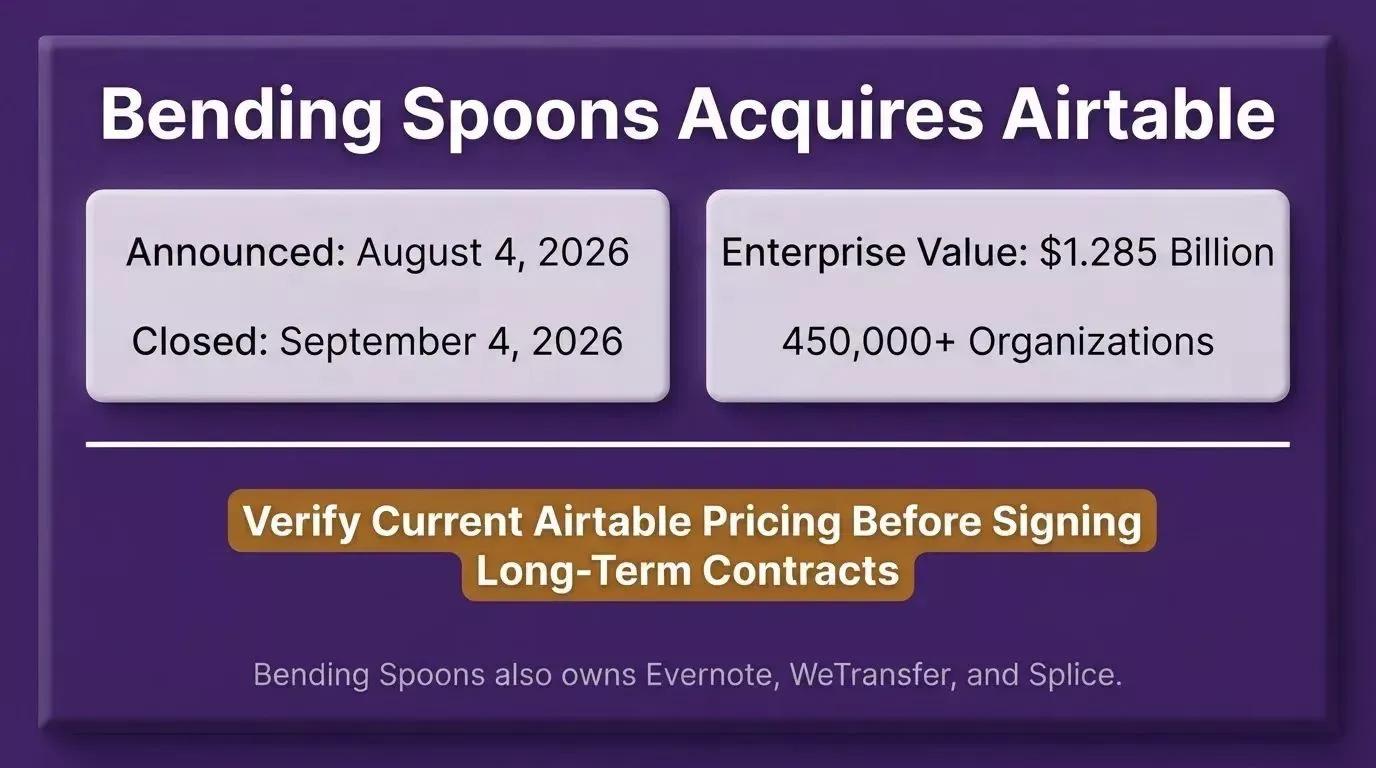
Bending Spoons previously acquired Evernote, WeTransfer, and Splice. Verify current Airtable terms before committing.
Bending Spoons is an Italian software company known for acquiring and improving digital products. Product direction and pricing may change under new ownership. Verify current Airtable pricing and terms directly before signing long-term contracts.
What is Rocket.new?
Rocket.new is a vibe solutioning platform that combines market research (Solve), AI app generation (Build), and competitor monitoring (Intelligence). The Build capability generates full-stack applications from plain-language descriptions.
- Web apps: Generate in Next.js with production-grade design systems, SEO-ready structure, and automated WCAG 2.1 AA audits and one-click fixes
- Cross-platform mobile apps: Generate in Flutter from a single codebase, ready for iOS and Android
- Full code ownership: Download the source code, connect a GitHub repo, or deploy to your own infrastructure (paid plan required for download)
- 25+ integrations: Connect directly into generation: Stripe, Supabase, Google Analytics, Airtable, Notion, and others, plus any REST API via Postman, cURL, or OpenAPI specs
- GDPR/CCPA: Consent banners, and privacy policies generated automatically; Core Web Vitals dashboard included
Team roles: Owner, Editor, and Viewer. Editors have a credit limit (default 100, adjustable from 0 to 10,000), which is useful for controlling build costs across a team.
Pricing (September 2026, verified from Rocket.new pricing):
| Plan | Monthly fee | Credits/month | Solve access |
|---|---|---|---|
| Free | $0 | 20 (one-time, never expire) | Light Solve |
| Pro | $25 | 100 | Light Solve only |
| Rocket | $50 | 250 | Light + Full Solve (auto-routed) |
| Booster | $250 | 1,500 | Light + Full Solve (auto-routed) |
Annual billing saves 20%. All paid plans include unlimited team members. SSO and data localization are available through Sales. Unused subscription credits roll over month-to-month while your plan is active.
Where Rocket.new has limits: Credits are consumed per build and generation. Complex apps cost more credits. There is no built-in database; Supabase is the recommended backend connector. The Airtable connector only works in Next.js TypeScript web tasks (not Flutter mobile apps), and Airtable's API is rate-limited to 5 requests per second per base.
Which Approach Fits Each Use Case?
Internal Team Workflow or Tracker
Airtable wins here. If you need a project tracker where a team of 15 people logs updates, assigns tasks, and filters by status, Airtable handles that out of the box. Views like kanban, calendar, and timeline let teams see the same data from different angles. Teams that want stronger workflow coordination may also compare ClickUp, since this project management app combines database-style organization with advanced collaboration features for project work.
Rocket.new can build an internal tracker too, but it would be building a custom app for a job Airtable already covers well. For teams looking to go deeper on internal tooling, the Rocket.new internal tools playbook covers patterns worth knowing.
CRM or Client Portal
This is where things split. A basic CRM built on Airtable works fine for small teams tracking deals in a table. But once you need authentication, a branded login screen, or a portal where clients can see their own records, Airtable's Portals add-on adds cost, and the experience is still tied to the Airtable interface.
Rocket.new can generate a fully custom CRM with role-based access, client-facing dashboards, and Stripe integration from a single description. Teams building customer portals can also explore how to build a client portal with AI for a step-by-step approach.
Customer-Facing Web App
Airtable was not primarily built for this. As one user put it in an Airtable Community discussion: "We utilize Airtable to organize our service center jobs within a university setting. One issue we continually run into is there is no way for us to share the job status, or any updates to the record status, with the submitters." The community's advice? Use a third-party form tool to create external-facing record views.
If your project is a customer-facing app, you need a tool that produces customer-facing software. Rocket.new generates apps built for end users, with proper navigation, authentication, and design. Compare top AI app builder tools to see how this differs from database platforms.
MVP or Startup Product
For MVPs, speed to a deployable product matters more than data structure. You need something you can put in front of users, collect feedback, and iterate on. Airtable can serve as a backend data layer for an MVP, but it does not produce the frontend.
Rocket.new compresses the MVP cycle significantly. Describe the product, get a working app, deploy it, and start collecting user feedback. The Rocket.new MVP playbook walks through real build patterns from idea to deployed product.
Mobile App
Airtable does not generate mobile apps. It has iOS and Android apps for accessing your bases, but those are Airtable's interface, not your product. Rocket.new generates cross-platform mobile apps in Flutter from a single codebase. You can distribute via APK for testing or submit to the App Store and Google Play. For a deeper look, see how to generate a mobile app using Rocket.new.
What Does It Look Like to Build the Same Thing in Both?
Brief 1: Project Tracker for a 10-Person Team
In Airtable, this takes about 20 minutes. Create a base, add columns for task name, assignee, status, due date, switch to kanban view, and add an automation to notify assignees. Airtable is built for exactly this.
In Rocket.new, the same brief produces a standalone web app with a dashboard, task cards, filtering, and a cleaner UI. The result is a deployed app at a URL, not a shared Airtable base. For a simple team tracker, Airtable is the faster and more appropriate choice.
Brief 2: Customer-Facing Booking App
In Airtable, you can create a base with booking records, time slots, and customer info. But exposing this to customers requires Airtable Portals (paid add-on) or a third-party frontend. The customer never interacts with a real app; they interact with a view of your database.
In Rocket.new, the same brief generates a booking app with a calendar interface, customer login, confirmation emails via integrations, and a responsive design, deployed on a custom domain. For anything customer-facing or product-shaped, Rocket.new delivers a fundamentally different result.
Other Airtable Alternatives by Need, Including Open Source Airtable Alternatives
Not every project fits neatly into "Airtable vs. Rocket.new." Here is a broader landscape of alternatives depending on what you are trying to do:
| Tool | Best for | Key trade-off |
|---|---|---|
| Notion | Docs + databases + wikis in one place | Combines documents with interconnected databases for lightweight project tracking, but is still less specialized for automations or app generation |
| Baserow / NocoDB | Open-source Airtable alternative, self-hosted | Baserow uses the MIT license, while NocoDB can connect to existing databases including MySQL and PostgreSQL; newer NocoDB releases use a Sustainable Use License, so verify fit if you plan to self host or need a fully open source platform instead of cloud hosting |
| Softr / Noloco | Build client portals on top of Airtable or Supabase | Still database-dependent; limited custom UI |
| Glide | Simple mobile apps from Google Sheets or Airtable | Limited to data-driven apps; no code ownership |
| Monday.com | Visual workflow management with strong collaboration | Includes work docs and Kanban boards, but is less database-centric for relational setup |
| Smartsheet | Spreadsheet-style project management for enterprise teams | Adds Gantt charts and automated task dependencies, but it is more project-management-focused than app-building-oriented |
| Bubble | Visual full-stack web app builder | Steeper learning curve; vendor lock-in |
| Supabase | PostgreSQL backend with auth, storage, edge functions | Developer-focused; requires pairing with a frontend |
| Rocket.new | Full-stack web and mobile apps from plain-language prompts | Credits consumed per build; no built-in database |
Google Sheets is completely free for individuals and works well for basic data tracking thanks to its familiar interface.
Pricing at Scale: 10, 25, and 50 Users
Airtable's per-seat model scales linearly. Rocket.new's credit-based model does not charge per team member. These are not equivalent units: Airtable charges for access, Rocket.new charges for build activity. The comparison is useful for budgeting.
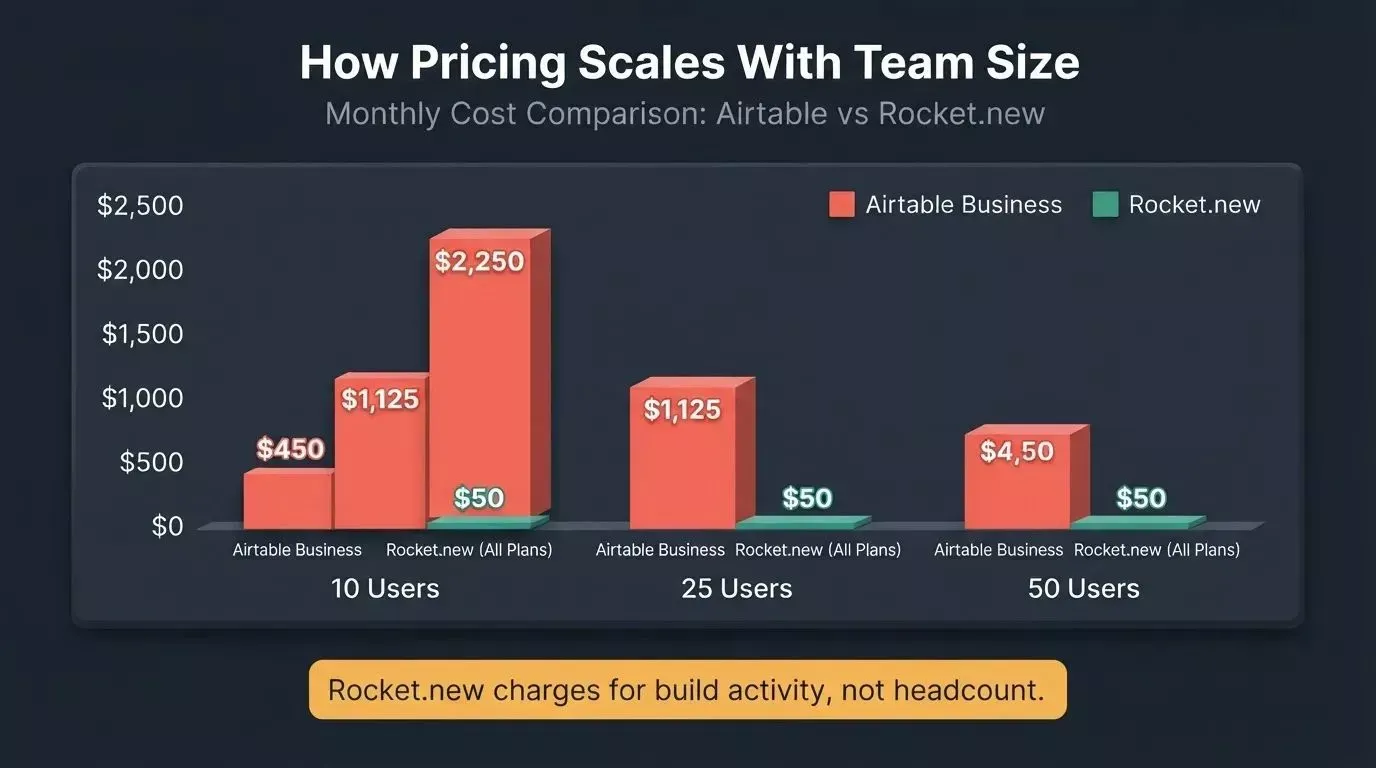
Airtable costs scale with headcount. Rocket.new costs scale with build activity, not team size.
| Scenario | Airtable Team ($20/seat/yr) | Airtable Business ($45/seat/yr) | Rocket plan ($50/mo) |
|---|---|---|---|
| 10 users | $200/mo | $450/mo | $50/mo (unlimited members) |
| 25 users | $500/mo | $1,125/mo | $50/mo (unlimited members) |
| 50 users | $1,000/mo | $2,250/mo | $50/mo (unlimited members) |
Airtable figures are annual billing rates. Rocket.new figures are monthly platform fees; credits are consumed separately per build activity. Add Portals, AI credit packs, and Enterprise features to Airtable costs for a complete picture.
Other Airtable alternatives use different pricing models too: NocoDB cloud hosting starts at $12/seat/month, ClickUp's basic plan starts at $10/user/month, and Stackby pricing starts at $10/user/month for 9,000+ rows. That makes the comparison more nuanced, since some tools price per user while others tie costs more closely to usage or workspace limits.
Neither model is universally cheaper. The question is whether your cost driver is people (Airtable) or build activity (Rocket.new). For teams exploring how to keep SaaS costs lean as they scale, Rocket.new's no per-seat pricing model is worth understanding in detail.
Can You Run Airtable and Rocket.new Together?
Yes, and this is often the most practical approach for teams already invested in Airtable. Airtable is strong as a data source. If your operations team already manages inventory, contacts, or project data in Airtable bases, that data does not have to move.
Rocket.new supports Airtable as one of its 25+ integrations, which means you can build a customer-facing frontend on Rocket.new that reads from and writes to your existing Airtable data while keeping your existing tools and workflows in place.
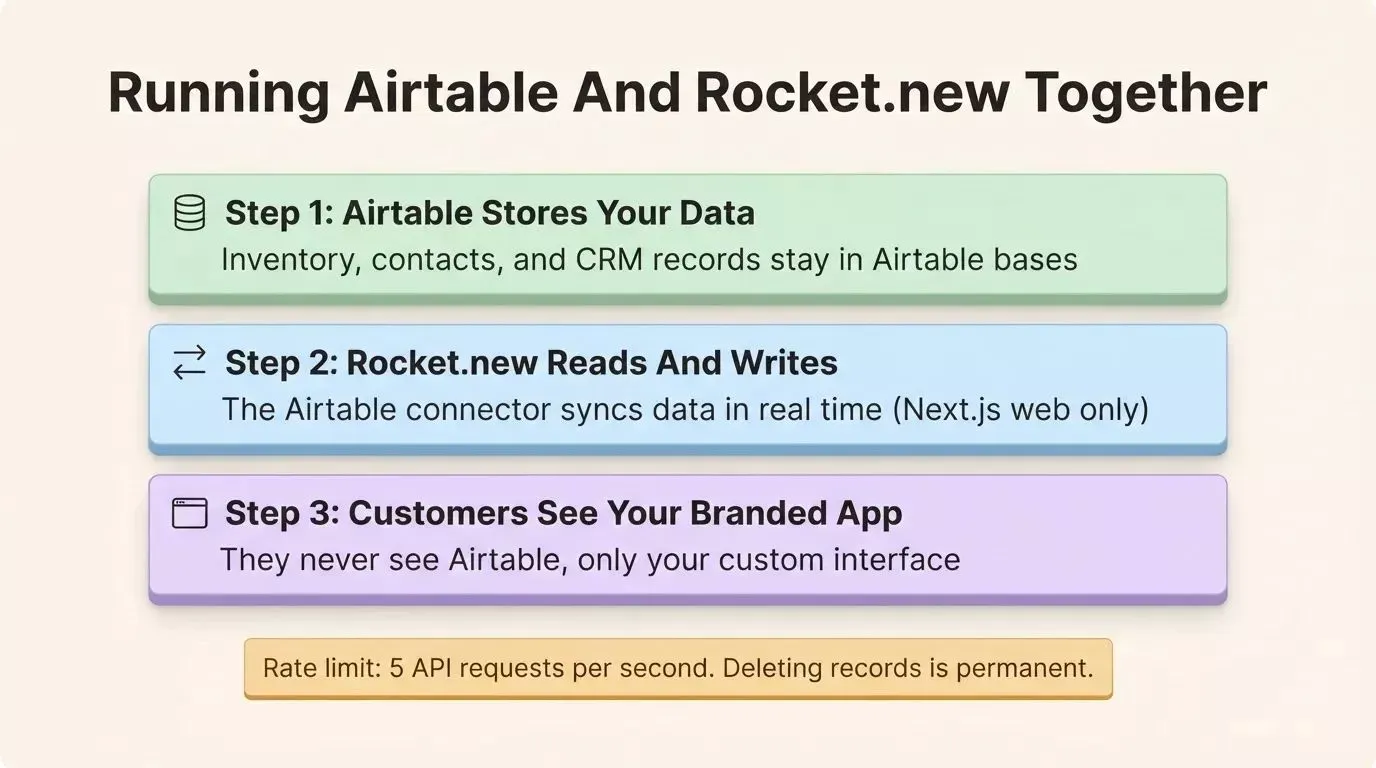
The hybrid approach: Airtable manages your data, Rocket.new powers what your customers see.
Important caveats for the hybrid approach:
- The Airtable connector in Rocket.new works only in Next.js TypeScript web tasks, so Airtable is just one of several supported data sources. It does not apply to Flutter mobile apps.
- Airtable's API is rate-limited to 5 requests per second per base. High-traffic apps may need caching or a dedicated backend (Supabase works well here).
- Deleting records through the connector is permanent. Airtable does not have a built-in undo for deleted rows.
How to Migrate Away from Airtable
If you decide to move off Airtable entirely, here are the main paths:
Keep Airtable as the data source. Use Rocket.new's Airtable connector to build a custom frontend while keeping your data in Airtable. This is the lowest-risk migration path: no data moves, and your team continues using Airtable for data management.
Export data as CSV and move to Supabase. Airtable exports data as CSV files. Import those into Supabase (a PostgreSQL backend), then use Rocket.new to build a new frontend on top. This gives you a full relational database with auth, storage, and edge functions.
Export data as CSV and rebuild. For simpler use cases, export your Airtable data as CSV, import it into a new tool (Notion, Baserow, or a custom database), and rebuild your workflows. NocoDB can also be useful if you want automated workflows on top of existing databases instead of rebuilding everything from scratch.
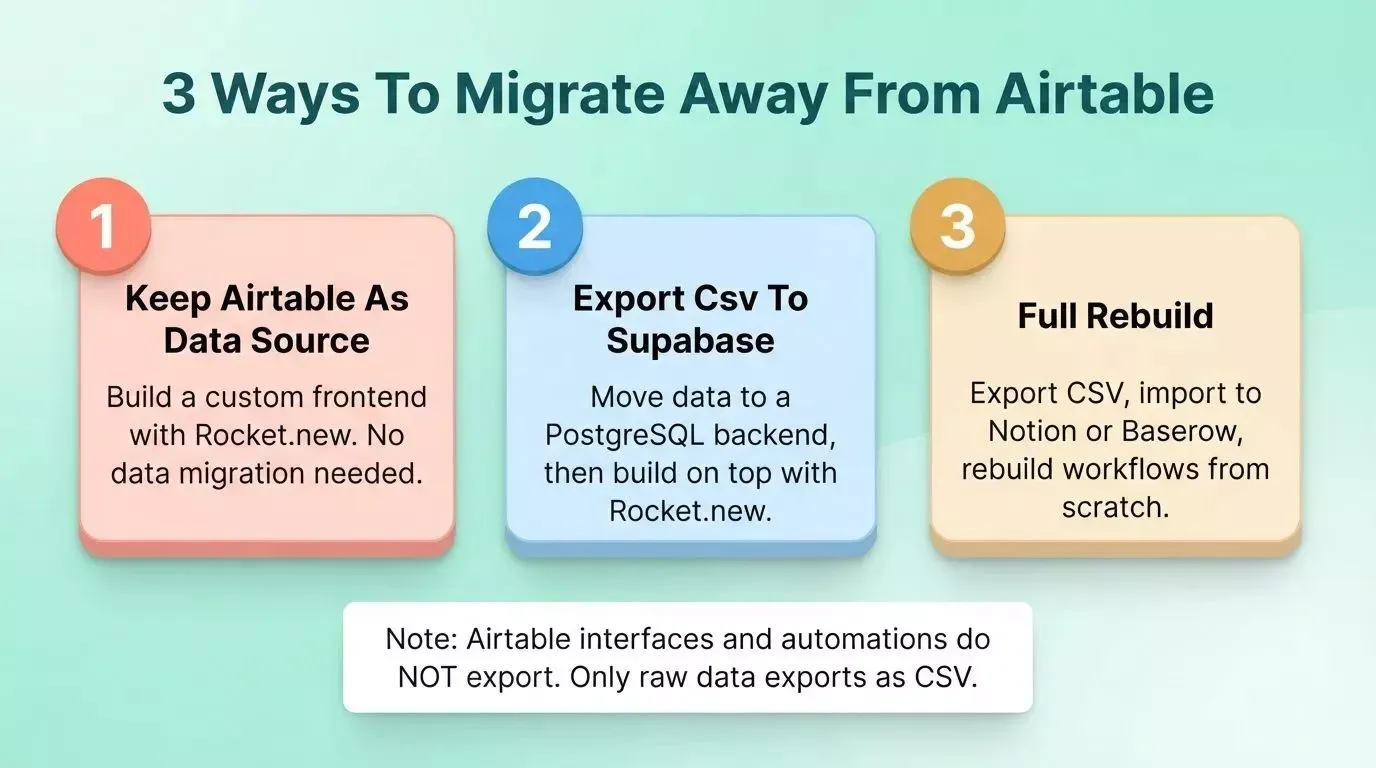
Only raw data exports from Airtable as CSV. Interfaces, automations, and logic must be rebuilt in your new tool.
When Not to Switch
Switching tools has a cost. Here are situations where staying on Airtable makes more sense than switching:
- Your team is already productive in Airtable. If the tool is working and your workflows are established, the switching cost is rarely worth it.
- You need HIPAA compliance today. Airtable's Enterprise Scale plan includes HIPAA compliance. Rocket.new does not currently offer HIPAA compliance.
- Your project is genuinely data-centric. If the primary output is a structured dataset that your team manages internally, Airtable is the right tool.
- You need deep audit logs and SSO without a sales conversation. Airtable includes these at the Enterprise Scale tier. Rocket.new offers SSO through Sales.
- You have no need for a customer-facing product. If everything stays internal, the case for switching to an app builder weakens significantly.
The Right Starting Point Depends on What You Are Building
Both Airtable and AI app builders like Rocket.new are good tools. Many people searching for an Airtable alternative are really comparing all the features they need across databases, project management, and app-building workflows. Airtable is strong for structured data, team collaboration, and governance. Rocket.new is built for shipping standalone products. Most teams benefit from choosing the right tool for the right job, and sometimes from running both together.
The Bending Spoons acquisition adds a variable to the Airtable equation. If you are evaluating a long-term commitment to Airtable, factor in the uncertainty of new ownership and verify current pricing and roadmap directly.
If your next project is a product rather than a workflow, Rocket.new lets you describe it and see the first working version in minutes. Start building today, no credit card required.
Table of contents
- -Quick Answer: Which Project Management Tools Fit Your Project?
- -Why is "Airtable or Something Else?" Such a Common Question?
- -What Separates a Database Platform from an AI App Builder?
- -Airtable is Database-first
- -Rocket.new is a Vibe Solutioning Platform
- -What is Airtable, and What Does the Bending Spoons Acquisition Mean?
- -The Bending Spoons Acquisition
- -What is Rocket.new?
- -Which Approach Fits Each Use Case?
- -Internal Team Workflow or Tracker
- -CRM or Client Portal
- -Customer-Facing Web App
- -MVP or Startup Product
- -Mobile App
- -What Does It Look Like to Build the Same Thing in Both?
- -Other Airtable Alternatives by Need, Including Open Source Airtable Alternatives
- -Pricing at Scale: 10, 25, and 50 Users
- -Can You Run Airtable and Rocket.new Together?
- -How to Migrate Away from Airtable
- -When Not to Switch
- -The Right Starting Point Depends on What You Are Building