
TL;DR: GoDaddy works for absolute beginners but locks you in, charges transaction fees, and has no app market. Rocket.new builds production-ready code from plain language with zero platform fees.
Is GoDaddy still the right website builder for your business in 2026 or has the market moved past it?
The short answer: GoDaddy website builder is a solid starting point for absolute beginners who need a basic online presence fast. But if you want a site that actually performs, scales, and does not lock you into a walled garden of limited tools, you need to look at what has changed.
According to a 2025 review by Website Builder Expert, GoDaddy ranked fifth in AI website builder testing behind Wix, Squarespace, and others and its AI-generated templates are described as "generic and outdated."
That gap matters more in 2026 than it ever did before. AI-powered platforms have raised the bar on what a website builder can actually do.
So let's break it all down.
What Is GoDaddy Website Builder?
GoDaddy website builder is the drag and drop website building tool offered by GoDaddy, one of the world's largest domain registrars, managing over 84 million domains. The builder targets non-technical users who want a basic online presence without writing code.
It uses an ADI (artificial design intelligence) system to generate a starter template in under 30 seconds. You answer a few questions, pick a category, and get a site structure to work from. The block-based drag and drop editor then lets you add sections, swap images, and edit text.
According to a 2025 review, GoDaddy ranked fifth in AI website builder testing behind Wix, Squarespace, and others and its AI-generated templates are described as "generic and outdated."
GoDaddy Pricing Plans
GoDaddy's paid plans break down like this:
| Plan | Monthly Price (Annual) | Renewal Price | Key Feature |
|---|---|---|---|
| Basic | $9.99/month | $16.99/month | SEO tools, custom domain |
| Premium | $14.99/month | $29.99/month | Appointments, email marketing |
| Commerce | $20.99/month | $34.99/month | Online store, unlimited products |
There is also a free plan, but it shows GoDaddy ads and does not allow a custom domain. That is a significant drawback for any business trying to build brand credibility.
Where GoDaddy Is Good
GoDaddy is genuinely useful in a narrow set of scenarios:
-
You need a site live in under an hour
-
You run a service-based business that needs appointment booking
-
You are on a tight budget and the basic plan fits your constraints
-
You want email marketing bundled in without a separate subscription
The booking tools are well-built. The social media calendar is handy. And GoDaddy's domain registrar ecosystem is hard to beat: 84 million domains means you can usually find and register what you need in one place.
Where GoDaddy Lacks: The Real Limitations
Here is where the GoDaddy website builder starts to show its age, and why so many small businesses and founders are actively searching for a GoDaddy website builder alternative in 2026.
No App Market
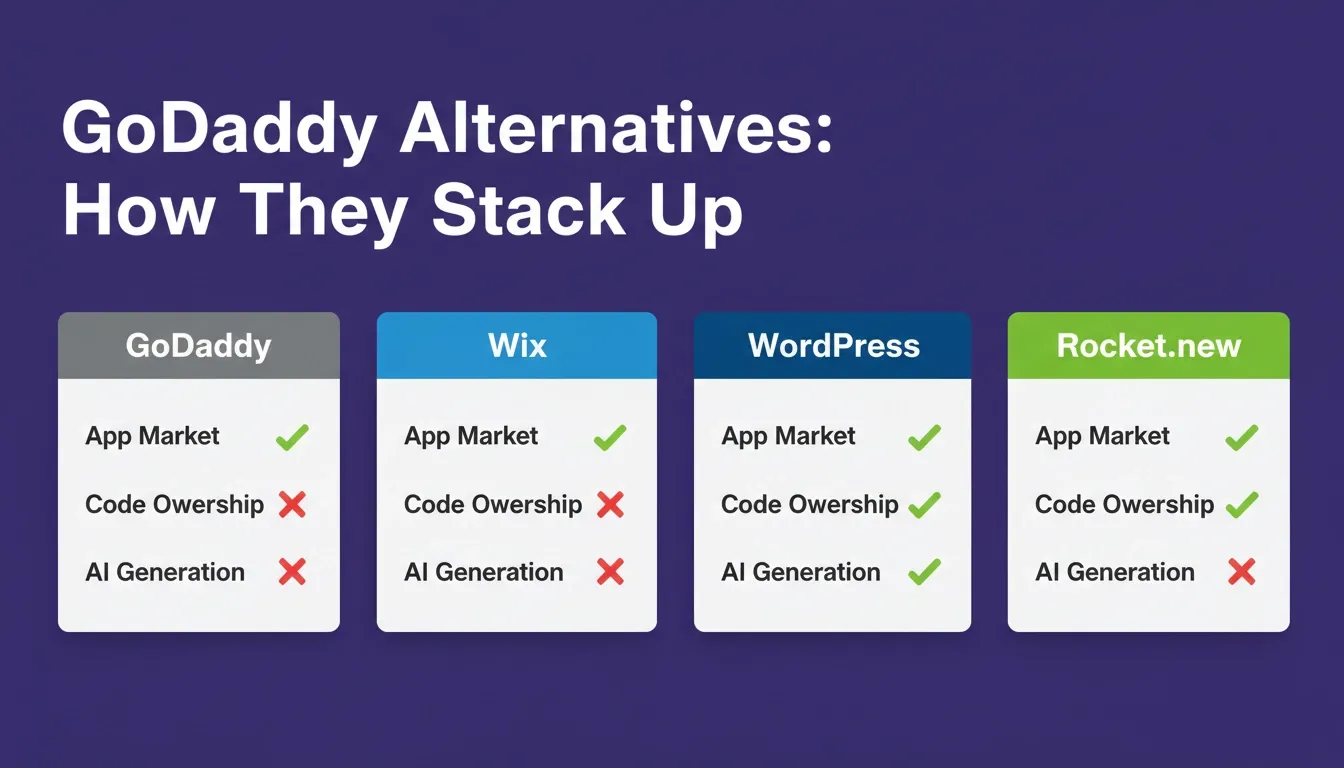
GoDaddy has no app market. If you need a third-party plugin, a booking tool that is not GoDaddy's own, a CRM, a custom form builder, or a specific payment gateway, you are out of luck. Wix has hundreds of apps in its marketplace. WordPress has thousands of plugins. GoDaddy simply does not have this infrastructure.
This is not a minor inconvenience. It means your website is limited to whatever GoDaddy has decided to build natively. If your business logic requires external tools, you will hit a wall fast.
Transaction Fees That Eat Into Revenue
GoDaddy Payments charges 2.7% + \$0.30 on every ecommerce transaction, plus a separate processing fee ranging from 2.6% + \$0.10 to 3.5% + \$0.49 depending on the card carrier. For a business doing any real volume of online sales, these transaction fees compound quickly.
Compare that to platforms that offer more control over payment processing and let you connect Stripe or PayPal directly without stacking fees.
Vendor Lock-In
GoDaddy's builder does not let you export your website code. If you decide to move to a different platform, you start from scratch. Your content, your design, your site structure: none of it is portable. This vendor lock-in is one of the most common complaints from users who outgrow GoDaddy and find themselves rebuilding everything from zero.
Design That Looks Like 2018
The ADI-generated templates are functional, but reviewers consistently describe them as "generic and outdated." The drag and drop interface gives you 22 theme customizer options, which sounds like a lot until you realize that is the ceiling of your creative control. There is no pixel-level layout control, no CSS editing on standard plans, and no way to build truly custom visual designs without writing code outside the platform.
Limited Backend Logic
GoDaddy is a front-end tool. It has no backend logic, no database connections, no API integrations beyond its own ecosystem, and no way to build custom functionality. If your business needs anything beyond a brochure site or a simple online store, GoDaddy simply cannot support it.
What the Community is Saying
The frustration with GoDaddy's limitations is not just in review articles. It shows up consistently in small business communities.
"GoDaddy is fine if you just want something online quickly, but the moment you need anything beyond the basics, a custom integration, a real ecommerce setup, or just a site that doesn't look like every other GoDaddy site, you're stuck. There's no app market, no real flexibility, and the renewal pricing is a nasty surprise." Shared perspective from small business owners on Website Builder Expert's community forum
This is the pattern that drives people to look for builder alternatives. Not because GoDaddy is broken, but because it stops being enough.
The GoDaddy Website Builder Alternative Landscape in 2026
When people search for a GoDaddy website builder alternative, they typically land on one of these options. Each of these builder alternatives solves a different problem:
-
Wix gives you a better drag and drop editor and an app market, but you are still on a hosted platform with limited portability
-
Squarespace offers cleaner visual layouts and better design quality, but ecommerce plans are expensive and customization is still constrained
-
Shopify is the right call if ecommerce is your primary focus, but it is overkill for businesses that also need a marketing site, a blog, or internal tools
-
WordPress gives you full control and thousands of plugins, but it requires hosting management, security patches, plugin updates, and a learning curve that beginners often find overwhelming
-
Webflow gives developers more flexibility and creative control over layout, but the learning curve is steep and pricing scales fast
None of these are bad choices. But none of them are built for 2026's actual needs, where AI tools should do more than just generate a template.
How AI Has Changed Website Building
The traditional website builder model, pick a template, drag and drop sections, fill in your content, was designed for a world where building a website meant assembling pre-built pieces. That model made sense in 2015. In 2026, it is a bottleneck.
The shift is not just about speed. It is about what the tool understands. A traditional website builder like GoDaddy's ADI generates a template based on your industry category. It does not understand your business, your customers, your competitive position, or your goals.
The next generation of website builders worth switching to generate production-ready output from natural language. They understand context, write code that actually works, and do not trap you in a walled garden. This is where Rocket.new enters the picture.
Rocket.new: A Different Kind of Website Builder
Rocket.new is not a drag and drop website builder. It is a full-stack AI platform where you describe what you want in plain language and get back a production-ready, deployable product: not a template, not a mockup, but working code.
More than 1.5 million people across 180 countries have used Rocket.new, and most apps generate in 1 to 3 minutes. Rocket.new is the world's first Vibe Solutioning platform, covering the complete arc from strategic research to building to competitive intelligence in one shared-context system.
Key Features: What Rocket.new Builds
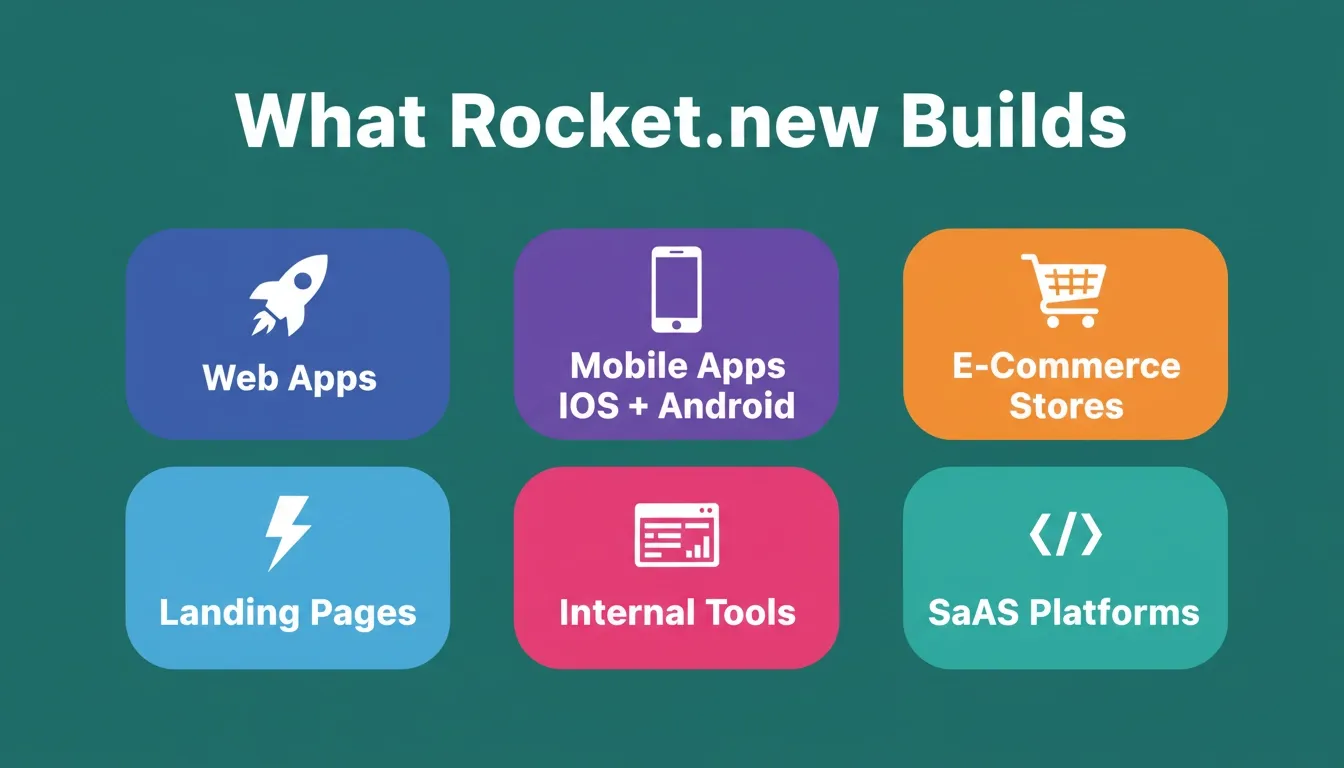
Rocket.new handles a wide range of output types that GoDaddy simply cannot touch:
-
Landing pages: Conversion-focused, SEO-ready, built from your actual business context
-
Multi-page websites: Every page at the same quality standard as the homepage
-
Web apps: SaaS tools, dashboards, customer portals, internal tools
-
Mobile apps: iOS and Android from a single Flutter codebase
-
E-commerce stores: Product catalogs, checkout flows, payment integrations
The key difference: Rocket.new generates production-grade Next.js code for web and Flutter for mobile. You own the code. You can download it, deploy it anywhere, or continue building on it. No vendor lock-in.
AI Tools That Actually Understand Your Business
GoDaddy's artificial design intelligence generates a template in 30 seconds. Rocket.new's AI tools generate a working product in 1 to 3 minutes, and they do so from a foundation of context about your business, your goals, and your users.
Before generating, Rocket.new surfaces the decisions that matter: target users, key interactions, data model, design direction. The output reflects genuine product thinking, not just a visual layout.
After the first generation, you refine through three modes:
-
Chat: Natural language prompts to change anything
-
Visual Edit: Click any element to change text, style, spacing, or layout — a true visual builder experience
-
Code: Direct access to the source files for advanced customization
Ecommerce Features Without the Fees
GoDaddy's ecommerce plans charge 2.7% + \$0.30 on every transaction. Rocket.new connects directly to Stripe and PayPal: you set up your own payment processing and keep more of your revenue. There are no platform-level transaction fees stacked on top of your payment processor's rates.
The ecommerce features built through Rocket.new include product catalogs, checkout flows, inventory management, and shipping integrations, all generated from natural language, all in production-ready code. For businesses serious about selling online, that difference in fees compounds fast.
Custom Domain, SEO Tools, and Core Web Vitals
Every Rocket.new build ships with:
-
SEO-ready structure by default (clean semantic HTML, meta tags, structured data)
-
Core Web Vitals monitoring built into the dashboard
-
Custom domain connection with automatic HTTPS and SSL certificates
-
WCAG accessibility compliance
-
Mobile-responsive layouts
GoDaddy's SEO tools are basic: a SEO wizard for keyword suggestions, meta title and description editing, and URL slug control. Rocket.new goes further: it generates structured data (JSON-LD), XML sitemaps, canonical tags, and internal linking as part of the build.
Backend Logic and Third-Party Integrations
This is where the comparison becomes one-sided. GoDaddy has no backend logic. Rocket.new builds full-stack applications with Supabase integration for database and auth, 25+ native integrations (Stripe, Google Analytics, Mailchimp, Mixpanel, Notion, Airtable, PayPal, SendGrid, Twilio, and more), and REST API support.
If your business needs a CRM connection, email marketing automation, or any kind of data-driven functionality, GoDaddy cannot help you. Rocket.new can build it. You can integrate the tools your business already depends on without rebuilding from scratch.
Content Tools and Version Control
Rocket.new includes staging and production environments, full version history, and one-click rollback. Every change is tracked. You can go back to any previous version without losing work. GoDaddy has no version control: once you make a change, it is live and the previous state is gone.
Rocket.new also includes built-in competitive intelligence through its Intelligence pillar, so you can monitor what competitors are doing and feed those insights directly into your next build, all without leaving the platform.
Quick Comparison: GoDaddy vs Rocket.new
| Feature | GoDaddy Website Builder | Rocket.new |
|---|---|---|
| Build method | Drag and drop, ADI template | Natural language, AI generation |
| Output type | Template-based website | Production-grade code (Next.js / Flutter) |
| Code ownership | No, locked in | Yes, download and deploy anywhere |
| App market / integrations | None | 25+ native integrations |
| Ecommerce transaction fees | 2.7% + $0.30 per sale | None (use your own Stripe/PayPal) |
| Backend logic | No | Yes (Supabase, APIs, custom logic) |
| Mobile apps | No | Yes (Flutter, iOS + Android) |
| Version control | No | Yes (full history, one-click rollback) |
| SEO tools | Basic (wizard, meta tags) | Advanced (structured data, sitemaps, audit commands) |
| Core Web Vitals monitoring | No | Yes (built-in) |
| Custom domain | Yes (paid plans only) | Yes (all plans) |
| SSL certificates | Yes | Yes (automatic) |
| Design flexibility | Limited (22 theme options) | High (chat, visual edit, code access) |
| Web hosting | Managed, no control | Flexible deployment, full control |
| Free plan | Yes (with ads, no custom domain) | Yes (20 free credits, no credit card required) |
The Right Website Builder Workflow: GoDaddy vs Rocket.new
Who Should Still Use GoDaddy?
GoDaddy website builder is not the right call for most businesses in 2026, but it is not useless either. It still makes sense if:
-
You need a one-page site live in under an hour and have zero technical knowledge
-
Your business is purely service-based (appointments, bookings, scheduling) and you do not need ecommerce or custom functionality
-
You are on a very tight budget and the introductory pricing fits your constraints
-
You already have a GoDaddy domain and want the convenience of managing everything in one dashboard
For everyone else: founders building products, small businesses that want to grow, developers who want production-ready output, agencies delivering client work — the limitations of GoDaddy's basic builders become a ceiling very quickly.
Leaving GoDaddy: Choosing the Right Alternative for Your Stage
The website building market has split into two tiers. Traditional builders like GoDaddy, Wix, and Squarespace are still useful for simple sites. But they were built for a world where the ceiling was "get something online quickly."
Rocket.new was built for a different goal: get something production-ready, scalable, and actually yours. The difference is not just in the features. It is in what happens after you launch.
With GoDaddy, you are managing a template. With Rocket.new, you own the code, you control the infrastructure, and you can keep building without hitting a wall. If you have been using GoDaddy and finding yourself working around its limitations, no app market, generic templates, transaction fees, no backend logic, that friction is telling you something. The right website builder for your next stage is one that grows with you, not one that caps you.
Ready to move beyond GoDaddy's limitations? Rocket.new is the AI-powered website builder that gives small businesses, founders, and developers production-ready code, zero transaction fees, and full creative control, all from a single platform. Whether you need a modern website, a scalable ecommerce store, or a full-stack web app, Rocket.new builds it from your description in minutes. Start building for free today.
Table of contents
- -What Is GoDaddy Website Builder?
- -GoDaddy Pricing Plans
- -Where GoDaddy Is Good
- -Where GoDaddy Lacks: The Real Limitations
- -No App Market
- -Transaction Fees That Eat Into Revenue
- -Vendor Lock-In
- -Design That Looks Like 2018
- -Limited Backend Logic
- -What the Community is Saying
- -The GoDaddy Website Builder Alternative Landscape in 2026
- -How AI Has Changed Website Building
- -Rocket.new: A Different Kind of Website Builder
- -Key Features: What Rocket.new Builds
- -AI Tools That Actually Understand Your Business
- -Ecommerce Features Without the Fees
- -Custom Domain, SEO Tools, and Core Web Vitals
- -Backend Logic and Third-Party Integrations
- -Content Tools and Version Control
- -Quick Comparison: GoDaddy vs Rocket.new
- -The Right Website Builder Workflow: GoDaddy vs Rocket.new
- -Who Should Still Use GoDaddy?
- -Leaving GoDaddy: Choosing the Right Alternative for Your Stage