
How does AI speed up backend systems? Learn how AI improves performance, scalability, and reliability, revealing why modern apps load faster through smarter automation and optimized backend workflows.
Can AI in backend development really be the reason my favorite app loads almost instantly?
Yes. From my experience, smart AI usage helps backend systems respond quicker, handle traffic like a pro, and avoid unnecessary slowdowns.
I recently read that 84% of developers use AI tools daily, which is completely shaping modern backend development trends.
From what I’ve seen, apps feel snappier, APIs respond faster, and backend processes run smoother thanks to AI.
But what’s really happening under the hood? Let me walk you through it step by step.
Why Does Backend Performance Slow Down?
I’ve spent countless hours working on backend systems, and I know what slows things down:
- Complex backend logic – Multiple checks, loops, and operations can stack up like a traffic jam.
- Database delays – Queries that aren’t optimized hold everything back.
- Repetitive tasks – Those manual routines that could totally be automated.
- Inefficient API design – Extra calls, unoptimized paths, it’s a nightmare.
When all of these pile up, APIs lag, users get frustrated, and as a backend developer, I’ve been there scrambling to fix things. That’s exactly where AI in backend development comes in and saves the day.
How AI Makes Backend Systems Smarter
AI isn’t just about fancy dashboards or predictive chatbots. From my experience, it can directly improve backend performance and API speed in ways that really matter.
Faster Coding with AI Assistance
I’ve spent way too much time on repetitive or boilerplate work setting up user management, writing endpoint routes, and handling backend security checks.
With AI tools, I can now:
- Generate boilerplate code automatically
- Get code snippets tailored to the project
- Predict backend logic flows and potential errors
It’s amazing. I can focus on complex logic, reduce errors, and keep backend systems running efficiently. Instead of manually writing multiple endpoints, I can have an AI coding tool do it in minutes. That frees me up to work on backend efficiency and performance.
Smarter API Paths
APIs have to handle many requests at once.
From my perspective,
AI helps by:
- Predicting which endpoints will be requested next based on user behavior
- Suggesting query optimizations for better database performance
- Reducing redundant data transfers
- Dynamically adjusting routes during high traffic
It’s like having a backstage crew for your app. APIs feel faster and more reliable, and as a developer, I get to focus on design instead of constant firefighting.
Improved Backend Logic
I’ve seen firsthand how messy backend logic can slow APIs.
AI can analyze code and:
- Flag slow loops or redundant conditions
- Suggest caching strategies for repeated requests
- Detect potential security risks in logic
Optimizing backend processes with AI keeps workflows smooth. Fewer errors mean faster development cycles and less stress.
Trust me, it’s a lifesaver.
AI Impact Areas in Backend Systems
Here’s a quick look at how I’ve seen AI in backend development tackle common challenges and improve API performance:
| Backend Challenge | AI Assistance | Impact on Performance |
|---|---|---|
| Slow database queries | AI query optimization & indexing suggestions | Faster responses & smoother user experience |
| Repetitive backend code | Auto-generated endpoints & boilerplate code | Reduced manual effort & fewer errors |
| API bottlenecks during traffic spikes | Predictive traffic routing & load balancing | Smarter APIs that handle high traffic smoothly |
| Lack of cache strategy | AI-based cache recommendations | Reduced server load & faster backend logic |
| Inefficient logic patterns | Real-time AI code suggestions | Leaner backend processes & fewer bugs |
| Error handling and debugging | AI-assisted anomaly detection & suggestions | Faster issue resolution & more reliable APIs |
Seeing these AI-powered interventions in action has helped me maintain high backend performance, minimize errors, and deliver smoother APIs for users.
AI Tools That Improve Backend Performance
From my experience, a variety of AI-powered tools are transforming backend development.
Here’s how they help backend developers work smarter and keep APIs fast:
1. Code Assistance Tools
These tools help me write cleaner backend code. They analyze patterns, suggest improvements, and automate repetitive tasks. GitHub Copilot, for instance, recommends API endpoints, loops, and backend logic in real time. I can’t tell you how much time that saves.
2. Testing Tools
Testing can drag down release cycles, but AI-driven testing tools handle error handling and edge cases automatically. Smooth API launches? Yes, please.
3. Log Analysis Tools
Logs can be a nightmare to sift through manually. AI spots anomalies, highlights slow endpoints, and flags risky backend processes. Catching issues early keeps backend performance and database performance solid.
4. Predictive Analytics Engines
AI doesn’t just react, it predicts. Machine learning models forecast traffic patterns and resource needs. Optimizing queries and preparing for spikes keeps APIs snappy and servers happy.
With the right AI tools, I’ve been able to cut down repetitive work, catch issues early, and keep backend processes running smoothly.
Security and Safety in Backend Systems
Speed is great, but I’ve learned that fast APIs are useless if security is compromised. AI in backend development keeps systems safe while staying snappy:
- Monitoring traffic for abnormal patterns
- Detecting security risks and vulnerabilities
- Suggesting improved authentication flows for sensitive data
With AI monitoring, I can maintain both speed and data security, ensuring users enjoy smooth, secure experiences.
Real-World Insights from Developers
I like seeing what the community thinks. One Reddit user shared:
“AutoBE achieved 100% compilation success of backend generation with LLMs. That shows AI models can reliably handle backend tasks now.”
From my perspective, it’s clear AI models aren’t just experiments; they’re real productivity boosters. Less repetitive work, faster backend performance, and more time for creative problem-solving.
How Rocket.new Supports Backend Development Workflows
I’ve found Rocket.new great for organizing backend work and tracking API performance in real projects.
It meshes naturally with AI in backend development by reducing coordination friction, allowing developers to focus on improving backend logic, performance, and reliability.
Key Features
- Task Boards for Backend Sprints – Plan and track API performance improvements, database optimizations, and backend logic tasks.
- Real‑Time Performance Alerts – Get notified when endpoints slow down or backend systems behave unusually useful alongside AI‑based monitoring.
- Integrated Tracking for Backend Systems – Monitor backend routes, caching, and database updates in one place.
- Collaboration Features for Developers – Teams can coordinate on backend fixes and performance tweaks, reducing back‑and‑forth.
Use Cases
1. Tracking API Performance Issues: If an endpoint slows down, you can create a task, assign it, and attach AI-flagged bottlenecks. The team identifies the causes of delays and fixes them faster, keeping APIs responsive.
2. Coordinating Backend Logic Improvements: AI may suggest caching or query changes. With Rocket.new, these become tracked tasks, allowing teams to implement improvements and measure the impact on backend performance.
Overall, Rocket.new complements AI in backend development by helping teams track, organize, and act on performance and backend logic insights. It turns AI recommendations into real improvements, keeping APIs faster and backend systems running smoothly.
How Developers Adapt to AI?
From my experience, AI in backend development doesn’t replace humans—it shifts our focus. Repetitive code is automated, freeing me to focus on complex logic and system design.
Some ways I adapt include:
- Reviewing AI-generated code snippets
- Tuning database queries with AI suggestions
- Focusing on backend security and architecture instead of routine code
Combining human judgment with AI keeps APIs fast and reliable.
Common Misconceptions About AI in Backend
AI is powerful, but I’ve seen a lot of confusion about it.
Let me clear a few myths:
-
Myth: AI will write everything for you.
Reality: It helps, but human oversight is still needed.
-
Myth: AI replaces backend developers.
Reality: It reduces repetitive work and gives humans more room for creativity.
-
Myth: AI slows down projects.
Reality: When used right, AI shortens cycles, improves code quality, and accelerates backend performance.
AI isn’t a replacement; it’s a partner. Knowing its limits lets me leverage it effectively and keep projects moving fast.
Quick Tips for Faster APIs with AI
Even small tweaks make a huge difference.
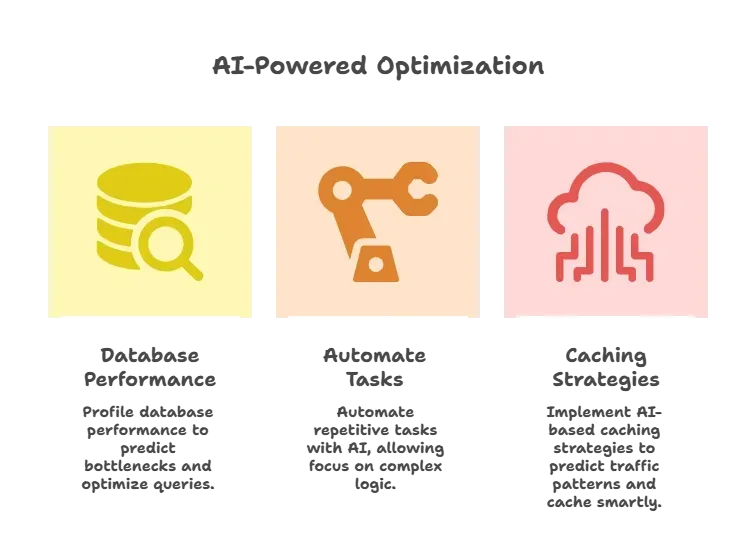
Closing Note: A few AI-driven adjustments can significantly improve backend performance, keeping APIs smooth and responsive.
How AI in Backend Development Speeds APIs
I’ve seen APIs bog down from repetitive work, inefficient queries, and heavy backend logic. Manual fixes are slow and stressful. AI in backend development automates routine tasks, predicts bottlenecks, and helps developers optimize backend processes.
The result? Smarter APIs, faster backend performance, and more reliable systems with less manual effort are a win for everyone.
Table of contents
- -Why Does Backend Performance Slow Down?
- -How AI Makes Backend Systems Smarter
- -Faster Coding with AI Assistance
- -Smarter API Paths
- -Improved Backend Logic
- -AI Impact Areas in Backend Systems
- -AI Tools That Improve Backend Performance
- -1. Code Assistance Tools
- -2. Testing Tools
- -3. Log Analysis Tools
- -4. Predictive Analytics Engines
- -Security and Safety in Backend Systems
- -Real-World Insights from Developers
- -How Rocket.new Supports Backend Development Workflows
- -Key Features
- -Use Cases
- -How Developers Adapt to AI?
- -Common Misconceptions About AI in Backend
- -Quick Tips for Faster APIs with AI
- -How AI in Backend Development Speeds APIs