
Marketing success is decided before a campaign launches not after. Rocket.new turns scattered competitor data into a real-time, actionable campaign brief. Teams using AI-driven intelligence launch faster, target better, and achieve higher conversions.
What does a marketing team actually do with competitive intelligence in the two weeks before a campaign goes live?
Most stitch together five competitor tabs, audience notes, and a stale pricing tracker. Rocket.new's Intelligence collapses that into one continuous brief that informs the campaign before anyone opens Figma. According to Sopro's 2026 AI sales and marketing report, AI-powered campaigns launch 75% faster than ones built without artificial intelligence and produce 47% better click-through rates, with most of that gain showing up at the brief stage.
Why Marketing Teams Need Pre-Launch Competitive Intelligence
The work that decides a campaign's outcome happens before any media is bought. Pre-launch is where teams lock positioning, messaging, target audience targeting, and the creative direction.
-
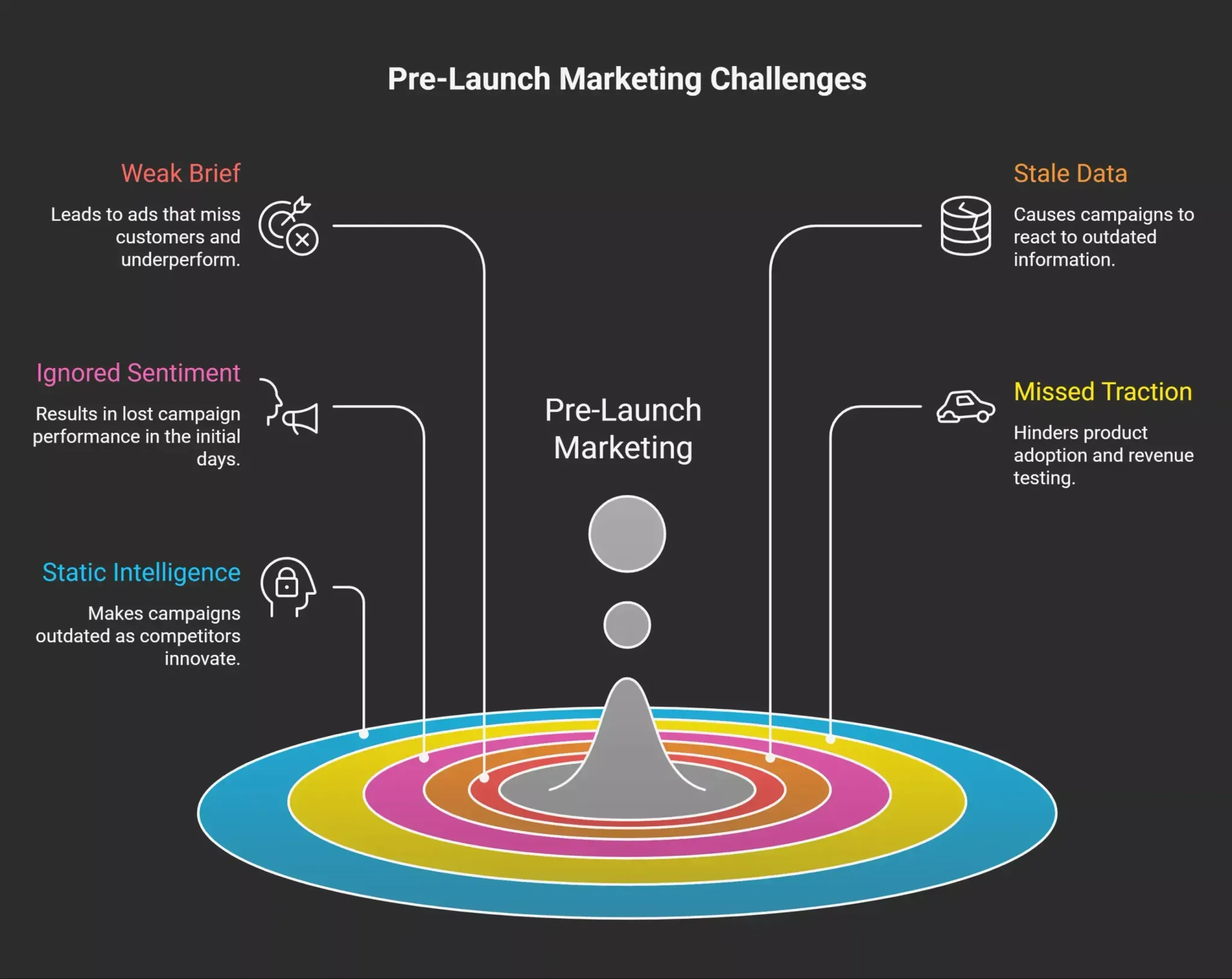
A weak brief leads to ads that miss customers entirely and lead to flat performance numbers.
-
Stale data forces marketing campaigns to react to last quarter's pricing while rivals run a new offer.
-
Messaging that ignores live community sentiment loses the first 72 hours of campaign performance.
-
The first 90 days post-launch are the window for product traction and early revenue testing.
-
Treating competitive intelligence as a static report ages it the moment competitors ship a feature.
How Market Intelligence Shapes the Campaign Brief
Market intelligence is the live picture: pricing, positioning, audience sentiment, hiring patterns, and ad activity. Market analysis is the structural picture: segment sizing, customer lifetime value drivers, channel economics. Both layered together give teams a clean foundation for the brief.
Translating Raw Signals into a Working Brief
-
Start with the audience. Pull data-driven insights from social listening to find what the target audience says about the category in their own words.
-
Map every active competitor message. Collect headlines, hero copy, and ad creative from Meta's Ad Library and competitor landing pages.
-
Score the gap. Rank each competitor signal on impact, urgency, and the differentiation room your brand has.
-
Create positioning around that gap, not around features the product team is excited about.
-
Create audience segmentation rules tied to behavior, not demographics alone.
That anchors the brief in a position with measurable success criteria.
The Time Frame Gap Between Marketing Intelligence and Traditional Research
Marketing research data is collected in studies, surveys, and panels that take weeks to field and months to publish. Marketing intelligence is gathered continuously, refreshed daily by AI tools and AI systems that scan thousands of public sources.
| Dimension | Traditional Marketing Research | Continuous Marketing Intelligence |
|---|---|---|
| Cadence | One-time or quarterly | Daily, sometimes hourly |
| Source | Surveys, focus groups, panels | Competitor sites, social, ads, hiring boards, reviews |
| Output | Static report after fielding | Live brief, refreshed before each work day |
| Useful window | 6 to 12 months | 24 hours to a few weeks |
| Best for | Long-range strategy, brand tracking | Pre-launch briefing, real time adjustments |
| Decision speed | Weeks to act | Same day action |
Both matter. Teams use research for the multi-quarter view of market conditions and competitive intelligence for the campaign that ships in the next release.
Five Pre-Launch Signals Every Marketing Team Should Track
The five signal categories that decide most marketing campaigns:
-
Competitor website changes: pricing pages, hero messaging, new feature drops.
-
Social and news activity: announcement cadence, share of voice, sentiment shifts among customers.
-
Hiring signals: roles in growth, partnerships, or new verticals that hint at the next strategic move.
-
Customer signals: review platform sentiment, support complaints, comparison threads on Reddit and Quora that team members scan daily for raw insights.
-
Ad activity: creative variations, channel mix, and offer cadence in Meta Ads Library and Google's Ad Transparency Center.
A pricing change, a hiring spike, and a refreshed investor relations page constitute a strategic pivot, not three separate updates. Reading patterns across signals separates pre-launch competitive intelligence from a noisy alert feed.
Building Creative Intelligence into Campaign Concepts
Creative intelligence ties the signal feed to campaign concepts. Teams use these AI capabilities and insights to create campaigns that resonate with people, not ads that survive a slide review.
-
Understand the audience, the environment, and the message before any storyboard or creative example.
-
Use imagination and originality to intentionally break category visual conventions.
-
Apply emotional intelligence and empathy so the ad connects on something real, not just a feature spec.
-
Pair creative concepts with data analysis and data points from past campaigns to keep what worked and replace what did not.
-
Create multivariate testing plans with data analytics and predictive tools before launch so the team knows which creative is the lead and which is the variant.
That mix of taste and data keeps strategy and creative specific without drifting.
How AI Capabilities Reshape Campaign Management Pre-Launch
Specific AI capabilities move the needle on campaign management before a launch. These tools are built into the systems most teams already use.
-
Predictive analytics forecast campaign performance using historical data, customer behavior data, and live market conditions, which helps teams allocate budgets more strategically.
-
Autonomous campaign management systems make real time adjustments to budgets and audience segmentation once the campaign is live, with no human in the loop for routine pacing.
-
AI-driven personalization engines analyze individual customer data and preferences and create tailored experiences across touchpoints, lifting engagement and conversion rates with target customers.
-
Synthetic users simulate real-world behavior so teams can test campaign assumptions before any budget is committed, surfacing early performance insights.
-
Intelligent automation handles ad variant generation and bid pacing in campaign management systems, so team members focus on strategy instead of manual work.
The most successful implementations of these AI capabilities pair predictive analytics with human judgment on positioning and strategy, not the other way around. That mix turns campaign management capabilities from a checklist into a learning system, with measurable efficiency gains across each launch. Teams that focus on performance data lead the category instead of trailing it.
Validating the Campaign Before Budget Allocation
The cheapest mistake to fix is the one caught before a single dollar is committed. Use the resources you already have, with focus on the best, most likely to convert.
-
Synthetic users pressure test campaign assumptions and surface weak spots in messaging before the brief locks.
-
Predictive systems flag which segments will drive conversion rates and which will inflate impressions without lifting sales for the business.
-
Tailored sales playbooks help teams across marketing and sales share feedback so messaging matches what closes deals with target customers.
-
Campaign management tools and data analytics log every assumption, so post-launch performance optimization becomes a comparison rather than a guess.
-
Careful planning at this stage plays a crucial role in protecting market share once competitors respond to the launch.
Teams that validate pre-launch strategy ship fewer marketing campaigns and land more of them. That performance advantage compounds when budgets tighten and CMOs face pressure to prove the success of every business dollar.
What People Are Saying
The shift in how marketing teams operate is a recurring theme among CMOs heading into 2026. Thomas Ranese, CMO of Intuit, put it directly in Marketing Brew's CMO priorities roundup:
"AI is changing the center of gravity in marketing. Execution is increasingly automated, so our teams' value comes from what AI can't do, deep customer insight, strategic judgment, and creative curiosity. My priority is building a culture of 'master prompters' who know how to get the best out of AI to move faster while differentiating us in ways that are more human." - Marketing Brew, How CMOs are thinking about AI in 2026
Ranese names the actual shift. AI handles execution, the team holds the judgment. That single line is one of the more useful success stories from the recent CMO conversation cycle and a clear signal of where competitive intelligence work and team development are heading. It also explains why every company is pouring resources into AI training programs and tools.
How Rocket.new Handles Pre-Launch Marketing Intelligence
Rocket.new is built around the idea that the thinking before a campaign matters more than the speed of the build.
Rocket Intelligence runs a continuous brief on every competitor a marketing team adds, scans more than 30 signal points across LinkedIn, Facebook, websites, blogs, YouTube, and news, and reads them as connected patterns rather than isolated alerts.
Per Rocket's 1.0 launch announcement, teams brief campaigns against what competitors are doing right now, with the brief arriving every morning before the workday starts.
Top Features Worth Knowing
-
A vibe-solutioning platform that links research, build, and continuous competitive intelligence under one shared context.
-
25k+ templates library, free to use across every plan.
-
Saves up to 80% tokens through template-first generation.
-
Supports Flutter for mobile and Next.js for web from the same prompt.
-
Collaboration features built in, with workspace, project, and task-level access control for every team.
-
Three products, one platform: Solve, Build, and Intelligence.
Pre-Launch Use Cases for a Marketing Team
-
Daily competitor brief: Rocket delivers a structured daily brief naming what moved, what it means for the brand, and what the team should do about it before the standup.
-
Audience and message validation: Solve runs research across 150+ sources using machine learning algorithms and natural language processing, scoring findings by confidence, so positioning is anchored in evidence and data quality stays high.
-
Pre-launch landing page builds: Rocket can create Next.js landing pages and campaign management microsites from the same project context that informed the brief, with SEO and accessibility built in.
-
Internal campaign dashboards: A two-person team built a complete campaign management stack for two new verticals in two weeks, including dashboards connected to Mixpanel and Airtable. That is one example of how small teams create enterprise-grade tools without extra resources.
The cleanest AI implementation here treats Rocket as the system of record for the campaign management brief, not a sidecar used to create content or replace judgment. Strong AI implementation paired with team development, training programs that bring every team member up to speed, and clear roles for strategic partners across product and sales is how the advantage compounds across launches.
Users report that intelligent automation and AI capabilities remove the parts of campaign management that used to drain teams serving customers. Even a small company can create the same machine learning capabilities and AI systems larger competitors run, flattening the playing field.
Pre-Launch Intelligence as the Foundation of Long-Term Campaign Success
The workflow itself is the answer. Teams bring competitor sets, audience research, and brand guidelines into one Rocket project, let the platform read those files structurally rather than skim them, and open each task with the full context already present.
Pre-launch becomes a sharper version of the same continuous brief, not a one-off scramble. The future belongs to companies that treat competitive intelligence as the foundation of every campaign rather than a slide in a deck. That is the actual game changer for any business that ties marketing speed to measurable success.
Start using Rocket.new today to turn pre-launch intelligence into your next campaign advantage.
Table of contents
- -Why Marketing Teams Need Pre-Launch Competitive Intelligence
- -How Market Intelligence Shapes the Campaign Brief
- -Translating Raw Signals into a Working Brief
- -The Time Frame Gap Between Marketing Intelligence and Traditional Research
- -Five Pre-Launch Signals Every Marketing Team Should Track
- -Building Creative Intelligence into Campaign Concepts
- -How AI Capabilities Reshape Campaign Management Pre-Launch
- -Validating the Campaign Before Budget Allocation
- -What People Are Saying
- -How Rocket.new Handles Pre-Launch Marketing Intelligence
- -Top Features Worth Knowing
- -Pre-Launch Use Cases for a Marketing Team
- -Pre-Launch Intelligence as the Foundation of Long-Term Campaign Success