
Most AI products fail not because of bad technology, but because teams skip launch preparation. This AI product launch checklist covers market validation, team readiness, technical checks, and post-launch iteration to help you ship applications that users actually adopt.
Why do 80% of AI projects fail?
A RAND Corporation study interviewed 65 data scientists and found the top reason is not bad technology. Leadership misunderstands the problem, and teams rush past the planning stage.
The difference between a successful launch and a failed one rarely comes down to code quality. It comes down to whether the team validated the right problem, aligned the right people, and coordinated execution across every moving part.
This checklist walks through every phase, from market research through post-launch iteration, so nothing critical falls through the cracks.
Why Do Most AI Products Struggle After Going Live?
AI products face unique challenges that traditional software does not. The gap between a working prototype and a product that real users adopt is wider than most teams expect.
-
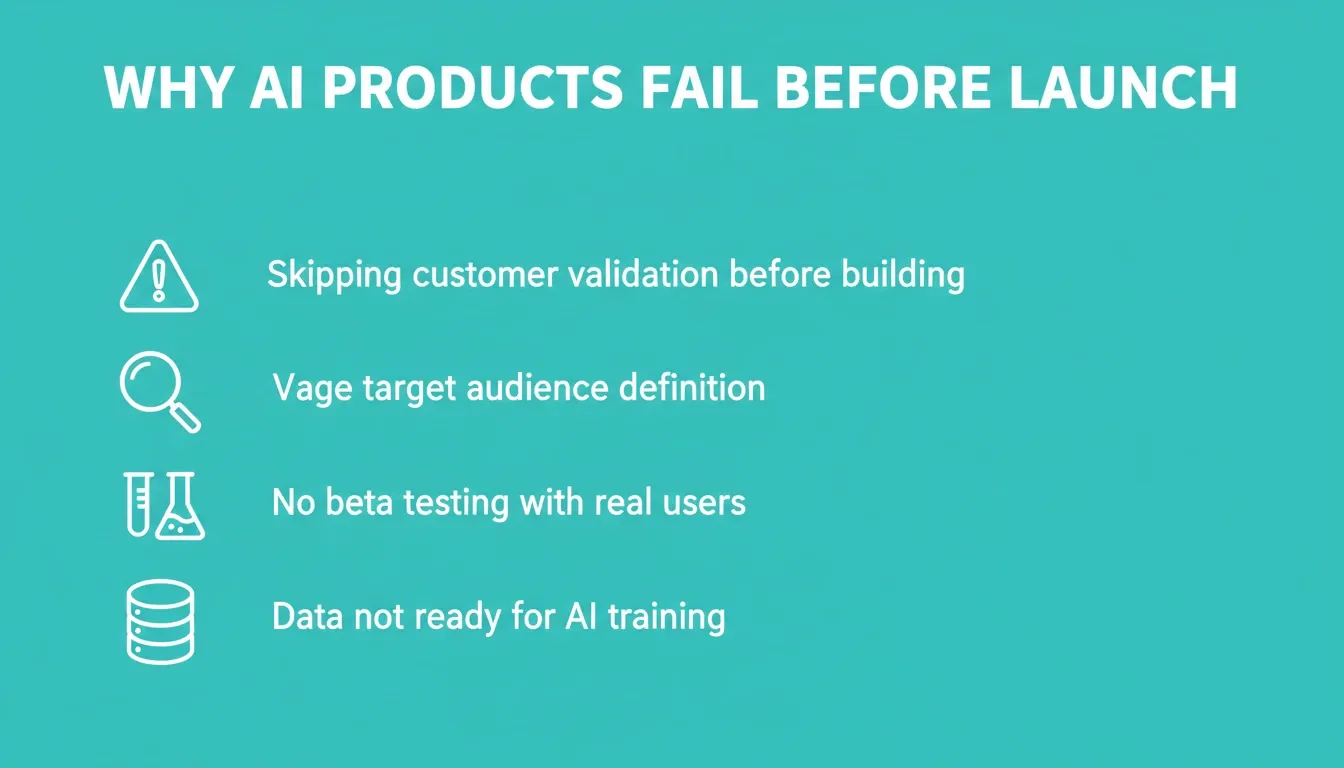
The problem validation gap. Teams build AI models optimized for the wrong metrics because they skip customer feedback loops before launch. Without talking to actual users, assumptions about pain points go untested until it is too late.
-
Target audience mismatch. Many AI products launch without a clear picture of who benefits most. When the target audience is vaguely defined, marketing campaigns miss and sales teams struggle to articulate value.
-
Beta testing shortcuts. Skipping beta testing with real users means bugs, usability issues, and unexpected edge cases surface on launch day instead of weeks before.
-
Data readiness blindspots. Organizations assume their data is ready for AI training when it often is not. Legacy datasets collected for compliance lack the context needed for effective models.
The pattern is consistent. Teams that skip market research and customer feedback before launch end up building features nobody asked for. A product launch checklist forces validation steps before a single line of code ships to production.
Conducting Market Research Before You Build
McKinsey's 2025 State of AI report found that 88% of organizations now use AI regularly. However, only 39% report any enterprise-level financial impact. The gap? Most teams skip validating whether the market actually needs their specific AI product.
-
Talk to potential customers early. Even five conversations with people in your target market reveal patterns about what problems matter most. They also show where existing solutions fall short.
-
Study market dynamics and competitors. Pricing expectations, distribution channels, and competitor positioning all shape whether your AI product gains traction once it goes live.
-
Conduct market research that goes past surveys. Combine interviews, competitor analysis, and usage data from similar products to build conviction before committing engineering resources.
When you conduct market research properly, you avoid the most expensive mistake in product development: building the wrong thing well. The checklist helps teams stay honest about what they know versus what they assume about their target audience.
What Does a Complete Product Launch Plan Look Like?
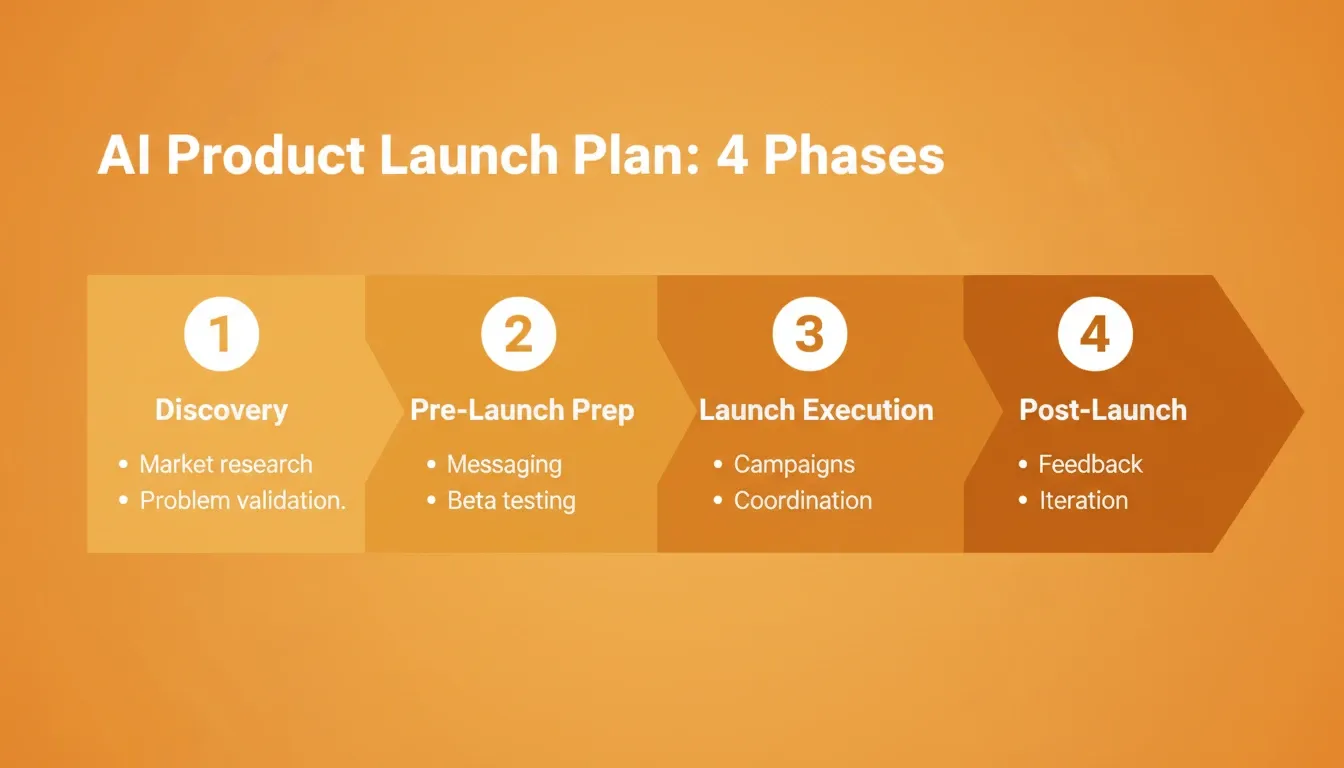
A complete AI product launch checklist breaks the work into phases, each with clear deliverables, owners, and timelines. Without this structure, launches feel chaotic and cross-functional teams work in silos.
Here is how the key steps map across a product launch plan for AI products:
| Phase | Timeline | Key Activities | Owner |
|---|---|---|---|
| Discovery | 8-12 weeks pre-launch | Market research, problem validation, competitive analysis | Product teams |
| Pre-launch preparation | 4-8 weeks pre-launch | Messaging, sales materials, training materials, beta testing | Marketing + Sales |
| Launch execution | Launch week | Press releases, marketing campaigns, product release coordination | Cross-functional teams |
| Post-launch | 2-8 weeks post-launch | Gather customer feedback, monitor performance metrics, iterate | Product + Support |
A product launch checklist that follows this structure keeps every team on the same page. It front-loads decisions that would otherwise create delays during launch week. Pre-launch planning is where most of the careful planning happens. The groundwork laid here determines whether launch day runs smoothly or falls apart under pressure.
How to Set Clear Goals and Track Key Milestones
Without clear goals, product teams cannot tell whether a launch succeeded or failed. Defining what success looks like before the launch date keeps everyone aligned and focused on measurable outcomes.
-
Set measurable revenue targets. Know your expected signups, conversion rates, and revenue numbers for the first 30, 60, and 90 days post-launch.
-
Define key performance indicators early. Track metrics like activation rate, time-to-value, and retention alongside traditional marketing activities.
-
Map key milestones to dates. From beta feedback incorporation to press release distribution, every deliverable needs a deadline and an assigned owner.
-
Build in checkpoints. Weekly syncs in the pre-launch phase catch problems before they compound into launch day surprises.
The launch date itself is just one milestone in a longer sequence. Teams that treat it as the finish line miss the post-launch work that actually drives adoption and long-term growth.
Building Your Messaging Framework and Positioning
Your messaging framework is the bridge between what your product does and why anyone should care. For AI products, this is especially hard because the technology feels abstract to buyers who just want to know what it solves.
-
Start with your positioning statement. Write one sentence that describes who the product is for, what it replaces, and why it matters now. Clear product positioning makes everything else easier.
-
Build competitive differentiation into the message. Articulate clearly how your AI product solves problems differently than alternatives. Focus on being fundamentally better for your target audience, not just faster.
-
Refine messaging through testing. Run your positioning past early adopters and prospects. What resonates? What confuses? Iterate before launch, not after.
A strong positioning statement makes every other piece of launch content easier to create. From your go-to-market strategy documentation to sales materials to press releases, it all flows from clear product positioning.
The AI-Specific Technical Readiness Checklist
This is the section most launch checklists skip entirely. It is also where AI products most commonly fail in production. Standard software QA does not catch the failure modes unique to AI systems.
Data and Model Layer Readiness
Before any AI product goes live, the data and model powering it must be validated, not just cleaned.
-
Audit training data quality. Check for label errors, missing values, distribution shifts, and recency gaps. Data collected for compliance often lacks the behavioral richness needed for effective AI models.
-
Run a bias and representation check. Identify whether underrepresented groups in your training data receive degraded model performance. Document findings before launch, as this is increasingly a legal and regulatory requirement.
-
Benchmark model accuracy against a defined baseline. Set minimum acceptable performance thresholds before launch. Do not ship a model without knowing its error rate on held-out test data.
-
Measure latency under production load. A model that performs well in testing may degrade significantly under concurrent user requests. Load test before launch, not after.
Setting up model monitoring and alerting before launch day is non-negotiable. Model drift, where performance degrades as real-world data diverges from training data, is invisible without it. Pair this with a tested rollback mechanism so you can revert quickly if production performance falls below threshold.
For more detail on technical requirements, read this production AI development checklist that covers what teams need to ship reliably.
How Do You Prepare Sales Teams for Launch Day?
BCG's research found that 66% of leaders remain dissatisfied with their AI progress. A key reason is that go-to-market teams are not ready when the product ships. Prepare sales teams weeks before launch day, not the morning of.
Sales enablement for AI products requires deeper preparation than standard SaaS launches. Here is what the process looks like when done right.
-
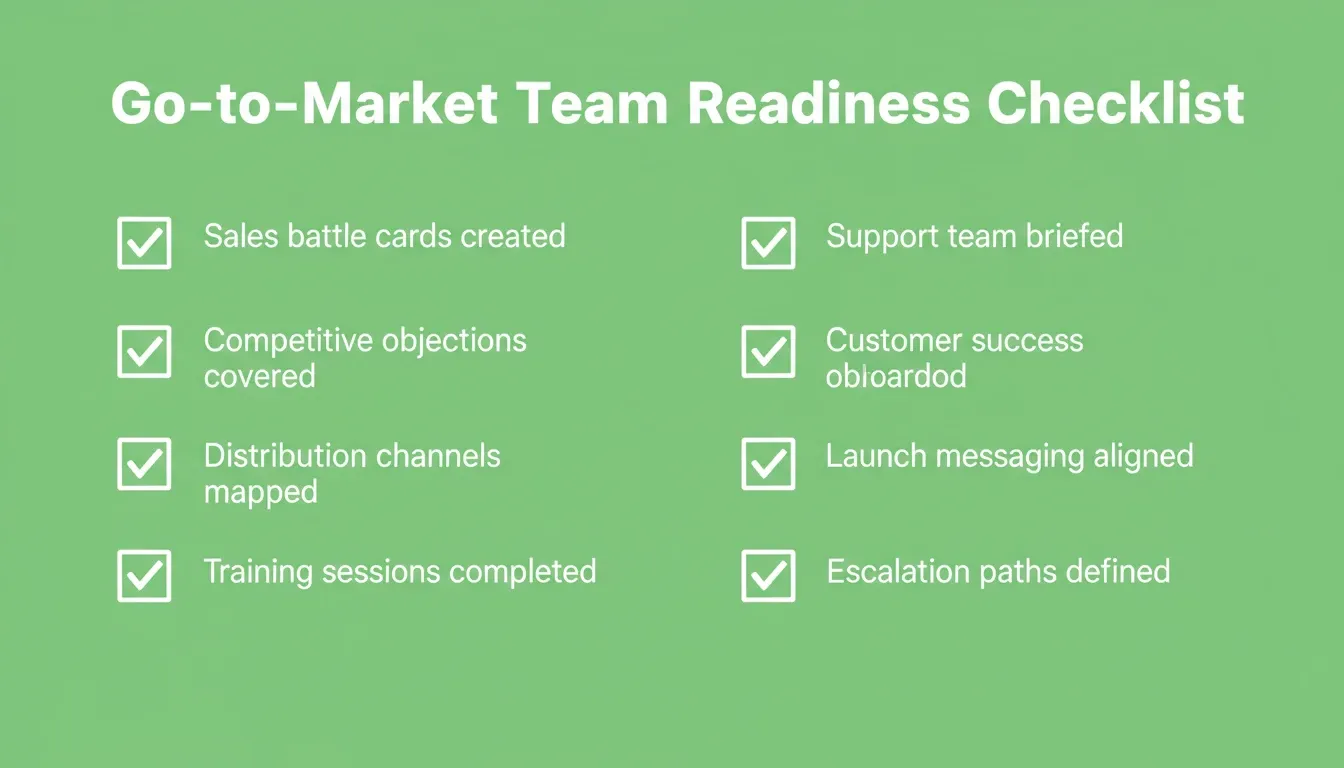
Develop training materials that cover objections. AI products face unique buyer skepticism. Sales reps need answers to hard questions about accuracy, data privacy, and time-to-value that prospects raise in every call.
-
Prepare sales teams with competitive context. Go-to-market teams should know what competitors offer, where they fall short, and how to position against them in conversations with potential customers.
-
Coordinate go-to-market strategy across departments. Marketing, sales, product, and support all need to be on the same page about launch timing, messaging, and escalation paths. A coordinated effort amplifies everything.
-
Map distribution channels early. Where will your target audience find you? Direct sales, product-led growth, partnerships, or referral programs? Decide and prepare before launch week.
Go-to-market teams that prepare properly create a strong launch that builds momentum. As one data scientist noted in the RAND study: "Often, models are delivered as 50% of what they could have been." Teams rush past the preparation that matters most.
Aligning Customer Success Teams and Support
The support team is your frontline defense against churn in the first weeks after launch. Customer success teams need context about what the product does, common issues they will see, and escalation paths when things go wrong.
-
Brief customer success teams on known limitations. Every AI product has edge cases and usability issues. Document them and share with support before users discover them on launch day.
-
Set up customer touchpoints for the first 30 days. Proactive check-ins with new users catch frustration before it becomes a cancellation or a negative review.
-
Prepare the support team with troubleshooting guides. The volume of tickets in launch week is predictable. Be ready with answers, and track patterns for the product team to fix.
Customer satisfaction in the first month predicts long-term retention better than any other metric. When customer success teams work closely with product during pre-launch preparation, they catch problems through beta feedback that engineering might miss.
Understanding how AI is changing product development helps teams set realistic expectations for both internal stakeholders and customers before launch day.
How Rocket Helps You Ship AI Products With Confidence
Most AI products fail because the thinking happens in one tool, the building in another, and market research in a third. By the time you launch, half the original context is lost in handoffs between tools and teams.
Rocket is the world's first Vibe Solutioning platform, where research, building, and market intelligence share one workspace with compound context. 1.5 million people have tried Rocket across 180 countries, from solo founders validating ideas to enterprise teams running strategy and execution on the same platform.
-
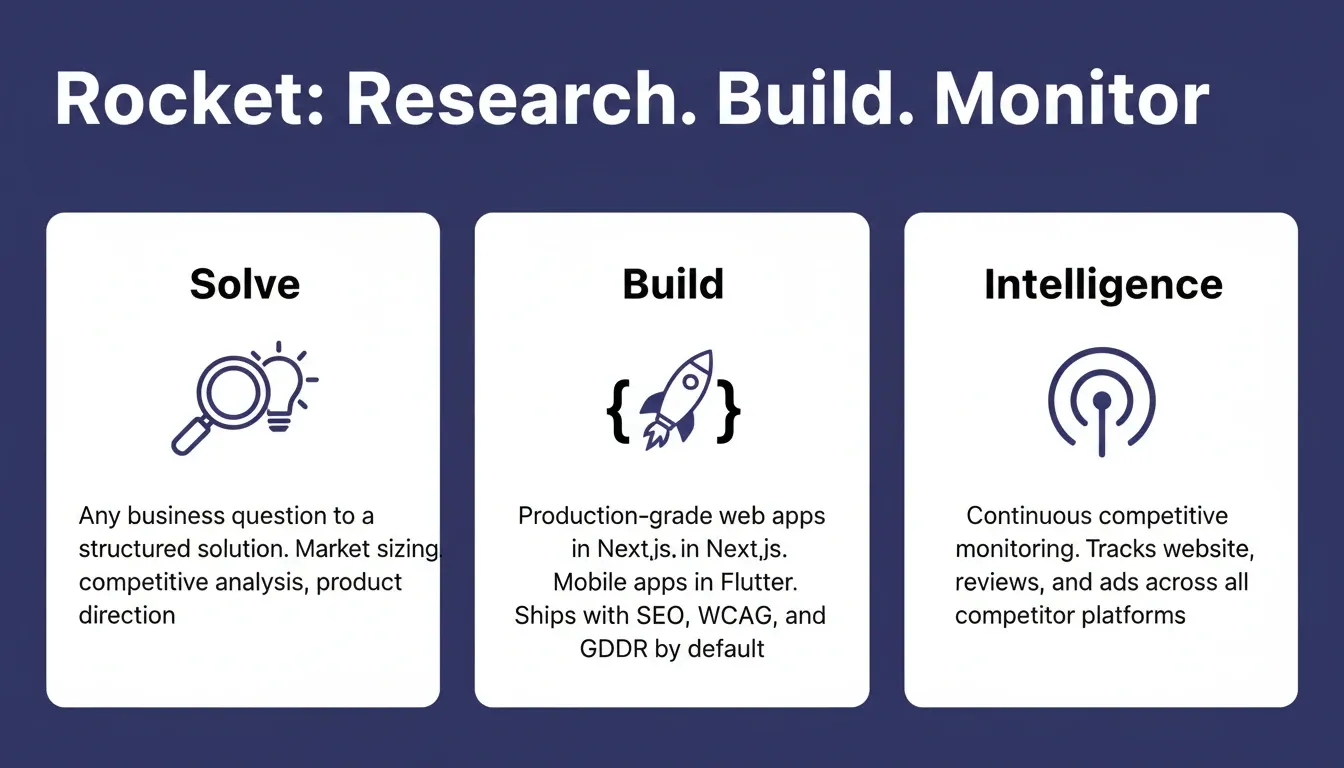
Validate before you build. Rocket Solve takes your business question and delivers structured research, including competitive analysis, market sizing, and customer problem validation. Your product launch plan starts from proof, not guesswork.
-
Ship production-grade products faster. Rocket Build generates working web applications in Next.js and mobile apps in Flutter from natural language. Every build ships with SEO-ready structure, WCAG accessibility compliance, and GDPR coverage by default.
-
Monitor what matters after launch. Rocket Intelligence tracks competitor moves, customer signals, and market shifts continuously across every public platform a competitor operates on.
The difference is not speed. The difference is that every product release from Rocket reflects market reality because the intelligence layer informed the build from the beginning. The Solve output that validated the direction becomes the foundation of the Build. Nothing is re-explained, and everything compounds.
What Happens During Launch Week and After?
Launch day is not the finish line. It is the starting point for a new set of tasks that determine whether your product gains traction or loses momentum.
-
Execute a soft launch first. Release to a small group of early adopters before opening to the public. Gather feedback, fix bugs, and confirm your systems handle real traffic volume under production conditions.
-
Coordinate marketing campaigns across channels. Blog posts, social media, email sequences, and press releases should hit in a planned sequence, not all at once. Spread launch activities across the full week.
-
Activate go-to-market teams simultaneously. Sales reps start outbound calls. Marketing amplifies content. Support monitors ticket volume. Product teams watch analytics dashboards in real time.
-
Track everything from day one. Launch execution without measurement is just hope. Set up your analytics dashboards before launch day so the data flows immediately.
A strong launch creates buzz and momentum that compounds through launch week. A weak launch forces you to spend months recovering attention you should have captured when anticipation was highest.
Tracking Performance and Gathering Feedback
Post-launch evaluation begins immediately, not two weeks later when someone remembers to check the numbers. The first days reveal patterns that shape your entire product roadmap.
-
Monitor launch performance daily. Activation rates, feature adoption, error rates, and support ticket themes tell you what is working and what needs immediate attention.
-
Gather customer feedback through multiple channels. In-app surveys, support conversations, user interviews, and usage analytics each reveal different user insights that matter.
-
Compare performance metrics against pre-launch targets. Did you hit your signups goal? Is retention tracking where you expected? Key metrics tell the truth about whether your launch plan worked.
Post-launch evaluation is not a one-time event. It is a continuous loop that runs for weeks, gradually shifting from firefighting to the work of refining features and flows that matter most to real users.
How Should You Run a Post-Launch Evaluation?
The post-launch phase is where you learn whether your product launch plan actually worked. It is also where you identify what to improve for the next product release. This step separates teams that build institutional knowledge from ones that repeat the same mistakes.
-
Run a post-mortem within two weeks. Gather the cross-functional teams that executed the launch and review what went well, what went wrong, and what to change next time.
-
Document lessons learned while memories are fresh. Launch details fade quickly. Capture them in a shared document that future launches can reference so nothing is lost.
-
Gather feedback from every team. Marketing teams, sales teams, support, engineering, and leadership all see different slices of the launch. Each perspective matters for building a complete picture.
-
Feed findings back into your checklist. Every post-launch evaluation should improve your launch template so the next product release runs smoother.
Teams that document lessons learned build a launch playbook that gets better with every release. The product manager who runs this process creates value that compounds across every future launch at the company.
Iterating Based on Early Adopter Signals
Early adopters are your most honest critics. They chose your AI product early, which means they care enough to tell you what is broken and what they wish it could do differently.
-
Prioritize beta feedback from power users. These people push the product hardest and surface issues that casual new users never encounter in their first sessions.
-
Watch for user insights in support tickets. Feature requests, confusion patterns, and workaround descriptions all contain signal about what to build next.
-
Ship improvements within the first month. Show early adopters that their user feedback leads to real changes. This builds trust, positive reviews, and word-of-mouth referrals that drive adoption.
The post-launch phase is not passive. It is the most active learning period your product team will experience. The insights gathered here shape whether your product survives its first year or joins the 80% that fail.
Your Next AI Product Deserves a Stronger Start
Every successful product launch follows the same pattern: validate first, prepare sales teams fully, execute with coordination, and iterate based on real data from real users. The AI product launch checklist above gives you a framework that covers every phase, from pre-launch planning through post-launch evaluation, so nothing critical falls through the cracks.
A well-executed launch separates AI products that gain traction from those that quietly disappear. The difference is not luck or timing. It is careful planning and a product launch plan that keeps every team moving in the same direction.
Launch Smarter With the Right Foundation
The AI product launch checklist in this guide covers what teams consistently get wrong: skipping validation, rushing technical readiness, and treating launch day as the finish line.
As AI products become the default in every category, the teams that ship successfully will be the ones that validate before they build, prepare every function before they launch, and iterate fast after they ship.
You described the problem. Now build from the answer. Start with Rocket today.
Table of contents
- -Why Do Most AI Products Struggle After Going Live?
- -Conducting Market Research Before You Build
- -What Does a Complete Product Launch Plan Look Like?
- -How to Set Clear Goals and Track Key Milestones
- -Building Your Messaging Framework and Positioning
- -The AI-Specific Technical Readiness Checklist
- -Data and Model Layer Readiness
- -How Do You Prepare Sales Teams for Launch Day?
- -Aligning Customer Success Teams and Support
- -How Rocket Helps You Ship AI Products With Confidence
- -What Happens During Launch Week and After?
- -Tracking Performance and Gathering Feedback
- -How Should You Run a Post-Launch Evaluation?
- -Iterating Based on Early Adopter Signals
- -Your Next AI Product Deserves a Stronger Start
- -Launch Smarter With the Right Foundation