Sales teams lose deals when competitive intelligence stays scattered across tools and tribal knowledge. Rocket.new transforms raw market signals into actionable insights, helping reps prepare smarter and react faster. With AI-powered competitive readiness, sales leaders can shorten sales cycles, improve win rates, and stay ahead of market shifts.
What Does "Ready for the Competition" Actually Mean Today?
What separates the sales team that wins from the one that keeps losing deals it should have closed?
Readiness. Not the "I skimmed their website" kind, but the kind where your reps walk into a call already knowing what a competitor changed on their pricing page last week, who they just hired, and what that hiring pattern signals about their go-to-market strategy.
According to Crayon's 2025 State of Competitive Intelligence report, 68% of B2B deals now involve at least one direct competitor, yet the average sales team rates its competitive preparedness at just 3.8 out of 10. That gap costs companies $2 million to $10 million per year in lost revenue.
Why Most Teams Lose Before the Conversation Starts
The Research Black Hole
-
Sales reps spend roughly 70% of their time on non-selling tasks, which includes digging through CRM records and pulling up old emails, leading to confusion and decreased confidence during sales calls.
-
Sales professionals today use an average of eight tools to close deals, which fragments information and kills focus.
-
The result: reps walk into a sales call confused, under-prepared, and lacking the competitive insights that could change the conversation.
Why Scattered Data Fails Sales Leaders
Sales leadership is evolving from activity supervision to systems orchestration, where leaders must guide teams through environments defined by human-machine collaboration and data interpretation. AI transforms leadership by shifting the focus from managing inputs to managing systems, requiring leaders to ensure data quality and behavior consistency for effective AI operation.
-
63% of sales leaders admit their competitive intelligence sits scattered across multiple systems or tribal knowledge rather than in one accessible place.
-
Most CI teams collect data. Few turn it into something a rep can use in a deal.
-
When research sits in a shared drive nobody opens, it has zero effect on win rates.
So the problem is not a shortage of information. A sales team drowns in data. The real problem is turning data into actionable intelligence at the exact moment a deal exists, and the sales team needs it.
Effective sales leaders must embrace systems thinking and demonstrate comfort with probabilistic decision-making to guide teams through uncertainty and change.
How Sales Leaders Are Rethinking Competitive Readiness
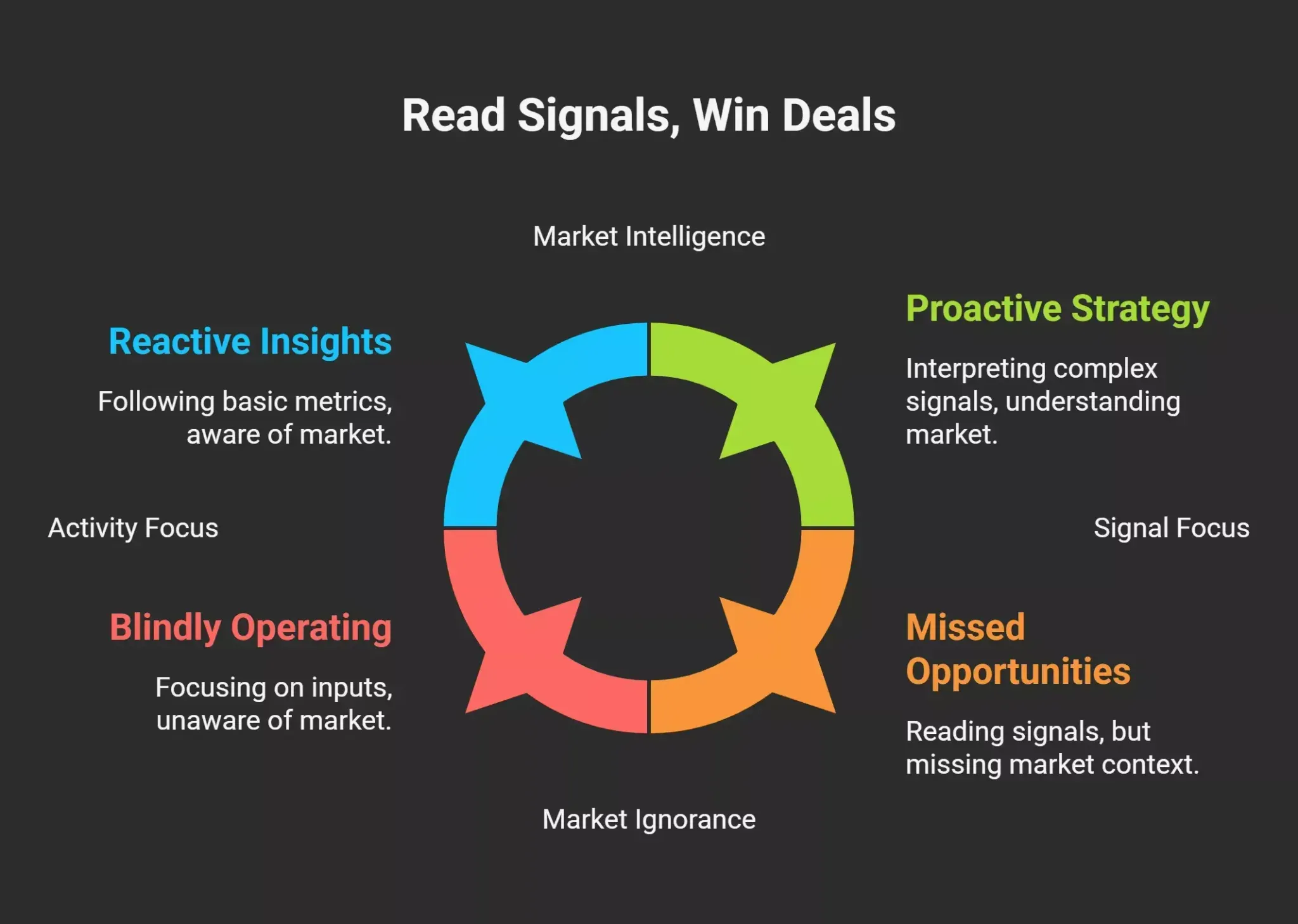 AI-driven sales leadership requires leaders to redefine success metrics, focusing on outcome-based numbers like deal velocity and win rates rather than traditional activity metrics.
From Activity Tracking to Signal Reading
-
AI is shifting leadership away from managing inputs (calls made, emails sent) and toward managing systems that interpret signals, patterns, and market conditions.
-
Sales leaders who focus on activity metrics alone miss the competitive shifts happening outside their CRM.
-
The real advantage comes from pattern recognition: connecting a competitor's hiring surge, a pricing shift, and a messaging change into one readable signal.
Smart sales leaders now think in terms of behavioral signals and competitive monitoring rather than pipeline spreadsheets. When competitors quietly add an enterprise tier and remove their team plan, that is a signal. When they post four LinkedIn articles about compliance in one week and start hiring senior enterprise account executives, those signals connect.
Together, they tell you competitors are making an enterprise push, and you have 60 to 90 days to respond. This kind of thinking separates leaders who react from leaders who act first.
Building a Deep Understanding of the Market
-
Competitive intelligence moves beyond competitor monitoring into market intelligence when it reads shifts in customer needs, pricing trends, and product updates across the market.
-
Sales leaders with a deep understanding of market conditions make strategic decisions faster, which shortens the sales cycle.
-
Companies that invest in market intelligence see their sales team make informed moves, leading to improved win rates and more revenue.
The Rules That Still Apply (and Where Thinking Changes Them)
What Is the 3-3-3 Rule in Sales?
-
The 3-3-3 rule says a salesperson should spend three minutes finding three relevant insights about a prospect before reaching out. It keeps research fast and outreach personal.
-
Where this falls short: three minutes of manual searching cannot uncover competitive positioning shifts, product updates, or hiring patterns that change how a deal should be framed.
-
Sales leaders can generate structured briefs within 90 minutes of major competitor moves using Rocket.new's Solve tool, so the rep gets relevant insights in seconds. That connects research to action rather than leaving it in a browser tab.
What is the 70/30 Rule in Sales?
-
The 70/30 rule says the prospect should talk 70% of the time and the salesperson 30%, spending most of the call listening.
-
This rule works best when the rep already knows what to listen for: which pain points competitors cannot solve and which market shifts affect the prospect's business.
-
Without competitive insights feeding the conversation, reps listen without context. With them, reps ask sharper questions that surface real problems and position against competitors with precision.
Is the Strategic Prospecting Process Often Viewed as a Sales Process?
-
Yes, and that thinking creates problems. Strategic prospecting is a research process that feeds the sales cycle. When companies collapse them into one, they lose the research capabilities that make prospecting work.
-
The sales team that focuses on strategy over activity spends time with the right prospects, talks to the right people about the right problems, and closes deals at higher rates.
-
Effective deal preparation means aligning multiple stakeholders before the conversation starts, producing shorter sales cycles and fewer surprises.
What Competitive Readiness Looks Like Inside a Deal
Signals That Change How You Sell
| Signal Type | What It Looks Like | What It Means for Your Deal |
|---|---|---|
| Price change | Competitors remove starter tier, add enterprise pricing | They are moving upmarket. Position your flexibility. |
| Hiring patterns | Surge in senior AE and security roles | Enterprise push incoming. Expect longer sales cycles. |
| Product updates | New compliance features announced | They are targeting regulated industries. Adjust your positioning. |
| Social signals | Shift from SMB tips to enterprise case studies | Messaging shift confirms upmarket move. Act now. |
| Customer signals | Negative G2 reviews about onboarding | Customers feel pain during setup. Emphasize your onboarding success. |
| Website changes | New case studies featuring Fortune 500 logos | Competitors signal credibility to larger customers. Match with your own proof. |
From Reactive Deals to Forward-Looking Strategy
-
Rocket.new connects scattered signals to predict competitors' strategic pivots before they are officially announced.
-
Sales leaders can prevent deals from stalling by identifying gaps, which produces higher win rates and shorter sales cycles.
-
Predictive intelligence turns the process from reactive deal-making to proactive strategy. Every deal exists within a competitive context, and the team that reads that context closes more deals and generates more revenue.
How CI Teams and Sales Leaders Drive Growth Together
Why CI Ownership Matters
-
A dedicated CI team acts as the research engine behind every deal, turning raw market data into structured briefs the sales team can act on immediately.
-
CI teams that update battlecards monthly see up to a 59% lift in win rates, compared to companies working from outdated materials.
-
A well-designed competitive intelligence program helps the team amplify strengths and address weaknesses during interactions with customers, making reps more successful at winning deals and bringing in more revenue.
Aligning the Revenue Organization
-
Sales leaders connect CI teams with marketing, product, and revenue to create organizational alignment around competitive positioning.
-
When the whole organization acts on competitive monitoring, insights flow faster and every group acts on the same signals.
-
AI reclaims lost hours by handling administrative work, freeing the sales team to focus on building relationships with customers and closing more deals.
What Sales Leaders Are Saying
"In competitive intelligence, people who advocate for more data simply have no clue what real intelligence looks like." - Dr. Ben Gilad, President of the Academy of Competitive Intelligence
This captures what many sales leaders already feel. The difference between companies that improve win rates and those that do not is rarely about how much they collect. Data quality matters more than volume.
The companies winning more deals are the ones turning competitor signals into insights their reps use on the next call. Thinking clearly about competitors, customers, and positioning before a deal starts is what produces success.
How Rocket.new Handles Competitive Intelligence for Sales Leaders
Rocket.new brings research, monitoring, and deal preparation into a single system. Where most tools stop at collecting information, Rocket connects that information to what your sales team actually does: prepare for deals, respond to competitor shifts, and act with confidence.
Rocket.new gives sales leaders and their teams:
-
A vibe-solutioning platform that moves from thinking to building to tracking in one shared context
-
25,000+ templates library, free to use, covering playbooks, deal briefs, and battle cards
-
Supports Flutter (mobile) and Next.js (web) for internal tools and customer-facing apps
-
Collaboration features are built in, so the sales team, CI teams, and leadership stay aligned
-
3 Products, One platform: Solve, Build, and Intelligence
Rocket collects from multiple sources, including website updates, hiring patterns, and pricing shifts, turning them into real-time signals your sales team can act on before the next call. It tracks changes at the page level, giving reps rebuttals for handling objections.
It stores all past signals and decisions in a persistent memory, improving the accuracy of competitive insights over time. Sales leaders can generate structured briefs within 90 minutes of a competitor's move using Rocket's Solve tool.
Rocket interprets competitive shifts and tells you the meaning behind changes like pricing updates or hiring surges for specific deals.
It provides actionable daily briefs summarizing competitor activity to your sales team. And it enables instant generation of tailored playbooks from real-time market intelligence.
How Sales Leaders Use Rocket.new for Competitive Readiness
-
Pre-deal briefs: Pull a structured brief covering stakeholder analysis, competitive analysis, and recommended messaging, all from live signals.
-
Ongoing signal tracking for the sales team: Track competitors across news, website, social, hiring, and customers to stay ahead of shifts that affect your deals and win rates.
-
Playbook generation from live signals: Turn competitive intelligence into ready-to-use playbooks that help reps handle objections, position against specific competitors, and close deals with the right talking points.
-
Market intelligence for go-to-market strategy: Use Rocket to spot market conditions, competitive trends, and customer pain points that inform new processes and go-to-market decisions for your business.
Turning Competitive Thinking into a Strategic Advantage Before Every Deal
How does Rocket.new's intelligence change the way a sales leader thinks about competitive readiness before a deal? It makes readiness a system rather than a scramble. Sales leaders who prepare their sales team before deals start see the competitive advantage compound across every conversation, every quarter, and every revenue target.
The companies that achieve success are not the ones with the most data. They are the ones where the right insights reach the right person at the right moment, giving every business a better strategy for winning.
Sign up now and turn competitor signals into winning deal strategies with Rocket.
Table of contents
- -What Does "Ready for the Competition" Actually Mean Today?
- -Why Most Teams Lose Before the Conversation Starts
- -The Research Black Hole
- -Why Scattered Data Fails Sales Leaders
- -How Sales Leaders Are Rethinking Competitive Readiness
- -From Activity Tracking to Signal Reading
- -Building a Deep Understanding of the Market
- -The Rules That Still Apply (and Where Thinking Changes Them)
- -What Is the 3-3-3 Rule in Sales?
- -What is the 70/30 Rule in Sales?
- -Is the Strategic Prospecting Process Often Viewed as a Sales Process?
- -What Competitive Readiness Looks Like Inside a Deal
- -Signals That Change How You Sell
- -From Reactive Deals to Forward-Looking Strategy
- -How CI Teams and Sales Leaders Drive Growth Together
- -Why CI Ownership Matters
- -Aligning the Revenue Organization
- -What Sales Leaders Are Saying
- -How Rocket.new Handles Competitive Intelligence for Sales Leaders
- -How Sales Leaders Use Rocket.new for Competitive Readiness
- -Turning Competitive Thinking into a Strategic Advantage Before Every Deal