
Rocket.new compresses mobile app development timelines by unifying design, development, and deployment in one platform. It eliminates tool fragmentation by connecting Figma, Flutter, APIs, and backend systems seamlessly. This helps teams move from idea to App Store and Play Store in significantly less time.
How long does it really take to go from a Flutter design to a live app on stores?
The answer is simple. With the right platform, teams can reduce weeks of effort into just a few days. In fact, Rocket.new compresses the build timeline for mobile teams by connecting design, code, and deployment in one smooth flow. Instead of jumping between tools, everything stays aligned, which helps developers move faster and avoid delays.
According to a report by Statista, global mobile apps are expected to generate over $613 billion in revenue by 2025, showing how fast this space is growing across smartphones and connected devices.
So, if speed matters, the way you handle mobile application development matters even more. This blog will help you understand how to shorten the timeline and create apps more efficiently.
The Real Challenge Behind Mobile App Development
Building mobile applications sounds exciting. But once teams start developing real projects, things get messy.
You have developers writing code, designers working on UI, and managers tracking progress across platforms. Each part lives in a different system or browser tab. The process slows down. The timeline stretches.
For most mobile apps, the journey looks like this:
- Design in Figma
- Write code using a programming language like Java or Flutter (Dart)
- Customize UI Screens and home screen layouts
- Connect backend and database
- Test across the Android operating system and iOS devices
- Submit to the Apple App Store and Google Play Store
Sounds simple, right? But delays happen at every step.
Teams struggle to connect data sources, manage APIs, and integrate third-party services or cloud-based services. They rewrite code from scratch, repeat tasks, and fix issues across web and mobile platforms.
Why Timelines Stretch for Mobile Teams
So, why does development take so long? The answer sits in fragmentation.
Mobile application development involves backend logic, APIs, data models, UI, functionality, and testing across devices like phones and computers.
When these parts don’t connect well, developers lose efficiency. For example, switching between web tools, Google Sheets, and backend systems breaks the flow and access to data history.
Also, building native apps for iOS and Android separately increases the timeline. Hybrid apps help, but still require effort. Native development and native mobile optimization add complexity.
Even simple features like push notifications, data storage, or security layers can delay delivery if platforms don’t support them well.
From Figma Design to Live Apps Faster
Flutter helps teams create mobile applications using one codebase. That reduces effort compared to native apps.
In many real-world workflows, designers first create UI/UX in tools like Figma, where screens, components, and user flows are finalized before development begins. These designs are then handed off to developers, who convert them into working mobile interfaces. However, this handoff often creates delays, misalignment, and repeated adjustments during mobile application development.
But even after using Flutter and Figma together, you still need to integrate APIs, backend services, databases, and cloud infrastructure for scalability.
A connected platform changes everything. Teams can directly convert designs, create, connect, customize, and export apps without switching tools. This improves speed, efficiency, and overall development flow while reducing friction between design and development stages
Simplify Development with Rocket.new
Rocket.new is a platform designed for modern software development. It combines AI, automation, and connected workflows to help developers build apps faster.
You don’t need to manage separate services. You can research, create, and deploy in one place. This gives teams a major advantage when building mobile applications for their target audience.
How Rocket.new Works
Rocket.new is built around three pillars: Solve, Build, and Intelligence.
Key Workflow
- Start with Solve to validate ideas
- Move to Build to generate mobile apps or web apps
- Connect data sources, APIs, and backend systems
- Test across Android and iOS devices
- Export builds to Google Play Store and Apple App Store
- Monitor competitors using Intelligence
Everything stays connected. No repeated process. No context loss.
Understanding the Three Core Pillars
1. Solve
Solve helps validate ideas using real data sources. It analyzes markets, users, and competitors so teams can focus on what matters. It gives structured outputs instead of raw data, improving decision-making and development direction.
2. Build
Build is the AI engine that helps developers create apps instantly.
You can describe your idea, and it generates code, UI, backend logic, and functionality. It supports:
- Mobile apps
- Web apps
- Landing pages and Dashboards
- Internal Tools
- SaaS platform
- E-commerce apps
It also supports frameworks, APIs, and integrations without manual setup.
3. Intelligence
This feature tracks competitors and market changes automatically. It connects data from multiple sources and provides insights so teams can improve continuously.
Core Features of Rocket.new
- Unified Platform: Research, development, and monitoring in one place
- AI App Builder: Generate apps without writing code manually
- 25000+ Templates: Library containing over 25,000+ templates, cost-effective for small to enterprise-level teams
- Connectors: Integrate third-party services, APIs, and databases
- Export Options: Download APKs or publish to Google Play Store
- Cross Platform Support: Works across Android, iOS, and web
- Cloud Integration: Uses cloud services for scalability
- Automation: Reduces manual effort across the process
Comparing Traditional vs Rocket.new Workflow
Fewer tools. Better connection. Faster results. Rocket.new improves speed, reduces friction, and enhances efficiency across the entire development lifecycle.
| Step | Traditional Process | Rocket.new Process |
|---|---|---|
| Research & Validation | Uses multiple tools to gather and analyze data manually, taking days or weeks. Insights are often disconnected from the build phase. | Solve centralized research. Ask in plain language and get structured, evidence-backed insights that stay connected to your product. |
| Design | Designers create using tools like Figma, then hand off to developers, leading to delays and miscommunication. | Teams can import Figma designs, which the platform converts into responsive screens and reusable UI components, drastically shortening the transition from design to development. |
| Code | Developers switch between tools for frontend, backend, and database, causing context loss and duplicated work. | Build everything in one AI-powered platform. Generate full apps using plain language and refine in a single environment. |
| UI Customization | Need manual intervention by professional developers, which is time-consuming | The platform allows teams to refine the app in real-time using an AI chat interface, enabling quick structural or logic changes to be applied instantly to the live build. |
| Backend & APIs | Requires manual setup of servers, APIs, and integrations, increasing complexity and failure points. | Use pre-built connectors for payments, databases, AI, and more—no manual setup needed. |
| Testing | Testing across platforms requires separate tools and environments, slowing down debugging. | One Flutter codebase with instant live preview for both iOS and Android, simplifying testing. |
| Export | Manual configurations and submissions for app stores can delay launches. | Export, preview, or publish apps directly to stores with minimal setup. |
| Post-Launch Monitoring | Teams manually track competitors and updates, which is inconsistent and time-consuming. | Continuous automated monitoring with real-time insights delivered to a centralized dashboard. |
Real Example Flow
Let’s take an example.
You want to build a fitness app.
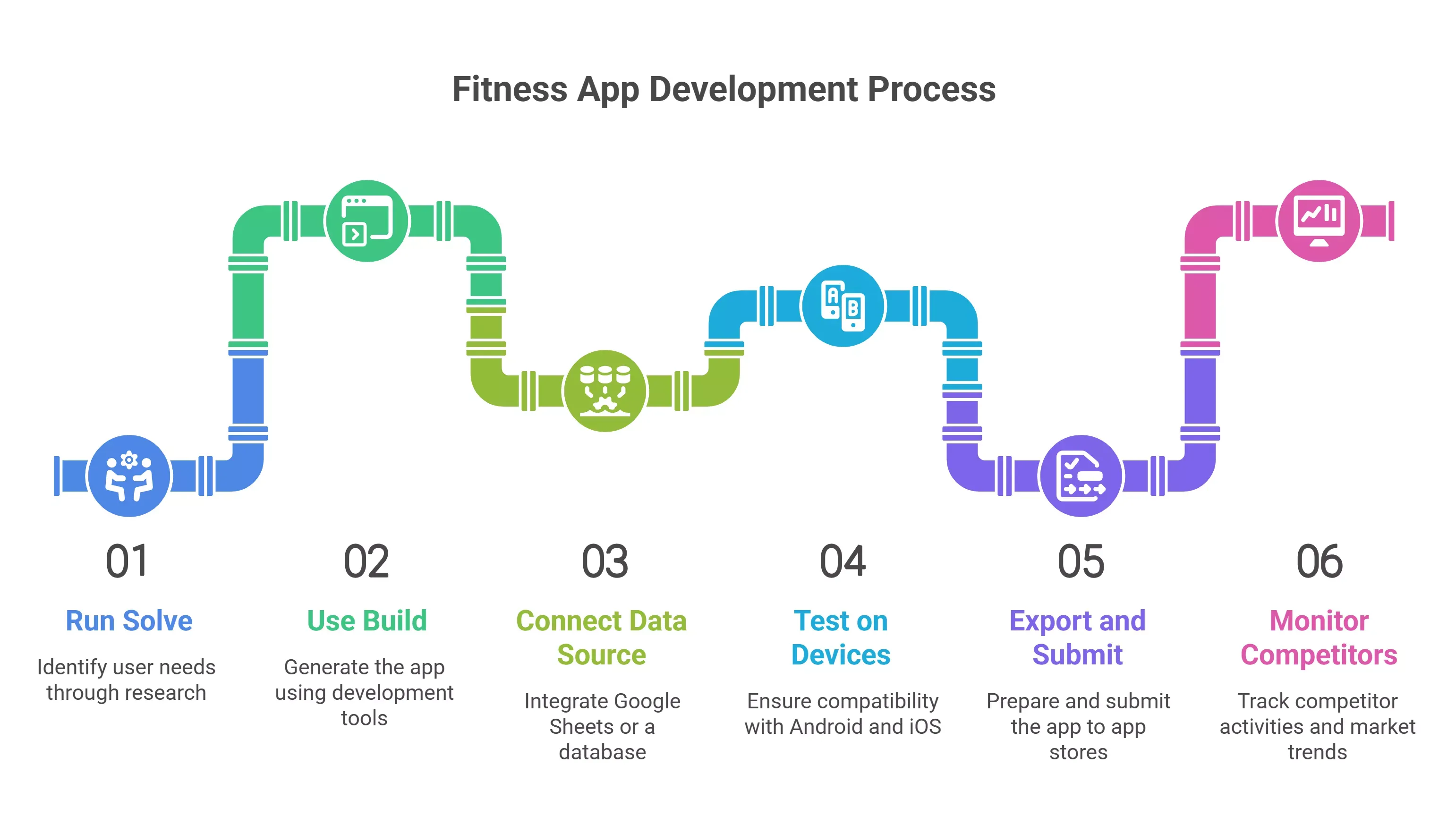
- Run Solve to figure out user needs
- Use Build to generate your app
- Connect Google Sheets or a database as a data source
- Test on Android phones and iOS devices
- Export and submit to Google Play and App Store
- Monitor competitors
No need to start from scratch. Everything stays connected.
Why This Matters for Developers
Developers want to focus on building, not managing tools.
Rocket.new helps:
- Improve speed and efficiency
- Reduce repetitive work
- Provide chat assistance using AI
- Enable faster deployment
- Improve scalability and security
This makes developing apps easier and faster.
Rocket.new Compresses the Build Timeline for Mobile Teams
Mobile application development slows down due to disconnected tools and workflows.
Rocket.new solves this by combining research, building, and monitoring into one platform.
It helps teams:
- Access everything in one place
- Connect frontend, backend, and data
- Automate workflows
- Deliver apps faster
That’s how Rocket.new compresses the build timeline for mobile teams.
Table of contents
- -The Real Challenge Behind Mobile App Development
- -Why Timelines Stretch for Mobile Teams
- -From Figma Design to Live Apps Faster
- -Simplify Development with Rocket.new
- -How Rocket.new Works
- -Understanding the Three Core Pillars
- -Core Features of Rocket.new
- -Comparing Traditional vs Rocket.new Workflow
- -Real Example Flow
- -Why This Matters for Developers
- -Rocket.new Compresses the Build Timeline for Mobile Teams