
Solve on Rocket.new transforms sector onboarding from days of scattered research into a structured, decision-ready brief in under 90 minutes. Consultants get market insights, risks, competitors, and customer dynamics in one place. This leads to stronger first impressions, faster onboarding, and better client outcomes.
You just landed a new client engagement. The kick-off call is in 48 hours. And the sector? One you haven't formally advised in before. What do you do?
The answer for most consultants is still: bury yourself in reports, tab through competitor websites, pull LinkedIn threads, and try to stitch it all together before the meeting. It works - kind of. But it takes days, it's scattered, and it rarely produces the structured, client-ready thinking that a first meeting deserves.
According to Technavio, the global strategy consulting market is set to grow by USD 121.2 billion between 2024 and 2028. As the market grows, consultants face pressure to cover new sectors faster than ever. The old preparation process wasn't built for that pace. Rocket.new's Solve was.
Why the Client Onboarding Process into a New Sector is Genuinely Hard
Strategy consultants get hired because clients trust their judgment. But judgment in a new sector requires research, real, structured research, not a quick search. This is where the client onboarding process breaks down for most independent advisors.
Before a first meeting, a consultant needs to build a complete picture of the sector. That means understanding how the market is structured, who the key players are, what regulatory pressures shape it, and where the structural risks sit. Customers in this space - the businesses the client serves - have their own dynamics that affect the strategy. Miss those dynamics in the first few days, and it shows.
What a Proper Sector Onboarding Process Must Cover
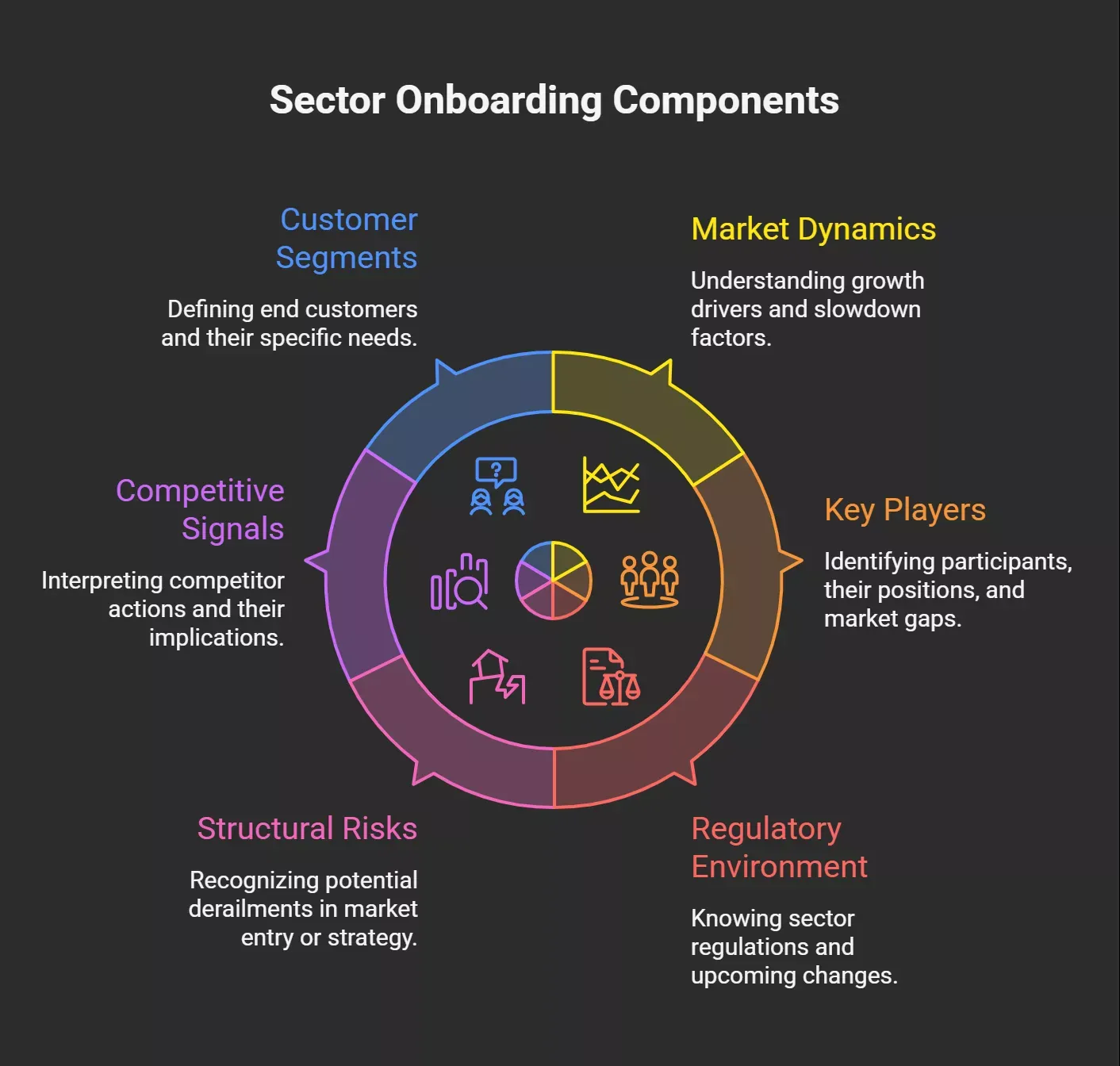
A proper sector onboarding process means covering:
- Market dynamics: what's driving growth, what's slowing it
- Key players: who's in the space, how they're positioned, where the gaps are
- Regulatory environment: what governs the sector, what's changing
- Structural risks: the things that can quietly derail a market entry or strategy
- Competitive signals: what moves competitors are making and what they mean
- Customer segments: who the end customers are and what they need
The Role of Documentation in Accelerating Consultant Onboarding
Good documentation provides insight into project structure, delivery dates, and the tech stack, which is crucial for new consultants to understand before engaging with the codebase. Consultants who take the time to read documentation before diving into code can significantly improve their understanding of the project and the team dynamics, leading to more effective contributions.
Documentation can be as important as the code itself, as it helps new team members orient themselves and understand the context of the project, which can lead to faster ramp-up times. Before engaging with the codebase, consultants should prioritize reviewing documentation to gain insights into project structure, tech stack, and delivery processes, which can significantly enhance their ramp-up efficiency.
Building Credibility and Team Dynamics from Day One
Consultants should focus on identifying key team members, including developers and upper management, to understand team dynamics and establish communication channels early in the project. Starting with small, manageable contributions, such as bug fixes or minor tweaks, allows consultants to build credibility and understand team processes without overwhelming themselves. Consultants should also adopt a mindset of patience and humility, recognizing that they will initially be the least knowledgeable person in the room, which can help them learn effectively and integrate into the team.
The Time Cost of Deep Sector Research
That level of depth used to take two or three days. For an independent consultant or small advisory firm, those are days that could have been billed elsewhere - or worse, they get cut short, and the first meeting suffers for it. Consultants focus their research on one critical problem or opportunity instead of analyzing the entire sector, and the solution focuses on mapping the problem's dimensions, such as market risks, pricing models, and customer pain points.
Why First Impressions in Onboarding Are Impossible to Undo
The client onboarding experience starts before you walk into the room. Your preparation shapes their first impression. Research shows that slow, inefficient onboarding can lead to real client loss, highlighting its direct impact on client retention and churn. And early damage is the hardest kind to fix.
Building Long-Term Client Relationships Through Smarter Onboarding
A successful client onboarding process sets clear expectations, ensures clients complete key tasks, and lays the foundation for a strong client relationship. Best practices for client onboarding include preparing for the beginning, ensuring smooth handoffs, and focusing on delivering value and ROI throughout the onboarding journey.
What Solve on Rocket.new Actually Does
Let's find out how does a strategy consultant use Solve on Rocket.new to onboard into a new sector before the first client meeting?
Solve is Rocket.new's decision intelligence engine. You describe your situation in plain language - the way you'd explain it to a smart colleague - and Rocket frames the problem before research begins. It identifies every relevant dimension (market dynamics, competitive landscape, regulatory environment, financial implications, risks), then runs thousands of queries across 150+ sources simultaneously.
Within 60 to 90 minutes, what would have taken a research team days or a strategy firm weeks is complete. The output is not a summary. It's a structured analytical deliverable covering 8 to 12 sections, with each finding tagged by signal strength (HIGH / MEDIUM / LOW) and conflicting signals called out explicitly - not smoothed over.
That's what separates Solve from a generic AI tool or chatbot. Solve doesn't just find information. It builds the case. The output is structured to be acted on, presented to a client team, or used directly to plan ahead for the engagement.
| What You Get | Search Engine | General AI Chat | Solve on Rocket.new |
|---|---|---|---|
| Format | Links | Paragraph | Structured 8-12 section report |
| Depth | You do the work | Shallow summary | Full research synthesis |
| Signal quality | Unfiltered | No rating | HIGH / MEDIUM / LOW tags |
| Conflicting data | Not handled | Smoothed over | Surfaced with reasoning |
| Follow-up | New search | Limited memory | Builds on full project context |
| Export | None | Copy/paste | PDF or full presentation deck |
The Step-by-Step Onboarding Workflow for a New Client
Here is exactly how the structured onboarding process works when a consultant uses Solve to get sector-ready before a first client meeting. Each step builds on the one before it, and the whole onboarding journey runs inside a single project workspace.
Step 1 - Create the New Project and Load Context
Open Rocket.new, and create a new project for the engagement. Upload whatever the client has shared - their pitch deck, annual report, or a brief. Rocket reads these files structurally, not as flat text. A financial model is understood as a financial model. Every task that follows inherits this context automatically. No re-uploading, no re-briefing. Teams working on the same engagement all access the same project and the same accumulated context from day one.
Step 2 - Write the Sector Onboarding Prompt
From a single prompt, the onboarding journey begins. The consultant types something like:
"I'm advising a mid-market healthcare logistics company looking to move into last-mile pharmaceutical delivery in Southeast Asia. I need a structured sector brief covering market dynamics, key players, regulatory environment, structural risks, and where the real opportunities are."
Rocket frames the research objective, breaks the question into component dimensions, and runs parallel research across each one simultaneously. The process starts immediately - no intake forms, no setup, no briefing a research team.
Step 3 - Review the Structured Output
The output covers everything needed to walk into a first client meeting with real sector knowledge:
- Verdict: The direct recommendation at the top - no burying the lead
- Key Findings: Evidence-backed findings, each tagged HIGH / MEDIUM / LOW by signal strength
- Competitive Landscape: Named players, positioning, structural gaps
- Regulatory Environment: What governs the sector and what's coming
- Risk Matrix: Structural risks with reasoning for why each one matters
- Customer Analysis: Who the end customers are, what shapes their behavior, what they need from suppliers in this sector
- Data Inventory: Sources cited with quality ratings
- Execution Path: Owners, timelines, and gate conditions where the decision calls for it
Solve also surfaces what you didn't ask for but needed to know. If research turns up a regulatory deadline, a competitor move, or a structural risk not in the original prompt, it appears in the output with reasoning for why it matters. That's the kind of insight that changes how a first client meeting goes.
Step 4 - Refine Through Follow-Up Chat
After the first output, the consultant can go deeper into any section without re-running the comprehensive research. Drill into the regulatory environment for a specific country. Reframe the risk matrix for a board-level audience. Ask for the strongest bear case for market entry. Ask the right questions about customer concentration in the sector. Each follow-up builds on the full prior context. Nothing gets re-explained. The onboarding process gets more precise with every exchange.
Step 5 - Export as a Client-Ready Deliverable
Export as a comprehensive PDF or hit "Generate PPT" for a full presentation deck. The consultant walks into the first meeting with a complete, structured sector brief - produced in hours, not days. That's a different kind of client onboarding experience than most independent advisors have been able to offer before. Customers and client teams notice the difference immediately.
👉Start using Solve on Rocket.new to turn sector onboarding into a competitive advantage today.
What Doesn't Disappear After the Export, and How You Can Plan Ahead
Here's where Rocket.new's architecture makes a real difference for ongoing client relationships. The sector brief doesn't vanish once exported. It stays inside the project and becomes the foundation of everything that follows.
The second Solve task - a competitive deep-dive, a pricing analysis, a market entry assessment - inherits everything the first one established. Every new task makes the next one smarter. Work compounds across the project, not just within a single session. The consultant can build a full intelligence dashboard for the client, pulling together competitive signals, market updates, and strategic briefs - all from the same accumulated context.
For retainer clients, the consultant can layer in Rocket.new's Intelligence capability, which continuously monitors the client's competitive landscape and surfaces weekly signals. The structured onboarding you build on day one becomes the foundation of a long-term intelligence practice. Client retention improves when clients feel their consultant is always ahead, not catching up. That's the difference between a one-off engagement and a relationship that compounds over time.
Why Other Tools Fall Short for This Use Case
A BCG survey from June 2025 found that more than three-quarters of leaders and managers now use generative AI several times a week. The tools are everywhere. But for a strategy consultant preparing for a first client meeting in a new sector, most of them create as much friction as they remove.
General AI assistants give you a paragraph. Not a verdict, a risk matrix, and a competitive landscape with named players and signal ratings. Research tools find information. Solve produces decisions. The difference between information and a decision is exactly what consultants get paid to deliver.
Multiple tools used together - a research tool, a document editor, a presentation builder - require the consultant to be the integration layer. They carry context between tools, re-explain the situation at every step, and do the synthesis work themselves. That's wasted time on tasks that don't help clients. One platform, one context, one continuous flow from a single prompt to a client-ready deliverable means the consultant can focus on what actually builds trust and improves the onboarding experience for both sides.
A community member from r/consulting put it directly in April 2025.
"How annoying do you guys find project onboarding at your workplace? I have worked across various enterprises, and it has resulted in me wasting the first few weeks when I join the project." - Source
That problem sits at the center of what Rocket.new's Solve is built to address. When onboarding ends in confusion instead of clarity, the whole engagement starts wrong.
Rocket.new Key Features Built for the Consultant as an Operator, All in One Platform
Rocket.new serves the strategy consultant as an Operator - not someone building apps, but someone who needs structured intelligence and client-ready deliverables, fast. Here's what the key features look like from that perspective, and how each one helps consultants deliver a better onboarding experience for new client teams:
- Solve - Any business question to a complete structured output, ready to act on, present, or build from. Sector onboarding is one of four named use cases for the Consultant persona on Rocket.new. The full range covers strategic decisions, competitive preparation, board materials, M&A assessment, and more. The research output from Solve enables consultants to refine their initial hypothesis based on real output.
- Context and Projects - Client files and background are loaded once, inherited by every subsequent task automatically. No re-briefing at the start of each new project task. Teams always work from the same shared context.
- Intelligence - Continuous monitoring of the client's competitive landscape on retainer. Signals are delivered weekly, so the consultant stays sharp between engagements and can build an ongoing intelligence practice for clients.
- Client Intelligence Dashboard - Rocket.new can generate a live intelligence portal for clients - replacing static quarterly PDF deliverables with a dashboard that customers and client teams access between reviews. That's a service upgrade that improves client retention.
- Export - PDF and full presentation deck generation. Client-ready output without a separate design workflow.
- Human Help - Rocket's Success team steps in when the AI reaches its limits, with user permission. No getting stuck at 90%.
The onboarding process gets faster. The quality of the output improves. The consultant spends less time on research overhead and more time on the actual client relationship, which is where client retention and building trust actually happen. Success metrics for an engagement start looking better from day one.
The Meeting Starts Before You Walk In
There's a direct connection between how well a consultant prepares for a first meeting and how that client relationship develops from there. The onboarding experience doesn't start with the kickoff call. It starts with the preparation that happens before it.
Poor preparation leads to a poor onboarding experience. The client notices. They start to question whether the engagement will deliver the value they expected. Client relationships built on shaky first impressions are hard to recover. Expectations get misaligned. That's expensive for everyone.
Solid preparation - a structured sector brief, a competitive landscape, a risk matrix, all of it client-ready within 90 minutes - sets the tone for everything that follows. The consultant walks in as a peer, not a new hire still finding their footing. Decision-making in that first meeting is sharper because the thinking was done before the room.
How does a strategy consultant use Solve on Rocket.new to onboard into a new sector before a client meeting?
They describe their situation once, in plain language. Rocket does the research. The structured brief is ready in hours. The client onboarding journey starts on the right foot.
Table of contents
- -Why the Client Onboarding Process into a New Sector is Genuinely Hard
- -What a Proper Sector Onboarding Process Must Cover
- -The Role of Documentation in Accelerating Consultant Onboarding
- -Building Credibility and Team Dynamics from Day One
- -The Time Cost of Deep Sector Research
- -Why First Impressions in Onboarding Are Impossible to Undo
- -Building Long-Term Client Relationships Through Smarter Onboarding
- -What Solve on Rocket.new Actually Does
- -The Step-by-Step Onboarding Workflow for a New Client
- -Step 1 - Create the New Project and Load Context
- -Step 2 - Write the Sector Onboarding Prompt
- -Step 3 - Review the Structured Output
- -Step 4 - Refine Through Follow-Up Chat
- -Step 5 - Export as a Client-Ready Deliverable
- -What Doesn't Disappear After the Export, and How You Can Plan Ahead
- -Why Other Tools Fall Short for This Use Case
- -Rocket.new Key Features Built for the Consultant as an Operator, All in One Platform
- -The Meeting Starts Before You Walk In