Use these ten tested prompts to build a habit tracker app with AI, covering streaks, gamification, onboarding, and social features, and go from idea to deployed product without writing a single line of code.
Can you build a working habit tracker app with a single prompt?
The AI code assistants market is projected to grow from $8.14 billion in 2025 to $127.05 billion by 2032, at a 48.1% CAGR, according to MarketsandMarkets.
Developers and non-developers alike are replacing manual coding with prompt-driven workflows. 82% of developers already use AI tools for writing code, making structured prompts to build habit tracker app the default starting point for new projects.
Today, AI prompts have replaced traditional wireframes for a growing number of builders. You describe what the app should do, and the AI generates production-ready code, complete with a database schema, API routes, and frontend components.
What Makes a Habit Tracker Prompt Actually Work?
Not every prompt produces a usable result. The difference between a vague instruction and a reliable one comes down to structure. According to Rocket's official Build best practices, the quality of your prompt directly determines the quality of the initial generation.
The most important rule: use the 3 to 5 feature rule. Limit each prompt to three to five core features. More than that, and the model cuts corners on each one.
-
Lead with purpose: Start with what the app is for and who uses it, then list features
-
Name every screen explicitly: List each screen by name so the AI knows what to generate
-
Separate design from functionality: Describe UI style in one prompt and logic in another
-
Include example data: Sample habit names, streak counts, and user profiles anchor the generation
-
Reference existing tables: In follow-up prompts, name your Supabase tables to prevent duplicate structures
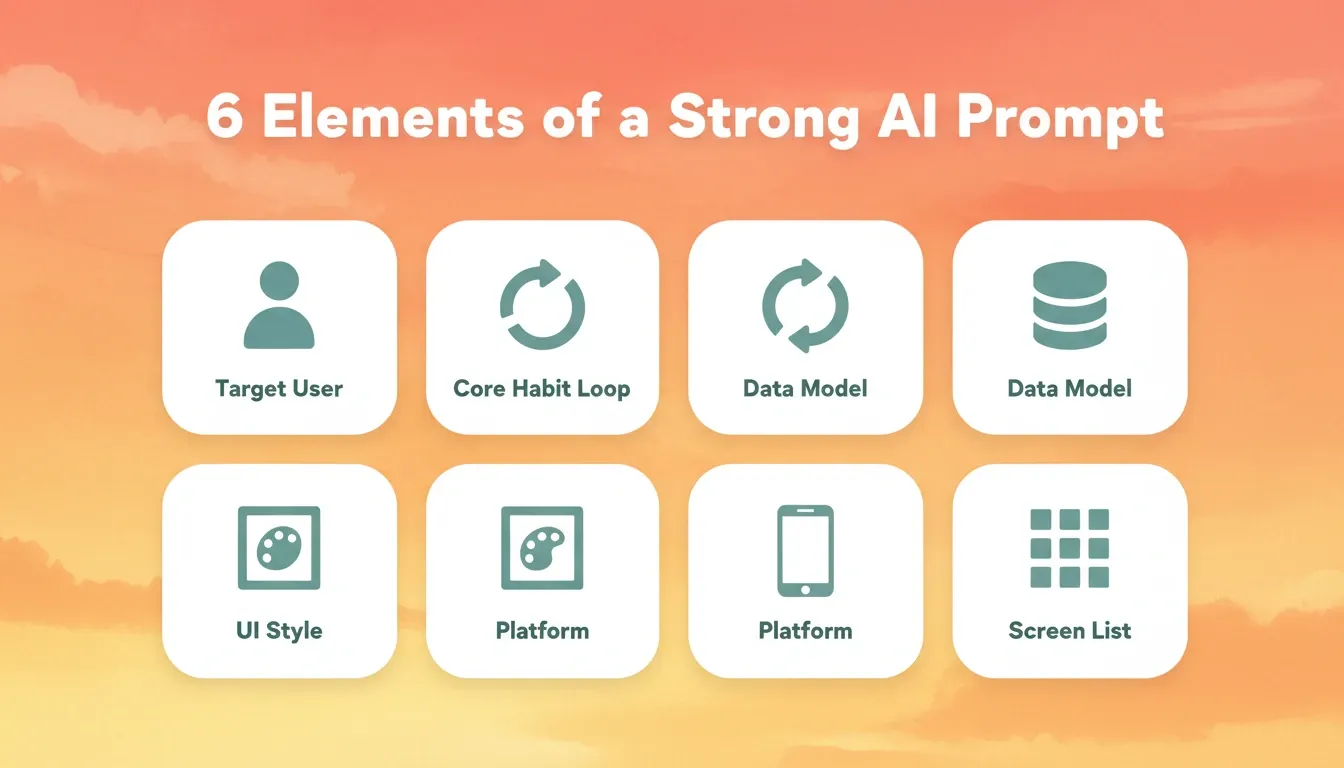
Here is a practical breakdown of what each prompt element does:
| Element | Purpose | Example |
|---|---|---|
| Target user | Grounds every feature decision | Busy professionals aged 25 to 40 |
| Core habit loop | Defines the main interaction | Check-in, streak counter, daily reminder |
| Data model | Shapes the backend structure | User, Habit, Entry, Streak tables |
| UI style | Guides the frontend output | Minimal, card-based, dark mode optional |
| Platform | Sets the tech stack | Cross-platform mobile with Flutter |
| Screen list | Eliminates ambiguity | Dashboard, Stats, Profile, Onboarding |
When you fill each slot, the AI stops improvising and starts executing. In short, the better your prompt structure, the fewer revision cycles you need.
What the Community Says
Practitioners who write prompts daily have a clear perspective on what this shift actually means. Astha.IT shared this on LinkedIn:
"The shift isn't from coding to prompting. It's from manual input to strategic guidance."Astha.IT, LinkedIn
You are not replacing coding skill with prompting skill. Instead, you are adding a strategic layer that multiplies what you can ship in a given time window.
Core Feature Prompts for Your Habit Tracker App
These three prompts cover the foundation of any habit tracker app: full-stack generation, streak tracking, and daily reminders. Run them in sequence for the cleanest output. For a deeper look at structuring full-stack builds, see how to build a full-stack app with an AI prompt.
Prompt 1: Full-Stack Habit Tracker Generation
1Build a cross-platform habit tracker app with the following:
2- User registration and login with email/Google OAuth
3- Dashboard screen showing today's habits with check-in buttons
4- Streak counter that resets on missed days
5- Weekly progress chart using bar visualization
6- Stats screen with completion history
7- Supabase backend with User, Habit, Entry, and Streak tables
8- Clean, card-based UI with a calming blue-green palette
9Target user: busy professionals aged 25 to 40 building consistent routines.
This single prompt produces the entire skeleton, including authentication, a database schema, and a working frontend in one generation cycle. Naming the screens explicitly prevents the AI from guessing your navigation structure.
Prompt 2: Streak Logic and Gamification Layer
1Add streak tracking to the habit tracker:
2- Calculate current streak from consecutive check-in dates
3- Display streak count with a flame icon on the dashboard
4- Trigger a celebration animation at 7, 30, and 100 day milestones
5- Store longest streak in the user profile
6- Add a freeze feature that preserves streak for 1 missed day per week
7Keep the existing UI and database schema intact.
Streaks are the psychological engine of every habit app. The instruction to keep the existing schema intact is critical, because it prevents the AI from regenerating parts you have already tested.
Prompt 3: Smart Reminders and Notifications
1Add a reminder system to the habit tracker:
2- Let users set custom reminder times per habit
3- Send push notifications 5 minutes before scheduled time
4- Include motivational message rotation from a preset list of 10 messages
5- Add a snooze 10 minutes action on the notification
6- Track notification open rates in the analytics dashboard
7Do not change the existing screens or database structure.
Reminders convert passive users into daily active ones. According to the Stack Overflow Developer Survey, 76% of developers now use or plan to use AI tools in their workflow, and notification systems are among the most commonly generated features.
User Experience and Design Prompts
A habit tracker lives or dies by its daily interface. These prompts shape how users interact with your app every morning. For a broader set of app-building prompts across categories, explore best prompts for app building.
Prompt 4: Personalized Dashboard Layout
1Redesign the main Dashboard screen:
2- Greeting with user's first name and current streak count
3- Today's habits listed as toggleable cards with completion checkmarks
4- Completion percentage ring at the top right
5- Quick-add button (floating action button) for creating new habits
6- Bottom navigation bar with Home, Stats, and Profile tabs
7- Subtle gradient background from light blue to white
8Keep all existing data logic and backend connections unchanged.
Specifying a gradient direction in your prompt anchors the visual direction and eliminates ambiguity. The dashboard is the first screen users see every day, so it needs to feel personal and scannable.
Prompt 5: Onboarding Flow for New Users
1Create a 3-step onboarding sequence that runs on first launch:
2- Step 1: Ask user to pick 3 starter habits from a preset list of 12 options
3- Step 2: Set preferred reminder time (morning 8am, afternoon 1pm, evening 8pm)
4- Step 3: Choose a motivational theme (minimal, nature, space)
5- Add a skip option on each step that goes directly to the dashboard
6- Show a progress indicator (1/3, 2/3, 3/3) at the top
7- Store all selections in the User table in Supabase
Onboarding determines whether someone becomes a weekly user or uninstalls after day one. As a result, this prompt keeps friction low while collecting meaningful preferences that personalize the experience.
Ready to test these first five prompts on a real app? Paste any prompt directly into Rocket and get a live, deployed habit tracker in minutes. No credit card needed. Start building on Rocket.new
Prompt 6: Data Visualization and Progress Screens
1Build a Statistics screen:
2- Weekly bar chart showing completion rate per habit (use the existing Entry table)
3- Monthly heatmap calendar with color intensity for consistency
4- Total habits completed counter with animated number increment on load
5- Comparison view: this week vs. last week percentage
6- Export data as CSV button that downloads a file
Visual progress is the reward loop that keeps users coming back. Referencing "the existing Entry table" prevents the AI from creating duplicate data structures, which is one of the most common generation mistakes.
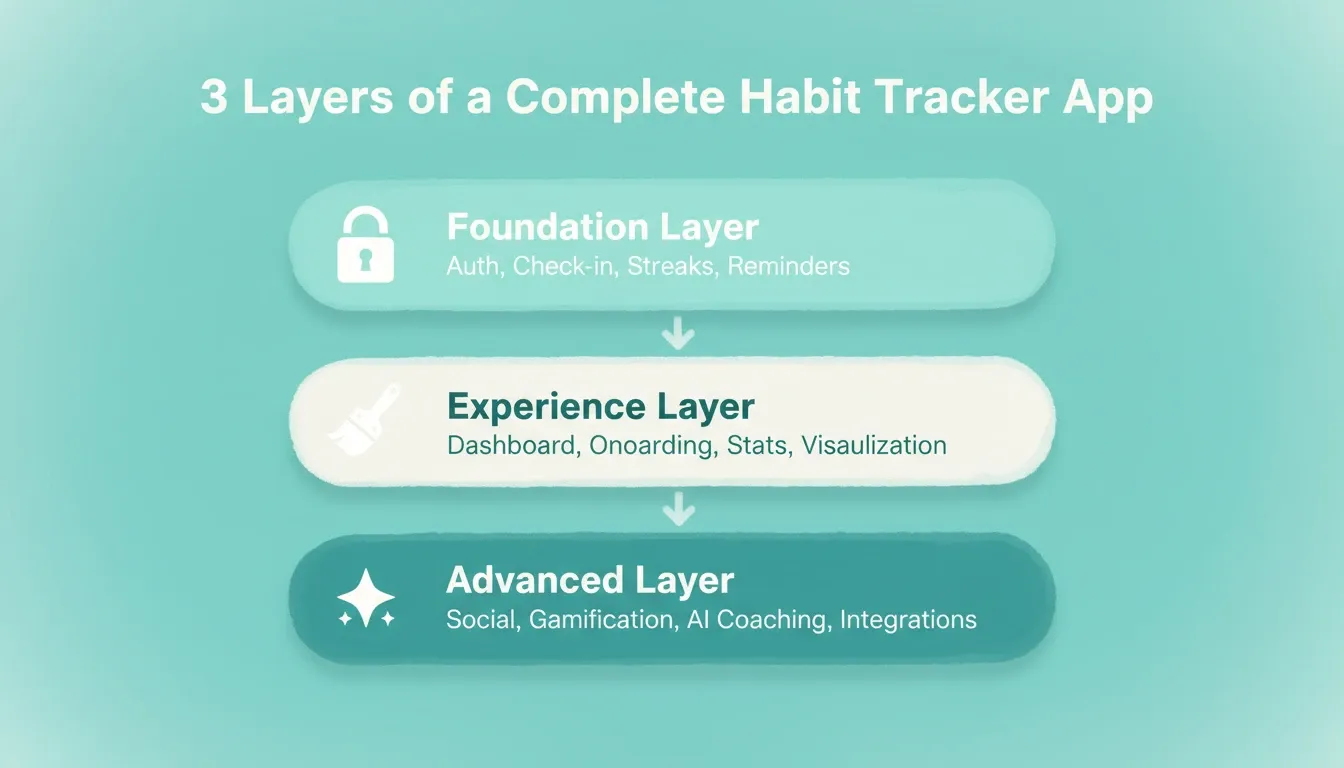
These three prompts form the experience layer of your app. Combined with the core feature prompts above, you now have a habit tracker that both works and feels good to use every day.
How Rocket Turns These Prompts into a Live App
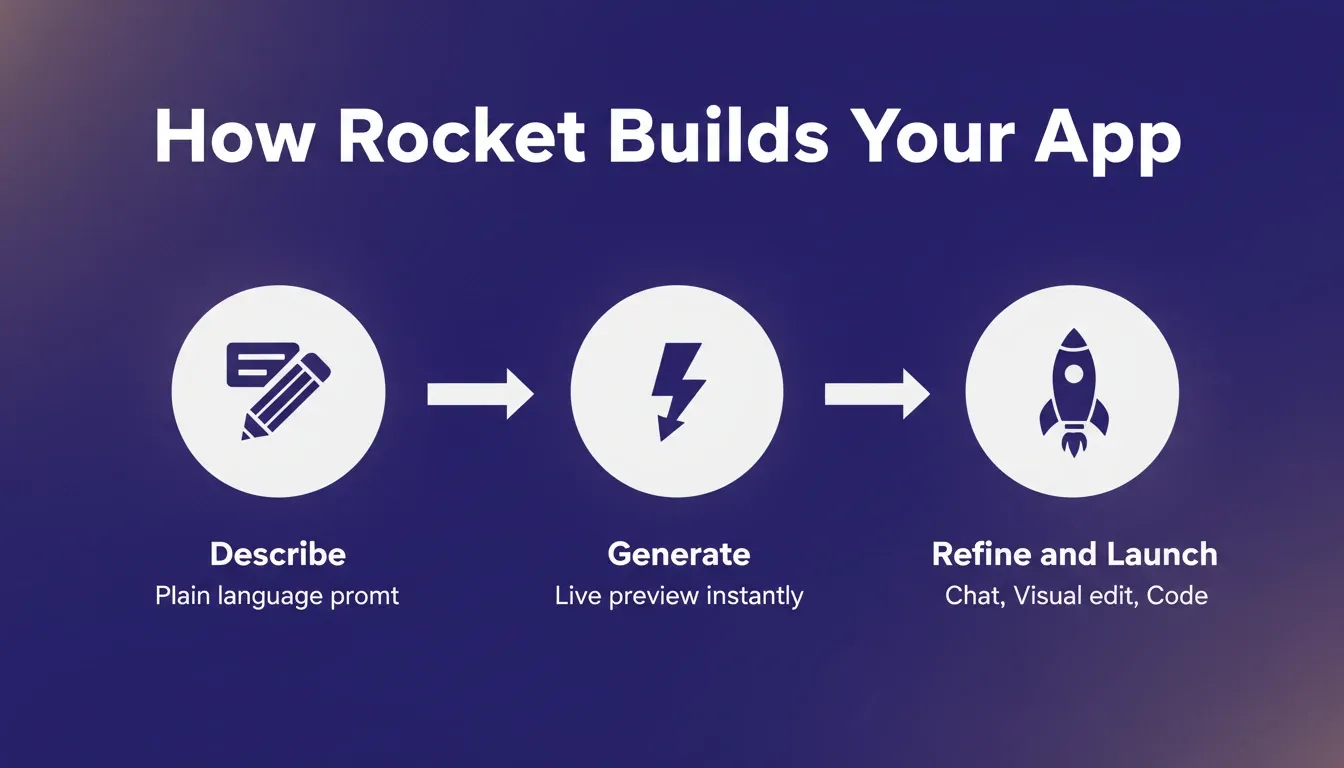
You have the prompts. Now you need a platform that turns them into working software, not just code snippets in a chat window. Here is exactly how Rocket handles each stage of the habit tracker build, verified against the official documentation.
Step 1: Describe — Paste Your Prompt
Open a new Build task and paste Prompt 1. Rocket reads your natural language description, plans the architecture, and begins generating. The more specific your prompt, the closer the first result will be to what you have in mind.
Step 2: Generate — Live Preview in Seconds
Rocket writes production-ready Next.js code for web and Flutter code for mobile from the same prompt. A live preview appears the moment generation finishes. The Supabase connection is set up as part of the build, so no separate backend configuration is required.
Step 3: Refine — Three Ways to Iterate
Once your V1 is live in the preview, Rocket gives you three distinct ways to refine it:
-
Chat: Describe changes in plain language ("make the streak counter larger and add a confetti animation")
-
Visual edit: Click directly on any element in the preview to change colors, text, and layout without writing code
-
Code view: Open the generated Next.js or Flutter code directly for precision edits
The official docs recommend incremental iteration. Add one feature at a time and test after each change. This approach keeps bugs isolated and prevents compounding issues.
Step 4: Launch — One Click to Production
Click Launch when your habit tracker is ready. Rocket publishes it to the web with a custom domain option. For mobile, you can download the APK, submit to Google Play, or submit to the Apple App Store, all from within the same workspace.
| Rocket Feature | What It Does for Your Habit Tracker |
|---|---|
| Next.js generation | Production-ready web app with SEO and fast load times |
| Flutter generation | Single codebase for iOS and Android |
| Supabase connector | Real database for users, habits, streaks, and entries |
| Visual edit | Click-to-change UI without touching code |
| Versions | Roll back to any previous build state if something breaks |
| Advisor Agent | Reviews your app and flags issues before launch |
| Custom domain | Publish your habit tracker at your own URL |
| App Store submission | Direct path to Google Play and Apple App Store |
Rocket also includes Solve for validating your habit tracker idea before you build, and Intelligence for monitoring competitor habit apps continuously. Both are available from the same workspace.
Pricing
| Plan | Price | Credits/Month | What's Included |
|---|---|---|---|
| Free | $0 | 20 (one-time) | Build production-ready apps + Light Solve |
| Pro | $25/mo | 100 | Build web apps, mobile apps, landing pages |
| Rocket | $50/mo | 250 | Build + Consultant-grade Solve + Intelligence |
| Booster | $250/mo | 1,500 | Full suite + SSO, data localisation, premium support |
All paid plans include unlimited team members. Annual billing saves 20%.
For a step-by-step walkthrough of going from idea to live app, see how to build an app with AI in minutes.
Advanced Feature Prompts That Set Your App Apart
Basic habit trackers are commodities. Fortunately, these prompts add the features that keep users subscribed past the free trial.
Prompt 7: Social Accountability and Friends
1Add a social layer to the habit tracker:
2- Friend system with invite via shareable link or username search
3- Shared habits screen showing friends' check-in status for today
4- Weekly accountability report sent to paired buddies via email
5- Leaderboard screen ranking friends by consistency percentage this week
6- Privacy toggle per habit (public / friends-only / private)
7Store friend relationships in a new Friends table linked to the User table.
Social pressure is the most underused retention lever in habit apps. Specifying the new database table prevents the AI from guessing where to store relationship data.
Prompt 8: Gamification and Rewards System
1Add gamification to the habit tracker:
2- XP points for each check-in (10 XP base, 2x multiplier during active streaks)
3- Level system: Starter (0 to 100 XP), Builder (101 to 500 XP), Master (501 to 2000 XP), Legend (2001 and above XP)
4- Badge collection for milestones: first habit, 7-day streak, 30-day streak, 5 habits active
5- Weekly challenge: complete all habits every day for bonus 50 XP
6- Reward store screen where XP unlocks app color themes
7Add XP and Level fields to the User table. Create a Badges table.
McKinsey's 2025 State of AI report found that 88% of organizations regularly use AI, and gamification logic is one of the clearest examples of prompt-generated complexity that would take a developer days to hand-code.
Prompt 9: AI Coaching and Adaptive Goals
1Add an AI coaching feature:
2- Analyze check-in patterns to detect habit stalling (3 or more consecutive misses)
3- Suggest difficulty adjustments when a user misses 3 or more days in a row
4- Generate personalized tips based on habit category (fitness, learning, mindfulness)
5- Weekly reflection prompt with a journaling text field stored in Supabase
6- Adaptive goal setting that scales daily targets up by 10% after 7 consecutive completions
7Display coaching insights on a new Coaching screen accessible from the bottom nav.
Prompt 10: Third-Party Connections
1Connect the habit tracker to external services:
2- Apple Health integration for auto-logging exercise and sleep habits
3- Google Fit integration for step count and activity data
4- Google Calendar sync to block habit time slots as calendar events
5- Zapier webhook endpoint for custom automation triggers
6- Stripe integration for a premium subscription tier ($4.99/month) unlocking the Reward Store
7Use Rocket's built-in Stripe connector for the payment integration.
Together, these advanced prompts transform a simple check-in app into a full productivity platform. Run them after your core features are stable and tested.
All ten prompts are ready. Now put them to work. Rocket takes your prompt from plain text to a deployed, production-ready habit tracker with a real Supabase backend, Flutter mobile output, and one-click hosting. Build your habit tracker on Rocket
Common Prompting Mistakes and How to Avoid Them
Good prompts produce good apps. Bad prompts, however, produce frustration. Here are the patterns that consistently lead to failed generations, drawn from Rocket's official best practices documentation. For a broader look at how AI tools are reshaping the build process, see vibe coding using AI tools to shape next-gen workflows.
| Anti-Pattern | Why It Fails | Fix |
|---|---|---|
| "Make me a habit app" | Too vague, AI improvises everything | Specify user, screens, data model, and platform |
| 20 features in one prompt | AI cuts corners on each feature | Use the 3 to 5 feature rule per prompt |
| No schema instructions | AI creates duplicate or conflicting tables | Reference existing tables by name in every prompt |
| Changing design and logic together | Bugs become impossible to isolate | Separate design prompts from logic prompts |
| Skipping mobile testing | Forces major restructuring late | Test on mobile after every significant change |
| Over-iterating before shipping | Polishing endlessly delays real feedback | Ship when it looks good; iterate on real user data |
This flowchart maps the decision path for structuring your prompts to build habit tracker app correctly:
Treat each prompt as a draft, not a final submission. The best results come from two or three focused iterations rather than one perfect attempt.
How Long Does It Take to Build a Habit Tracker App with AI?
This is one of the most common questions from first-time builders. Here is a realistic timeline using the prompts in this guide:
| Phase | What You Do | Time Estimate |
|---|---|---|
| Prompt 1: Core generation | Paste the full-stack prompt, review live preview | 5 to 10 minutes |
| Prompts 2 to 3: Streaks and reminders | Run each prompt, test each feature | 15 to 20 minutes |
| Prompts 4 to 6: UX and design | Dashboard, onboarding, stats screens | 20 to 30 minutes |
| Testing and refinement | Chat, Visual edit, mobile preview | 30 to 60 minutes |
| Launch | Custom domain or App Store submission | 10 to 15 minutes |
| Total V1 | Working habit tracker, live | About 1.5 to 2 hours |
Advanced features (Prompts 7 to 10) add another two to four hours depending on complexity. A production-ready habit tracker with social features, gamification, and third-party integrations is achievable in a single day.
Habit Tracker App Features: What to Build First vs. Later
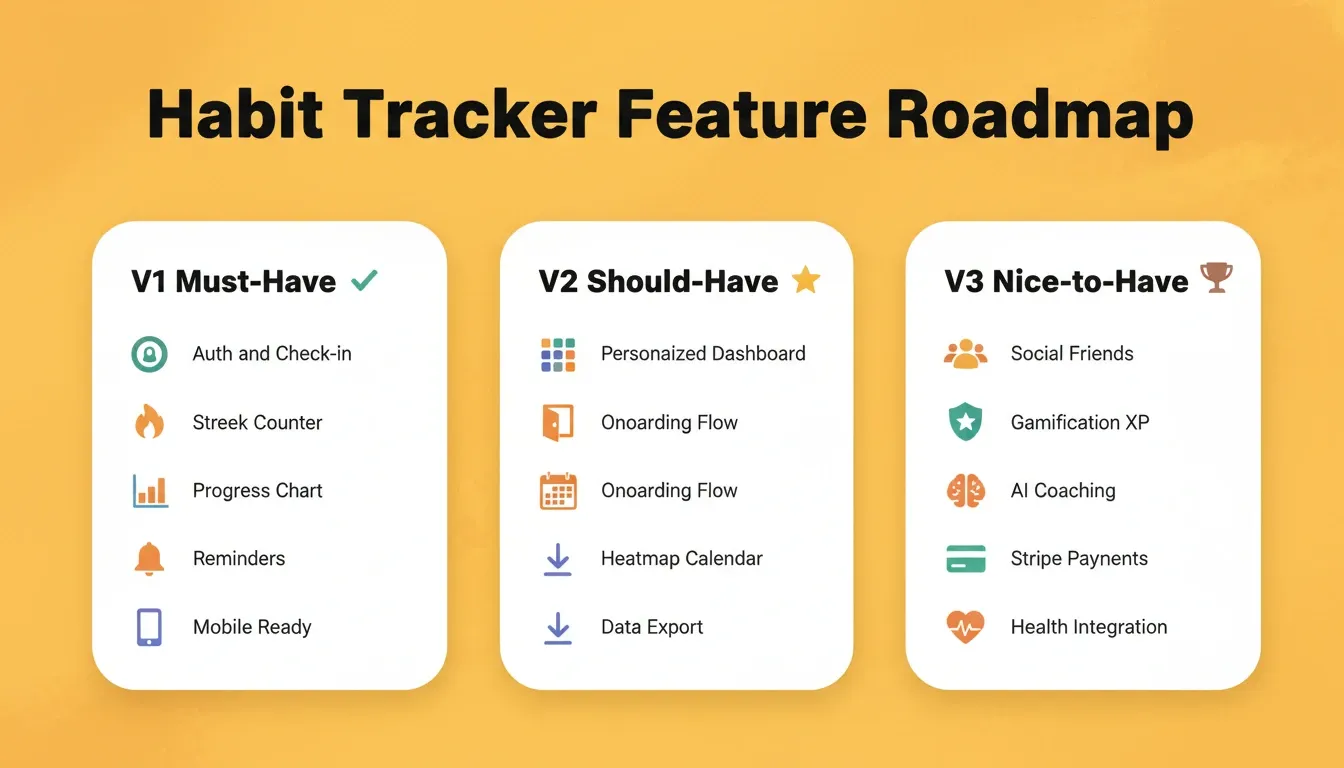
A common mistake is trying to build everything at once. Instead, here is a prioritized feature roadmap based on what drives user retention:
Must-Have (V1 — Launch with These)
-
User authentication (email and Google OAuth)
-
Habit creation and daily check-in
-
Streak counter with reset logic
-
Basic progress visualization
-
Push notification reminders
Should-Have (V2 — Add After First Users)
-
Personalized dashboard with completion ring
-
Onboarding flow with starter habits
-
Monthly heatmap calendar
-
Data export (CSV)
Nice-to-Have (V3 — Add for Retention and Revenue)
-
Social accountability and friend system
-
Gamification (XP, levels, badges)
-
AI coaching and adaptive goals
-
Premium subscription with Stripe
-
Apple Health and Google Fit integration
This phased approach maps directly to Rocket's recommended "build in phases" pattern from the official documentation. Each phase is a self-contained set of prompts you can run, test, and ship independently.
Your Habit Tracker Is One Good Prompt Away
The ten prompts in this guide cover every layer of a habit tracker app, from database schema to gamification to third-party integrations. AI-powered app development is only getting faster, and the builders who learn to write structured prompts today will ship production-ready products in hours, not months.
You have the blueprint. Type the first prompt, review the live preview, and iterate from there. Start building on Rocket.
Table of contents
- -What Makes a Habit Tracker Prompt Actually Work?
- -What the Community Says
- -Core Feature Prompts for Your Habit Tracker App
- -Prompt 1: Full-Stack Habit Tracker Generation
- -Prompt 2: Streak Logic and Gamification Layer
- -Prompt 3: Smart Reminders and Notifications
- -User Experience and Design Prompts
- -Prompt 4: Personalized Dashboard Layout
- -Prompt 5: Onboarding Flow for New Users
- -Prompt 6: Data Visualization and Progress Screens
- -How Rocket Turns These Prompts into a Live App
- -Step 1: Describe — Paste Your Prompt
- -Step 2: Generate — Live Preview in Seconds
- -Step 3: Refine — Three Ways to Iterate
- -Step 4: Launch — One Click to Production
- -Pricing
- -Advanced Feature Prompts That Set Your App Apart
- -Prompt 7: Social Accountability and Friends
- -Prompt 8: Gamification and Rewards System
- -Prompt 9: AI Coaching and Adaptive Goals
- -Prompt 10: Third-Party Connections
- -Common Prompting Mistakes and How to Avoid Them
- -How Long Does It Take to Build a Habit Tracker App with AI?
- -Habit Tracker App Features: What to Build First vs. Later
- -Must-Have (V1 — Launch with These)
- -Should-Have (V2 — Add After First Users)
- -Nice-to-Have (V3 — Add for Retention and Revenue)
- -Your Habit Tracker Is One Good Prompt Away