
The fastest path to a profitable micro SaaS in 2026 is picking an idea with proven demand signals, not guessing. This guide covers 25 AI micro saas ideas across five clusters with MRR benchmarks, a scoring framework, and build prompts.
What is a micro SaaS?
A micro SaaS is a small, focused software product, usually built and run by one or two people, that solves one specific problem for a narrow audience and earns recurring monthly revenue. Unlike traditional SaaS, it requires minimal capital, no large team, and can reach profitability within months.
What Separates Profitable AI Micro SaaS Products From Side Projects?
How do you pick a SaaS idea that actually makes money month after month? The AI SaaS market hit $182 billion in 2026, growing at 38.3% year over year (source). Yet roughly 70% of micro SaaS products earn under $1,000 MRR, while the top 1% cross $50K monthly.
The difference is not the code. It is whether the founder picked an idea with proven demand before starting to build. According to Freemius data, 95% of micro SaaS products reach profitability within their first year when founders validate a real problem for a specific niche audience.
| Revenue Stage | % of Products | What It Signals |
|---|---|---|
| Under $1K MRR | 70% | Still validating product-market fit |
| $1K to $5K MRR | 18% | Covering costs, buying time to grow |
| $5K to $50K MRR | 11% | Sustainable solo business |
| Above $50K MRR | 1% | Scaling with small teams |
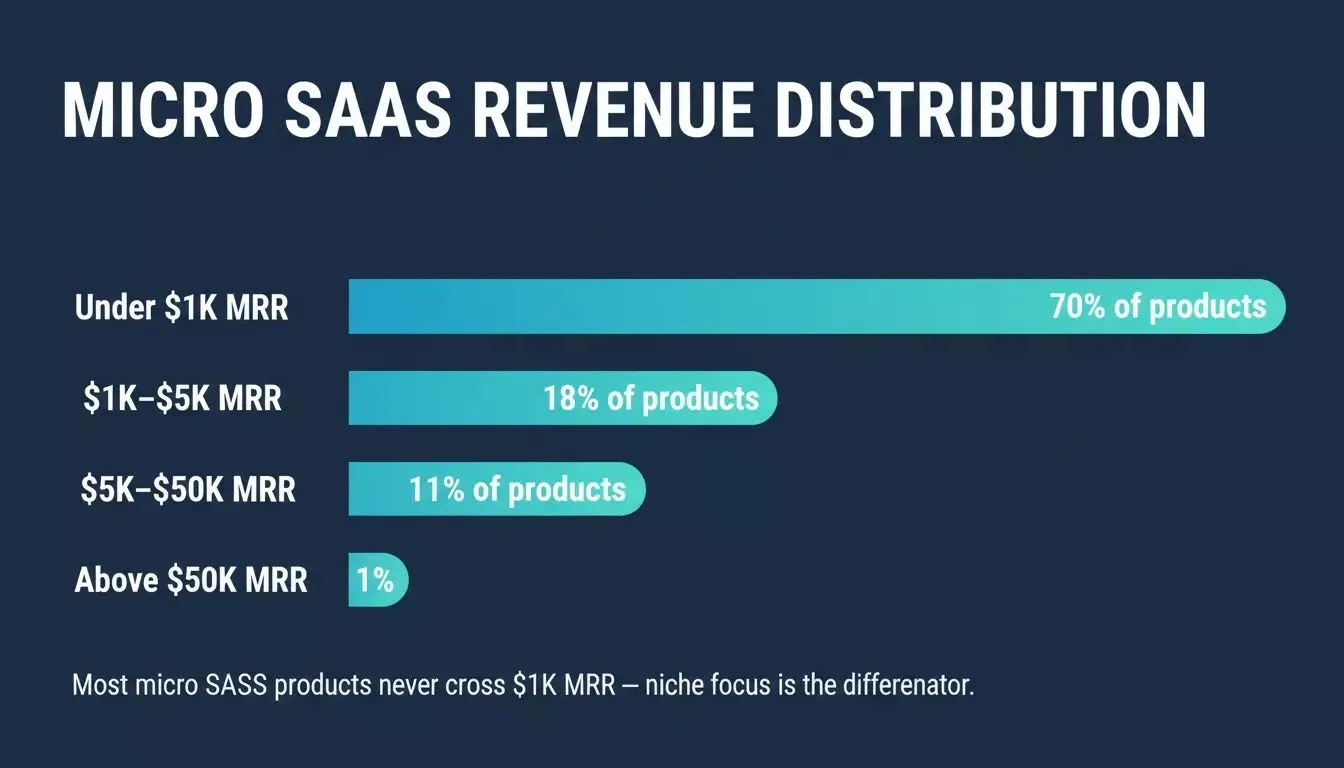
Micro SaaS revenue distribution: most products never cross $1K MRR. Niche focus is the differentiator.
John Rush, an indie hacker running 24 micro SaaS products, shared his approach in an interview featured by Freemius: "You can, and you should move between tools and talk to them as though they're your co-founders." That mindset of building fast, iterating faster, and letting user feedback guide every decision is what separates the top 1% from the 70% stuck below $1K.
The AI micro saas ideas below are organized into five clusters. Each one targets a niche with low competition, clear monetization, and customers already paying for partial solutions. Every SaaS idea includes the target customer, core features needed, a revenue signal showing proven demand, and a build prompt you can use to ship your first version this week.
Which AI Productivity Tools Are Hitting $5,000 MRR?
AI productivity tools solve problems that many professionals face daily, which makes recurring revenue straightforward. The monetization model is simple: charge a flat monthly fee or tiered pricing based on usage. These micro SaaS projects target busy marketers, sales teams, and small businesses that struggle with repetitive tasks.
Does an AI Meeting Notes Summarizer Still Have Room to Grow?
-
Target: Remote teams of 5 to 20 people and agencies managing multiple clients
-
Core features: Automatic transcript, tagged action items, Slack and Notion sync, weekly digest email
-
Revenue signal: Otter.ai has reportedly surpassed 25M users but targets enterprise pricing. Small teams needed a $19/month solution, not $30/seat
-
Build prompt: "Build a meeting notes app that records audio, generates summaries with action items, and sends them to Slack channels"
How Do AI Email Draft Writers Reach $3K to $8K MRR?
-
Target: Solo practitioners and small sales teams doing outbound
-
Core features: LinkedIn profile analysis, personalized cold email drafts, follow-up sequences, open tracking
-
Revenue signal: Lemlist has publicly reported crossing $25M ARR. Solo founders building simpler tools for freelancers and agencies hit $3K to $8K MRR within months
-
Build prompt: "Build an AI email writing tool that analyzes LinkedIn posts and generates personalized outreach emails with follow-up scheduling"
Why Is AI Social Content Scheduling a Strong Micro SaaS Idea?
-
Target: Creators, marketers, and small businesses managing LinkedIn posts, short videos, and multiple platforms
-
Core features: Multi-platform scheduling, AI caption generation, hashtag suggestions, performance dashboard in one place
-
Revenue signal: Buffer serves millions but lacks AI-native content generation. Products combining scheduling with AI writing hit Product Hunt top 5 monthly
-
Build prompt: "Build a social media scheduler that generates captions using AI, schedules across different platforms, and shows analytics in one dashboard"
Founders who want to validate demand before writing a single line of code consistently outperform those who build first and search for customers later.
Can an AI Project Status Report Generator Reach $49/Month Per Customer?
-
Target: Project management leads and agencies sending weekly client updates
-
Core features: Pulls data from Linear, Notion, or Jira via AI APIs. Generates professional PDF reports with charts. Automated reminders for team input
-
Revenue signal: Agencies pay $500 to $2,000/month for custom reporting. A $49/month tool that automates the entire process saves time and reduces hiring needs
-
Build prompt: "Build a project report generator that connects to project management tools and creates branded weekly status PDFs automatically"
How Does an AI Content Repurposer Reach $5K MRR With Under 200 Customers?
-
Target: Blog post writers, YouTube video creators, and podcast audio producers who need distribution across channels
-
Core features: Turns one piece of long-form content into LinkedIn posts, tweet threads, newsletter sections, and short video scripts
-
Revenue signal: Repurpose.io has reportedly grown past $2M ARR. Simpler, niche tools focusing on text-to-social (not video) reach $5K MRR with fewer than 200 customers
-
Build prompt: "Build a content repurposing tool that takes a blog post URL and generates social media posts for LinkedIn, X, and newsletters"
All five of these micro SaaS ideas share one trait: they solve a problem that comes back every single week for their target users, making monthly subscription retention natural.
Which Vertical AI SaaS Niches Have the Lowest Competition?
Vertical micro SaaS products grow at 18 to 32% annually compared to 12 to 15% for horizontal tools (source). The reason is clear: small businesses in specific industries pay more per user because the software speaks their language and handles their exact workflow without configuration.
Vertical SaaS consistently outgrows horizontal tools because niche focus commands higher prices and lower churn.
Is an AI Recipe Cost Calculator a Viable Restaurant SaaS Idea?
-
Target: Independent restaurants, bakeries, and cloud kitchens tracking food cost per dish
-
Core features: Ingredient price tracking across suppliers, recipe cost calculator with margin alerts, menu pricing suggestions, multiple currencies support
-
Revenue signal: Restaurant management software market growing 15% YoY. Simple recipe cost calculator tools on Product Hunt collect 500+ upvotes consistently
-
Build prompt: "Build a recipe cost calculator app for restaurants that tracks ingredient prices, calculates per-dish costs, and suggests menu prices for profitability"
Can an AI Legal Document Reviewer Work for Solo Practitioners?
-
Target: Freelancers, small business owners, and solo practitioners reviewing contracts without a lawyer on retainer
-
Core features: Upload PDF contracts, AI highlights risky clauses, plain-language explanations, comparison against standard terms, export notes
-
Revenue signal: Legal tech SaaS projected to reach $130B by 2027. Products like Legalese Decoder gained thousands of users by simplifying legal documents for non-lawyers
-
Build prompt: "Build a legal document reviewer that scans uploaded contracts, flags risky clauses, and explains legal terms in simple language"
Why Do Real Estate Agents Pay for AI Listing Description Generators?
-
Target: Real estate agencies, property managers, and Airbnb hosts who write dozens of listings per month
-
Core features: Analyze images of properties, generate SEO-friendly descriptions, adjust tone per platform, batch processing for agencies
-
Revenue signal: ListingAI and similar tools reportedly reached $2K MRR within weeks of launch. Real estate professionals pay for time savings on repetitive writing tasks
-
Build prompt: "Build a property listing generator that takes photos and key details then writes optimized descriptions for Zillow, Airbnb, and MLS platforms"
How Does an AI Patient Intake Form Processor Reduce Admin Costs?
-
Target: Small medical clinics, dental offices, and wellness studios still using paper forms
-
Core features: OCR scanning of paper forms, data extraction into digital records, appointment scheduling integration, HIPAA-compliant storage
-
Revenue signal: Healthcare AI SaaS growing 20% per year. Clinics pay $200 to $500/month for solutions that reduce admin hours from five per day to one
-
Build prompt: "Build a patient intake form processor that scans paper forms with OCR, extracts patient data, and stores records in a secure searchable database"
Building healthcare tools with Rocket's full-stack AI builder means authentication, database, and HIPAA-friendly storage patterns are generated from a single prompt.
What Makes an AI Personalized Learning Path Builder Profitable?
-
Target: Online course creators, corporate training managers, and education platforms
-
Core features: Assessment quiz, AI-generated personalized learning paths, progress tracking, certificate generation, Stripe integration for payments
-
Revenue signal: EdTech micro SaaS products with AI personalization hit App Store review velocity of 50+ reviews/month within 90 days of launch
-
Build prompt: "Build a personalized learning platform that assesses skill level, creates custom course paths, tracks progress, and issues completion certificates"
The pattern across vertical niches: building for one specific industry means less competition and higher willingness to pay per seat.
What Developer Tools Are Solo Founders Shipping for Recurring Revenue?
Developer tool micro SaaS projects represent some of the biggest opportunities for technical solo founders. Developers understand the problem deeply, know where to find customers (GitHub, Dev.to, Hacker News), and can validate by shipping a free tier fast. The monetization model is typically tiered pricing with a generous free plan that converts to $29 to $99/month for teams.
Can an AI API Documentation Generator Reach $4K MRR?
-
Target: Developers and small teams shipping APIs without dedicated technical writers
-
Core features: Scans code and API routes, generates OpenAPI docs, creates interactive examples, auto-updates on deploy
-
Revenue signal: ReadMe has raised over $40M validating the documentation tooling space. Solo-built alternatives focusing on simplicity and no-code setup reach $4K MRR serving agencies and freelancers
-
Build prompt: "Build an API documentation generator that reads code repositories, creates formatted docs with examples, and publishes a hosted documentation site"
Why Do Teams Pay for an AI Changelog Writer?
-
Target: Software teams and solo developers who need professional release notes without writing them manually
-
Core features: Connects to GitHub/GitLab, groups commits by category, generates a user-friendly changelog, posts to a blog or Slack
-
Revenue signal: Products like Changelogfy have reportedly hit $2K MRR. The combination of AI summarization plus distribution (email, Slack, widget) is what customers pay for
-
Build prompt: "Build a changelog tool that connects to GitHub, reads recent commits, generates human-readable release notes, and publishes them to a hosted page"
Is an AI Code Review Bot Viable for Small Development Teams?
-
Target: Startups and agencies with 2 to 10 developers who cannot afford senior code reviewers
-
Core features: PR analysis, security vulnerability flags, style consistency checks, natural language feedback on complex code blocks
-
Revenue signal: CodeRabbit hit significant traction on Product Hunt (2000+ upvotes). Focused alternatives for specific frameworks like React or Python find less competition
-
Build prompt: "Build an AI code review bot that analyzes pull requests, flags bugs and security issues, and posts natural language feedback as PR comments"
Developers who use vibe coding workflows to build their own tools report dramatically faster iteration cycles compared to traditional development approaches.
How Does an AI Natural Language Database Query Builder Eliminate Developer Dependency?
-
Target: Business analysts, marketers, and non-technical team members who need data from SQL databases
-
Core features: Natural language to SQL conversion, visual results with charts, saved query templates, user management with access controls
-
Revenue signal: Tools like AI2SQL have reportedly gained 10K+ users. Companies pay $49 to $199/month per team to eliminate developer dependency for simple data queries
-
Build prompt: "Build a database query tool where users type questions in natural language and get SQL results displayed as tables and charts"
What Gap Does an AI Error Log Analyzer Fill Between Free Tools and Enterprise Pricing?
-
Target: Indie developers and small teams who use Sentry or LogRocket but struggle to interpret patterns across thousands of logs
-
Core features: Ingests error logs from multiple data sources, clusters similar errors, suggests fixes with code examples, weekly summary reports
-
Revenue signal: Observability tools command premium pricing. A focused $29/month micro SaaS that just handles error pattern analysis fills a gap between free logging and $400/month Datadog
-
Build prompt: "Build an error log analyzer that ingests application logs, groups similar errors using AI, and suggests code fixes with priority ranking"
Developer micro SaaS journey: six steps from niche selection to continuous iteration
The right platform handles authentication, payments, and hosting so developers can focus on the AI model logic that makes their tool valuable. Adding Stripe payment integration to a Rocket-built app takes a single prompt and wires subscriptions directly to authenticated Supabase users.
Can Localization SaaS Still Generate Reliable Recurring Revenue?
Localization sits at the intersection of global e-commerce growth and AI language capabilities. Every company selling across borders needs translation, but existing solutions are either too expensive (human translators) or too generic (Google Translate). The opportunity is building AI-powered tools that handle specific content types for specific industries.
How Does an AI App Store Listing Localizer Find Customers Fast?
-
Target: Mobile app developers shipping to multiple countries who need App Store descriptions in 15+ languages
-
Core features: Keyword research per language, culturally adapted descriptions (not just translation), A/B test variants, bulk processing
-
Revenue signal: ASO tools charge $100 to $500/month. A focused localizer for app store listings at $39/month with no-code setup finds customers through developer communities fast
-
Build prompt: "Build an app store listing localizer that translates and culturally adapts iOS and Android app descriptions into multiple languages with keyword optimization"
Why Is an AI Subtitle Generator a Strong Localization Micro SaaS Idea?
-
Target: Content creators making short videos for TikTok, Reels, and YouTube Shorts in multiple languages
-
Core features: Auto-transcription, translate to 30+ languages, burn-in styled subtitles, batch processing for agencies, export in multiple formats
-
Revenue signal: Captions.ai and similar products have reportedly reached millions in revenue. Focused tools for specific creator niches (fitness, education, food) find loyal users who pay monthly subscription fees
-
Build prompt: "Build a subtitle generator for short videos that transcribes audio, translates into selected languages, and exports videos with burned-in captions"
What Makes an AI Knowledge Base Translator Reach Product-Market Fit Quickly?
-
Target: SaaS companies expanding internationally who need help with docs in new languages
-
Core features: Connects to Notion, Gitbook, or Zendesk, translates all articles maintaining formatting, handles updates incrementally, supports custom glossaries
-
Revenue signal: Localization platforms like Phrase charge enterprise rates. A simple tool focused only on knowledge base content at $79/month per language finds product-market fit quickly
-
Build prompt: "Build a knowledge base translator that syncs with documentation platforms, translates articles incrementally, and maintains original formatting and links"
How Does an AI Product Description Localizer Serve E-commerce Stores?
-
Target: Shopify and WooCommerce store owners selling to multiple countries, handling multiple currencies
-
Core features: Bulk product description translation, cultural adaptation (measurements, sizing, idioms), SEO keyword localization per market, CSV import/export
-
Revenue signal: E-commerce localization market growing 23.6% CAGR. Stores expanding from a single platform to international see 40%+ revenue increases after localizing listings
-
Build prompt: "Build an e-commerce product localizer that translates Shopify listings into target languages, adapts measurements, and optimizes descriptions for local search"
Can an AI Podcast Transcription and Translation Service Generate Reliable MRR?
-
Target: Podcasters expanding to international audiences, media companies repurposing podcast audio into written content
-
Core features: Full episode transcript, chapter markers, translate transcript to 20+ languages, generate blog post from episode, speaker identification
-
Revenue signal: Podcast production services charge $200+ per episode. An AI-powered subscription-based service at $29/month that handles the text side of podcast distribution generates reliable recurring revenue
-
Build prompt: "Build a podcast transcription service that converts audio files into formatted transcripts, translates them, and generates blog-ready summaries"
The localization category rewards products that handle one content type well for one industry, rather than trying to compete with horizontal translation platforms. Founders who have never shipped a mobile product before can use a no-code app builder to get a working iOS or Android version live without writing native code.
What Niche Automation Products Reach Profitability Fastest?
Niche automation micro SaaS products often reach profitability fastest because they replace manual tasks that specific professionals repeat daily. The user management overhead is low, the product is simple, and customers rarely churn because the tool becomes part of their daily workflow. Most founders building in this category start with a focused solution and expand features based on what users request.
Why Does an AI Invoice Scanner for Freelancers See 40%+ Annual Retention?
-
Target: Freelancers and solo practitioners handling receipts, invoices, and expense tracking manually
-
Core features: Photograph receipts, OCR extraction, categorize expenses, generate monthly reports, handle payment tracking with multiple currencies
-
Revenue signal: Expense tracking apps see 40%+ annual retention rates. Focused tools for specific professional groups (photographers, consultants) convert better than generic alternatives
-
Build prompt: "Build an invoice scanner for freelancers that photographs receipts, extracts data with OCR, categorizes expenses, and generates monthly financial reports"
How Does an AI Review Response Generator Serve a $5B Market?
-
Target: Restaurants, salons, clinics, and local service businesses managing Google and Yelp reviews
-
Core features: Monitor new reviews across platforms, generate professional responses matching brand voice, flag negative reviews for immediate attention, weekly reputation report
-
Revenue signal: Reputation management for small businesses is a $5B market. Simple tools focused only on response generation (not full reputation suites) find customers through Facebook groups and local business communities
-
Build prompt: "Build a review response tool for local businesses that monitors Google reviews, generates personalized replies matching the business tone, and sends daily alerts for negative feedback"
Can an AI Appointment Reminder System Pay for Itself Immediately?
-
Target: Dental offices, physiotherapy clinics, and wellness studios losing revenue to no-shows
-
Core features: Automated reminders via SMS and WhatsApp, customizable timing (24h and 1h before), reschedule links, no-show tracking analytics, calendar sync
-
Revenue signal: Clinics lose 5 to 10% revenue to no-shows monthly. A $49/month tool that reduces no-shows by 30% pays for itself immediately, making this a great idea with low competition
-
Build prompt: "Build an appointment reminder system for clinics that sends automated SMS and WhatsApp reminders, includes reschedule links, and tracks no-show rates"
Why Do Restaurants Stick With AI QR Code Menu Builders Long-Term?
-
Target: Restaurants and cafes wanting digital menus that update in real-time without reprinting
-
Core features: QR code generation, visual menu editor, real-time price updates, allergen labeling, multi-language support, analytics on popular items
-
Revenue signal: Post-pandemic QR menu adoption remained high. Simple builders charging $19 to $39/month per location see strong retention because switching costs are higher than the monthly fee
-
Build prompt: "Build a QR code menu builder for restaurants with a visual editor, real-time price updates, allergen tags, and analytics showing which dishes get the most views"
How Does an AI Job Post Generator Serve Small HR Teams?
-
Target: Small HR teams and hiring managers writing 10+ job descriptions per month
-
Core features: Generate job descriptions from role requirements, bias-free language checking, format for different job sites, track application conversions per listing
-
Revenue signal: Textio has raised over $60M, proving demand for better job copy. Focused tools for small businesses (not enterprise HR suites) at $29/month find customers through LinkedIn posts and HR communities
-
Build prompt: "Build a job post generator that creates optimized job descriptions from basic role requirements, checks for bias, and formats them for multiple job boards"
Every niche automation idea above targets customers who currently handle these complex tasks manually and would happily pay a flat monthly fee to never think about them again. Tracking what competitors in your niche charge is just as important as setting your own price; Rocket's Intelligence pillar helps founders decode competitor pricing signals automatically.
How Do You Go From SaaS Idea to Deployed MVP With a Single Build Prompt?
Most founders struggle with the gap between picking a SaaS idea and actually shipping a working product. Traditional paths require hiring developers, managing multiple tools, and spending months before a single customer can test the product. That time gap is where most ideas die.
Rocket is the vibe solutioning platform that combines strategic research, AI app building, and competitive intelligence into a single product. Here is how its three pillars work together for micro SaaS founders:
-
Solve validates before you build: Describe your micro SaaS idea in plain language. Rocket's Solve pillar runs market research, checks existing solutions, identifies the specific problem and niche audience, and produces structured reports with data, insights, and actionable recommendations, all before writing code.
-
Build ships production-ready software from simple prompts: Paste your build prompt. Rocket's Build pillar generates a full-stack Next.js web app or Flutter mobile app with authentication, user management, Stripe integration, Supabase database, and polished UI. The first version ships often in minutes, not months.
-
Intelligence monitors after launch: Once your micro SaaS is live, Rocket's Intelligence pillar monitors competitors continuously, delivering automated daily briefs, pricing change alerts, and trend signals in a live dashboard, without needing separate monitoring tools.
Unlike tools that focus solely on code generation, Rocket's positioning is that the research validating your direction becomes the foundation of what gets built; context carries forward across Solve, Build, and Intelligence tasks through cross-task context. Solo founders and small teams who launch fast on the platform report getting their first paying customers within days of deployment, not quarters.
Scoring Framework: How Do You Pick the Right AI Micro SaaS Idea in Ten Minutes?
With 25 AI micro saas ideas on the table, picking one requires a structured approach. Use this four-factor scoring matrix to evaluate each opportunity against your specific situation. Rate each factor from 1 to 5, multiply by the weight, and total the score. Ideas scoring 35+ are strong candidates for building this week.
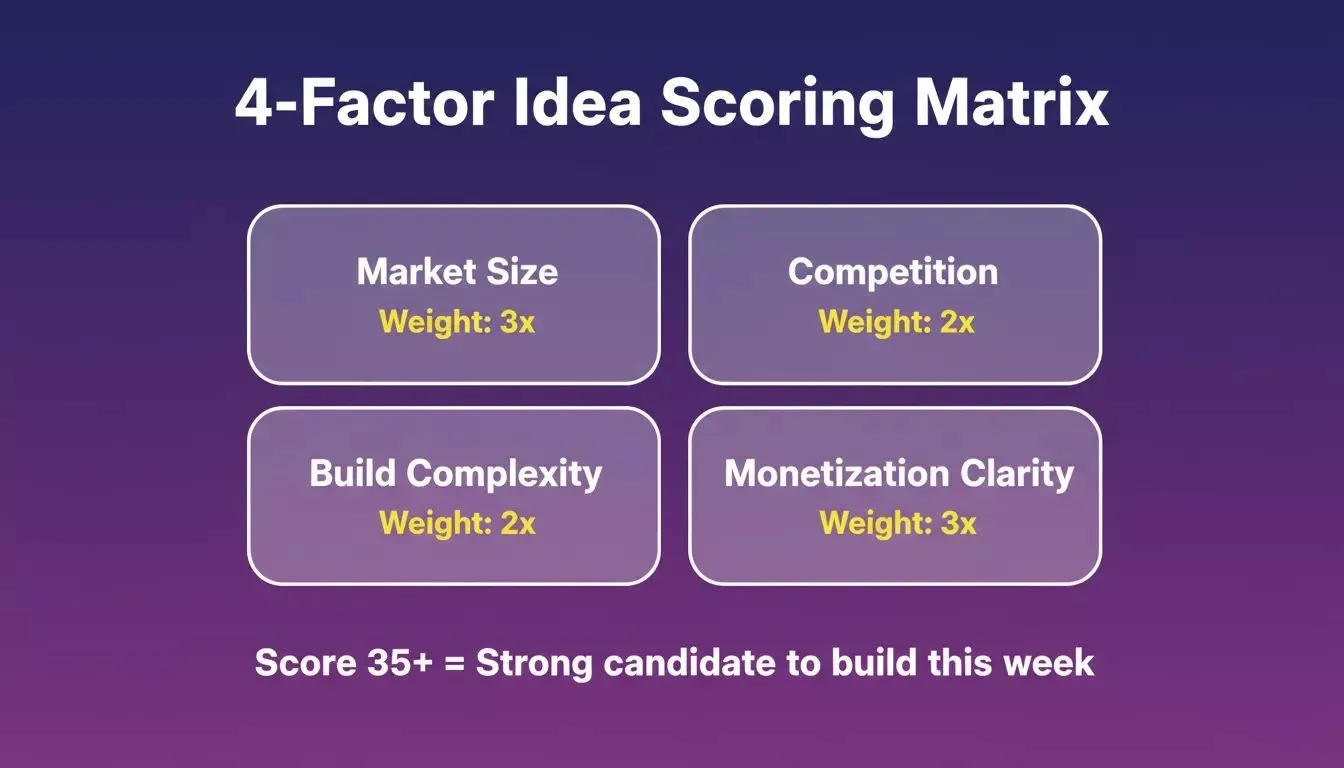
Use this four-factor matrix to score any micro SaaS idea in under ten minutes before committing to build.
How Does the Four-Factor Scoring Matrix Work?
| Factor | Weight | Score 1 | Score 3 | Score 5 |
|---|---|---|---|---|
| Market Size and Demand | 3x | Under 1,000 potential users | 10K to 100K addressable users | 100K+ with active communities |
| Competition Density | 2x | 5+ funded competitors | 2 to 4 competitors with gaps | No direct competitor for target |
| Build Complexity | 2x | Needs custom AI model training | Standard AI APIs with custom logic | Single AI API call with simple UI |
| Monetization Clarity | 3x | Users expect it free | Similar products charge $10 to $29/month | Users already pay $50+/month |
A recipe cost calculator for restaurants might score: Market (3x4=12) + Competition (2x5=10) + Complexity (2x4=8) + Monetization (3x4=12) = 42 points. That is well above the 35 threshold, confirming it as a strong pick.
The AI meeting notes summarizer might score: Market (3x5=15) + Competition (2x2=4) + Complexity (2x3=6) + Monetization (3x3=9) = 34 points. Still viable but competition is higher, so distribution strategy matters more.
Run your top three picks through this matrix. The numbers will show you which idea matches your skills, budget, and timeline for starting a profitable SaaS product.
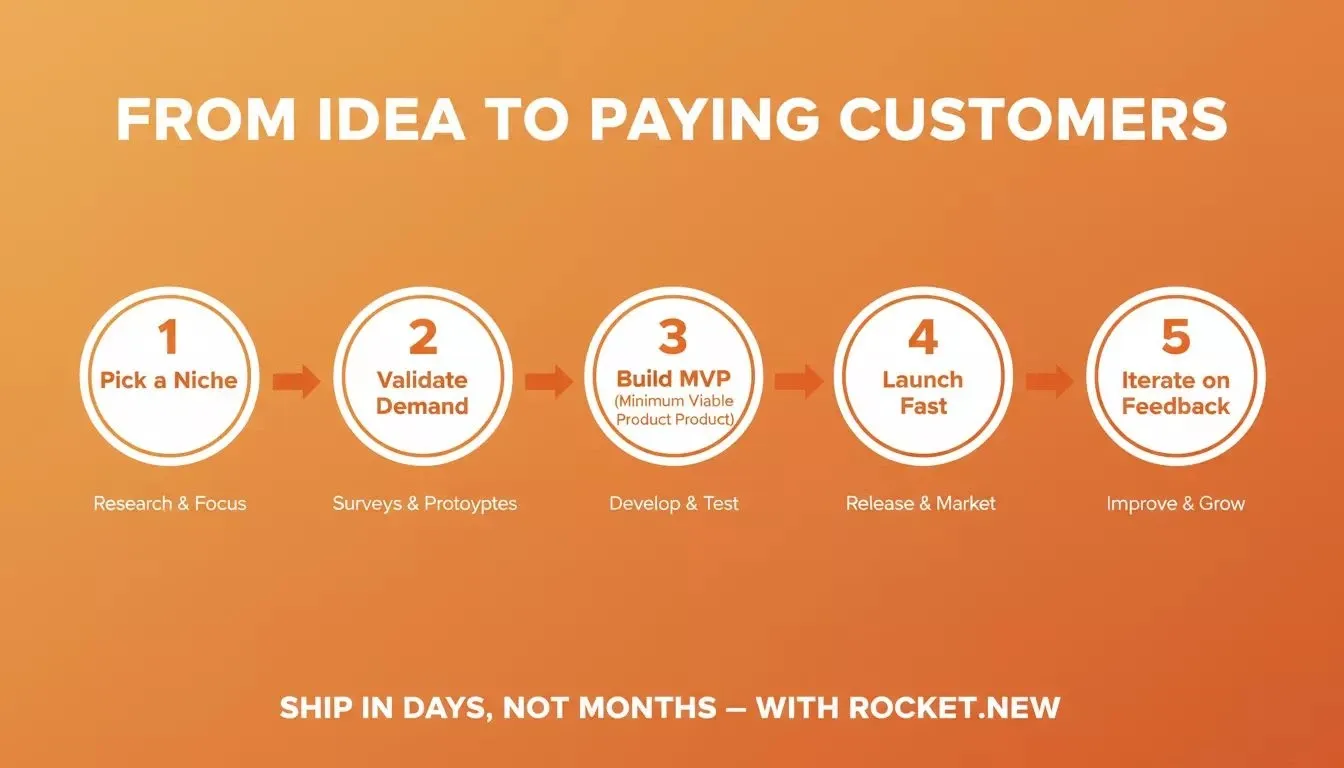
The five-step path every successful micro SaaS founder follows: validate first, build second, iterate always.
Your Next Move Starts With the Right Signal
The micro SaaS market rewards founders who pick ideas backed by evidence, not intuition. Every concept in this post comes with revenue data, customer profiles, and a build path because those signals are what separate products that grow from products that stall at zero users.
Score your top pick, validate it against real market data, and ship your first version before the week ends. Founders who want to move fast without managing infrastructure can explore how prompt engineering best practices help them get better outputs from every build prompt they write.
Every AI micro saas idea in this list targets a niche with proven demand, low build complexity, and customers already paying for partial solutions. Rocket.new is the vibe solutioning platform that gives you the fastest path from idea to deployed product: market research with Solve, full-stack code generation with Build, and competitive intelligence with Intelligence, all in one place. Start building your micro SaaS today and go from idea to paying customers in a single sitting.
Table of contents
- -What Separates Profitable AI Micro SaaS Products From Side Projects?
- -Which AI Productivity Tools Are Hitting $5,000 MRR?
- -Does an AI Meeting Notes Summarizer Still Have Room to Grow?
- -How Do AI Email Draft Writers Reach $3K to $8K MRR?
- -Why Is AI Social Content Scheduling a Strong Micro SaaS Idea?
- -Can an AI Project Status Report Generator Reach $49/Month Per Customer?
- -How Does an AI Content Repurposer Reach $5K MRR With Under 200 Customers?
- -Which Vertical AI SaaS Niches Have the Lowest Competition?
- -Is an AI Recipe Cost Calculator a Viable Restaurant SaaS Idea?
- -Can an AI Legal Document Reviewer Work for Solo Practitioners?
- -Why Do Real Estate Agents Pay for AI Listing Description Generators?
- -How Does an AI Patient Intake Form Processor Reduce Admin Costs?
- -What Makes an AI Personalized Learning Path Builder Profitable?
- -What Developer Tools Are Solo Founders Shipping for Recurring Revenue?
- -Can an AI API Documentation Generator Reach $4K MRR?
- -Why Do Teams Pay for an AI Changelog Writer?
- -Is an AI Code Review Bot Viable for Small Development Teams?
- -How Does an AI Natural Language Database Query Builder Eliminate Developer Dependency?
- -What Gap Does an AI Error Log Analyzer Fill Between Free Tools and Enterprise Pricing?
- -Can Localization SaaS Still Generate Reliable Recurring Revenue?
- -How Does an AI App Store Listing Localizer Find Customers Fast?
- -Why Is an AI Subtitle Generator a Strong Localization Micro SaaS Idea?
- -What Makes an AI Knowledge Base Translator Reach Product-Market Fit Quickly?
- -How Does an AI Product Description Localizer Serve E-commerce Stores?
- -Can an AI Podcast Transcription and Translation Service Generate Reliable MRR?
- -What Niche Automation Products Reach Profitability Fastest?
- -Why Does an AI Invoice Scanner for Freelancers See 40%+ Annual Retention?
- -How Does an AI Review Response Generator Serve a $5B Market?
- -Can an AI Appointment Reminder System Pay for Itself Immediately?
- -Why Do Restaurants Stick With AI QR Code Menu Builders Long-Term?
- -How Does an AI Job Post Generator Serve Small HR Teams?
- -How Do You Go From SaaS Idea to Deployed MVP With a Single Build Prompt?
- -Scoring Framework: How Do You Pick the Right AI Micro SaaS Idea in Ten Minutes?
- -How Does the Four-Factor Scoring Matrix Work?
- -Your Next Move Starts With the Right Signal