Lead scoring assigns numerical values to prospects based on fit and behavior. This guide covers model types, attribute selection, data quality, score decay, and how live company signals make scoring sharper over time.
How do sales teams know which leads are ready for a conversation and which ones still need time to warm up?
That is the core idea behind lead scoring: assigning each lead a numerical score based on how closely they match your ideal buyer and how actively they engage with your brand.
According to HubSpot's 2024 State of Sales Report, 53% of sales reps say selling got harder over the past year. Getting a reliable score on each lead changes that equation.
Marketing and sales teams that get this right stop treating their pipeline as one flat list. Qualified leads rise to the top, cold contacts wait their turn, and sales reps spend their time on the accounts most worth pursuing.
This blog builds that approach from scratch covering how scoring models are structured, how to calibrate them, and what makes a lead scoring model your team will actually trust.
How Does Prospect Scoring Work?
Understanding lead scoring starts with a straightforward question: what makes one prospect more likely to buy than another? The answer falls into two categories: who a lead is, and what they do. Both dimensions form the foundation of every scoring system, and neither alone tells the complete story.
The "who they are" side comes from firmographic and demographic data. The "what they do" side comes from behavioral data. Getting both right separates a scoring process sales teams use every day from one that sits untouched in the CRM.
Firmographic and Behavioral Data: The Two Dimensions of Every Scoring System
Lead scoring context starts here: most scoring models mix explicit data (firmographic attributes the lead submits directly) with implicit data (behavioral signals your system observes). Here's what goes into each:
-
Job title and seniority: Does the contact have purchasing authority? A VP of Operations scores differently from an analyst at the same company size.
-
Company size: A 500-person business typically has a different buying process than a 10-person startup. Company size is a direct fit signal.
-
Industry: If you serve SaaS companies specifically, a contact at a regional logistics firm scores lower by default.
-
Website visits: Which pages did this lead view, and how many times? Multiple pricing page visits signal something very different from one quick blog read.
-
Demo requests: One of the highest-intent behavioral signals in most scoring models. Sales teams treat demo requests as a strong indicator that a contact is close to a decision.
-
Email engagement: Click-through rates, content downloads, and webinar attendance all measure interest level through the buying process.
-
Geographic location: If your product serves specific markets, location adds or subtracts points depending on fit.
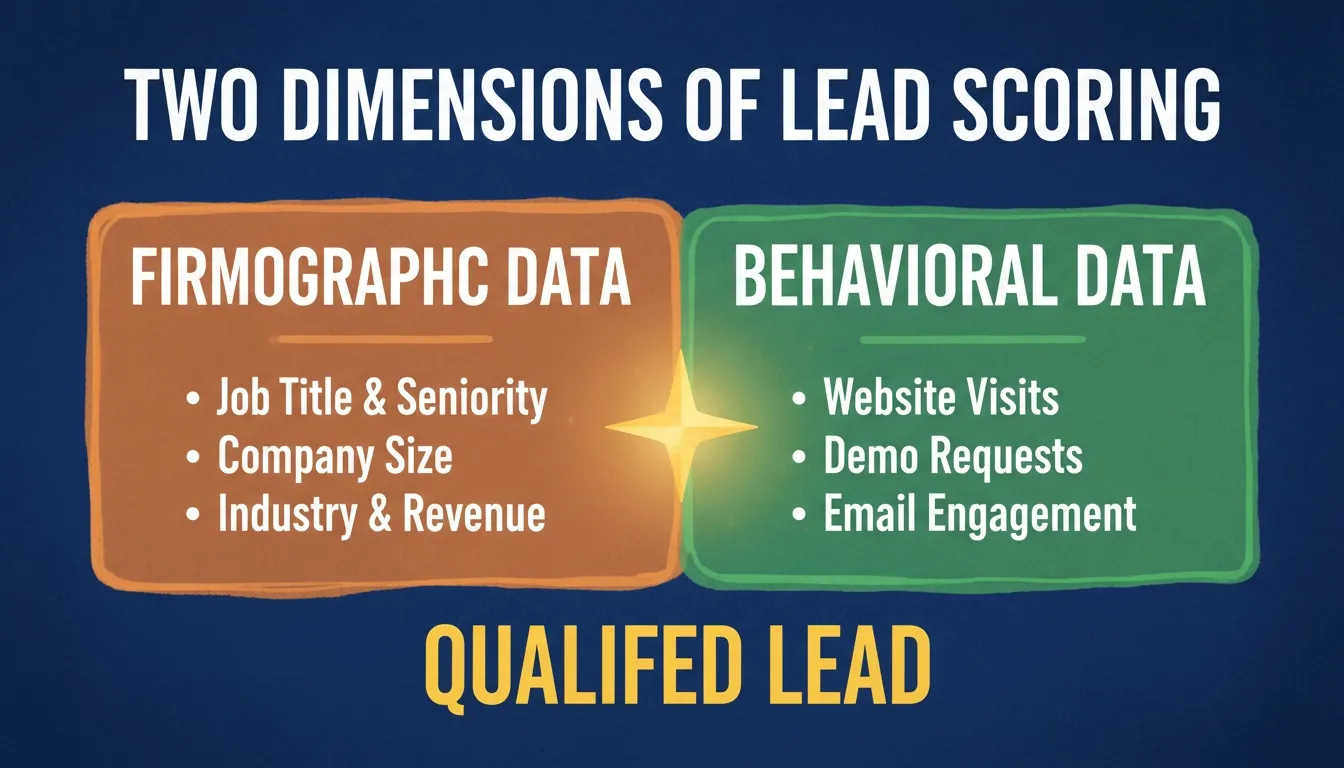
Two-dimensional lead qualification model showing firmographic fit and behavioral engagement as the two scoring axes, with high-fit high-engagement leads routed to sales.
| Data Type | Category | What It Reflects |
|---|---|---|
| Job title, company size, industry | Firmographic (explicit) | Fit with your ideal customer profile |
| Website visits, demo requests, email opens | Behavioral (implicit) | Intent and engagement level |
| Content downloads, webinar attendance | Behavioral (implicit) | Stage in the buying process |
| Geographic location, company revenue | Firmographic (explicit) | Likelihood of becoming a qualified lead |
A scoring system that ignores either dimension sends sales reps after the wrong people: either chasing engaged contacts who are the wrong fit, or ignoring well-matched companies that simply have not warmed up yet.
Why Do Reps Lose Trust in Scoring Systems?
The mistrust usually starts in one of three places. Scoring criteria were set by marketing alone, without the sales team reviewing which attributes actually correlated with closed deals. The behavioral data only covers part of the buying process. Or the model never gets recalibrated after launch and slowly drifts from reality.
The fix is simpler than it sounds: get sales teams into the room before building the attribute list, review closed-won deals to find real patterns, and commit to quarterly calibration. Marketing qualified leads cannot do their job if the rep on the receiving end does not believe in the number.
What Do Common Scoring Models Actually Look Like?
Most teams start with one of several standard approaches and refine from there. Knowing the common lead scoring models helps you pick a starting point that fits your current scale, and recognize when it's time to graduate to something more powerful.
The core split is between manual scoring and predictive scoring. Both have real strengths. The gap between them mostly comes down to data volume, technical resources, and how much you want machine learning in the loop.
For a deeper look at how sales app development can support these workflows, the underlying tooling matters too.
Manual Scoring Versus Predictive Scoring
Manual lead scoring means your team defines the scoring criteria, assigns point values, and updates the model by hand. It is fast to set up and easy to explain to sales teams. The downside: it depends on human judgment about which attributes matter most, and that judgment can drift. Manual lead scoring also needs someone to actively recalibrate the model on a regular schedule, otherwise the scoring criteria slowly lose contact with reality.
Predictive lead scoring uses machine learning to scan historical conversion data: closed-won deals, lost deals, disqualified contacts, and identify the patterns that actually predicted outcomes. The resulting scoring models update automatically as new data comes in. Automated lead scoring like this tends to outperform manual approaches once you have enough history to train on.
| Manual Scoring | Predictive Scoring | |
|---|---|---|
| Setup time | Low to medium | Higher, requires historical conversion data |
| Accuracy at launch | Moderate | High once enough conversions are logged |
| Maintenance | Manual recalibration required | Auto-updates with new data |
| Machine learning | No | Yes |
| Best for | Teams early in the process | Teams with ample historical data |
A Real-World B2B Scoring Example
Say you run a B2B software company targeting mid-market operations teams.
Here is a simplified lead scoring model:
-
Company size 100-500 employees: +15 points
-
Job title includes "Operations" or "VP": +20 points
-
Visited pricing page: +25 points
-
Demo requests submitted: +30 points
-
Downloaded a case study: +10 points
-
Email click-throughs above 3 over 30 days: +10 points
-
Engagement scores at zero for 45+ days: -15 points (score decay)
-
Used a personal email address: -10 points (negative scoring)
A contact hitting 60+ gets routed to the front of the rep queue. According to Salesforce, a software company implementing AI-based lead scoring tools saw a 27% increase in sales. The gains come from consistently calling the right contacts at the right time.
What Scoring Software Should You Know About?
Most lead scoring software sits inside a broader CRM or marketing automation platform. HubSpot, Salesforce, and Marketo all include native scoring tools. Standalone lead scoring tools also exist for teams that want more control over data sources or need to pull in third-party intent signals. The right lead scoring software depends on where your data lives and how much customization your workflow needs.
The scoring models that earn rep trust are the ones sales teams helped shape. Their skepticism about initial scoring criteria is genuinely useful: it tells you which attributes they do not believe in, which is exactly what you need to know before the model goes live.
How to Build a Scoring Model Step by Step
A lead scoring model that holds up requires getting the foundation right first. Start with your ideal customer, work outward, and build correction mechanisms in from the start.
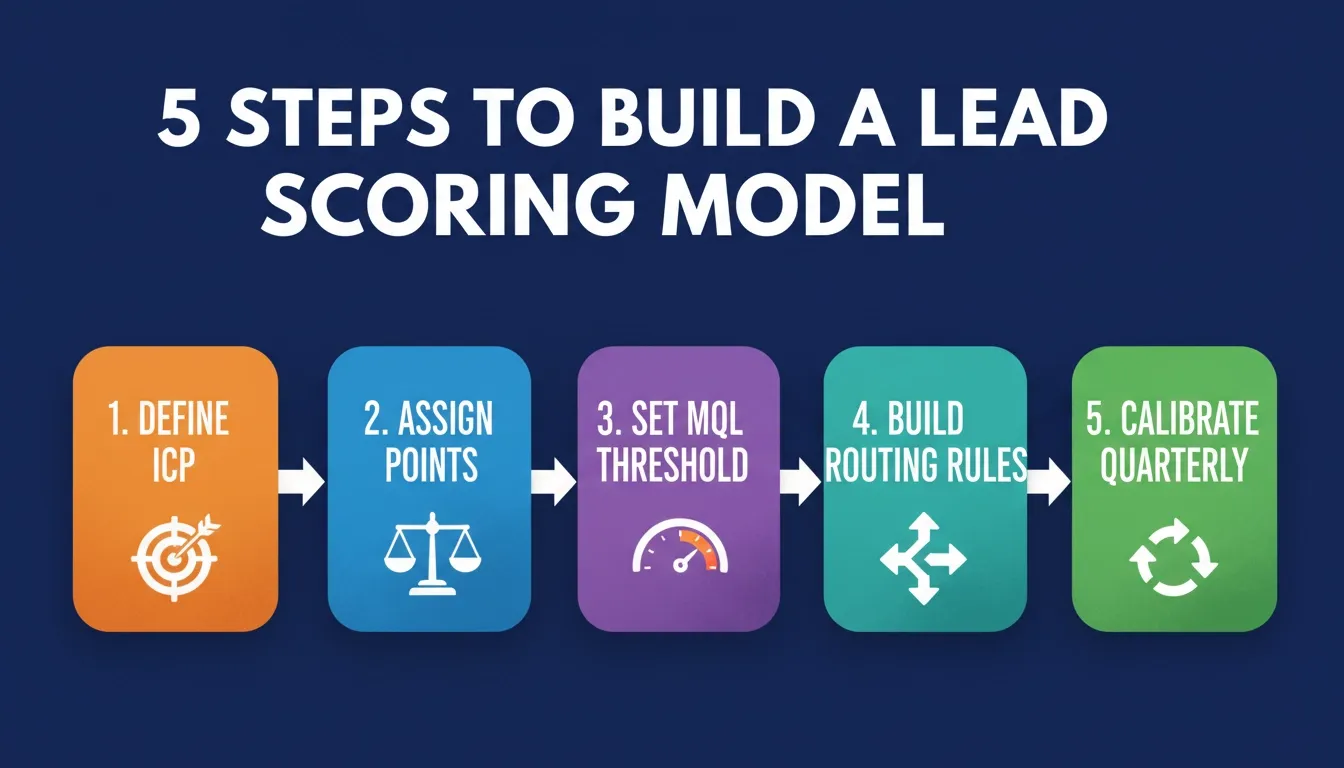
The build involves five moves: define your attribute list, assign point values, set a threshold, establish routing rules, and maintain the system over time. Miss any one of them and the gaps compound.
Step 1: Define Your ICP and Scoring Criteria
Pull your last 30 closed-won deals and look for patterns. What was the contact's job title? The company size? How many weeks from first touch to close? Which content did they engage with before submitting demo requests? The scoring criteria you set should reflect what actually happened in the data, not what you hope will happen.
Cross-reference with sales team input and historical data from your CRM. McKinsey research on B2B hybrid selling found that companies restructuring around a formal lead-scoring system saw a twofold increase in SDR lead-to-appointment conversion rate. That result comes from getting the attribute list right, not from adopting a particular scoring platform.
Key attributes for most B2B scoring models:
-
Firmographic: job title, company size, industry, company revenue, geographic location
-
Behavioral: website visits, content downloads, email engagement, demo requests, webinar attendance
-
Negative: spam-like form behavior, non-target industries, unsubscribes, extended low engagement periods
Step 2: Assign Point Values to Behaviors and Attributes
Once you have your attribute list, assign point values. The clearest method: calculate the close rate for each attribute separately, then compare it to your overall lead-to-customer conversion rate. If your baseline is 5% and contacts who submit demo requests close at 40%, that action is 8x more predictive, so give it proportionally more weight in the model.
Most scoring systems use a 0-100 range. Set clear tiers: cold leads (0-30), warm leads (31-59), and sales-ready contacts (60+). The exact numbers matter less than consistency, as long as your sales teams and marketing teams agree on what each tier means.
Here is the full build workflow for a lead scoring model:
Step 3: Set the MQL Threshold and Build Routing Rules
The MQL threshold is the score at which a contact officially becomes a marketing qualified lead and gets routed to a sales rep. Too low, and sales reps get buried in contacts who are not ready. Too high, and good prospects sit in nurture too long and go cold.
Most teams find the right threshold through structured negotiation between marketing departments and sales. Work backward from your conversion data: at what historical score did contacts typically close? Set the MQL threshold just below that range. Build routing rules into your CRM so handoffs happen automatically when a contact crosses the threshold. This removes human delay from the lead scoring process.
Score Decay and Negative Scoring
A score that only goes up becomes useless fast. Score decay automatically reduces a contact's score when they go quiet. If a lead has not opened an email, visited the site, or interacted with any content in 45 days, subtract points. The rate of decay should match your typical sales cycle length.
Negative scoring applies point deductions for clear disqualification signals. A personal email address used on a gated form, an unsubscribe, or a cluster of careers page visits are all worth subtracting points for. Lead scoring best practices consistently flag negative scoring as one of the most underused parts of any model. Teams build the positive side and forget to actively penalize the clear disqualifiers.
Implement lead scoring as a living system. Successful lead scoring system management means reviewing which attributes actually predicted conversions each quarter. Effective lead scoring gets sharper the more consistently you calibrate it. Scoring models reviewed quarterly after 12 months have meaningfully sharper criteria than those left untouched.
Understanding how business workflow automation using AI can support your scoring pipeline is also worth exploring, as automated triggers tied to score thresholds reduce manual handoff delays significantly.
Why Does Data Quality Make or Break Your Scores?
A scoring model is only as accurate as the data behind it. You can set perfect scoring criteria and still end up with numbers sales teams ignore, because the underlying data is incomplete, outdated, or too narrow to capture what actually predicts conversion.
Most teams discover this a few months after launch. High-scoring leads are not converting at the expected rate. The scoring models look fine. The criteria look right. The issue is almost always the data quality.
Where Do Most Scoring Systems Lose Accuracy?
The common failure points:
-
Stale CRM records: Job titles change, companies get acquired, contacts switch teams. If your model pulls a job title entered 18 months ago, the score for that contact could be significantly off.
-
Narrow behavioral data: If your scoring system tracks email clicks but not website visits, or tracks page views but not content downloads, you are scoring on an incomplete picture of the buying process.
-
No signals from outside your ecosystem: Most CRM-based lead scoring tools only see what happens inside your own platform. They miss the signals happening elsewhere: competitive research activity, category-level buying behavior, or changes in a company's hiring that might predict upcoming budget decisions.
-
Static criteria in shifting markets: A lead scoring model built during a strong market may score leads very differently than those same contacts behave in a tighter buying cycle. When market conditions shift, static scoring criteria gradually drift from reality.
The result of these data gaps: longer sales cycles, declining conversion data, and reps who quietly stop looking at the scores. You can learn more about how real-time company signals close these gaps at Rocket Intelligence.
What Role Do Intent Signals Play in a Modern Scoring Model?
Intent signals capture what a prospect is researching, not just on your site, but across the web. A company actively comparing vendors on review platforms, consuming competitive content, or evaluating solutions in your category is showing high intent even before they fill out a form.
Behavioral signals like these sharpen predictive lead scoring considerably. Instead of waiting for a prospect to arrive at your pricing page before flagging high intent, you can assign elevated scores to companies clearly in an active buying process, earlier in the sales cycle, when outreach timing matters most. Predictive scoring models that incorporate intent data convert at measurably higher rates than those running on first-party data alone.
Most lead scoring software that includes intent data tracks behavioral signals like review site activity, topic cluster engagement, and third-party content consumption. For teams already running predictive lead scoring, adding intent signals is consistently one of the highest-return improvements available.
Data quality sits at the center of every meaningful scoring improvement. Adding intent signals, keeping records current, and calibrating regularly against actual conversion data produces a scoring approach that gets sharper every quarter.
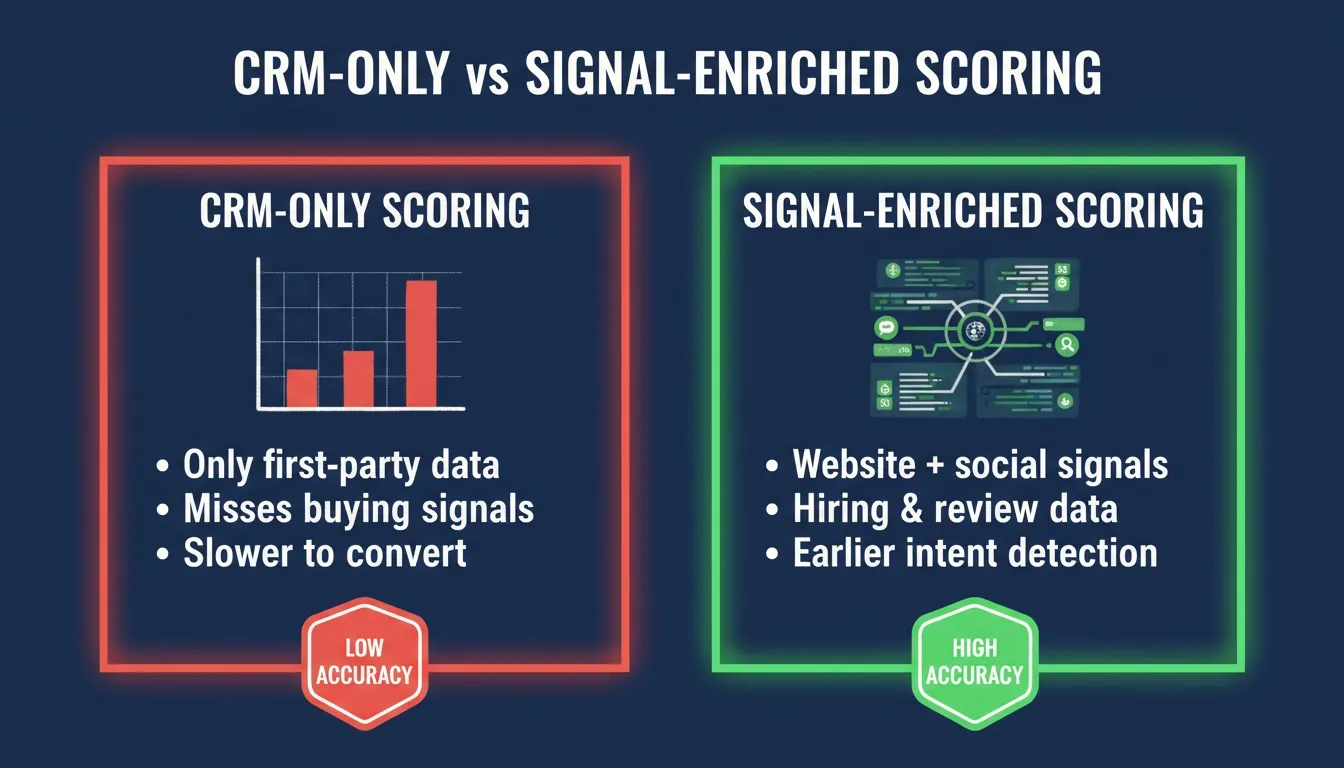 Side-by-side comparison of traditional CRM-only scoring versus signal-enriched scoring, showing the data coverage gap and its impact on conversion accuracy.
How Rocket Intelligence Turns Company Signals Into Live Score Inputs
Most scoring tools improve over time by analyzing what already happened: closed deals, lost deals, historical patterns. What they cannot do is show you what is happening right now at the companies in your pipeline. That is the gap Rocket Intelligence is built to close.
Rocket Intelligence monitors every public platform a company operates on, continuously, and interprets what any change in behavior means for your specific business context. It is not a monitoring dashboard. It is an interpretation layer that makes raw company signals actionable.
What Does Rocket Intelligence Surface That Your CRM Cannot?
Rocket tracks six signal categories per company: website changes (messaging shifts, pricing updates, new feature pages), social media activity across LinkedIn, X, Reddit, Instagram, and YouTube, press and news coverage, review platform sentiment on G2 and Glassdoor, hiring patterns and executive activity, and ad spend shifts across LinkedIn, Meta, and Google.
The difference between this and a standard lead scoring system is interpretation. A pricing page update in isolation is noise. That same update, combined with new enterprise-focused job postings, defensive G2 responses about security, and a shift in social content toward compliance messaging, points to a strategic repositioning move weeks before any announcement confirms it.
Sales teams that use Rocket Intelligence before high-stakes deals get account context grounded in what the company is actually doing right now, not what was logged in the CRM six months ago.
How Do Sales Teams Use Rocket Before a High-Stakes Deal?
The intelligence layer works alongside your existing lead scoring tools rather than replacing them. Your scoring model tells you a contact is ready. Rocket Intelligence tells you what that company is doing right now, whether they are expanding into new product lines, facing competitive pressure, or signaling budget availability through hiring velocity.
For sales reps preparing for an enterprise meeting, that context changes how the first call lands. Effective lead scoring gets a contact to the top of the queue. Rocket Intelligence makes sure the rep does not walk into that conversation with stale account context.
Teams that pair a solid lead scoring model with live company signals report more productive first calls and shorter paths to close. See a detailed example of how this works in practice at what Rocket Intelligence shows sales teams before a high-stakes deal.
Scoring models and real-time company intelligence are not competing approaches. One tells you who to call. The other tells you what to say when you get there.
Making Lead Scoring Work for Your Team
Scoring models work best when they are treated as living systems rather than one-time projects. Teams that get consistent results start simple, with a handful of firmographic and behavioral attributes, a clear MQL threshold, and a quarterly review process, then build from there as the data matures and the model proves itself.
Getting sales teams and marketing teams genuinely aligned on what each score tier means in practice is often more impactful than getting the initial point values exactly right. Pick your attributes, launch the model, listen carefully to what sales reps report about the contacts coming through, and adjust. The scoring approach gets sharper the more you use it.
Ready to build a smarter lead scoring system and launch faster with AI-powered workflows? Start here: Rocket.new
Table of contents
- -How Does Prospect Scoring Work?
- -Firmographic and Behavioral Data: The Two Dimensions of Every Scoring System
- -Why Do Reps Lose Trust in Scoring Systems?
- -What Do Common Scoring Models Actually Look Like?
- -Manual Scoring Versus Predictive Scoring
- -A Real-World B2B Scoring Example
- -What Scoring Software Should You Know About?
- -How to Build a Scoring Model Step by Step
- -Step 1: Define Your ICP and Scoring Criteria
- -Step 2: Assign Point Values to Behaviors and Attributes
- -Step 3: Set the MQL Threshold and Build Routing Rules
- -Score Decay and Negative Scoring
- -Why Does Data Quality Make or Break Your Scores?
- -Where Do Most Scoring Systems Lose Accuracy?
- -What Role Do Intent Signals Play in a Modern Scoring Model?
- -How Rocket Intelligence Turns Company Signals Into Live Score Inputs
- -What Does Rocket Intelligence Surface That Your CRM Cannot?
- -How Do Sales Teams Use Rocket Before a High-Stakes Deal?
- -Making Lead Scoring Work for Your Team