
This guide explains how startups can build and launch a SaaS MVP quickly using structured planning, validation, and automated development workflows powered by Rocket.new. It covers MVP concepts, feature prioritization, metrics tracking, and product-market fit strategies. Readers learn how to move from idea to scalable SaaS product while minimizing development costs and accelerating early growth.
Introduction to SaaS MVP Development
Software-as-a-service businesses continue to expand as organizations shift toward subscription-based software. Many founders want to create products quickly without spending months writing infrastructure code. A SaaS MVP approach allows teams to test ideas early, validate demand, and refine product direction before making large investments.
Modern platforms like Rocket.new help startups build faster by converting prompts into working applications, with backend services, authentication, and deployment workflows already configured. When teams combine structured planning, customer validation, and automated development tools, they can move from idea to launch in weeks instead of months.
What Is a SaaS MVP and Why It Matters
A SaaS MVP is the smallest functional version of a SaaS product that solves a defined problem for a target market and includes only the core features required to validate demand. It focuses on essential functionality rather than complex workflows.
Startups often struggle because they build large products before testing demand. Research shows that about 42% of startups fail due to insufficient market need, underscoring the importance of validating product-market fit early.
SaaS MVP vs Minimum Viable Product Concepts
The term minimum viable product is widely used across industries. In the SaaS business, the concept evolves into several stages:
MVP (Minimum Viable Product)
A basic version was released to early adopters to collect user feedback, monitor user behavior, and measure early conversion rates.
MMP (Minimum Marketable Product)
A more refined version with improved onboarding, design polish, and better user engagement, often designed for a broader target audience reach.
MAP (Minimum Awesome Product)
A mature stage where advanced, important features and optimized user retention strategies support scaling.
Each stage plays a role in achieving product-market fit, reducing development costs, and aligning the product strategy with the real market demand.
Why SaaS Startups Depend on MVP Strategy
Many saas startups operate with limited resources, tight timelines, and uncertain demand. A SaaS MVP helps founders quickly test their business model and determine whether potential customers will pay for the solution.
Avoiding the Common Startup Failure Pattern
Industry data indicates that more than 90% of SaaS startups fail within three years, often due to weak demand validation or poor retention strategies.
A structured MVP-first development process allows companies to:
- Validate core value proposition
- Collect real feedback
- Reduce development time
- Adjust pricing and recurring billing
- Identify the right target audience
This iterative approach aligns with lean startup thinking, where founders launch quickly, learn from users, and refine continuously.
Role of Rocket.new in SaaS MVP Development
Rocket provides an AI-assisted platform that accelerates development workflows. Instead of assembling multiple tools, teams can create functional applications from prompts, templates, and integrations.
The platform supports:
- Authentication setup
- Backend APIs
- Database configuration
- UI generation
- Deployment pipelines
These capabilities help teams reduce development costs and focus on key areas such as product market fit, user engagement, and customer lifetime value.
When Rocket Makes the Most Impact
Rocket.new is especially valuable when:
- A SaaS company wants a basic version of a saas product quickly
- A startup lacks a large in-house team
- Founders want to validate market fit before full development
- Teams need scalable deployment and scalable architecture
Step-by-Step Guide: Building SaaS MVP with Rocket
Step 1: Define the Target Market and Customer Problem
Every SaaS business starts by identifying the target market and understanding user behavior patterns. The planning phase should map:
- Customer pain points
- Current solutions
- Expected outcomes
- Pricing expectations
Market validation interviews with potential users help confirm whether the idea solves a real problem. A strong core value proposition increases the likelihood of achieving product-market fit.
Example
A startup building an HR analytics app interviews HR managers and discovers that automated retention dashboards are missing in many mid-size organizations. This insight shapes the product strategy.
Step 2: Identify Core Features for the First Release
A SaaS MVP should include only essential features that deliver immediate value. Teams should avoid feature expansion until real user feedback confirms demand.
Typical core features for early releases include:
- User authentication
- Dashboard interface
- Data upload capability
- Reporting modules
- Payment gateway for recurring billing
Rocket templates enable founders to rapidly configure core features, shortening initial development time.
Example
A subscription analytics SaaS product launches with only data tracking and performance dashboards rather than complex forecasting models.
Step 3: Build the SaaS MVP Using Rocket Templates
Rocket enables teams to create applications through AI prompts, code generation, and automation. Founders define the solution requirements, connect third-party services, and deploy the application within hours.
The workflow typically involves:
- Create project workspace
- Select SaaS template
- Configure database schema
- Generate Essential UI screens
- Add authentication and billing
- Deploy to a cloud environment
Build your MVP with Rocket.new
Here is how Rocket enables users to select key screens for their application.
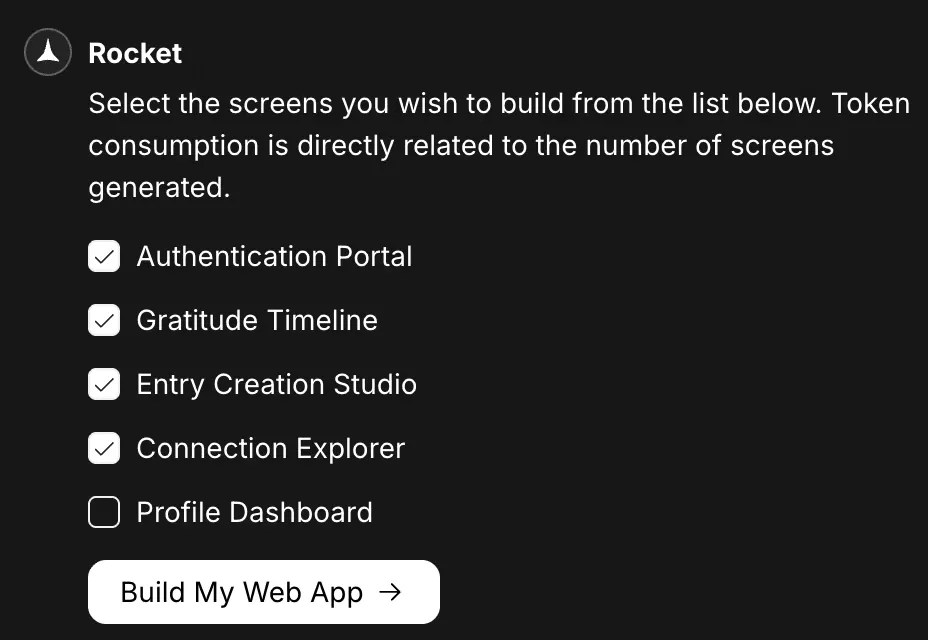
Moreover, Rocket's template library helps developers launch applications faster by reducing setup effort and lowering token usage. Pre-built templates enable teams to start projects quickly and focus on building features rather than configuring infrastructure.
“With Rocket.new’s template library, you can cut token usage by up to 80% and start building faster than ever.” - LinkedIn
This structured development process simplifies infrastructure setup and allows teams to focus on validating the market.
Step 4: Launch to Early Users and Trial Users
Once the SaaS MVP is deployed, the founders invite early users, trial users, and early adopters to test the system. During this phase, companies collect:
- Behavioral analytics using Google Analytics
- Feature adoption patterns
- User feedback via in-app surveys
- Engagement metrics such as session frequency
Tracking how users interact with the product reveals which features drive value and which require adjustments.
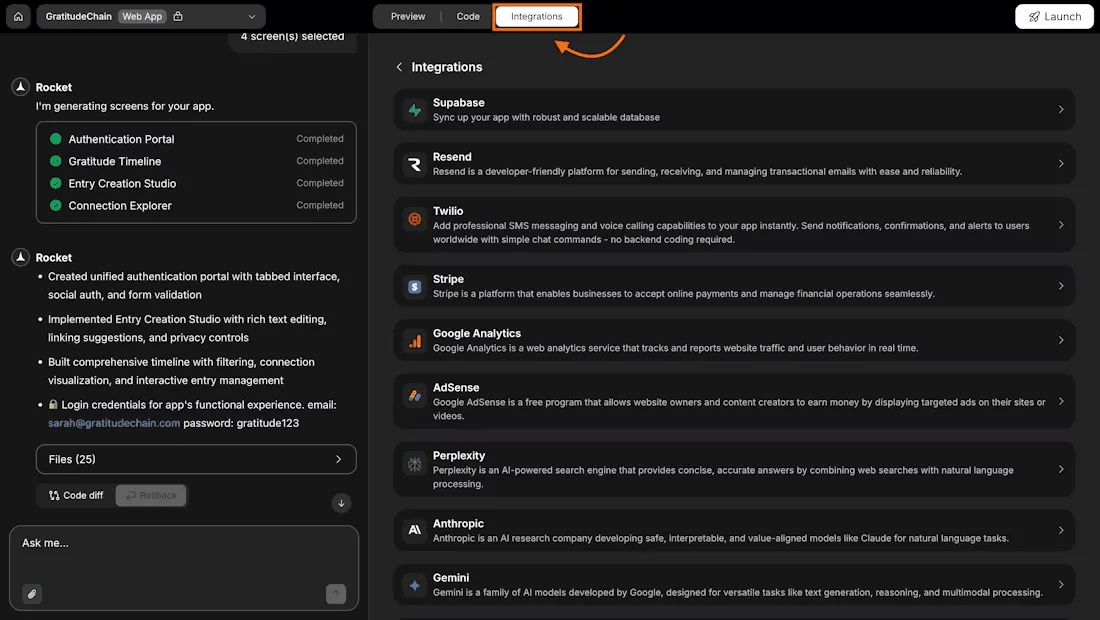
The platform offers multiple third-party integrations, including Google Analytics, Resend, and Gemini, as shown in the snippet below.
Step 5: Measure Metrics That Drive Product-Market Fit
Achieving product-market fit depends on tracking the right metrics, not vanity metrics. Key performance indicators include:
- Monthly recurring revenue
- Conversion rates
- Churn rate
- Activation rate
- Feature adoption
- Net promoter score
Research indicates that the median annual churn rate for SaaS businesses is around 10%, showing the importance of retention monitoring during early growth.
A strong retention trend signals progress toward sustainable market fit.
Step 6: Iterate Based on User Feedback and Data Insights
Continuous feedback cycles enable teams to refine the SaaS MVP, improve onboarding, and adjust pricing. Product teams often:
- Improve sign up process
- Simplify workflows
- Add automation features
- Introduce onboarding tutorials
- Enhance user engagement
Iteration helps companies fine-tune the product strategy and strengthen the customer lifetime value.
Metrics That Define SaaS MVP Success
Customer Lifetime Value and Revenue Stability
Tracking customer lifetime value enables founders to measure how much revenue each customer generates over their lifetime. Increasing retention by small percentages can significantly improve profits and long-term sustainability.
User Retention and Engagement Signals
A successful saas product maintains strong user retention and regular activity. If users drop off quickly, the product likely lacks strong market fit or onboarding clarity.
Product-Market Fit Validation
Indicators of strong product market fit include:
- Consistent usage growth
- Positive net promoter score
- Increasing paying customers
- Rising monthly recurring revenue
- Low churn rate
These signals confirm that the product solves real market problems.
Practical Example: SaaS MVP Lifecycle
Consider a marketing analytics SaaS company targeting e-commerce brands:
- The startup defines the target audience
- It builds a saas mvp with reporting dashboards
- Early users test the system
- Feedback shows demand for campaign ROI tracking
- The company adds new modules
- Revenue grows through recurring billing
This iterative process allows the startup to move from validation to scale while maintaining a cost-effective development approach.
Industry Trends Influencing SaaS MVP Strategy
Several industry trends shape modern saas mvp development:
- AI-assisted coding platforms are reducing development time
- Cloud-native deployment enabling scalable architecture
- Subscription-based pricing models are increasing predictable revenue
- Data-driven onboarding improves user engagement
These trends push saas startups to launch faster and iterate continuously to maintain a competitive advantage in the evolving market.
Top SaaS Companies and Ecosystem Examples
Many successful organizations started with an MVP-driven strategy. Examples of major saas companies include:
- Salesforce
- Microsoft 365
- Adobe
- Shopify
- Zoom
- Slack
- HubSpot
- Atlassian
- ServiceNow
- Workday
Streaming platforms such as Netflix operate primarily as subscription services but are usually classified as digital media SaaS-style subscription platforms rather than traditional PaaS offerings.
Expert Insights on SaaS MVP Strategy
An expert discussion on SaaS growth strategy highlights the importance of systems and structured processes in reaching revenue milestones. Here is a LinkedIn Expert Discussion on SaaS Growth Systems.
The Brutal Truth About SaaS Startup Failure: Most founder failure post-mortems focus on surface-level issues: "We didn't find product-market fit," "We ran out of money," or "The market wasn't ready." But after analyzing hundreds of failed startups through my coaching practice, the real reasons run much deeper.
Industry practitioners often emphasize early validation, strong onboarding, and continuous iteration as drivers of product-market fit.
Cost Planning and Resource Allocation for MVP Development
Building a saas mvp requires careful planning of resources, infrastructure, and team roles. Startups usually allocate budgets for:
- Cloud hosting
- Billing systems
- Analytics tools
- Security frameworks
- Customer support systems
Using platforms like Rocket.new reduces engineering overhead and enables startups to shift budgets toward marketing and customer acquisition in later stages.
Building a Culture That Supports Iterative Development
A growth-focused company culture supports continuous testing, rapid learning, and frequent updates. Teams that regularly gather user feedback and analyze metrics are more likely to achieve strong market fit and long-term success.
Founders should create workflows that encourage experimentation, rapid deployment, and collaboration between product, engineering, and customer success teams.
Key Takeaways for Founders Building SaaS MVPs
Launching a SaaS MVP allows startups to validate their business model, confirm market demand, and gather actionable feedback from real customers. Platforms such as Rocket.new shorten the development process, reduce costs, and enable teams to iterate faster, while also supporting the transition from MVP to a full-fledged, production-ready SaaS product with scalable infrastructure, integrations, and deployment workflows.
Teams that focus on product-market fit, retention, and measurable growth signals can scale from early validation to sustainable revenue with lower risk. Founders who continuously refine the product based on data, user feedback, and metrics position their SaaS company for long-term growth while avoiding common reasons why startups fail.
Building successful products requires ongoing iteration, analysis of customer insights, and structured development planning. When startups follow these principles, building a SaaS MVP with Rocket .new becomes a practical strategy not only for launching an MVP but also for expanding it into a fully functional, scalable subscription software platform ready for later stages of growth.
Table of contents
- -Introduction to SaaS MVP Development
- -What Is a SaaS MVP and Why It Matters
- -SaaS MVP vs Minimum Viable Product Concepts
- -MVP (Minimum Viable Product)
- -MMP (Minimum Marketable Product)
- -MAP (Minimum Awesome Product)
- -Why SaaS Startups Depend on MVP Strategy
- -Avoiding the Common Startup Failure Pattern
- -Role of Rocket.new in SaaS MVP Development
- -When Rocket Makes the Most Impact
- -Step-by-Step Guide: Building SaaS MVP with Rocket
- -Step 1: Define the Target Market and Customer Problem
- -Example
- -Step 2: Identify Core Features for the First Release
- -Example
- -Step 3: Build the SaaS MVP Using Rocket Templates
- -Step 4: Launch to Early Users and Trial Users
- -Step 5: Measure Metrics That Drive Product-Market Fit
- -Step 6: Iterate Based on User Feedback and Data Insights
- -Metrics That Define SaaS MVP Success
- -Customer Lifetime Value and Revenue Stability
- -User Retention and Engagement Signals
- -Product-Market Fit Validation
- -Practical Example: SaaS MVP Lifecycle
- -Industry Trends Influencing SaaS MVP Strategy
- -Top SaaS Companies and Ecosystem Examples
- -Expert Insights on SaaS MVP Strategy
- -Cost Planning and Resource Allocation for MVP Development
- -Building a Culture That Supports Iterative Development
- -Key Takeaways for Founders Building SaaS MVPs