Thinking about launching your own ride-hailing platform? Learn how to plan, design, and scale an Uber-like app using Rocket.new, covering MVP features, backend workflows, integrations, and practical development strategies effectively.
Can a small team really compete in the ride hailing market today?
The demand keeps rising, and users now expect fast booking, live tracking, secure payments, and smooth performance as the standard. So when founders begin researching how to build an Uber-like app, they quickly see that it involves much more than copying features.
Instead, it calls for clear planning, a practical revenue model, and a tech stack that can grow beyond an MVP. At the same time, speed matters. You want to launch quickly, yet you also need stability from day one.
That is where Rocket.new helps. It supports faster progress with core screens, backend workflows, and integrations. In this blog, you will learn the key steps and smart decisions behind building a reliable ride-sharing app.
Rocket.new: App Development Made Easy
If Rocket.new is new to you, here’s the gist: it lets developers design, build, and launch apps quickly using AI-powered tools. Features like Prompt to App Creation allow you to generate app layouts and logic from a single prompt.
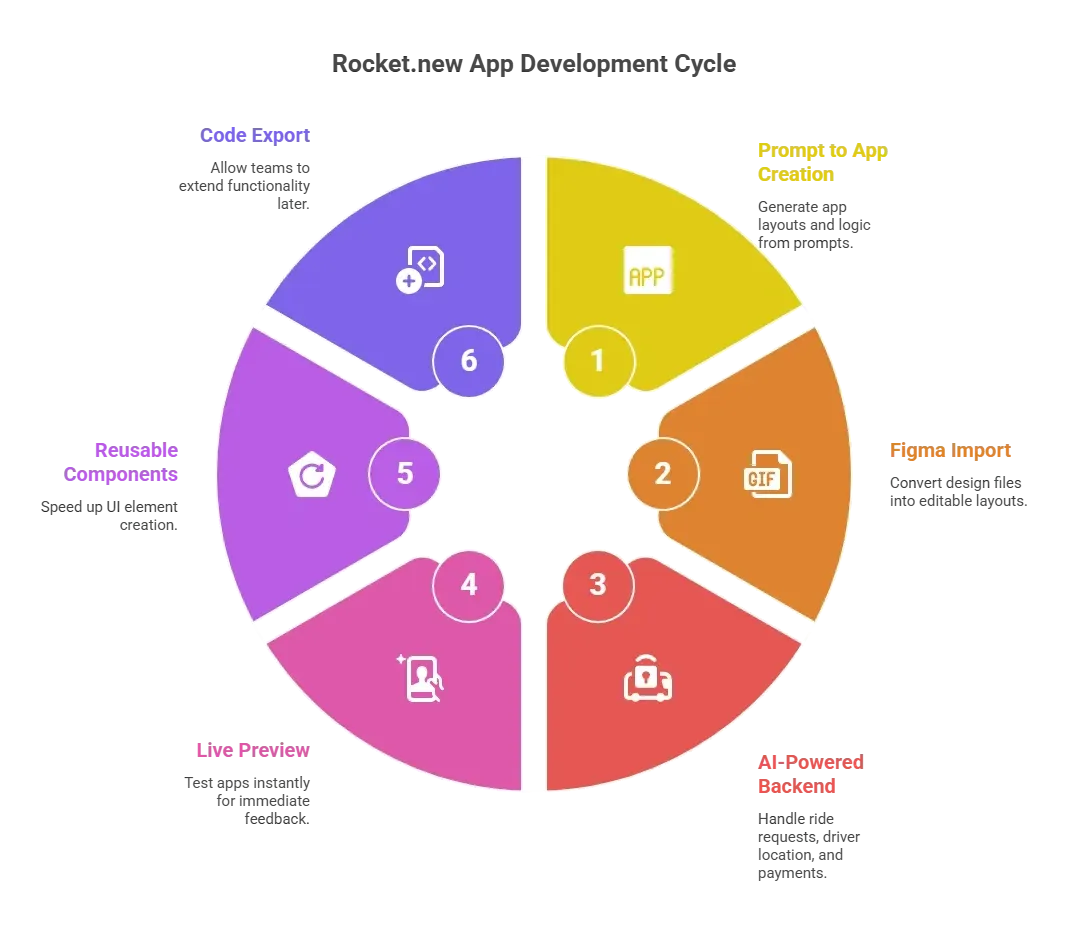
For official documentation, see Rocket.new Launchpad.
Key Steps to Build Your Uber-Like App
Creating an Uber-like app might sound intimidating at first, but breaking it down into clear, actionable steps makes it manageable.
Below, we’ve outlined a structured roadmap that takes you from planning to launch. Each step is designed to help you build a taxi booking app efficiently with Rocket.new, incorporating both basic and advanced features such as real-time tracking, dynamic pricing, and in-app chat.
Follow these steps carefully, and you’ll eventually build a robust Uber-like application ready for real-world users.
Step 1: Planning Your Uber-Like App
Planning is the blueprint of your taxi booking app. Before writing any code or dragging UI components, you need to know exactly what your MVP will look like.
Before starting, outline your development process:
- Define your MVP using Rocket.new’s Prompt to App Creation.
- Decide on core components: passenger app, driver app, admin panel.
- Identify functional requirements: ride requests, driver’s location tracking, fare estimation.
- Plan tech stack and third-party integrations like payment gateways and Google Maps.
- Assign roles for project managers and the development team.
Starting with an MVP helps you test ideas without burning resources and makes adding advanced features later easier.
A solid plan ensures your MVP hits the mark. Clear goals here make adding advanced features much smoother down the line.
Step 2: Defining Functional Requirements
Functional requirements are the backbone of your app. Knowing exactly what your Uber-like app should do prevents confusion during development.
A successful taxi booking app needs:
- User registration for passengers and drivers
- Real-time driver’s location tracking
- Ride request acceptance and management
- Fare estimation and payment integration including cash payments
- Push notifications for ride status and wait times
- In app chat for passengers and drivers
- Cancellation fee policies
Advanced features can include dynamic pricing, multiple ride categories, and integration with food delivery services like Uber Eats.
With requirements clearly defined, both your passenger and driver apps will operate seamlessly and avoid feature gaps.
Step 3: Starting with Rocket.new
Now that your MVP and requirements are clear, it’s time to bring your idea to life using Rocket.new. This step turns your planning into a working app without coding.
-
Open Rocket.new and use Prompt to App Creation. Describe your app in a clear prompt, e.g.,
“Build a taxi booking app with passenger login, driver login, ride request, driver location tracking, fare calculation, and push notifications.”
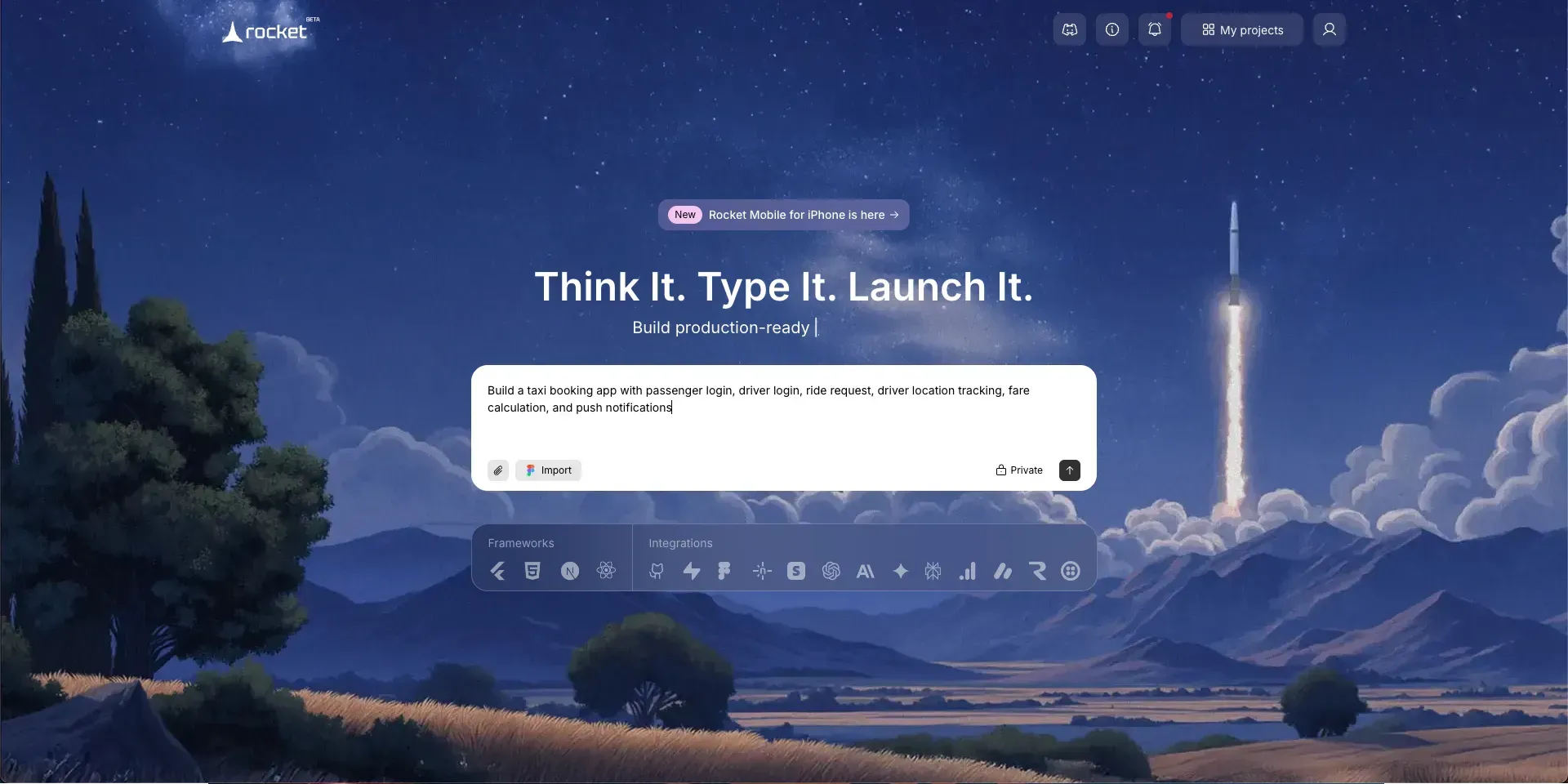
- Rocket.new will generate passenger, driver, and admin panel screens automatically.
- Review the generated screens and pick the ones you actually need.
This step gives you a working skeleton for your Uber-like app. It’s fast, functional, and ready for customization.
Step 4: Refining Screens and UI
After generating your base app, customize the UI and UX to match your vision:
- Use Figma Import if you have custom designs.
- Organize screens logically: login → ride booking → driver tracking → payment.
- Add Reusable Components for buttons, maps, ride cards, and notifications.
- Test Live Preview constantly to see your app in action.
This step makes your app feel polished and professional, instead of a generic, generated template.
Step 5: Adding Functionality and Advanced Features
This is where the app truly starts behaving like Uber:
- Set up AI-Powered Backend for ride logic, fare calculation, route optimization, and notifications.
- Use command-based actions (/ and @) to handle ride requests, push notifications, and driver location updates.
- Add advanced features like dynamic pricing, multiple ride categories, in app chat, or Uber Eats/food delivery integration.
Iterative testing with Live Preview ensures the app works perfectly for both passengers and drivers.
Step 6: Publishing the App
Finally, make your app available to the world by clicking on the Launch button.
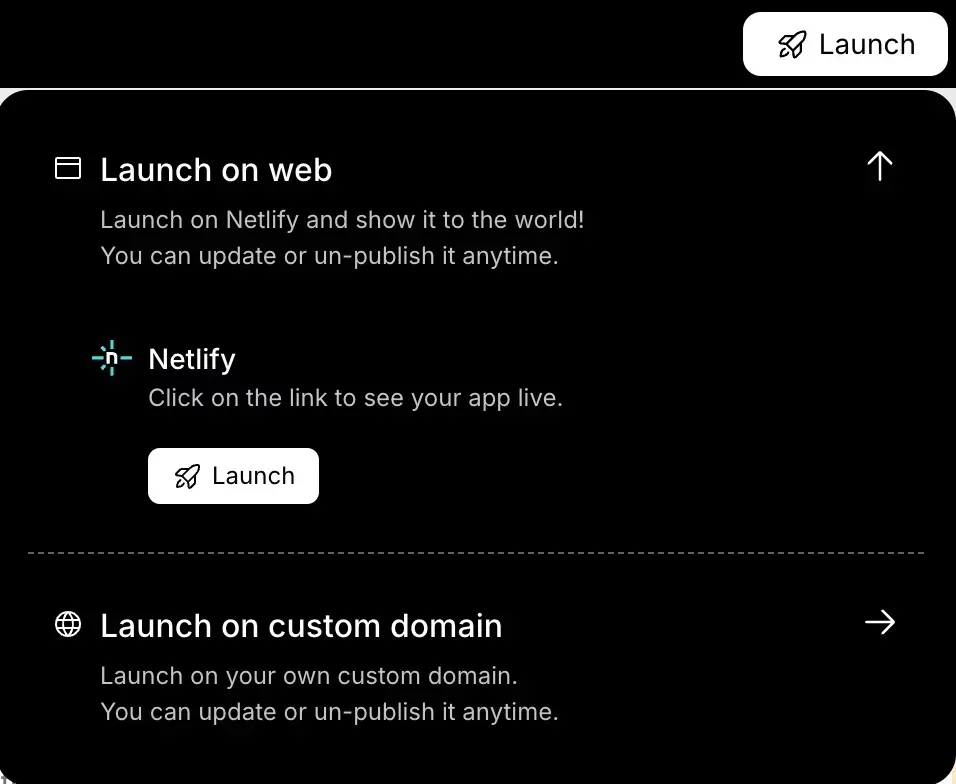
- Use Custom Domain Support for a branded launch.
- Test all features in real scenarios: ride requests, payments, notifications, and driver tracking.
- Optionally, use Code Export to allow your dev team to extend or customize further.
Your Uber-like app is live, functional, and ready for real users, all built with minimal coding effort thanks to Rocket.new.
Turning Ideas into Action
By understanding how to build an Uber-like app with Rocket.new, developers can confidently enter the ride-hailing market. Start with a minimum viable product (MVP), leverage Rocket.new’s Prompt to App Creation, AI-Powered Backend, and Live Preview, and refine your app based on real user feedback. Over time, gradually integrate advanced features such as dynamic pricing, multiple ride categories, and food delivery.
This approach lets your app grow alongside the ride-hailing market efficiently, professionally, and with less friction, turning your original idea into a fully functional, scalable app.
Table of contents
- -Rocket.new: App Development Made Easy
- -Key Steps to Build Your Uber-Like App
- -Step 1: Planning Your Uber-Like App
- -Step 2: Defining Functional Requirements
- -Step 3: Starting with Rocket.new
- -Step 4: Refining Screens and UI
- -Step 5: Adding Functionality and Advanced Features
- -Step 6: Publishing the App
- -Turning Ideas into Action