How to Do Market Research: Validate Your Business Idea, Then Ship It on Rocket.new
Is Your Business Idea Actually Worth Building?
Most founders do not pause long enough to ask this. They have a spark of an idea, get excited, and jump straight into building. Weeks - sometimes months - later, they launch to total silence. No sign-ups. No paying customers. Just a product nobody asked for.
The numbers are uncomfortable. According to Founders Forum, citing CB Insights data, 42% of startups fail because there was simply no market need for what they built. That is not a product quality problem. It is a market research problem - and it starts long before the first line of code.
Comprehensive market research is the step between having a business idea and knowing whether it deserves to exist.
This blog walks through the methods that work, the signals to look for, and how to go from a validated idea to a shipped product faster than most people think possible.
What Market Research Actually Is?
Market research is the process of gathering data about your target audience, the market demand for your product, and the competitive space you are stepping into. It answers questions like: Who has this problem? How much does it cost them? How are they solving it today? What would they pay to solve it better?
Done well, it turns assumptions into informed decisions. Done poorly - or skipped entirely - it turns those same assumptions into expensive mistakes.
The market research industry itself reflects how seriously businesses take this. The global market research industry hit $140 billion in revenue in 2024, up from $130 billion the year before, with online and mobile research accounting for 35% of that revenue.
The Trap Most Founders Fall Into
Most entrepreneurs know they should validate before building. They just rarely do it properly.
On LinkedIn, product consultant Henryk Brzozowski described what he sees repeatedly:
"I've watched beginners spend 5 to 8 months building a SaaS product before talking to a single customer. No market validation, no paying users, just months of tweaking features in isolation... The hard part is finding out if anyone actually wants what you're building. And that takes one conversation, not six months of building." Henryk Brzozowski (LinkedIn)
Building feels productive. You can see progress every day. But it can be the most expensive form of avoiding the hard question: does anyone actually want this?
According to McKinsey, more than 50% of product launches fail to hit their business targets. The most common cause is building products that solve problems customers do not have, or solving them in ways customers do not value.
Core Market Research Methods That Work?
There is no single correct way to research a market. The right mix depends on your product idea, your target market, and the stage you are at. Here are the methods that consistently generate useful signals.
Online Surveys
85% of market research professionals use online surveys regularly, according to Statista data. They are fast, scalable, and give you quantitative data across a broad set of potential customers. The key is to ask about the problem - not your solution. Good surveys ask how people currently handle a challenge, what it costs them, and what they wish were different.
Customer Interviews
One-on-one interviews go deeper. You can follow up on answers, notice hesitation, and understand the emotional weight behind a problem. For a new product idea, 10 to 15 interviews with your target market before concluding is a reasonable starting point. The goal is to hear people describe their pain points in their own words.
Focus Groups
Focus groups bring potential customers together for structured discussion. They work well when you want to see how people react to a concept in real time, or when group dynamics influence purchase decisions. They can be expensive to run, so combining them with surveys gives you better coverage at a lower overall cost.
Landing Page Tests
One of the fastest ways to test real demand is a simple landing page with a clear value proposition and a sign-up or pre-order button. Drive a small amount of traffic to it and measure conversion rates. If real users take action with their email address or money, that is a genuine validation signal - far stronger than survey responses.
Market Research vs. Market Validation: Know the Difference
These two things serve different purposes and happen at different stages.
| Stage | Core Question | Methods |
|---|---|---|
| Market Research | Who are customers and what do they need? | Surveys, interviews, focus groups, competitive analysis |
| Market Validation | Will they buy this specific product? | Landing pages, MVPs, pre-orders, sign-up counts |
| Product Validation | Does this version work for them? | Beta tests, usage data, feedback loops, pricing tests |
Market research gives you the picture. Market validation confirms whether your specific product idea fits into it. Product validation tells you whether the version you built is the right one. All three involve feedback from real users - just at different stages and with different questions.
What Validated Demand Actually Looks Like
Validation is not someone saying your idea sounds cool. It is data-driven decisions based on real behavior.
Paying customers before a product is fully built. Sign-ups from your target audience on a landing page. A potential customer willing to put their contact details on a waitlist. Pricing research that shows people are willing to pay within your intended range.
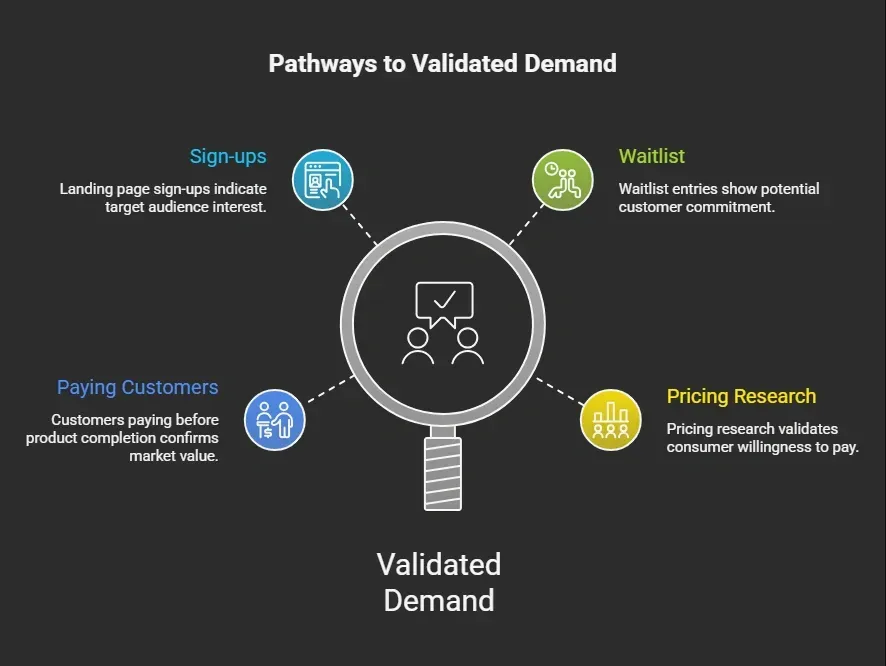
The validation process for a new product idea should include at minimum: a clear definition of the target market, at least two research methods to test assumptions, a measure of purchase intent (not just interest), and a pricing signal showing what consumers would pay.
Each step is a checkpoint. The goal is to make informed decisions at every stage, not just at the end.
Launch Faster with Rocket.new
Research the Market. Decide What to Build. Ship It.
Most AI builders start at the build step. You arrive with your idea, describe what you want, and they generate something. But what about figuring out whether the idea was worth building in the first place? That part is still entirely on you.
Rocket.new works differently. It is the world's first Vibe Solutioning platform - combining strategic market research, product building, and competitor tracking in one connected system. The thinking and the building happen in the same place, with no context lost between them.
Solve: Market Research in 60 to 90 Minutes
Rocket.new's Solve capability takes any business question - "Is there pricing room in the B2B invoicing space for a mobile-first product?" or "What are the main pain points of freelancers using current accounting tools?" - and delivers a complete, structured research report.
It searches 150+ sources simultaneously, maps the competitive landscape, surfaces risks you did not ask about, and ends with a clear recommendation. The kind of comprehensive market research that used to take a consultant days now happens inside one platform, before a single screen is designed.
Every finding stays connected to the project. When you move to building, the Solve research is already there - informing the product direction, the messaging, and the feature decisions.
Build: Ship Production-Ready Products Fast
Once market validation confirms your direction, Build generates a fully working product from a plain language description. Web apps in Next.js. Mobile apps in Flutter. Landing pages optimized for conversion - built from the same project context as your research, so the value proposition reflects what your target audience actually said.
For entrepreneurs testing demand, a landing page can go live in minutes. For those ready to ship a full product, a working web or mobile app ships without a development team or months of sprints.
Speed matters here because faster shipping means faster feedback from real users - which is the only feedback that actually counts.
Intelligence: Track Competitors After You Launch
Once your product is live, Rocket.new's Intelligence module monitors competitors continuously across every public channel they operate on. Pricing changes. New features. Messaging shifts. You see them as they happen, not weeks after they have already affected your market.
What Other Builders Cannot Do
Tools like Lovable, Bolt, and v0 build products from prompts. They do this well. But they start at execution. There is no research layer, no market validation step, no context about whether the idea was worth building before you committed to it. Every one of those steps is still your problem to solve elsewhere.
Rocket.new describes the difference plainly: "They build what you tell them to build. Rocket figures out what is worth building - then builds it."
The Bottom Line on Market Research
Skipping market research is how good ideas become expensive failures. The top reason startups fail is not a bad product - it is a product the market never needed. Getting the research right before you build changes those odds.
For entrepreneurs and product teams who want to go from business idea to validated, launched product without switching tools or losing context between research and building, Rocket.new connects every step. The market research informs the build. The build generates the product. The intelligence tracks what happens after launch. One platform. One shared context. No starting over.
FAQs
How long does market research take before launching a new product?
It depends on the methods you use. Online surveys can return useful data in a few days. Customer interviews take one to three weeks to schedule and complete. A landing page test with paid traffic can generate conversion signals in under a week. Most founders should plan for two to four weeks of active market validation before committing to a full build.
What is the difference between market research and market validation?
Market research explores who your potential customers are and what they need. Market validation tests whether your specific product idea has real demand from that audience. Market research tells you about the space. Market validation tells you whether your idea fits into it.
Can I validate a business idea without a prototype?
Yes. A landing page, a pre-order form, or even a simple email waitlist can validate real demand before any product is built. The goal is to test whether your target audience takes action based on your value proposition - not whether they like a demo.
How does Rocket.new support market research and validation?
Rocket.new's Solve capability runs comprehensive market research on any business question in 60 to 90 minutes, covering competitive landscape, demand signals, pricing benchmarks, and risks. Once the idea is validated, Build generates a production-ready product from that same project context - so the research feeds directly into what gets built, without starting over in a different tool.
Table of contents
- -What Market Research Actually Is?
- -The Trap Most Founders Fall Into
- -Core Market Research Methods That Work?
- -Online Surveys
- -Customer Interviews
- -Focus Groups
- -Landing Page Tests
- -Market Research vs. Market Validation: Know the Difference
- -What Validated Demand Actually Looks Like
- -Launch Faster with Rocket.new
- -Research the Market. Decide What to Build. Ship It.
- -Solve: Market Research in 60 to 90 Minutes
- -Build: Ship Production-Ready Products Fast
- -Intelligence: Track Competitors After You Launch
- -What Other Builders Cannot Do
- -The Bottom Line on Market Research
- -FAQs
- -How long does market research take before launching a new product?
- -What is the difference between market research and market validation?
- -Can I validate a business idea without a prototype?
- -How does Rocket.new support market research and validation?