
Most founders treat market research as a one-time pre-build task. This blog shows how to combine AI market research tools with fast MVP shipping on Rocket.new so real user feedback becomes your most accurate research source, continuously improving with every iteration.
What If the Best Research Happens After You Launch?
Most founders treat market research like a pre-flight checklist. Run some surveys. Read competitor reviews. Maybe pay for a report. Then build based on a best guess about what the market wants.
Here is the honest problem with that: 78% of organizations are already using AI in core business functions according to the Stanford 2025 AI Index Report - and the teams pulling ahead are not just using a market research AI tool to front-load their research. They are using it to create a continuous feedback loop between their product and their users.
This blog walks you through how to combine sharp AI market research tools with a fast MVP approach so your users become your most accurate researchers.
Why Traditional Market Research Falls Short
Traditional market research is not broken, but it has real limits when speed and validation matter most.
-
Focus groups take weeks to arrange and schedule before any meaningful data is collected
-
Survey data can be skewed by how questions are worded, leading to unreliable consumer insights
-
Commissioned research reports often land on decision-maker desks weeks after the window to act has already closed
-
Most research teams end up with moderately trusted findings derived from methodologies designed for a slower era
-
The result: many founders skip proper market research entirely and start building on gut feel
That gap is expensive. According to CB Insights research (cited in Velam.ai's MVP analysis), 42% of startups fail because there is no market need for their product. That is not a technology problem or a talent problem. It is a validation problem - one that should have been caught before a single line of code was written. The smarter move is to combine AI market research tools for early directional signals with a fast MVP to get real feedback from real users.
What AI Market Research Tools Actually Do
Modern AI market research tools bring machine learning, natural language processing, and predictive analytics to tasks that once required large research teams, expensive agencies, or weeks of manual data analysis. Research that used to take weeks now takes hours.
| Capability | What It Does | Example Use Case |
|---|---|---|
| Survey creation and survey automation | Generates optimized surveys with smarter question design | Launch targeted surveys to specific audience segments in minutes |
| Sentiment analysis | Analyzes text across reviews, comments, and social media | Track how real people feel about a product or campaign |
| Competitive intelligence | Monitors competitors across pricing, messaging, and hiring | Spot strategic gaps before they cost you market share |
| Consumer behavior analysis | Identifies patterns in how users interact and purchase | Predict churn risk or model upsell moments |
| Predictive analytics | Uses historical data to forecast future trends | Anticipate demand shifts before they happen |
| Data visualization and report generation | Turns raw survey data into readable dashboards | Share actionable insights with stakeholders quickly |
| Synthetic data and synthetic users | Models consumer personas using AI to simulate responses | Test ideas before recruiting real participants |
Each of these is a category in itself. The key point is that AI market research tools reduce the cost, time, and technical expertise needed to generate consumer insights but using them well means knowing where they end and where real user data begins.
The Smart Research-to-MVP Flow
Here is how a lean product team can run this well - four phases, with a feedback loop at the end that is where the real value compounds.
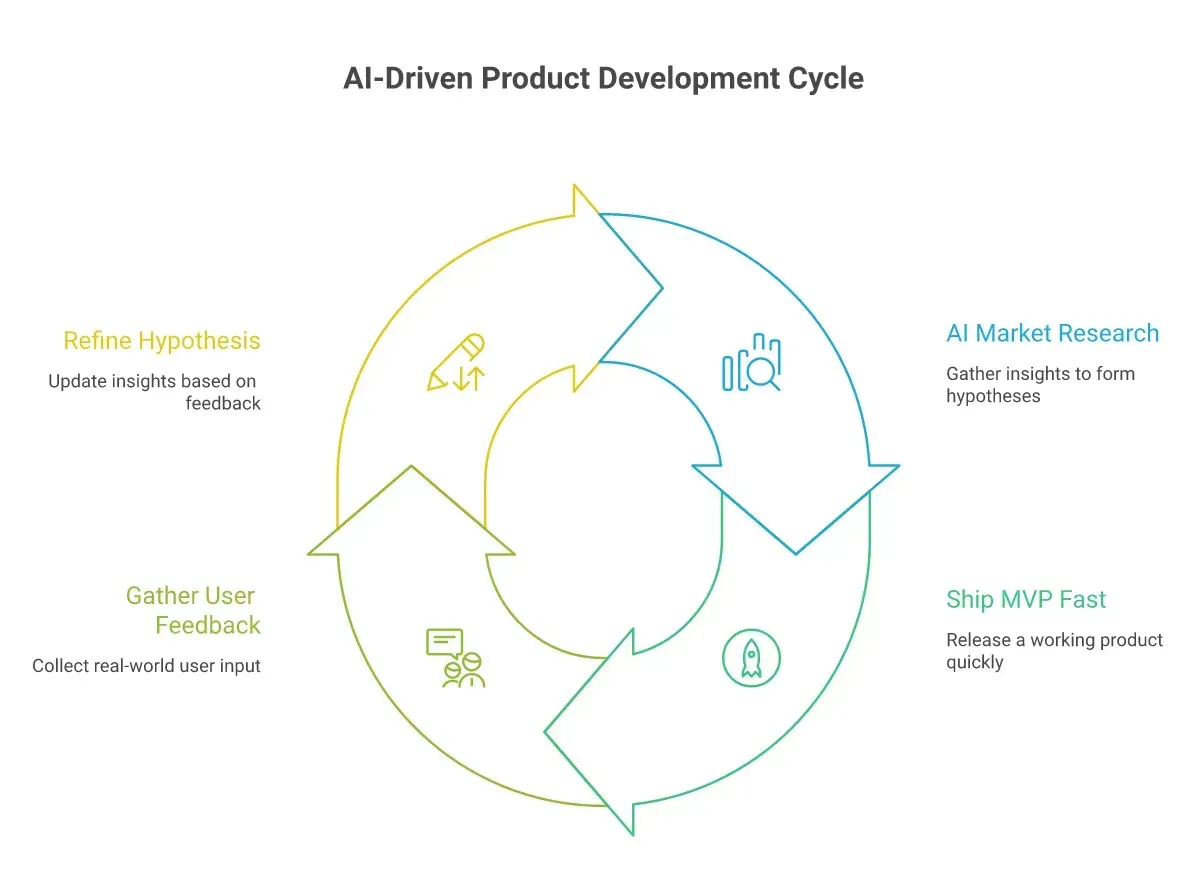 The Research-to-MVP Feedback Loop
-
Phase 1: Crystallize the question. Before anything else, define what you need to know. AI analysis tools can scan vast datasets, secondary research sources, and social listening signals to surface patterns humans would take days to spot. They work best with specific research objectives, not vague prompts.
-
Phase 2: Validate with AI tools before you build. Run survey automation on your target segment. Use sentiment analysis to assess reactions to different positioning angles. Leverage synthetic users to model how consumer personas might respond before you invest in development. This phase is about forming a sharp hypothesis not a confirmed answer.
-
Phase 3: Ship a working MVP. Most founders stall here. They over-engineer. They wait for perfect. They add features nobody asked for. The better move: ship something real that does one core job well, then let real users tell you what they actually want next.
-
Phase 4: Learn from real users, then loop back. Synthetic data gives you directional signals. Real people using your product tell you where it breaks, where it bores them, and where it genuinely helps. That real-world feedback sharpens every subsequent research cycle.
The loop matters more than any single phase. Each cycle of real user feedback makes your AI market research smarter and more targeted.
Where AI Market Research Tools Have Real Limits
AI tools are fast, scalable, and get meaningfully better every year. Being honest about where they fall short helps you use them better and helps you understand why the MVP step is not optional.
-
Synthetic research has a ceiling. Synthetic users and AI models can identify patterns and simulate responses at scale, but they cannot replicate the emotional texture of a real customer conversation. Human judgment is still needed to interpret qualitative depth from focus groups, analyzing interviews, or one-on-one discovery calls. AI gets you to the right questions. Real users give you the real answers.
-
Survey data only reflects what people say. Consumer behavior research consistently shows that what users say they will do and what they actually do are often very different. AI analysis of survey results catches patterns, but it cannot observe behavior in real-world contexts the way a live product can. A user might say they want three features. In practice, they only use one.
-
Research teams still need to ask better questions. The quality of AI analysis depends entirely on the quality of inputs. Poor research objectives lead to poor findings, regardless of how advanced the AI models are. Survey creation tools can optimize question structure, but they cannot define your research strategy for you.
-
Competitive intelligence is a snapshot, not a strategy. Tracking competitor websites, social media, and hiring signals is genuinely useful - but competitive intel tells you what others are doing, not what your specific users need. It is directional, not definitive.
That is exactly why shipping a working MVP closes the gap. Real users in real-world contexts generate the most accurate data any market research process can collect.
What Separates the Best AI Market Research Tools from the Average Ones
Not all AI market research tools are built the same. Here is what to look for when evaluating options for your research workflows.
-
Natural language processing depth. Can the platform analyze open-ended responses and extract themes from free-text survey answers, or does it only handle structured data? The ability to identify patterns humans miss in qualitative responses separates good analysis tools from basic ones.
-
Real-time competitive intelligence. Does it track competitors across multiple markets and surface emerging trends continuously, or does it run a weekly snapshot? For fast-moving markets, the speed of data collection matters as much as the quality.
-
Connects with your existing stack. Does the platform connect to your existing CRM, product analytics, or social listening tools? Research platforms that sit in a silo create more work, not less. The goal is to bring survey data, behavioral data, and consumer insights into one place where research teams can act on findings quickly.
-
Synthetic data quality. Are the synthetic users grounded in real consumer data and demographic profiles, or modeled on generic assumptions? The reliability of AI-generated consumer personas depends entirely on the underlying data.
-
Speed from survey data to report generation. Can your research team get from raw responses to a shareable, actionable report in hours? Analysis tools that require heavy manual interpretation defeat the purpose of automating repetitive tasks in the first place.
Tools like Browse AI and Delve.ai have built strong reputations for web data extraction and consumer intelligence respectively. For most product teams, the real advantage is not picking a single best AI tool in isolation - it is combining the right AI analysis layer with fast product shipping to close the feedback loop.
What the Community Is Saying
This tension between "research first" and "ship first" is something founders and developers discuss constantly. Real practitioners have a grounded take on where AI tools end and where real-world validation begins.
"I'd work out your MVP with it. Iterate until you have your perfect MVP. Then pass it to a developer to create a first version that's scalable. As a developer, having a good working MVP is extremely helpful."- r/vibecoding, September 2025
That is the view most experienced builders land on. AI tools inform the hypothesis. The MVP proves or disproves it. Then you refine, rebuild, and test again - faster each time.
Launching Your Market Research MVP with Rocket.new
Rocket.new: Where AI Research Meets Real Product Shipping
Rocket.new is an AI-powered platform that takes you from idea to a working, production-ready application without requiring deep technical expertise. For marketing teams, product managers, and founders using AI market research tools, it collapses the gap between "what the data suggests we should build" and "here is a real product users can actually test."
From Hypothesis to Live MVP in Hours
Once your AI market research tools surface a validated hypothesis, getting it in front of real users fast is everything. That is exactly what Rocket.new is built for.
-
Describe what you want to build in plain language Rocket.new handles the full technical execution
-
User authentication, database setup, payment processing via Stripe, API connections, and live deployment are all generated automatically
-
No waiting in a developer queue and no months of build time before your first real user data point arrives
-
Ship a working product in hours, not weeks making your research loop run significantly faster with each cycle
For research-driven teams, faster shipping means faster learning. Each round of real consumer feedback sharpens the next research cycle.
Built-In Competitive Intelligence
Most teams using AI market research tools run competitive analysis separately, manually, and on a lag. Rocket.new changes that.
-
The Intelligence feature tracks competitors across nine domains: website changes, social media sentiment, GTM motion, hiring signals, and more
-
Competitive tracking runs continuously in the background while you build and ship - not as a separate monthly report to commission
-
Emerging trends and competitive positioning shifts surface in real time, so your research teams are always working from current data
-
You stay ahead of competitor moves without adding to your research workflows or hiring a dedicated competitive intelligence function
This is competitive intelligence working as a live layer, not a static snapshot you pull once a quarter.
No Technical Barriers for Research Teams
Marketing teams and product managers without coding backgrounds can ship a functional MVP and gather real consumer feedback without depending on a separate development team.
-
Build and deploy a production-ready app using plain language prompts, no coding knowledge required
-
Iterate on the product quickly as real user feedback comes in, without a development bottleneck slowing the research loop down
-
Test multiple product directions during early research phases before committing to a full build
-
40% of marketers already use AI to conduct research. The teams that outperform are the ones who close the loop between that research and actual product testing, without a six-week development delay in between
Removing the technical barrier between research and shipping is one of the most underrated advantages for modern research teams.
The Full Loop in One Platform
Rocket.new is designed to cover three things in one place: deciding what to build based on market data, building it, and tracking market shifts after launch.
-
Validate your research hypothesis with built-in market intelligence before committing to a build
-
Ship a production-ready MVP fast, with all the technical infrastructure handled automatically in the background
-
Monitor competitive shifts and consumer sentiment after launch to inform your next research cycle directly
-
No switching between a research platform, a development team, and a separate competitive monitoring tool
For teams where market research and product development are part of the same workflow, that end-to-end capability reduces coordination overhead and closes the time between insight and action.
How Rocket.new Compares to Other Vibe-Coding Platforms
Platforms like Lovable, Replit, and Bolt.new all offer AI-assisted development. Each has its strengths for general building. For research-driven teams, though, the comparison looks different.
-
Most competitors require you to maintain separate tools for market research, competitive tracking, and development creating context switching and manual work connecting insights to product decisions
-
Lovable and Replit are strong for general app building but do not carry built-in competitive intelligence or market research capabilities
-
Bolt.new focuses on fast front-end prototyping but lacks the full backend infrastructure and post-launch market monitoring that research-to-product workflows depend on
-
Rocket.new is the only platform that combines market intelligence, fast MVP shipping, and ongoing competitive monitoring in one place
-
For teams where research and development are not separate departments, that continuity is a meaningful difference in speed and decision quality
The platforms that focus only on building will always require a separate research layer bolted on. Rocket.new is built with research teams in mind from the start.
Let Users Be Your Best Researchers
The old model of market research was slow by design. Weeks of surveys. Months of data analysis. Reports that arrived just in time to be outdated. Research teams were grinding through repetitive tasks that produced findings nobody could act on quickly enough.
AI market research tools have changed what is possible. Sentiment analysis runs in minutes. Predictive analytics models market trends from vast datasets. Synthetic users let you test assumptions before committing to a build. Research workflows that once required a large team now run leaner and faster.
But no market research AI tool, no matter how good, replaces the clarity you get from shipping something real and watching what real users actually do with it.
The right approach combines both: use AI to form a sharp hypothesis, ship an MVP fast with Rocket.new, collect real consumer insights from actual users, and loop that data back into your next research cycle. That is how you get market research done right not as a one-time task, but as a continuous learning engine.
Table of contents
- -Why Traditional Market Research Falls Short
- -What AI Market Research Tools Actually Do
- -The Smart Research-to-MVP Flow
- -Where AI Market Research Tools Have Real Limits
- -What Separates the Best AI Market Research Tools from the Average Ones
- -What the Community Is Saying
- -Launching Your Market Research MVP with Rocket.new
- -Rocket.new: Where AI Research Meets Real Product Shipping
- -How Rocket.new Compares to Other Vibe-Coding Platforms
- -Let Users Be Your Best Researchers