
Learn how launching a Rocket.new MVP helps validate demand, uncover real customer behavior, and improve market sizing accuracy before investing heavily in product development, scaling, or long-term growth strategies effectively.
Is Your Market Sizing Actually Grounded in Reality?
What if your market size estimate is completely wrong and you won't find out until after you've spent six months building?
That's not a hypothetical. It's how most startups end up. Founders run market research, stack up TAM, SAM, and SOM figures, and build confidence around a number that looks good on a pitch deck but falls apart on contact with real users.
According to Founders Forum, citing CB Insights data, 42% of startups fail because they build products nobody wants not because their market was too small on paper, but because their market assumptions were never properly tested against actual user behavior.
This is a step by step guide to market sizing done right. Start with the frameworks. Test them with a minimum viable product (MVP). Then let user feedback close the gap between theory and real demand.
The Two Primary Approaches to Market Sizing
When founders sit down to size a market, two primary approaches dominate the conversation. Both are useful. Neither one is enough on its own.
Top Down Market Sizing: Start Big, Filter Down
Top down market sizing starts with the total market and works inward. You take the total addressable market (TAM) say, the global project management software market - and carve out the serviceable addressable market (SAM) based on your geography and product type, then narrow further to the serviceable obtainable market (SOM) you can realistically reach.
Top down market sizing is fast. It works well for pitch decks and early investor conversations because it shows the scale of the opportunity. Most secondary research industry reports, analyst estimates feeds directly into a top down analysis.
The limitation? This approach relies on published data that may be years old, built on assumptions about the total market that may not apply to your specific product idea. It tells you a market exists in theory. It says nothing about whether your solution will find traction inside it.
The Bottom Up Approach: Build From Real Data
The bottom up approach works in reverse. Instead of starting with the total market, you start with what you can actually measure: how many potential customers exist in your specific target segment, what price point they would reasonably pay, and what percentage you could realistically reach in year one.
For example: "There are 70,000 independent HR consultants in the US. If 4% of them pay $89/month for a tool, that's roughly $3M in annual recurring revenue."
This method forces you to think through your target market in concrete terms. It produces an estimate grounded in real unit economics rather than broad industry figures. It's more credible with investors because it requires you to show your work. A well-built bottom up analysis also feeds naturally into your early marketing strategy and business model thinking.
But even the bottom up approach is still a forecast. You're working from assumptions about conversion rate, pricing sensitivity, and user needs none of which you've tested yet with real users.
Why Both Methods Still Leave You Guessing
Top down and bottom up market sizing are the right starting point for any market research process. They help you understand market demand at scale, communicate growth potential to investors, and make early product development decisions.
They share one structural problem: they're backward-looking and assumption-heavy.
Industry reports capture current trends - not future user behavior around your specific solution. Your estimated conversion rate might be off by a factor of five. The core user problem you're prioritizing might not be the one your target audience cares about most.
"Most teams struggle here because they try to find users instead of going where the problem already shows up." Kairos-369, r/Entrepreneurs, April 2026 (source)
Research from the Startup Genome project, cited by Failory, shows that startups need 2-3 times longer to validate their market than most founders expect. That gap - between what you assume and what real users tell you - is where development costs pile up and product market fit stays out of reach.
The fix isn't a better spreadsheet. It's a live product.
MVP Development as Market Research
A minimum viable product (MVP) flips the research model.
Instead of predicting what users want, you build only the core features required to deliver your core value then watch what actually happens. Every sign-up, every session, every support message, every feature request is real market data that no industry report can generate for you.
The minimum viable product MVP concept comes from lean startup methodology. The idea is straightforward: don't spend months in full development before you know whether people will use what you're building. Ship the smallest version that solves the core problem, get it in front of early users, and gather feedback in real time.
This approach changes the entire development process. Your MVP isn't just a cheaper product it's a market research instrument.
The numbers back this up. According to Failory citing the Startup Genome Project, startups that pivot 1-2 times based on early user feedback have 3.6x better user growth and raise 2.5x more money than those that never pivot at all. That's not a coincidence. Early feedback shapes product market fit faster than any amount of pre-launch analysis.
How to Conduct Market Research Using an MVP: A Step by Step Guide
Here's how to run a market sizing MVP process from first assumptions to validated market demand.
Step 1 - Define the Core Problem First
Before thinking about features, get specific about the core user problem you're solving. Not a list of pain points one central problem that your target audience faces right now and would pay to fix.
Map the user journey before and after your solution exists. Where does friction live? What does a successful outcome look like for the user?
Step 2 - Pick Your Target Market Segment
Don't try to serve the total market in round one. Pick the most specific target segment the group of potential users who feel your core problem most acutely.
Primary research (user interviews, small surveys) helps here more than secondary research at this stage. You're not trying to size the whole market yet. You're identifying who your early adopters are and what they care about.
Step 3 - Feature Prioritization Before You Build
Feature prioritization is one of the most important parts of the MVP development process. The instinct is to add features. The discipline is to subtract them.
Use a simple framework to categorize features before you build:
| Feature Category | Include in MVP? | Reason |
|---|---|---|
| Core features that solve the core problem directly | Yes | These are the core features required for MVP success |
| Features that support the core value but aren't central | Conditionally | Include only if they are truly core to the user journey |
| Nice-to-have features | No | Validate market demand first, then add these |
| Reporting and analytics | No | User behavior data should drive this decision after launch |
| Third-party tool connections | No | Add based on real user feedback from early users |
Only the core features belong in a successful MVP. Everything else is a hypothesis you can test after launch.
Step 4 - Build and Ship
Get the MVP live. Traditional software development for an MVP typically costs between $5,000 and $150,000 and takes around four months, depending on complexity and team structure.
That's a significant investment before you've gathered a single data point from real users. Longer timelines mean more drift between your original market assumptions and what the market actually looks like when you launch.
The faster you ship, the sooner your market research gets real.
Step 5 - Gather Feedback from Early Users
Once the MVP is live, the focus shifts completely. You're not building anymore you're listening.
Ways to gather feedback from potential customers and early adopters:
-
In-app surveys and feedback prompts
-
Short user interviews (15-20 minutes, focused on the core problem)
-
Usage analytics - what users do, where they drop off, what they ignore
-
Support conversations that reveal user pain in their own words
-
Key performance indicators tied to product market fit metrics (retention, return visit rate, referral)
This is where your market research stops being theoretical. Real users interacting with real software tell you things no industry report ever could.
Step 6 - Analyze and Iterate
Now comes the step that separates successful MVPs from stalled ones. Use what you learn to update your understanding of your market segment, refine your target audience definition, adjust your marketing strategy, and prioritize the next round of core features based on actual user needs.
Startups that treat this loop as the product development process rather than a one-time validation exercise are the ones that find product market fit.
Top Down vs. Bottom Up vs. MVP: A Reality Check for Market Demand
Top down market sizing and the bottom up approach both produce estimates. The market sizing MVP approach produces evidence. All three belong in your research process - but only one of them involves real users.
Top down sizing gives you the scale of the opportunity. Bottom up gives you unit economics and a credible SAM estimate. An MVP gives you something neither can produce: actual user behavior against your actual product in your actual market segment.
The strongest founders use all three in sequence. Size the market with top down analysis. Build a credible case with bottom up modeling. Then ship a minimum viable product MVP to validate or challenge every assumption both methods produced.
Why Established Companies Still Build MVPs Before Committing
It's not only early-stage startups that use this model. Established companies launching new products into new market segments treat every release as a validation exercise.
Amazon tests new features with small percentages of users before rolling them out broadly. Dropbox famously validated market demand with a simple explainer video - before writing production code. These aren't corner-cutting moves. They're disciplined applications of the minimum viable product MVP principle to reduce technical risk and gather real demand signals before committing to full development.
The difference between a successful MVP and a stalled one usually comes down to one thing: whether the team was genuinely willing to let user feedback reshape the product idea - or whether they were just waiting to confirm what they already believed.
Launch a Rocket.new MVP and Let the Market Research Begin
You've done your primary research and secondary research. You've sized your target market using both top down and bottom up analysis. You've identified your core features. Now you need to move fast - because every week between your market assumptions and real user feedback is a week your competitors could be learning things you're not.
Traditional MVP development timelines slow this down. Months of software development. Significant development costs. By the time your MVP is live, your initial market research may already be outdated.
Rocket.new is built to close that gap.
Build a Working MVP in Hours, Not Months
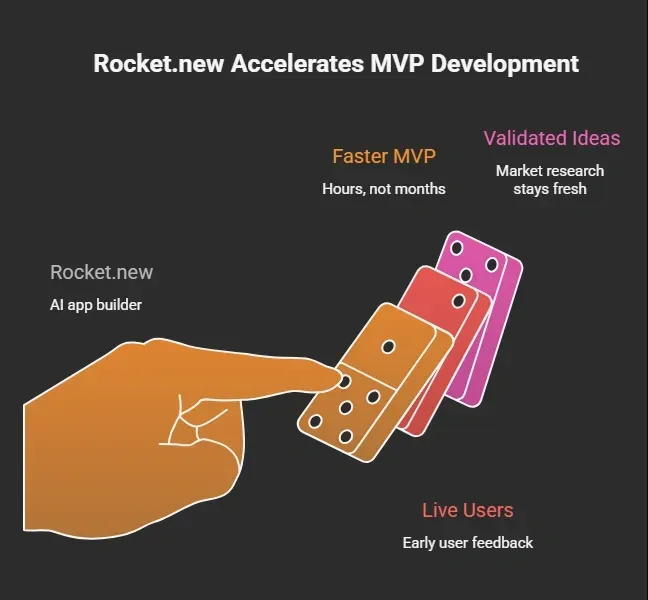
Research First, Then Build - In One Platform
Rocket.new includes Solve, a decision intelligence layer that turns market research questions into structured analysis before a line of code gets written. What does your total addressable market look like? Who are your potential competitors? What market needs are currently unserved?
Solve handles that first. Then Build takes that context directly into product generation. Your market research, competitive analysis, and user needs analysis aren't sitting in a separate tab they feed directly into what gets built.
This is the loop that traditional software development can't close: market research informs the build, the build surfaces user feedback, and user feedback updates your market understanding. All inside one platform.
What Other AI Builders Miss
Tools like Lovable, Bolt, and v0 are capable at the build step. But they start at execution. They have no opinion on whether what you asked them to build was worth building. They don't carry your market research context into the product. They don't connect your competitive intelligence to your feature prioritization decisions.
Rocket.new's positioning is clear: "They build what you tell them to build. Rocket figures out what's worth building - then builds it."
For founders using MVP development as a market sizing tool, that distinction matters at every step.
What Rocket.new Gives You for MVP Market Validation
-
Solve - Run structured market research and competitive analysis before the first line of code is written
-
Build (Web + Mobile) - Generate a production-grade minimum viable product MVP from a plain-language description, in minutes
-
Projects (Context) - Add your market research, brand guidelines, and customer insights once - they feed into every build task automatically
-
Built-in Analytics - Track user behavior, conversions, and Core Web Vitals after launch, without additional tools
-
25+ Native Tool Connections - Connect Stripe, Mixpanel, Supabase, and others directly through the build to capture real market demand data from day one
-
Staging and Production - Share your MVP with early adopters before going fully live, with full version history and one-click rollback
What Market Sizing Looks Like When You Get It Right
The market sizing MVP problem isn't really about picking the right formula. It's about how quickly you're willing to test your assumptions against what real users actually do.
Top down and bottom up market sizing give you a foundation. They shape your early business model, help you size the opportunity for investors, and give you a starting point for your marketing strategy. But they can't tell you whether your product will find product market fit in your specific market segment.
Real users tell you that. And the faster you ship a minimum viable product MVP to those users, the faster your market research goes from theoretical to actionable.
Rocket.new exists to close that gap so founders can ship faster, learn faster, and let the people who actually matter most tell them exactly what the market wants.
Table of contents
- -The Two Primary Approaches to Market Sizing
- -Top Down Market Sizing: Start Big, Filter Down
- -The Bottom Up Approach: Build From Real Data
- -Why Both Methods Still Leave You Guessing
- -MVP Development as Market Research
- -How to Conduct Market Research Using an MVP: A Step by Step Guide
- -Step 1 - Define the Core Problem First
- -Step 2 - Pick Your Target Market Segment
- -Step 3 - Feature Prioritization Before You Build
- -Step 4 - Build and Ship
- -Step 5 - Gather Feedback from Early Users
- -Step 6 - Analyze and Iterate
- -Top Down vs. Bottom Up vs. MVP: A Reality Check for Market Demand
- -Why Established Companies Still Build MVPs Before Committing
- -Launch a Rocket.new MVP and Let the Market Research Begin
- -Build a Working MVP in Hours, Not Months
- -Research First, Then Build - In One Platform
- -What Other AI Builders Miss
- -What Rocket.new Gives You for MVP Market Validation
- -What Market Sizing Looks Like When You Get It Right