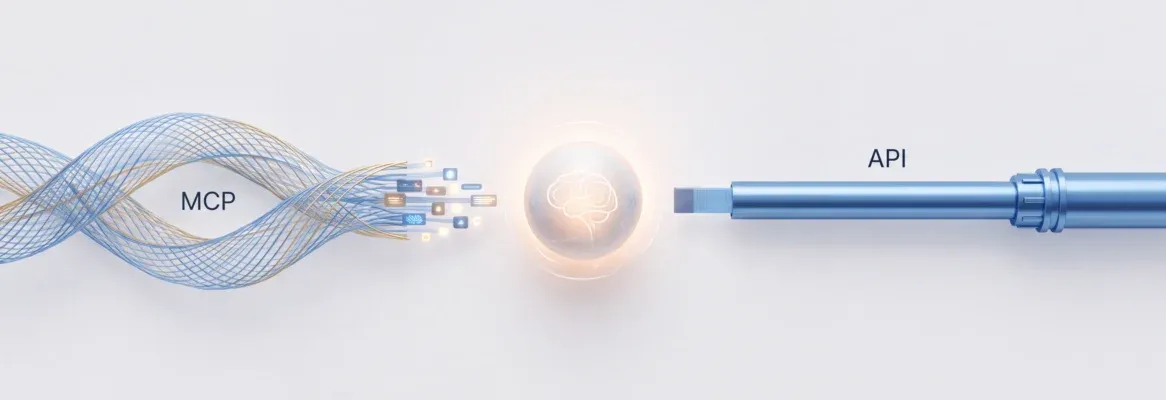
MCP (Model Context Protocol) and traditional APIs serve different roles in AI development. MCP enables agents to discover and call tools automatically, while REST APIs handle deterministic service calls. Most production apps need both.
Why Do APIs No Longer Work Alone for AI?
According to Postman's 2025 State of the API Report, 70% of developers are already aware of the Model Context Protocol. Yet only 10% use it regularly in production. That gap tells an interesting story.
APIs have powered software integrations for over two decades. REST endpoints handle billions of requests daily. So why are developers paying attention to a protocol that Anthropic released just months ago?
The answer sits at the intersection of two shifts. AI applications now need dynamic, real-time access to external tools. The old pattern of writing custom integration code for every service no longer scales when AI agents need to discover and call tools autonomously.
What Is MCP? A Plain-Language Definition
The Model Context Protocol (MCP) is an open-source standard that defines how AI applications communicate with external tools and data sources. It creates a universal interface between language models and the services they need to access.
Before MCP, connecting an AI agent to a new service meant writing custom integration code: authentication handling, endpoint mapping, error states, and pagination logic. With MCP, any service that ships an MCP server becomes instantly discoverable and callable by any MCP-compatible AI host. No custom wiring is required.
The protocol is transport-agnostic and model-agnostic. It works with Claude, ChatGPT, Gemini, and any other LLM that implements the client specification. Think of it as a USB-C port for AI applications: one standard connector that works everywhere.
What Does the Model Context Protocol Actually Do?
The Model Context Protocol creates a standardized way for AI applications to communicate with external systems. Every MCP server exposes three core primitives that define what it can offer to a connected AI agent.
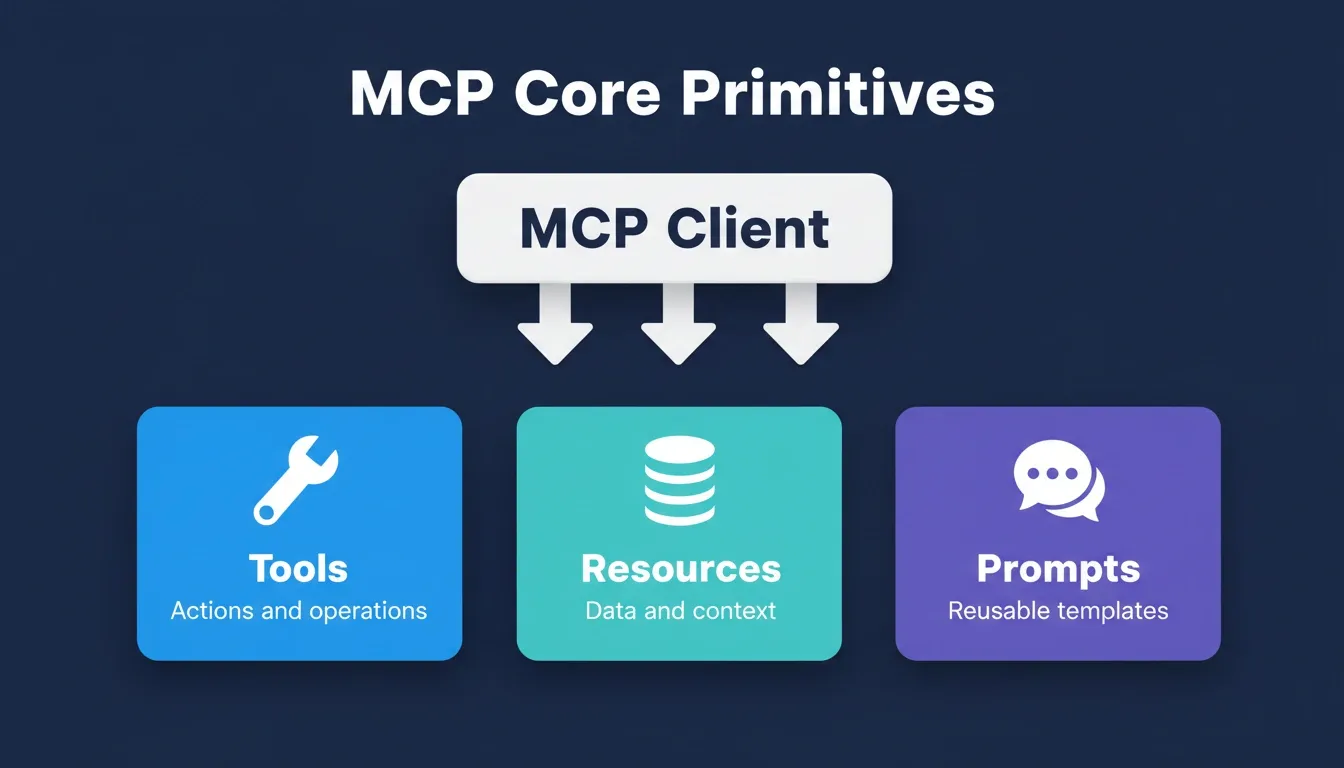
MCP's three core primitives: Tools for actions, Resources for data, and Prompts for reusable templates, all announced automatically when a client connects.
- Client-server architecture built on JSON-RPC 2.0. An AI host application (like Claude, ChatGPT, or VS Code) creates MCP clients. Each client maintains a dedicated connection to an MCP server that exposes specific capabilities.
- Three core primitives define what servers offer. Tools let AI perform actions such as database queries and file operations. Resources provide contextual data like file contents and API responses. Prompts offer reusable interaction templates.
- Automatic tool discovery replaces manual documentation. When a client connects, the server announces its available tools, resources, and prompts in a machine-readable format. The AI knows what it can do without reading docs.
- Two transport mechanisms cover local and remote use cases. Stdio handles same-machine communication with zero network overhead. Streamable HTTP enables remote server access with Server-Sent Events for streaming.
The protocol focuses solely on context exchange. It does not dictate how AI applications use language models or manage the provided context, as noted in the official MCP documentation.
How Do Traditional APIs Handle AI Integrations?
REST APIs follow a request-response pattern that has worked reliably for decades. A client sends an HTTP request to a specific endpoint. The server processes it and returns a response. The approach is simple, stateless, and well-understood.
- Endpoints are static and predefined. Each API operation has a fixed URL, method, and expected payload. Developers read documentation, write integration code, handle authentication, and manage error states manually.
- No built-in discovery mechanism exists. An AI agent cannot connect to a REST API and automatically learn what operations are available. It needs pre-programmed knowledge of endpoints, parameters, and response formats. OpenAPI specs help, but they require a separate layer of interpretation.
- Authentication patterns vary across services. OAuth, API keys, bearer tokens, and HMAC signatures each require custom handling per integration.
- Rate limiting and pagination require custom logic. Every API enforces different rules. Agents must be programmed to respect them individually.
This pattern works well when developers build integrations manually. The challenge emerges when AI agents need to interact with dozens of services autonomously. That is the problem MCP was designed to solve.
Where Do MCP vs API Approaches Diverge?
The fundamental difference is not about replacing APIs. The Model Context Protocol sits on top of APIs in many cases. It provides a standardized wrapper that AI applications can interact with programmatically.
| Dimension | Model Context Protocol | Traditional REST API |
|---|---|---|
| Discovery | Automatic: server announces capabilities on connection | Manual: developer reads docs and writes integration code |
| Communication | Bidirectional via JSON-RPC with notifications | Unidirectional request-response over HTTP |
| Session State | Protocol version and capabilities sent per request | Stateless by default |
| Multi-service | One protocol connects to any MCP-compatible server | Separate code per API integration |
| AI Optimization | Built for machine consumption and tool calling | Designed for human developers |
| Real-time Updates | Subscription-based notifications for changes | Polling or webhooks (varies per service) |
For teams evaluating how to structure these integrations, API integration best practices are worth reviewing before committing to an architecture.
MCP servers typically wrap underlying REST APIs. They add a standardized discovery and orchestration layer that AI agents can use without custom integration code.
MCP vs REST API vs GraphQL: How They Compare
It is worth clarifying where GraphQL fits in this picture. GraphQL is a query language for APIs. It improves how clients request data from a single service, but it still requires pre-programmed knowledge of the schema. Like REST, it has no built-in discovery mechanism for AI agents. MCP operates at a different layer entirely.
| Dimension | Model Context Protocol | Traditional REST API | GraphQL |
|---|---|---|---|
| Discovery | Automatic at runtime | Manual, docs required | Manual, schema required |
| Communication | Bidirectional JSON-RPC | Unidirectional HTTP | Query-based HTTP |
| AI Optimization | Built for agent tool calling | Designed for human developers | Designed for flexible data fetching |
| Real-time Updates | Native subscriptions | Polling or webhooks | Optional subscriptions |
| Primary Use Case | AI agent orchestration | Web service integration | Flexible data APIs |
When Should You Choose One Over the Other?
This is not an either-or decision for most teams. The right approach depends on what you are building and who consumes the integration.
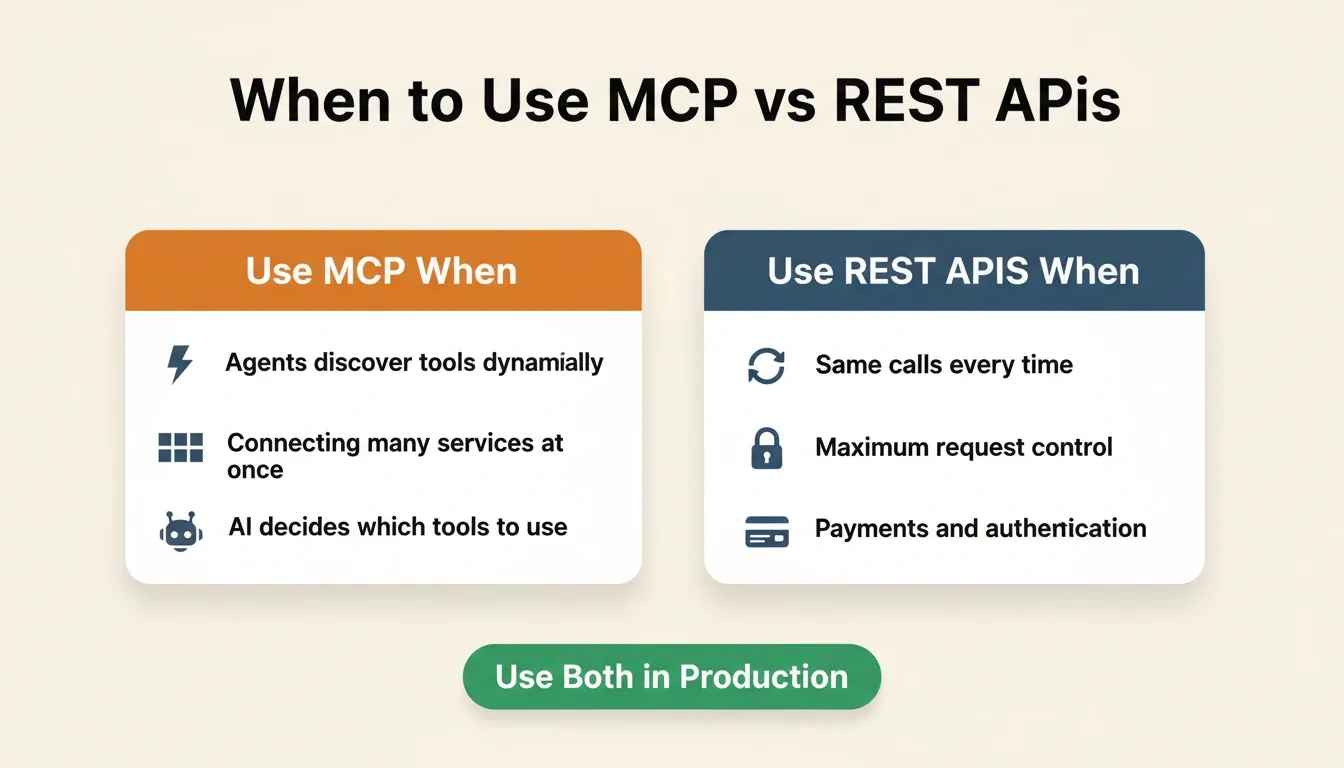
Use MCP for dynamic, agent-driven workflows. Use REST APIs for predictable, deterministic operations. Most production systems need both.
Use MCP when:
- Your application involves AI agents that need to discover and call tools dynamically.
- You want to reduce per-service integration boilerplate across many services.
- You are building agentic workflows where the AI decides which tools to invoke.
Use direct REST APIs when:
- Your application makes the same API calls in the same order every time.
- You need maximum control over request construction and error handling.
- The service has no MCP server and the integration is simple enough to write directly.
Use both in production: Most real-world AI applications combine protocol-based tool access for the AI layer with direct API calls for deterministic operations. A customer support agent might use MCP to discover and call knowledge base tools dynamically. At the same time, the same application uses a direct Stripe API call for subscription management, because that flow never changes.
Real-World MCP Use Cases
Understanding the theory is useful. Seeing where MCP actually gets deployed makes the decision clearer.
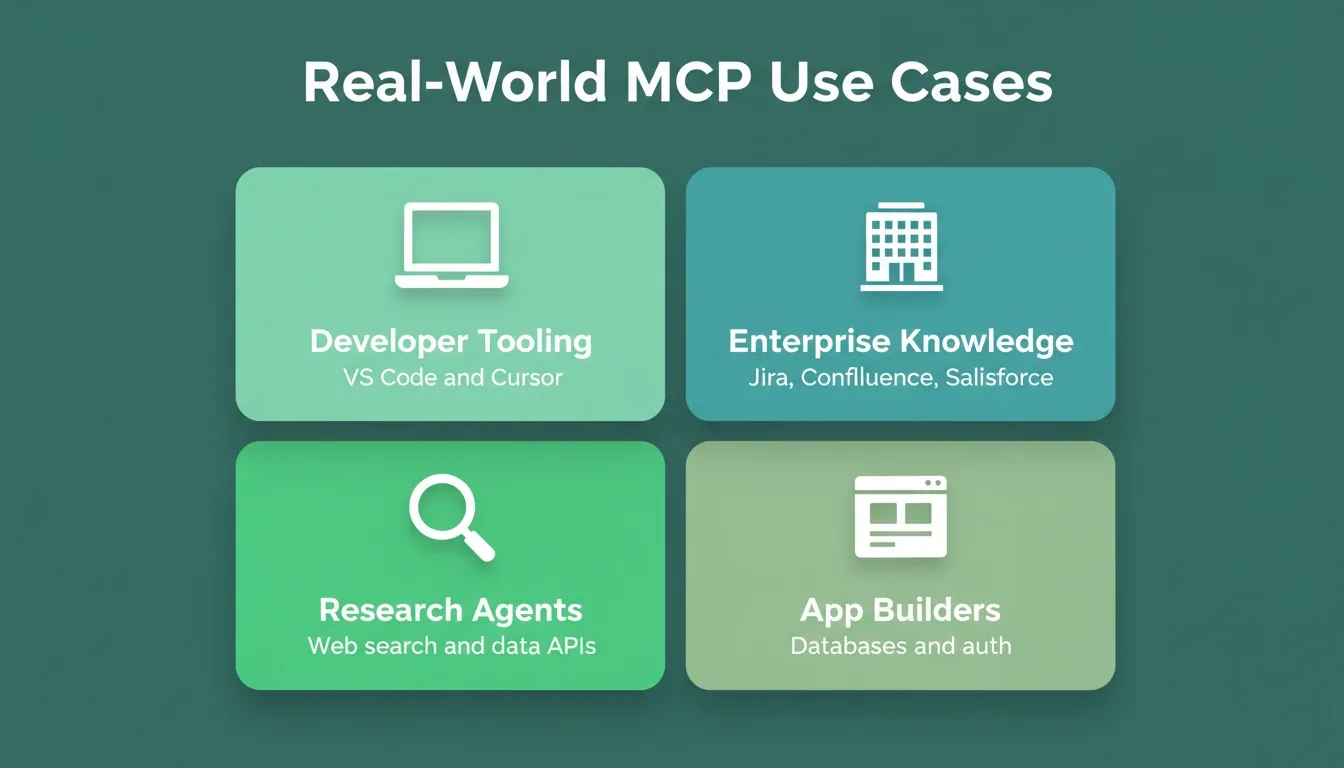 MCP in practice: developer tooling, enterprise knowledge retrieval, autonomous research agents, and AI-powered app builders.
Developer tooling: VS Code Copilot, Cursor, and other AI coding assistants use MCP to give their agents access to file systems, terminals, documentation, and external services. Instead of hardcoding integrations for every tool a developer might use, the AI discovers available tools at runtime.
Enterprise knowledge retrieval: Organizations deploy MCP servers in front of internal knowledge bases, CRM systems, and project management tools. An AI assistant can then query Confluence, Jira, and Salesforce through a single standardized interface, without separate integration code for each.
Autonomous research agents: AI research agents use MCP to connect to web search, document stores, and data APIs. The agent decides which tools to call based on the research task. This capability would require extensive custom routing logic with traditional API integrations.
AI-powered application builders: Platforms that generate applications from natural language descriptions use MCP-style tool connections. Their agents access databases, authentication services, and third-party APIs during the build process. Teams exploring this pattern can see how an AI-powered API builder handles authentication automatically.
Security Considerations for Production MCP Deployments
Security is a top concern for teams evaluating MCP for production use. Fortunately, the protocol has matured significantly in this area.
- OAuth-based authentication is supported natively. The June 2026 Enterprise-Managed Authorization extension added centralized SSO across connected servers.
- Least-privilege access is a best practice. Each MCP server should expose only the tools and resources the connected AI agent actually needs.
- Input validation against JSON Schema prevents injection attacks through tool parameters.
- Short-lived tokens reduce the blast radius of credential exposure.
- Transport-level encryption (TLS) is required for all remote Streamable HTTP connections.
The protocol supports enterprise-grade security when implemented correctly. The risk is not in the protocol itself but in implementation shortcuts: overly broad tool permissions, long-lived credentials, and missing input validation. Teams building production systems should review web application security best practices alongside MCP implementation guides.
How Rocket Connects AI Intelligence to Production Apps
You type what you want to build. The question is what happens before that line gets written.
Rocket is the world's first Vibe Solutioning platform, where strategic research, AI app building, and competitive intelligence connect in a single workspace. 1.5 million people have tried Rocket across 180 countries. It is backed by Salesforce Ventures and Accel.
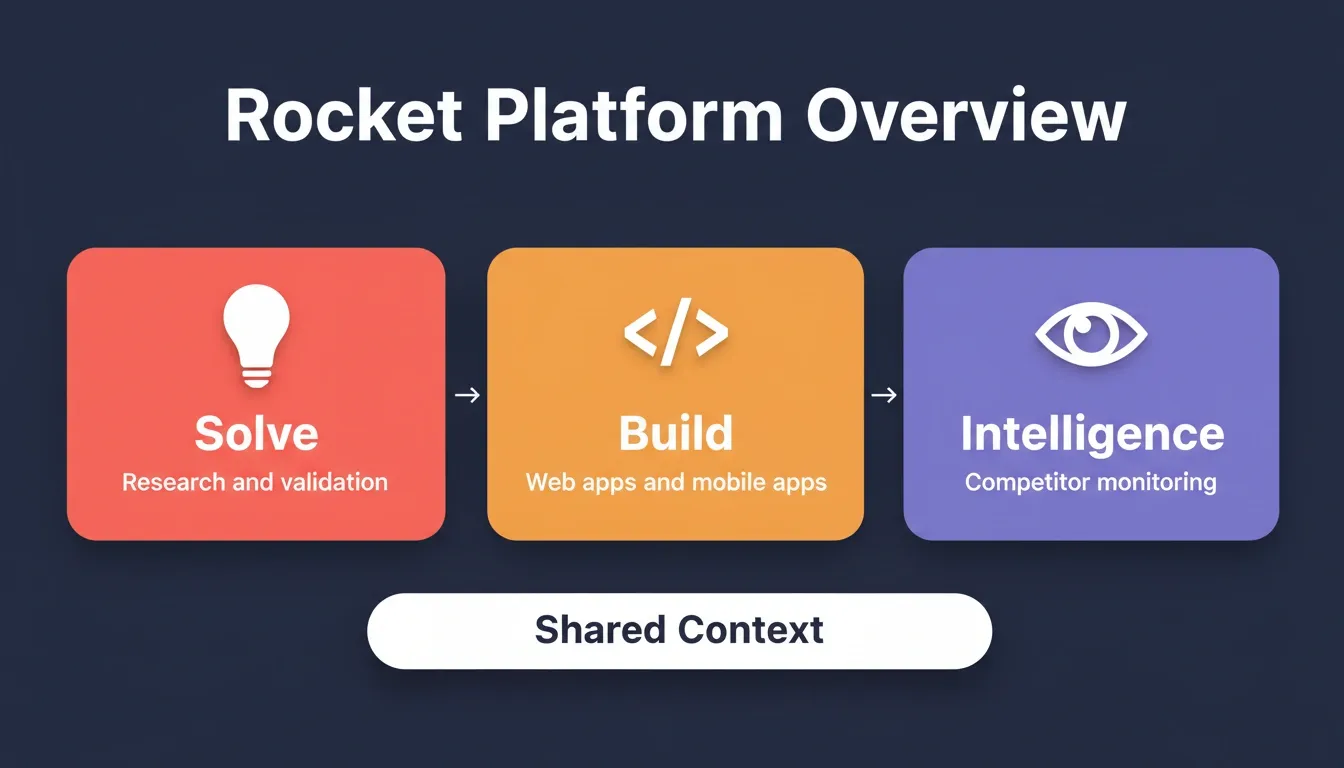
Rocket's three pillars, Solve, Build, and Intelligence, share context automatically so every task builds on what came before.
Rocket is built on three pillars that share context automatically:
- Solve validates ideas, runs market research, creates PRDs, and delivers structured reports with data, insights, and recommendations, before a single line of code is written.
- Build generates production-ready web apps in Next.js and mobile apps in Flutter from natural language. Every build ships with SEO-ready structure, WCAG accessibility compliance, and GDPR coverage by default.
- Intelligence monitors competitors continuously. It delivers automated daily briefs, pricing change alerts, and trend signals to a live dashboard.
What makes this relevant to the MCP vs API discussion: Rocket's Build pillar connects 26+ services directly into generation. Stripe, Supabase, Google Analytics, Notion, Linear, Airtable, Mailchimp, Mixpanel, OpenAI, Anthropic, Gemini, and others authenticate once and flow into every build. Describe what you want, and Rocket handles the integration layer automatically, with no custom wiring per service.
The shared context architecture means nothing gets lost between steps. The competitive intelligence from last week is present when the developer opens the build task today. Every task compounds on previous decisions. That is the architectural difference between a platform and a collection of tools.
What the Industry Data Reveals About Adoption
The numbers paint a clear picture of where the industry is heading. The protocol ecosystem is growing at a pace rarely seen in open-source infrastructure.
- SDK downloads crossed a significant threshold. According to the official MCP documentation, both the TypeScript and Python SDKs have each surpassed 1 billion total downloads, with combined monthly downloads approaching half a billion.
- Awareness far outpaces production usage. Postman's 2025 data shows 70% awareness but only 10% regular usage. Additionally, 24% plan to start soon. The gap represents an opportunity for teams that adopt early.
- 89% of developers now use AI in daily work. Yet only 24% design their APIs with AI agent consumption in mind. This creates a mismatch between how software gets built and how it gets consumed.
The convergence is clear. Teams building AI applications today need both patterns: robust APIs for deterministic operations and protocol-aware connections for autonomous agent behavior.
Building for the Protocol-First Future
The distinction between MCP vs API approaches will matter less over time. As the protocol layer matures, more services will ship compatible servers. What matters now is building applications that can adapt to both patterns without rewriting infrastructure every time a new standard emerges.
The practical path forward for most teams:
- Audit your current integrations. Identify which ones AI agents call dynamically versus which application code calls deterministically.
- Wrap dynamic integrations first. Start with the services your AI agents call most frequently. These benefit most from MCP's discovery mechanism.
- Keep deterministic flows as direct API calls. Payment processing, authentication, and scheduled data syncs do not need the overhead of protocol negotiation.
- Choose a platform that handles the integration layer. The teams shipping fastest are not managing their own MCP infrastructure. They are building on platforms that handle it.
The MCP vs API Decision Starts Before the Code
MCP and traditional APIs are not competing standards. They solve different problems at different layers of the stack. As AI agents become the primary consumers of external services, teams that understand both patterns will ship faster and debug less.
The MCP vs API question will only grow more relevant as agentic applications move from experiment to production. The protocol layer is maturing, the tooling is improving, and the adoption gap documented by Postman's 2025 data is closing. Teams that build with both patterns today are not chasing a trend. They are laying the foundation for how software will be built next.
You type the problem. Rocket researches it, recommends a direction, and builds from that direction. Start your first project on Rocket.new and let shared context drive every decision from research to deployment.
Table of contents
- -What Is MCP? A Plain-Language Definition
- -What Does the Model Context Protocol Actually Do?
- -How Do Traditional APIs Handle AI Integrations?
- -Where Do MCP vs API Approaches Diverge?
- -MCP vs REST API vs GraphQL: How They Compare
- -When Should You Choose One Over the Other?
- -Real-World MCP Use Cases
- -Security Considerations for Production MCP Deployments
- -How Rocket Connects AI Intelligence to Production Apps
- -What the Industry Data Reveals About Adoption
- -Building for the Protocol-First Future
- -The MCP vs API Decision Starts Before the Code