
Looking for a fast way to create apps without coding? A no-code mobile app builder with AI lets anyone quickly design, deploy, and manage apps using templates and smart automation.
Can building an app really be this simple now?
Sounds like a stretch, right?
For years, building an app meant writing code, fixing bugs, and fighting deadlines.
That story is changing fast.
Today, people can build full apps without deep coding experience, often using AI-driven tools. According to Gartner, over 70% of new applications will be built using no-code or low-code platforms.
So yes, app building has shifted. And it’s not just for developers anymore.
Let’s walk through how this actually works.
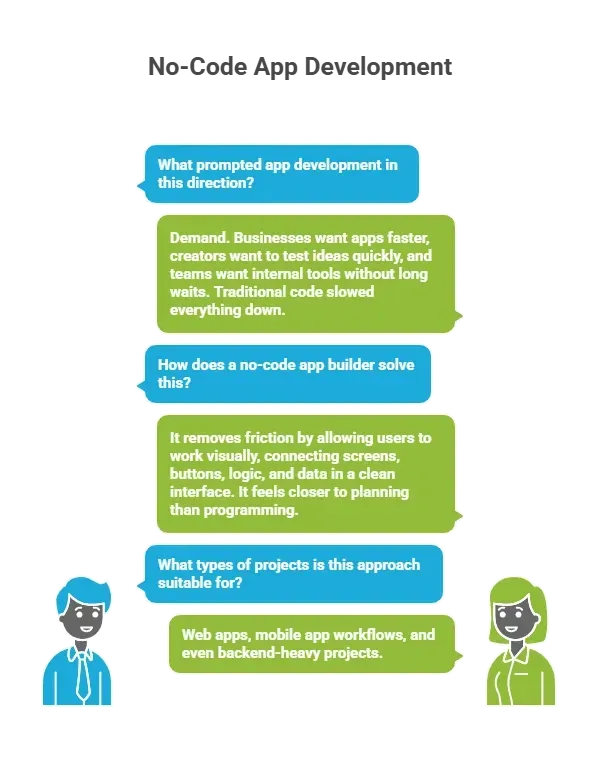
What prompted app development in this direction?
Demand. Simple as that.
Businesses want apps faster. Creators want to test app ideas quickly. Teams want internal tools without long waits. Traditional code slowed everything down.
Why does no-code feel easier than expected?
Most people assume no code is limited. That’s outdated thinking.
Modern no-code platforms support complex flows while keeping the learning curve reasonable. Users focus on structure and logic, not syntax errors.
Here’s what usually clicks fast:
- Visual programming language instead of raw code
- Pre built components for common features
- Easy ways to add features without breaking things
- Clear control over app's design
The result? A complete app without the usual stress.
Web apps and mobile apps: picking the right path
This question comes up every time.
Web apps run in browsers. They work across devices and update instantly. Many teams start here because it’s simple.
A mobile app is installed on a phone. It can be native mobile or cross platform. Native mobile apps feel smoother and integrate more effectively with device hardware.
Some app builders support both. Others focus on one path.
There’s also the progressive web app option. It loads in a browser but behaves like a mobile app.
Quick comparison:
| Type | Best for | Install | Device access |
|---|---|---|---|
| Web apps | Fast launches | No | Limited |
| Mobile app | User engagement | Yes | Full |
| Progressive web app | Mixed use | Optional | Medium |
The choice depends on the idea, users, and device requirements.
From idea to first app without panic
Every app starts with an idea. Some stay small. Others grow.
A no-code app builder lets people test app ideas without long delays. That matters.
Common early projects include:
- Booking systems
- Community platforms
- Fitness trackers
- Simple AI app dashboards
- Team internal tools
The first app rarely looks perfect. That’s fine. After that, creators gradually add features and improve the flow.
This approach feels lighter. And honestly, more fun.
Handling backend, data, and storage without pain
Apps need structure behind the scenes. That’s where backend work lives.
Most no-code platforms handle backend logic quietly. Users connect data sources, manage database tables, and control workflows visually.
Typical features include:
- Built-in database support
- External database connect options
- File storage for images and documents
- API connect for other apps
Some platforms also sync with Google Sheets for quick setups.
No heavy coding knowledge needed. No guessing.
AI shows up and makes things smoother
AI didn’t change app building overnight. It quietly stepped in where things felt repetitive and slow. Instead of taking control, it started handling the parts that usually drain time and attention.
Many app builders now use AI to assist with logic, layout, and workflows. Users type natural language prompts. The system responds with structure.
This further reduces the coding required.
Some platforms support:
- AI-powered features for workflows
- AI agents for automation
- Smart suggestions for layout and logic
Ultimately, AI works best in the background. It clears small obstacles, shortens steps, and keeps app building focused on decisions rather than repetition. The work still belongs to humans. AI just keeps it moving.
Native mobile apps without traditional coding
Native mobile apps used to feel out of reach unless someone lived and breathed code. That assumption stuck around longer than it should have, even as tools quietly improved.
A native mobile app once meant months of code. Today, no-code platforms do not enable native mobile builds without deep coding experience.
Apps can be launched on iOS and Android, including via the Apple App Store.
Users still control screens, data flow, and logic. The difference is the interface.
What’s changed isn’t the goal, but the path. Native mobile apps still demand clear thinking and solid structure. The difference now is fewer layers of code standing in the way of getting there.
Community insight: what builders actually say
People talk honestly about this online.
A Reddit thread on r/nocode shared this:
“I shipped a working app using no-code tools with no prior coding experience. It wasn’t fancy, but users signed up and stayed.”
That’s the pattern. Working beats perfect.
Rocket.new and why it fits this shift
Rocket.new focuses on fast app building using AI and a clean structure.
It helps users create web apps and mobile flows without juggling tools. The platform turns natural language prompts into functional layouts and logic.
Top features:
- Text to App Creation – Builds apps directly from simple text prompts
- Figma Import – Converts design files into live, editable layouts
- AI Powered Backend – Automatically handles logic, data, and workflows
- Custom Domain Support – Publishes projects with a branded domain
- Code Export – Allows developers to extend or customize later
- Live Preview – Shows instant updates while editing
- Reusable Components – Speeds up building with ready-to-use elements
Use cases :
- Startup MVPs: Teams test a new app idea without long delays.
- Internal tools: Companies build dashboards and workflows for teams.
- AI app projects: Creators build AI-powered apps with built-in AI features.
- Client projects: Freelancers deliver complete app solutions faster.
Rocket.new doesn’t try to impress with noise or promises. It focuses on structure, clarity, and steady progress, making app building feel manageable rather than rushed.
Pricing, free plans, and scaling calmly
Pricing often feels like the moment where curiosity turns into hesitation. That’s why most no-code platforms keep the first step light and low commitment.
Paid plans usually scale based on:
- Users
- Data limits
- Features
- Billed annually options
This approach keeps things steady. Users experiment freely, scale when ready, and avoid surprises along the way. App growth stays intentional, not rushed.
Clearing up common myths
Some still think no-code apps can’t scale. That’s old news.
Modern platforms support:
- Advanced logic
- Full stack applications
- Secure backend systems
- Native mobile builds
Another myth is that write code never appears. Some platforms allow optional code. That’s flexibility, not a flaw.
Low code exists for edge cases.
Is the learning curve manageable?
Yes. It exists, but it’s friendly.
Templates, guides, and visual tools help users move fast. Most people learn by building, breaking, and fixing.
No deep coding experience required. No heavy theory.
Just progress.
Who actually benefits from this?
No code works well for:
- Founders testing app ideas
- Creators launching a new app
- Businesses building internal tools
- Designers are tired of waiting
If speed and control matter, this approach fits.
Why does this save time without shortcuts?
No code eliminates the repetitive parts of app development that slow teams down. Instead of rewriting the same logic or layouts, builders work with visual structures that are faster to update.
It also reduces the need for large teams. One person or a small group can handle tasks that once required multiple roles.
Most importantly, control remains with the builder. Changes happen quickly, decisions stay clear, and progress doesn’t stall over small technical hurdles.
Mobile app no-code builder with AI
A no-code mobile app builder with AI reshapes how apps are created. It reduces friction, shortens build cycles, and keeps the focus on ideas rather than syntax. With the right app builder, creating and launching apps feels structured, calm, and doable, even for people without deep coding knowledge.
It also opens doors for experimentation. Creators can test new app ideas, iterate quickly, and refine features without getting stuck on code. In other words, the focus shifts from struggling with syntax to building something that actually works and delights users.
Table of contents
- -What prompted app development in this direction?
- -Why does no-code feel easier than expected?
- -Web apps and mobile apps: picking the right path
- -From idea to first app without panic
- -Handling backend, data, and storage without pain
- -AI shows up and makes things smoother
- -Native mobile apps without traditional coding
- -Community insight: what builders actually say
- -Rocket.new and why it fits this shift
- -Use cases :
- -Pricing, free plans, and scaling calmly
- -Paid plans usually scale based on:
- -Clearing up common myths
- -Is the learning curve manageable?
- -Who actually benefits from this?
- -Why does this save time without shortcuts?
- -Mobile app no-code builder with AI