
Rocket.new helps founders turn ideas into live MVPs in as little as 7 days without a development team. The platform handles the full tech stack, including backend, auth system, database, and deployment. Faster MVP validation means less wasted time, lower costs, and quicker feedback from real users.
What if you could take an idea from your head to a live product in a week, without a development team?
That's not hype. AI app builders have made this the new normal. And the data backs up why speed matters: 42% of startups fail because they build products nobody wants, according to CB Insightsdata cited by Founders Forum. The fix isn't better planning.
It's faster validation getting a working MVP in front of real users before you spend months and tens of thousands of dollars on the wrong direction.
This guide covers how to do exactly that, and why Rocket.new is the platform the founders are using to pull it off in 7 days.
Why Most Founders Never Actually Ship
Most founders get stuck in a loop. They plan the app. They debate the tech stack. They sketch out features they'll "add later." Six months go by. Nothing ships.
The old MVP building process was genuinely painful. Hiring a development team, wiring up user authentication from scratch, configuring database schemas, handling session management, setting up deployment - all of that before a single real user ever saw the product.
Traditional MVP development with a professional development team costs between $15,000 and $120,000. That's a serious bet to place on an idea that hasn't been tested yet.
AI-powered tools have changed the equation. AI app builders now compress development cycles from 2-3 months to just 1-7 days, according to nxcode.io's 2026 research. Non technical founders can build and ship complete applications without any technical knowledge - and the gap between idea and validated idea has never been smaller.
What a Real MVP Actually Is
An MVP - Minimum Viable Product - is a fully functional product built around core features, designed to test an idea with real users as fast as possible.
Most founders misread the word "minimum." They either overbuild - packing in every feature they imagined - or they underbuild, shipping something so stripped down it can't actually be used by real users. Neither approach gets you feedback that matters.
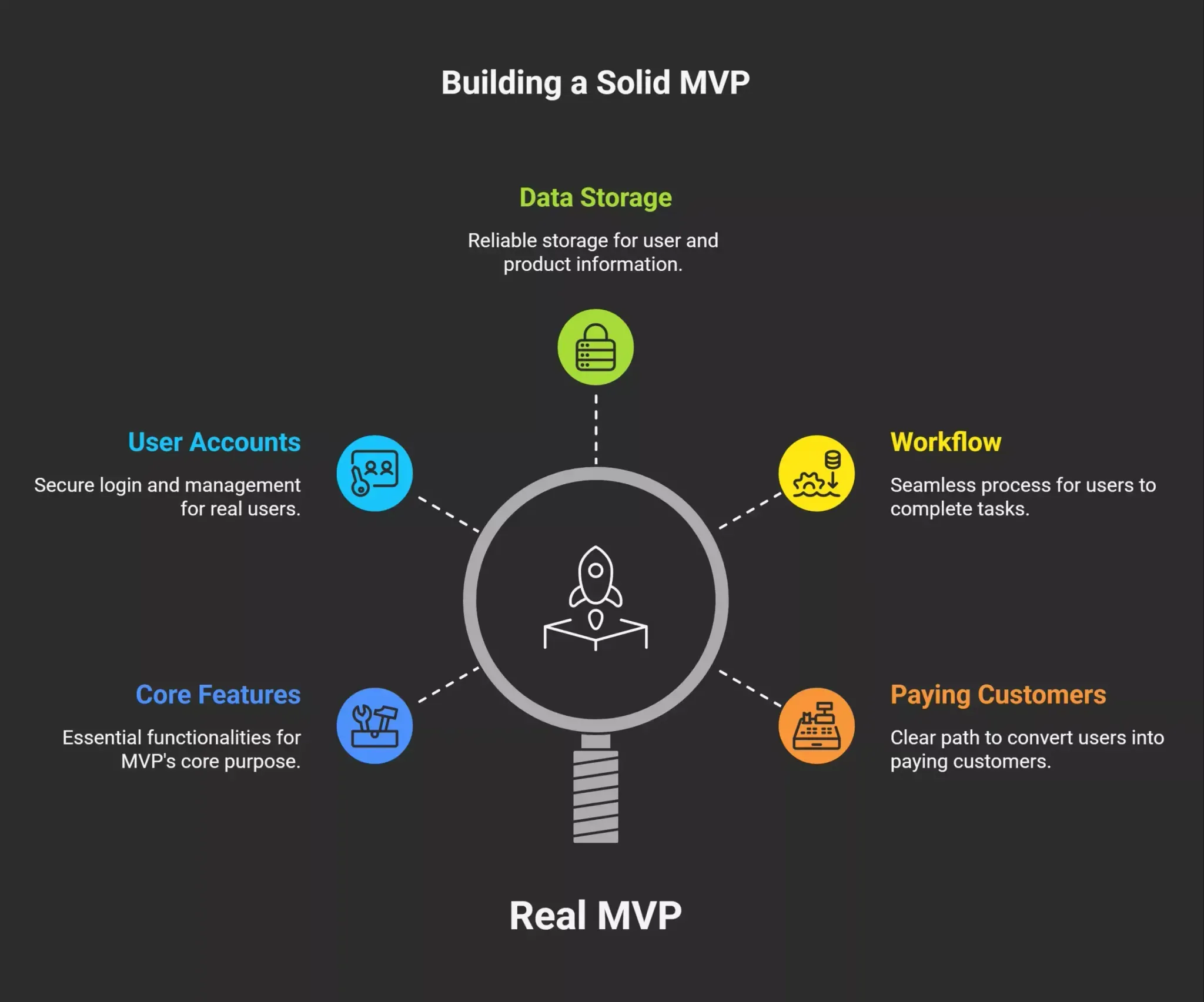 A solid MVP:
-
Solves one specific problem for a specific person
-
Has working user accounts and an auth system
-
Stores data and handles the core workflow end-to-end
-
Lets real users complete the main task from start to finish
-
Creates a clear path toward paying customers
Getting to a working prototype quickly is the whole game. The sooner you test it with real users, the sooner you know whether the idea is worth the full build.
The MVP Feature Decision Table
| Category | Examples | Build in MVP? |
|---|---|---|
| Core functionality | Auth system, core workflow, data models | Yes |
| Supporting features | Email notifications, basic analytics | Maybe |
| Nice-to-have | Advanced filters, dark mode | No |
| Future scope | New features, complex API endpoints | Later |
| Launch requirements | Custom domain, pricing page | Yes |
If a feature doesn't directly test your core idea, it waits. This discipline is what makes the 7-day timeline real - and what separates founders who ship from those still planning.
How AI App Builders Changed MVP Building
A few years ago, non-technical founders had two real options: learn to code, or find a technical co-founder. Both paths were slow. Both had obvious constraints.
That's changed. The no-code AI platform market sits at $6.56 billion in 2025 and is projected to reach $75 billion by 2034. No-code platforms can cut development time by up to 90%. Citizen developers already outnumber professional software developers four to one.
The result is an entirely new kind of founder: the solo founder who ships complete applications without writing a single line of code. Someone who can go from rough idea to validated idea in under a week - and get their MVP in front of customers before competitors even finish hiring.
What Non-Technical Founders Used to Have to Wait For
Building an MVP with a development team used to mean:
-
Weeks debating tech stack choices
-
Setting up database schemas, backend infrastructure, and deployment from scratch
-
Waiting for engineers to implement each change
-
A $20,000 to $50,000 bill before you heard from a single user
That process hasn't disappeared entirely. But it's no longer the only path for founders who need to test an idea fast.
The Real Talk from the Builder Community
Parisa Zare, a product consultant working with early-stage founders, shared this in a recent LinkedIn post:
"People with strong ideas no longer need to wait for a technical co-founder to bring them to life. You do not need to code. You do not need to hire a developer on day one. You need the right tools and, more importantly, the right way of thinking about building software."- Source: Parisa Zare on LinkedIn
This is the shift. The tools have caught up to the ideas. For most founders right now, the real bottleneck isn't code - it's clarity on what to build and the courage to ship it early.
A Practical 7-Day MVP Plan
Here's how to turn an idea into a live MVP in one week:
Days 1-2: Define and Scope
Before you write a prompt or a single line of code, write down:
-
The one problem your MVP solves
-
Who the target user is - get specific
-
The 3-5 core features that test the idea
-
What you'll measure to call the MVP a success
This step is not optional. A vague brief produces a vague app. Clarity here makes the build 10x faster, and it makes the feedback you collect on day 6 actually useful.
Days 3-5: Build the App
With a clear scope in hand, describe your app in plain language and let your AI app builder generate it. A good platform handles the full tech stack: frontend, backend, user authentication, data models, database, session management, and API endpoints.
Most apps take 1-3 minutes. After that, you iterate through chat - add a screen, fix a flow, connect a payment demo, swap a layout. Each round refines the working prototype. No developers on call.
Day 6: Test with Real Users
Five to ten real user sessions tell you more than weeks of internal review. Put the app in front of real users who match your target. Don't guide them.
Look for:
-
Where they get stuck or confused
-
What they try to do that doesn't exist yet
-
What questions they ask before they can complete the core task
Log every friction point. This becomes your next build list.
Day 7: Launch and Collect Feedback
Ship the MVP. Connect a custom domain. Write a short launch post. Get the link in front of the right people.
The goal at launch is not a perfect final product. It's to get real users in the app so you can test assumptions with real data - and start learning what actual paying customers want from the entire product.
From here, you iterate weekly. Add new features based on real usage. Cut what nobody uses. Keep shipping.
Build Your SaaS MVP with Rocket.new
Rocket.new is the world's first Vibe Solutioning platform designed for founders who want the thinking and the building in one place.
Over 1.5 million people across 180 countries have tried Rocket.new. Here's why MVP builders keep coming back to it:
AI-Powered Build from a Single Prompt
Describe your app in plain language. Rocket.new generates a fully functional product with its Build feature - complete UI, navigation, logic, production-ready code. Web apps use Next.js. Mobile apps use Flutter. A live preview is ready in 1-3 minutes.
You can build:
-
SaaS MVPs with user accounts, billing, and a full database
-
Internal tools for your team or clients
-
Landing pages to test demand before you write a single line of code
-
Mobile apps ready for iOS and Android from a single Flutter codebase
-
Customer portals, dashboards, and onboarding systems
Full Tech Stack, Ready Instantly
No more stack setup. Rocket.new handles the entire tech stack - backend logic, user authentication, database schemas, data models, API endpoints, and session management - as part of the build.
The platform ships with 25+ integrations: Stripe for billing, Supabase for database, Mailchimp, Mixpanel, Notion, Airtable, and more. Authenticate once, and they connect to every app you build.
Lovable generates frontends fast - but handling deployment, backend, and database configuration still lands on you. That's the time a solo founder or small team can't afford when you're trying to ship in 7 days.
Three Ways to Iterate, No Limits
Once your app is generated, you refine it in three ways:
-
Chat: plain-language instructions ("Add a pricing page with three tiers", "Fix the mobile layout on the signup screen")
-
Visual Edit: click any element in the live preview and change it directly
-
Code: open the source files for more control over the final product
There's no cap on changes. Test after every significant iteration. Ship when it's ready.
SaaS MVP to Internal Tools - Same Platform
Rocket.new isn't just for customer-facing apps. Teams use it to build internal tools - OKR trackers, customer health dashboards, onboarding systems, and compliance trackers. Things that used to take a full development team weeks now take a single afternoon.
The same platform handles your SaaS product and your team's internal tools - with shared context across every build.
What Competitors Miss
Lovable generates apps at speed, but there's no pre-built intelligence layer. If your idea isn't solid before you type the prompt, Lovable builds the wrong thing anyway. It doesn't research the market, surface competitor moves, or help you validate a concept - it only executes.
Bubble gives developers more control over database schemas and workflows, but that control comes at the cost of a steep learning curve. Setup time for the auth system, backend logic, and data structure can easily eat the first three of your seven days.
Rocket.new takes a different approach. Its Solve feature can help you research the market, define what's worth building, and feed that directly into the build. The thinking connects to the code. Everything runs through shared context, so decisions you make on day 1 inform what gets generated on day 3.
That's the real difference between shipping a validated idea and shipping an assumption.
Ship the MVP, Then Learn What to Build Next
Here's the trap most founders fall into: they wait for a perfect product before they show it to real users. That's how you end up six months in, having never collected a single piece of real feedback or heard from a paying customer.
The 7-day approach flips that sequence. Ship an MVP quickly. Test it with real users on day 6. Launch on day 7. Learn before you commit to the full build.
MVP building: the Rocket.new way isn't a shortcut. It's the right order of operations - think first, build fast, test early, ship often. The tech stack is handled. The backend is handled. User authentication, database schemas, deployment, and your custom domain are all handled. What's left is the work that actually matters: getting your idea in front of real users who might pay for it, and learning fast enough to build something they actually want.
Launch your MVP in 7 days with Rocket.new and start validating your idea before competitors even begin building.
Table of contents
- -Why Most Founders Never Actually Ship
- -What a Real MVP Actually Is
- -The MVP Feature Decision Table
- -How AI App Builders Changed MVP Building
- -What Non-Technical Founders Used to Have to Wait For
- -The Real Talk from the Builder Community
- -A Practical 7-Day MVP Plan
- -Days 1-2: Define and Scope
- -Days 3-5: Build the App
- -Day 6: Test with Real Users
- -Day 7: Launch and Collect Feedback
- -Build Your SaaS MVP with Rocket.new
- -AI-Powered Build from a Single Prompt
- -Full Tech Stack, Ready Instantly
- -Three Ways to Iterate, No Limits
- -SaaS MVP to Internal Tools - Same Platform
- -What Competitors Miss
- -Ship the MVP, Then Learn What to Build Next