
Solve on Rocket.new turns a strategic question into a board-ready report in under an hour. It produces a structured, multi-source output with an executive summary, live data, and recommendations, exportable as PDF, PowerPoint, or HTML.
Yes. Solve on Rocket.new turns a strategic question into a structured, evidence-backed report in under an hour, with an executive summary, supporting analysis, and recommendations you can export as a PDF, PowerPoint, or HTML file and walk straight into the boardroom.
What Does a Board Deck Actually Need to Land?
How long should it take to build a presentation that holds up when the board starts asking questions?
Most people spend days gathering information, waiting on input from other teams, and stitching pages together across multiple tools. A 2026 analysis found that AI tools can generate roughly 80% of a board deck structure in under a minute when given the right prompt.
The core problem is not effort. It is how disconnected your thinking, your data, and your output stay throughout the process.
Why Board Presentations Take Days Instead of Hours
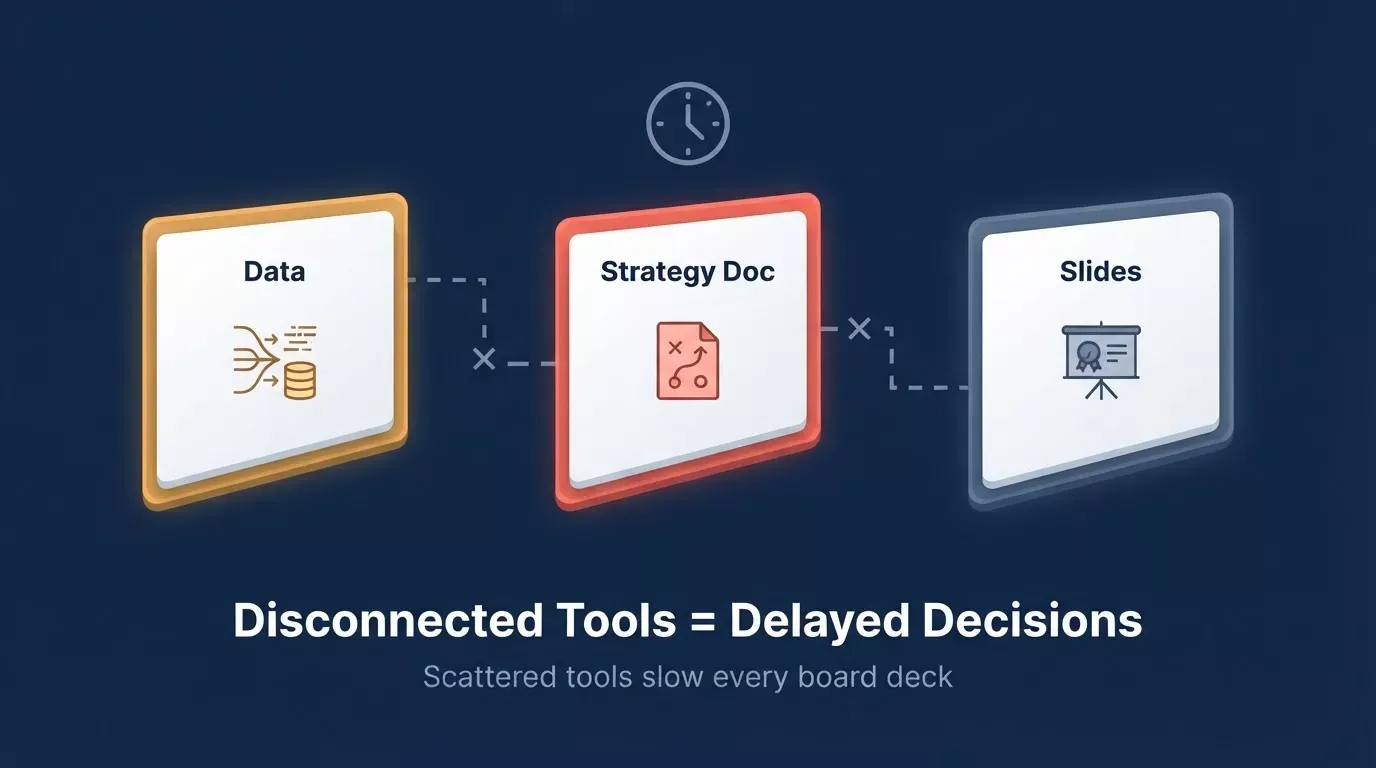
Three separate tools, zero shared context. This is where board deck delays begin.
Scattered Tools, Scattered Thinking
Teams face delays in decision-making because disconnected tools and unclear context slow progress. Your data lives in one system, your strategy doc in another, your slides in a third. That is where gaps appear: waiting on formatting, waiting on alignment, waiting on someone to fix an error in the charts.
The Whole Experience Breaks Down
When workflows are scattered, the whole experience of going from concept to presentation slows down. The background for the call gets lost. The person who builds the deck does not have the same context as the person who wrote the strategy.
You end up waiting longer on process overhead than on the actual thinking.
What Board Ready Slides Actually Need
Structure That Matches How Boards Think
Board presentations work best with 4 to 6 high-impact slides instead of 30 pages of detail. An Executive Summary should answer the situation, the recommendation, and the required decisions upfront, ideally in one sentence.
A strong call to action section up front helps the board move forward faster.
Analytical Models and Logical Flow
McKinsey-style reports follow a pyramid: lead with the answer, then show the data. Strategy frameworks like SWOT, Porter Five Forces, and TAM/SAM/SOM give pages a logical flow that boards trust.
Risk analysis, growth projections, and competitive pages all need live data, not last quarter guesses.
| Board Deck Element | Default Approach | What Actually Works |
|---|---|---|
| Executive Summary | Written last | Written first, then refined |
| Data pages | Old dashboard screenshots | Connected live metrics |
| Risk analysis | Generic bullet points | Specific risks with owners |
| Strategy pages | Reused from last quarter | Mapped to current signals |
| Tone and structure | Inconsistent across slides | One voice, one logic throughout |
How Solve Works: From Question to Board-Ready Report
Solve is Rocket.new research engine. Unlike a chatbot that gives you a paragraph answer from training data, Solve produces a structured, multi-source report with an executive summary, supporting evidence, and actionable recommendations, built from live data, not cached knowledge.
Understanding how Solve works makes it clear why it outperforms generic AI tools for high-stakes deliverables. Here is the Full Solve pipeline, step by step:
- Ask a business question in plain language, for example: What is the market opportunity for AI-powered board reporting tools in the US?
- Prompt intelligence scores your prompt. If the question is ambiguous, Solve asks clarifying questions before starting, so research stays on target.
- The question is decomposed into its component dimensions. Each dimension becomes an independent research query.
- Parallel agents research each stream simultaneously, pulling live data and synthesizing findings.
- A structured report is generated with an executive summary, detailed analysis, supporting evidence, and recommendations.
- Export as PDF, PowerPoint, or HTML and take it straight into the boardroom.
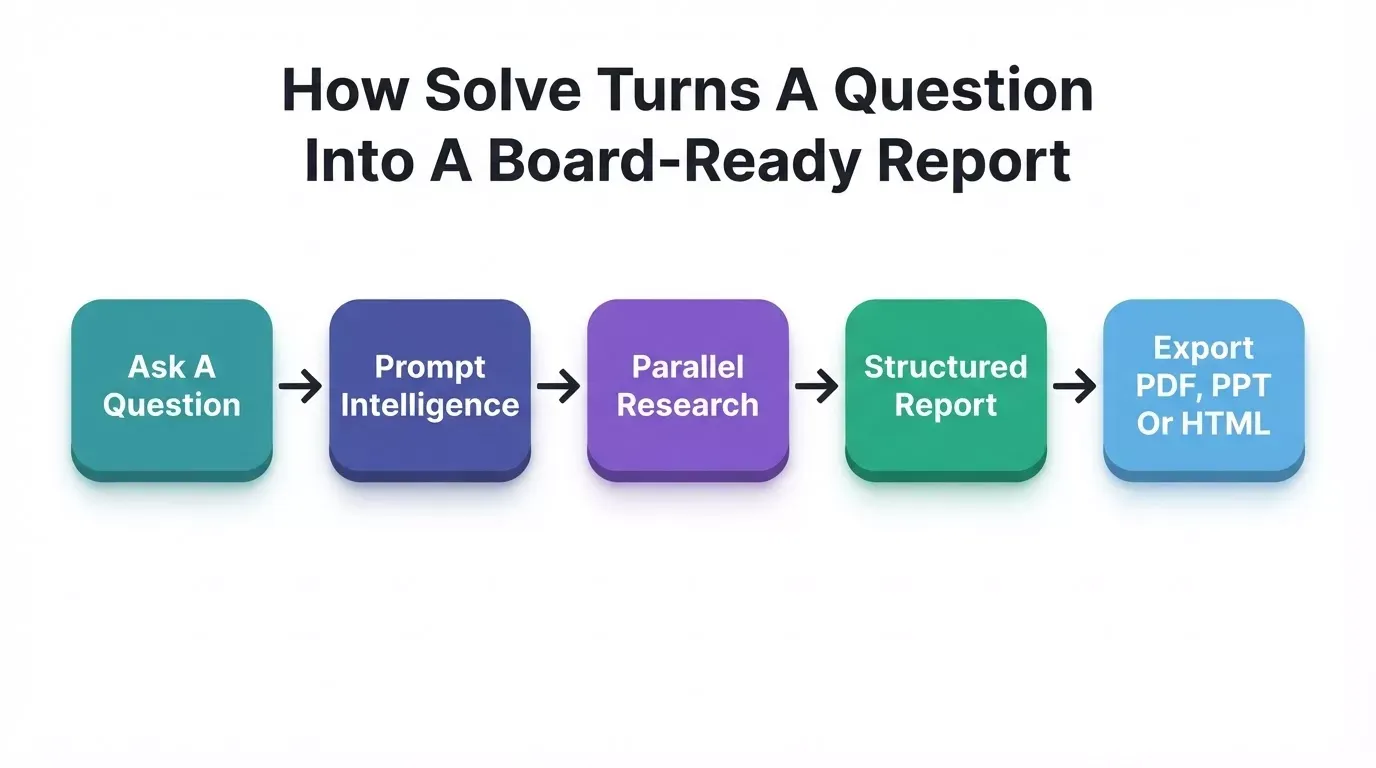
From question to export-ready deliverable: Solve handles every step in between.
A note on data sources: Solve reports draw on publicly available data and AI analysis. They are a structured, evidence-backed starting point, not a substitute for proprietary financial data or legal due diligence.
How Solve Compares to Other Research Tools
Most teams preparing board decks bounce between a search engine, a chatbot, and a spreadsheet. Here is how that compares to using Solve directly for business research:
| Dimension | Search Engine | AI Chatbot | Solve on Rocket.new |
|---|---|---|---|
| What you get | Links to read yourself | A paragraph answer | Structured multi-source report |
| Research effort | You do all the work | None, but shallow | Done for you, in depth |
| Live data | Yes, unstructured | No | Yes, synthesized |
| Output format | Ten blue links | Paragraph answer | Executive summary, analysis, evidence, recommendations |
| Follow-up | New search | Some memory | Builds on full project context |
| Export for board | No | No | PDF, PowerPoint, HTML |
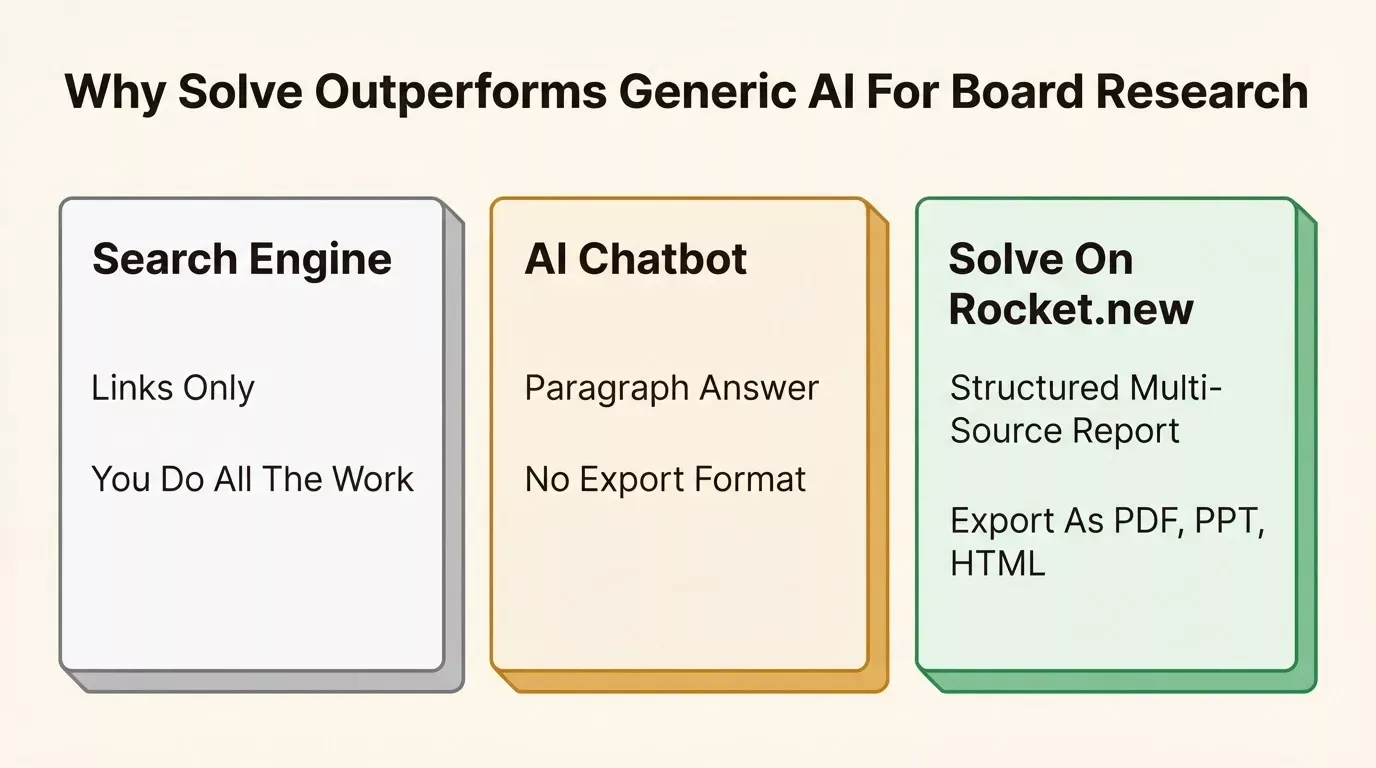
Solve delivers a formatted, exportable deliverable. Generic AI tools deliver a chat reply.
The Data Behind Board Deck Delays
Preparation time is the single biggest bottleneck in board reporting. Teams using traditional research methods spend 3 to 5 days assembling a board deck. Teams using AI chatbots cut that to 4 to 6 hours, but still produce unstructured output that requires manual formatting.
According to McKinsey, boards spend a disproportionate amount of meeting time on information they could have received in advance. Structured pre-read materials, not live presentations, are what drive faster decisions.
Ethan Mollick, Wharton Professor, documented this shift: Five high-quality drafts were done in under a minute. I had a thirteen-page slide deck with speaker notes, a market summary, and a product launch strategy that was really solid.
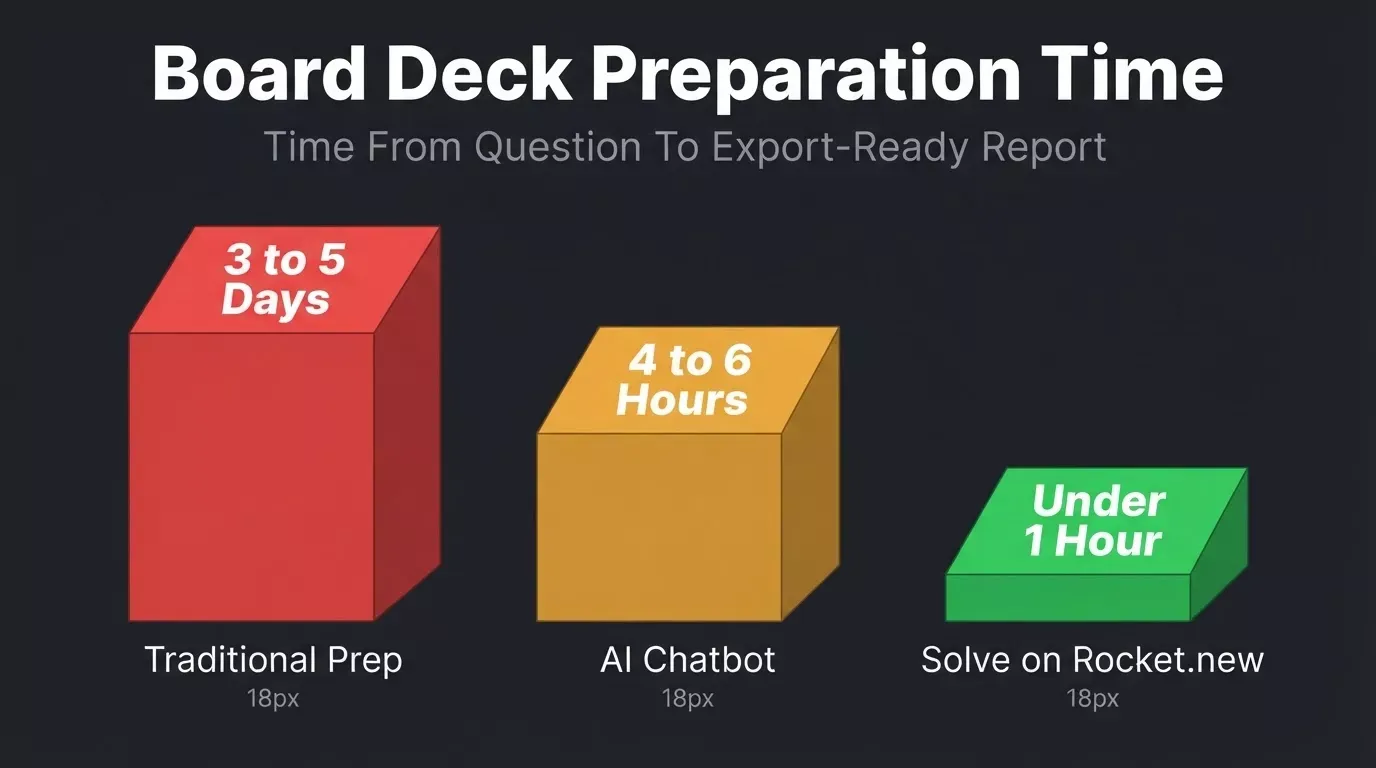
Preparation time drops from days to under an hour when research and output are connected in one system.
How Decision Making Stalls Without a Connected System
Context Gets Lost
Teams get stuck when disconnected tools break the logic between strategy and presentation. Gaps between tools create communication gaps: slides say one thing, the account data says another.
Using multiple tools in parallel creates confusion, not clarity.
What Changes When Everything Connects
A connected workflow helps teams move forward from question to decision in hours, not weeks. When context and output connect, no one is waiting on someone to re-explain the strategy.
For teams running ongoing competitive intelligence, Solve integrates that signal directly into the research output, so board decks reflect current market reality, not last month snapshot.
How Rocket Helps You Build Board Presentations
You can use Solve on Rocket.new by typing your strategic question and getting back a structured report with live metrics and a recommendation. That report functions as a deliverable you can export as a PDF, PowerPoint, or HTML file, present to a client, or take into Build without re-explaining anything.
The platform converts high-level strategic questions into structured reports. Solve pulls live market information, competitor signals, and current research to build the output. The whole experience stays connected. The context you establish during research carries directly into your deliverable.
Rocket.new vibe solutioning platform connects Solve (research), Build (app and page creation), and Intelligence (competitor monitoring) in one place. For teams that need board and sales alignment, this connected structure means every stakeholder works from the same evidence base.
Key Solve Features for Board Presentations
- Structured multi-source report with executive summary, analysis, evidence, and recommendations
- Prompt intelligence scores your question and asks clarifying questions before research begins
- Parallel research streams run simultaneously for deeper, faster coverage
- Export as PDF, PowerPoint (PPT), HTML, or PRD on every plan
- Password-protected sharing so recipients can view without a Rocket.new account
- Cross-task context via mentions to build on prior Solve reports
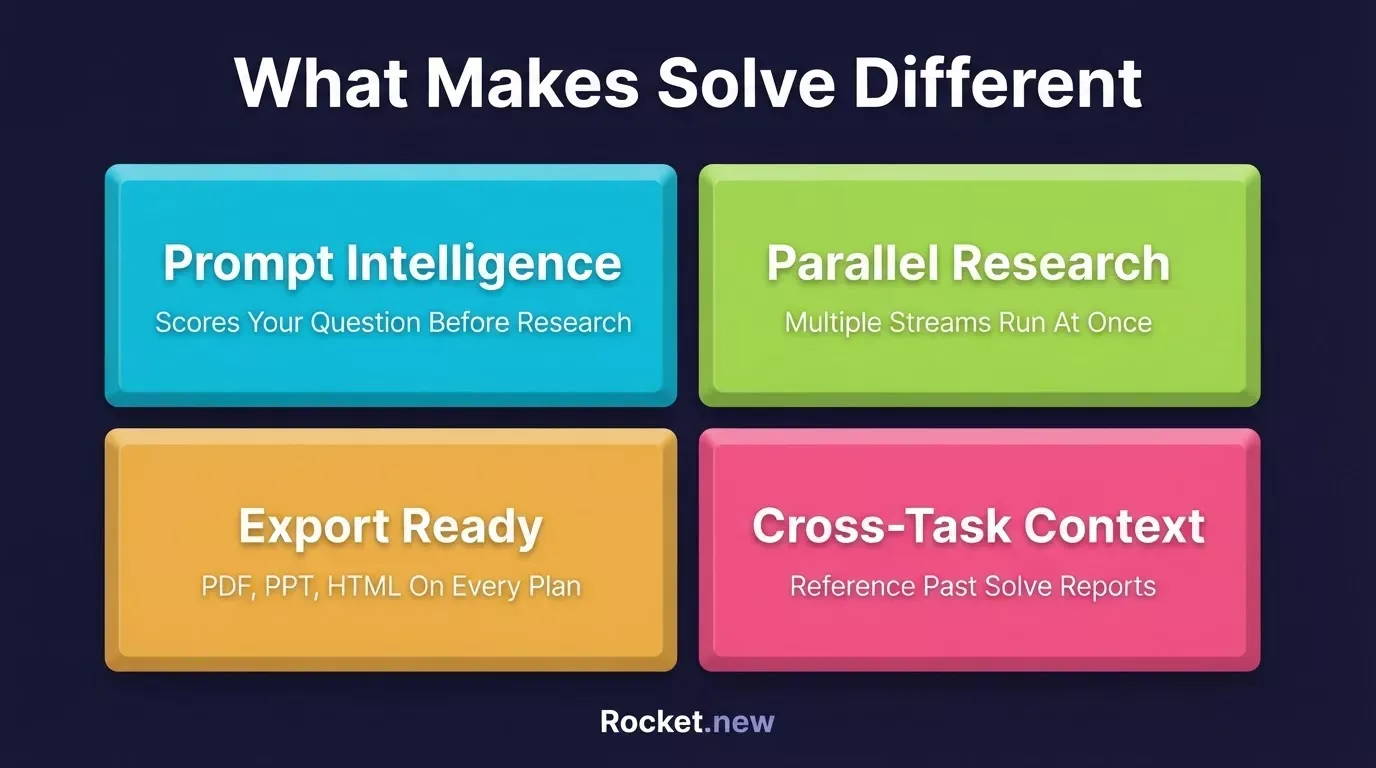
The four capabilities that make Solve the right tool for board-level research.
Use Cases for Board Presentations
- A VP of Strategy needs to analyze market entry. They input the question, get structured pages with models and risk analysis, and export them as a PowerPoint for the board. No waiting for separate tools.
- A startup founder preparing for a board meeting needs growth metrics and market research on competitive positioning. Solve connects both into one structured output.
- A client-facing consultant needs to build decks for a quarterly business review. They start with a prompt, get the deliverable, and the account information and structure stay in context with no overlap.
- A product lead inputs a go-to-market question. Solve runs parallel analysis, tests assumptions, and the structured output is ready for presentation.
Stop Waiting on Disconnected Pages
You can use Solve on Rocket.new to prepare a board presentation backed by real evidence in under an hour, and walk into the room with pages that account for the data, the strategy, and the risk. Stop spending days on pages that should take minutes. Write your question, connect it to your data, and let Solve do the work.
Ready to turn your next board question into a decision-ready presentation? Start building with Rocket.new today and see how fast a board-ready deliverable comes together.
Table of contents
- -What Does a Board Deck Actually Need to Land?
- -Why Board Presentations Take Days Instead of Hours
- -Scattered Tools, Scattered Thinking
- -The Whole Experience Breaks Down
- -What Board Ready Slides Actually Need
- -Structure That Matches How Boards Think
- -Analytical Models and Logical Flow
- -How Solve Works: From Question to Board-Ready Report
- -How Solve Compares to Other Research Tools
- -The Data Behind Board Deck Delays
- -How Decision Making Stalls Without a Connected System
- -Context Gets Lost
- -What Changes When Everything Connects
- -How Rocket Helps You Build Board Presentations
- -Key Solve Features for Board Presentations
- -Use Cases for Board Presentations
- -Stop Waiting on Disconnected Pages