Primary market research works best when users interact with a real product, not just surveys or interviews. A lean MVP helps founders validate demand through actual user behavior and continuous feedback loops. Rocket.new lets founders build, launch, and iterate production-ready MVPs in minutes without a traditional dev team.
Does Your Business Idea Actually Have a Market?
What if the most accurate market research tool you have is a product people can actually use?
That is not a trick question. Traditional primary market research, surveys, interviews, and focus groups give you what people say they want. A minimum viable product gives you what they actually do. And that gap between "said" and "did" is where most startups sink.
A staggering 42% of startups fail because they build products nobody wants, according to a 2025 report by Founders Forum Group. Not because the team lacked skill. Not because the business idea was bad on paper. Because the market said no, but only after the team had built everything.
The MVP approach flips this. Instead of treating research as a pre-launch checkbox, you treat the basic version of your product as a living research instrument. Ship the core features, put it in front of real users, and listen to what they actually do.
This post walks through how primary market research really works, where traditional methods fall short, and how shipping a lean minimum viable product, especially with a tool like Rocket.new, turns your earliest users into your sharpest research team.
What Primary Market Research Actually is (And Why it Often Misleads You)
Primary market research is data you collect directly. You design the questions, pick the participants, and run the study. Surveys, one-on-one customer interviews, and usability sessions all fall under this category.
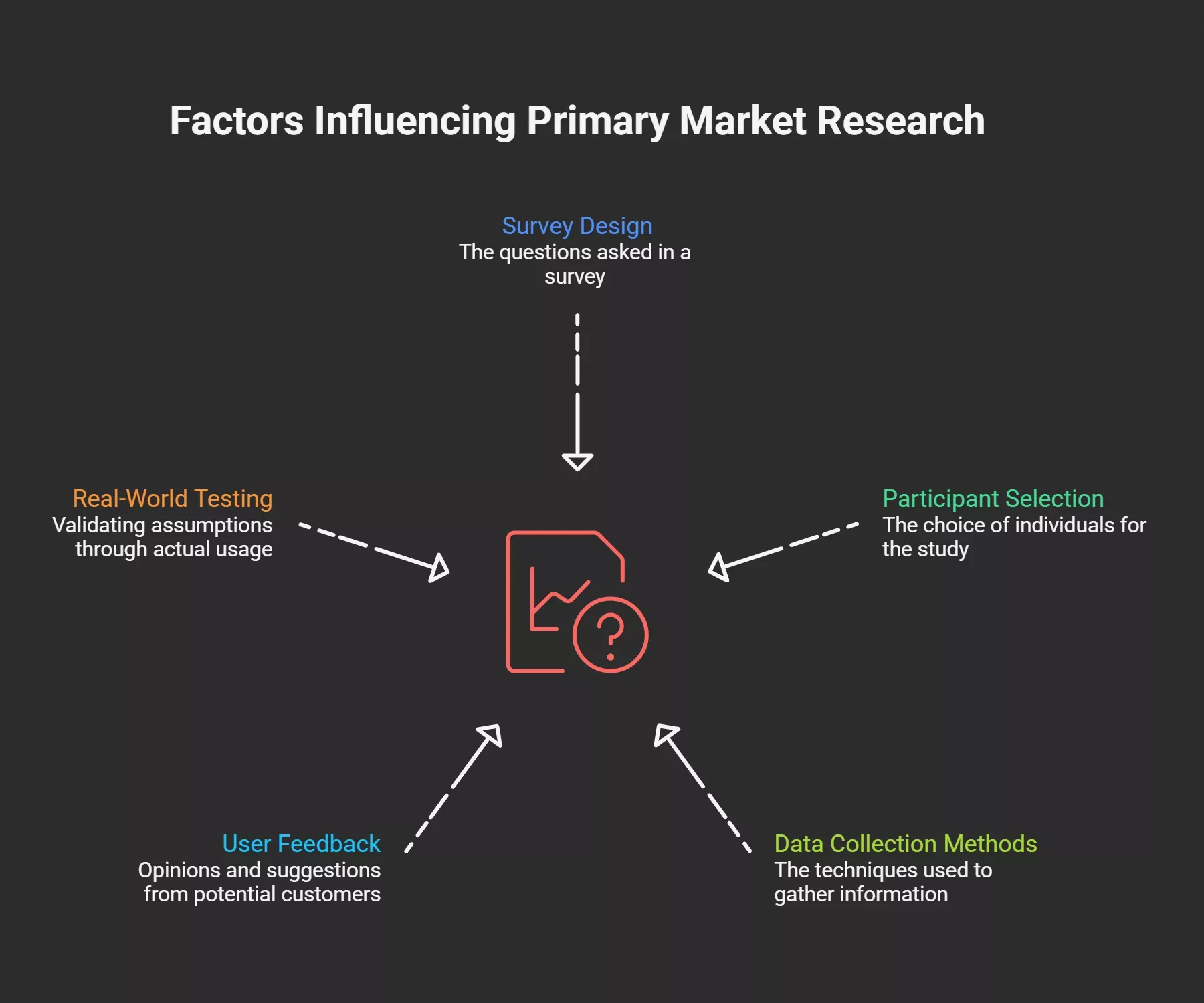
The appeal is control. You get to ask exactly what you want to know. No secondhand reports. No stale industry data. You can get very specific: "Which of these two value propositions resonates more with your workflow?" or "How much would you pay for this feature?"
But here is where it gets complicated.
What people say they want is often different from what they actually use. A potential customer who enthusiastically says "yes, I'd definitely pay for that" in a customer interview may never open your app once the product launches. User feedback gathered before someone has real skin in the game tends to be optimistic and often wrong.
Eric Ries, who coined the lean startup methodology, built an entire framework around this insight: Assumptions need to be tested in the real world, not in a conference room. The best market research validates behavior, not belief. And that is why the most effective form of primary market research is the minimum viable product itself.
The Real Problem with Surveys and Focus Groups Alone
Traditional research methods have their place. But used alone, they have blind spots that can genuinely mislead your product development team.
Surveys give you scale but lack depth. You can reach hundreds of potential customers in a week, but multiple-choice questions rarely surface the nuance behind why someone would or would not use your product.
Focus groups create social dynamics that distort answers. Participants defer to the most vocal person in the room. Nobody wants to say the business idea is bad.
Customer interviews are the most valuable of the traditional tools, but only if you ask behavioral questions ("Tell me about the last time you tried to solve this problem") rather than hypothetical ones ("Would you use something like this?").
The gap all three share: they capture intent, not behavior. And in product development, behavior is the only data that matters.
"Had to learn the hard way that user feedback during development is completely different from user behavior after launch. People say they want features they'll never actually use when it matters."-r/startups, May 2025
This is not a knock on traditional research. It is a call to complement it with something more revealing: actual usage data from real users.
The MVP as Primary Market Research in Action
MVP stands for Minimum Viable Product. The lean startup framework popularized by Eric Ries built the concept into a build-measure-learn loop. Ship the most basic version of your product that delivers real value, then let data from real users guide future development.
What makes the MVP approach so powerful for market research is that it generates behavioral data instead of attitudinal data. You are not asking people how they feel. You are watching what they do.
An effective MVP answers questions that surveys cannot:
- Which core features do users actually return for?
- Where do they drop off during onboarding?
- What do they request immediately after signing up?
- Do they invite others? Or quietly churn?
These signals are primary market research in its purest form. No question design bias. No social pressure. Just users voting with their behavior.
The market reflects how seriously founders have taken this shift. According to Dataintelo, the global MVP building tool market was valued at $3.8 billion in 2025 and is projected to reach $9.6 billion by 2034, growing at a CAGR of 10.9%. Founders are not just building MVPs. They are investing seriously in tools to build them faster and smarter.
How to Build an Effective MVP for Real Market Research
A good minimum viable product is not a half-finished product. It is a focused one. Here is how to build one that generates real research value.
Step 1: Define the One Core Problem You Are Solving
Before you write a single line of code or prompt an AI builder, get specific about the problem. Your MVP is not a product idea poured into a basic version of every feature you eventually want. It is the smallest thing that solves the core problem well.
The lean startup question worth asking: What is the one thing your target customers cannot do right now that your product would let them do? Start there. Everything else is future development.
Step 2: Identify Your Target Customers and Early Adopters
Not every potential customer is a good research subject for your MVP phase. You want early adopters - people who feel the problem acutely, who are actively looking for a solution, and who will use something that is not fully polished yet.
These are not your general target audience. They are the specific customer segments who care enough to give you honest, detailed feedback. They will tell you what is broken, what is missing, and what made them stay.
Step 3: Build Only the Core Features
Scope creep is the enemy of the minimum viable product. When every new idea feels like it belongs in version one, the basic product never ships. Build the core features that demonstrate your value proposition - and nothing more. You can iterate based on user feedback. You cannot iterate based on a product you never launched.
Every feature you skip in the MVP phase is not a loss. It is a question you are letting real users answer for you.
Step 4: Set Up Clear Feedback Channels
Once your MVP is live, you need a structured way to gather valuable feedback. In-app prompts, short surveys after key actions, customer interviews with your first users, and usage analytics all work together. The goal is to build a clear roadmap from what users actually need, not what you assumed they needed.
Market research has become core infrastructure for startups. Glorium Technologies notes that the research industry has already passed $150 billion in annual value, with demand driven by founders who need a real signal before committing their runway to a product decision.
Step 5: Iterate Based on What Users Tell You
Your first version will not be right. That is the point. Real users will show you exactly what to fix, what to add, and sometimes what to remove entirely. This continuous improvement loop is how a basic version grows toward genuine product-market fit.
What Your Early Users Are Actually Telling You
When you ship a lean minimum viable product and pay attention to what happens next, the signals are rich. Here is a quick guide to reading them:
| Signal | What It Means |
|---|---|
| High return rate | Core features are working, and users find real value |
| Low activation rate | Onboarding is confusing, or the value proposition is unclear |
| Feature requests clustering around one area | There is a gap in your core offering |
| Minimal churn in early adopters | Strong product-market fit signals |
| Organic sharing by users | Value proposition resonates beyond your target audience |
| Repeated support tickets on one issue | A bug or UX problem needs fixing fast |
| Low return after the first session | The product does not yet solve the problem clearly enough |
Reading these signals is how market research becomes continuous. You are not doing research once before launch. You are building a feedback loop that shapes every product decision - which is exactly what customer development is designed to do.
The Build-Measure-Learn Loop in Practice
The MVP is not a one-time event. It is a cycle. The loop works like this:
- Define the core problem
- Build your minimum viable product with only the essential core features
- Ship it to early adopters
- Gather user feedback and usage data
- Check whether the data confirms your hypothesis
- Either expand and build the next feature set or pivot and refine based on real feedback.
The cycle repeats with every new version.
This loop is how companies like Dropbox, Airbnb, and Uber validated massive markets before committing to full-scale products. Dropbox did not build a full product first; they built a landing page with a demo video. Airbnb manually photographed apartments and managed bookings by hand. These were MVPs that let real users tell them whether the idea had legs.
Community building around early adopters played a big role in these stories, too. Early users who feel heard become advocates. They share the product. They bring in the next wave of real users who generate the next round of research data. The MVP phase is not just about learning; it is about earning the loyalty of the people who will help you build what comes next.
Launch Your MVP Faster with Rocket.new
The Problem with Traditional MVP Development
Traditional MVP development has a problem that has nothing to do with the idea: It takes too long. Weeks of developer meetings. Months of build cycles. By the time you ship, the market may have shifted - or a competitor may have gotten there first.
This is where Rocket.new changes the equation.
Rocket.new is the world's first Vibe Solutioning platform: a single place where non-technical founders and product teams can go from business idea to a live, working product without a traditional tech stack or a full development team.
Over 1.5 million people across 180 countries have used Rocket.new to research, build, and ship products. That reach, built almost entirely through organic, product-led growth, says something clear: founders want a faster, smarter path from idea to market.
How Rocket.new Turns Your MVP Into a Research Engine
For primary market research purposes, speed to ship matters enormously. Rocket.new generates a fully functional app from a plain language description. Most apps are ready in 1 to 3 minutes. What ships is not a rough prototype; it is production-ready code in Next.js for web apps and Flutter for mobile, with real design systems, SEO-ready structure, and accessibility compliance built in by default.
Build from a prompt. Describe your product idea in plain language, list your core features, and Rocket.new generates a working app with Build. Category tabs on the build screen cover Landing page, Dashboard, SaaS, Mobile App, and E-commerce, each with example prompts to get you moving fast.
Iterate through the conversation. After the first generation, you can refine features, fix bugs, adjust design, and add new functionality through natural language chat. No re-explaining context. No new development sprint.
Ship with one click. When your basic product is ready for real users, launch it to a live URL instantly. Staging environment, version history, and one-click rollback mean you can improve without risk.
25+ integrations built in. Connect Stripe for payments, Mixpanel for usage analytics, Typeform for in-app surveys, Supabase for backend, and more. The tools you need to gather valuable feedback from your user base are wired in from the start.
One platform for the whole team. Shared workspaces, role-based access, and inline comments mean your product development team and your research thinking stay aligned in one place.
What Competitors Cannot Do?
Other AI builders like Lovable, Bolt, and v0 generate code quickly. But they share a structural gap: they build what you tell them to build. They have no opinion on whether what you asked for was worth building.
Rocket.new solves the first half of the problem, too. The platform's Solve capability takes any business question and delivers a complete, structured analysis, market sizing, competitive intelligence, user personas, go-to-market strategy recommendations before you build a single screen.
| Capability | Lovable / Bolt / v0 | Rocket.new |
|---|---|---|
| Fast code generation | Yes | Yes |
| Pre-build market intelligence | No | Yes (Solve) |
| Shared team memory across tasks | No | Yes (Context) |
| Competitive monitoring | No | Yes (Intelligence) |
| Redesign existing products | No | Yes (8 slash commands) |
| Human expert help in-platform | No | Yes (Support) |
For founders who want their MVP to function as real market research, not just a launch artifact, this distinction is significant. You are not just shipping fast. You are shipping with the thinking already done, and every iteration compounds that thinking.
A Note for Non-Technical Founders
Non-technical founders have the clearest view of the market problem; they often live it themselves. But they have historically depended on developer partners or agencies to ship anything testable.
Rocket.new removes that dependency entirely. A non-technical founder can describe their product idea, generate a fully functional web or mobile app, and have it in front of potential customers in a single day. The iteration that follows happens through conversation, not code. This is how you de-risk a business idea without a six-month development cycle.
Stop Guessing What Your Market Wants
The best market research doesn't happen before you build; it happens because you build. Surveys capture what people think they want. Real users interacting with a real product tell you what they actually do.
A well-scoped MVP turns your idea into a hypothesis and your early adopters into a research team. No survey can replicate that.
Ready to find out what your market really wants? Build your MVP with Rocket. Visit Rocket.new, and sign up to ship your product in a day. Get real feedback within the week.
Table of contents
- -Does Your Business Idea Actually Have a Market?
- -What Primary Market Research Actually is (And Why it Often Misleads You)
- -The Real Problem with Surveys and Focus Groups Alone
- -The MVP as Primary Market Research in Action
- -How to Build an Effective MVP for Real Market Research
- -Step 1: Define the One Core Problem You Are Solving
- -Step 2: Identify Your Target Customers and Early Adopters
- -Step 3: Build Only the Core Features
- -Step 4: Set Up Clear Feedback Channels
- -Step 5: Iterate Based on What Users Tell You
- -What Your Early Users Are Actually Telling You
- -The Build-Measure-Learn Loop in Practice
- -Launch Your MVP Faster with Rocket.new
- -The Problem with Traditional MVP Development
- -How Rocket.new Turns Your MVP Into a Research Engine
- -What Competitors Cannot Do?
- -A Note for Non-Technical Founders
- -Stop Guessing What Your Market Wants