
These 15 AI prompts help you validate any startup idea in minutes. Test market demand, target audience fit, competition, and willingness to pay before writing code. Use Rocket.new's Solve to go from validated idea to deployed product in one platform.
The best way to validate a startup idea with AI is to run it through structured prompts that test market demand, competition, and willingness to pay, not to simply ask an AI "is this a good idea?" These 15 best AI prompts to validate an idea before you build give you that structured framework, copy-paste ready.
These 15 best AI prompts to validate an idea before you build help founders pressure-test any startup idea in minutes. Test market demand, target audience fit, competitive positioning, and willingness to pay before writing a single line of code.
Why Do 43% of Startups Fail Before They Test a Single Idea?
How many product ideas die not because they lack potential, but because nobody ran them through the right questions first?
According to CB Insights' analysis of 431 failed startups, 43% cited poor product-market fit as a primary cause of death. That means nearly half of all VC-backed companies built something their target customers did not actually want to pay for. The fix is simple: validate your business idea before you invest serious time and money building the wrong thing.
These 15 AI prompts give you a structured, prompt-based approach to pressure-test any startup idea, product idea, or new business concept. Each prompt is designed to surface honest data about market demand, the competitive landscape, and whether real people would actually pay for what you plan to build. Copy them, paste them into ChatGPT, Claude, or any AI tool, and let the responses guide your next step.
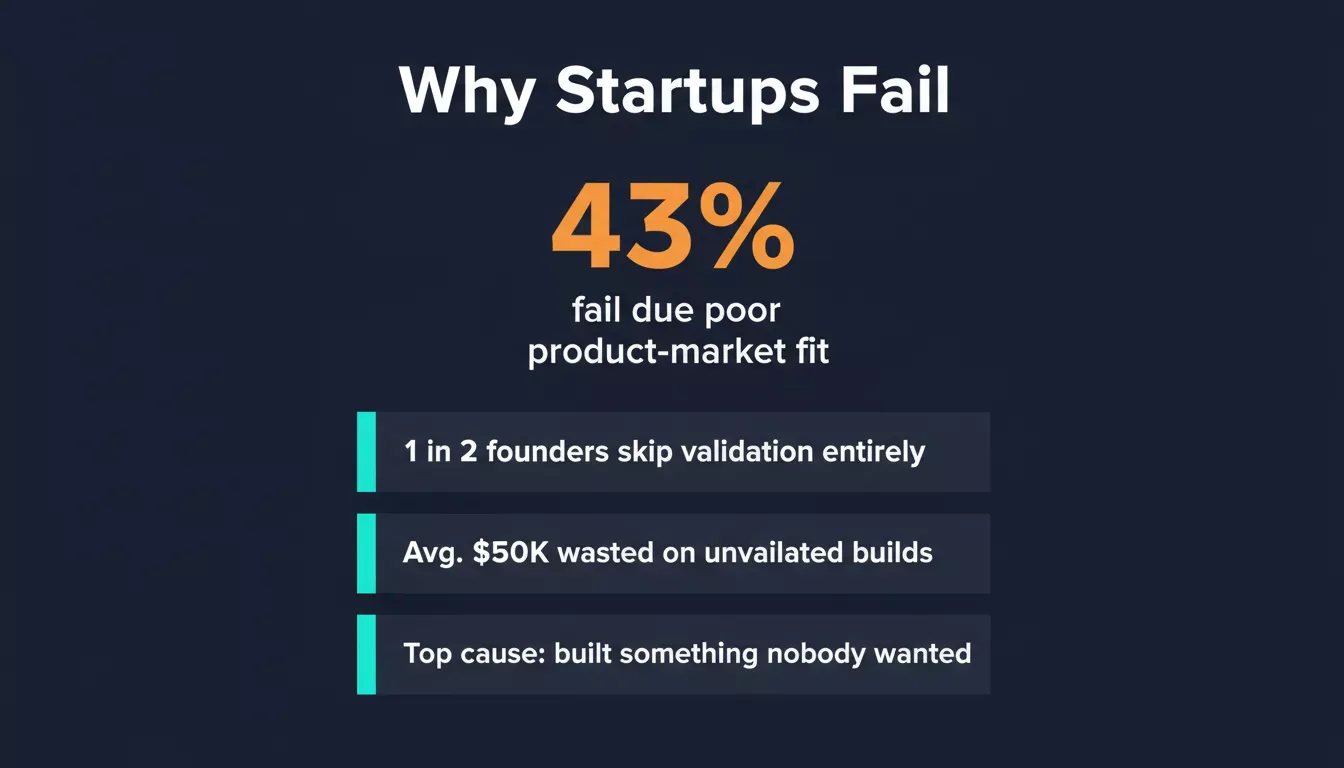
Nearly half of funded startups fail due to skipping idea validation. The data makes the case for testing before building.
Why Traditional Idea Validation Fails Most Founders
Traditional market research worked in a pre-AI world, but the process came with a brutal cost in time and money that most founders could not afford.
- Customer discovery interviews require scheduling 30 to 50 conversations over 6 to 8 weeks, and most founders never finish the process before their excitement fades
- Market sizing reports from research firms cost $5,000 to $50,000 and take weeks to arrive, while industry trends shift underneath you
- Focus groups and surveys demand a marketing budget, a defined target audience, and months of planning before you see a single data point
The old playbook made idea validation feel like a punishment for having new business ideas. Most founders responded by skipping validation entirely and spending money on building first, only to realize later they built the wrong thing.
| Approach | Timeline | Cost | Outcome |
|---|---|---|---|
| Traditional market research | 3 to 6 months | $5,000 to $50,000 | Thorough but slow; wasted money if idea pivots |
| AI prompt-based validation | 2 to 10 minutes per prompt | Free | Fast signal on market demand; stop guessing early |
| No validation at all | 0 time upfront | Wasted budget later | 43% failure rate from no product-market fit |
In 2026, there is no reason to choose between speed and rigor. AI prompts give you the research speed to validate a business idea in hours, then you can use focused work sessions with real people to double-check the strongest signals.
How Should You Structure AI Prompts for Brutally Honest Validation?
The quality of your idea validation depends entirely on how you structure each prompt. Vague questions produce vague answers. Specific, context-rich prompts produce actionable feedback that helps you decide whether an idea is worth pursuing.
- Describe your idea in a single line so the AI model understands the core concept without confusion
- Assign a critical role like "brutally honest startup advisor" or "experienced venture capitalist who has seen 500 startups fail" to get responses that challenge your assumptions
- Add constraints such as "identify weaknesses before strengths" or "assume this idea will fail and tell me why" to avoid confirmation bias
- Request a structured format like a viability score, a numbered list of potential obstacles, or a competitive analysis table
When you describe your idea clearly and force the AI to be specific in its critique, you receive responses that test your concept rather than validate your ego. This is where most founders get stuck: they ask "Is my idea good?" instead of asking "What evidence suggests people are actively searching for this solution?"
Six-step flow for structuring any AI validation prompt from raw idea to actionable output
Treat each AI conversation as a focused work session with a co-founder who has zero emotional attachment to your startup idea and will kill bad ideas without hesitation. For more on writing effective AI prompts, see Rocket's prompt engineering best practices.
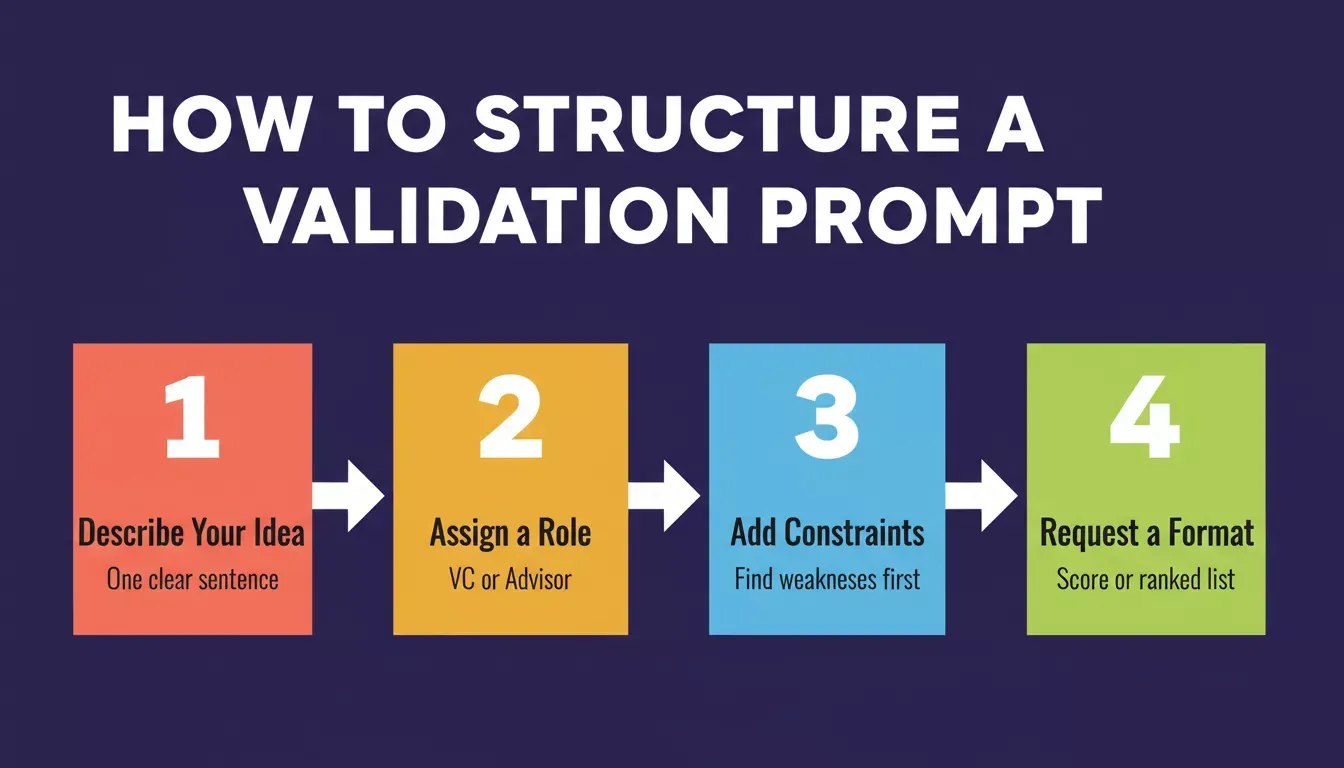
The four stages of a well-structured AI validation prompt, from raw idea to actionable output.
Market Demand and Target Audience Prompts
These five prompts help you validate whether genuine interest and real market demand exist for your idea. They force you to identify your target audience, define customer pain points, and assess market size before you commit resources to building.
Prompt 1: Ideal Customer Profile Discovery
"Act as a market research analyst. My business idea is [describe idea in one sentence]. Identify my ideal customer by defining their job title, income level, age range, specific problems they face daily, and what solutions they currently use. Be specific about demographics and psychographics. Tell me why these target customers would actively switch from their current solution to mine."
This prompt surfaces your ideal customer with enough detail to test whether you can actually reach them. If the AI struggles to identify a clear target audience, your idea may be too vague or too broad to succeed.
Prompt 2: Pain Point Severity Assessment
"I am building [describe your product idea]. Acting as a customer pain points researcher, rank the top 5 pain points my potential customers experience today on a scale of 1 to 10for severity, frequency, and willingness to pay for a fix. For each pain point, tell me whether people are actively searching for solutions or simply tolerating the problem without spending money."
Not all pain points are worth solving. The ones that score high on all three dimensions: severe, frequent, and people already paying to address them, point toward ideas worth pursuing.
Prompt 3: Market Size and Growth Signals
"Analyze the market size for a product that solves [specific problem] for [target market]. Provide TAM, SAM, and SOM estimates with reasoning. Identify whether this market is growing, flat, or declining based on demand trends and industry trends. Include market opportunities that suggest genuine interest from early customers and buyers."
If your market size comes back too small or demand trends show declining interest, that is a clear signal to pivot your idea before you invest any further. Google Trends data and community signals should confirm what this prompt surfaces.
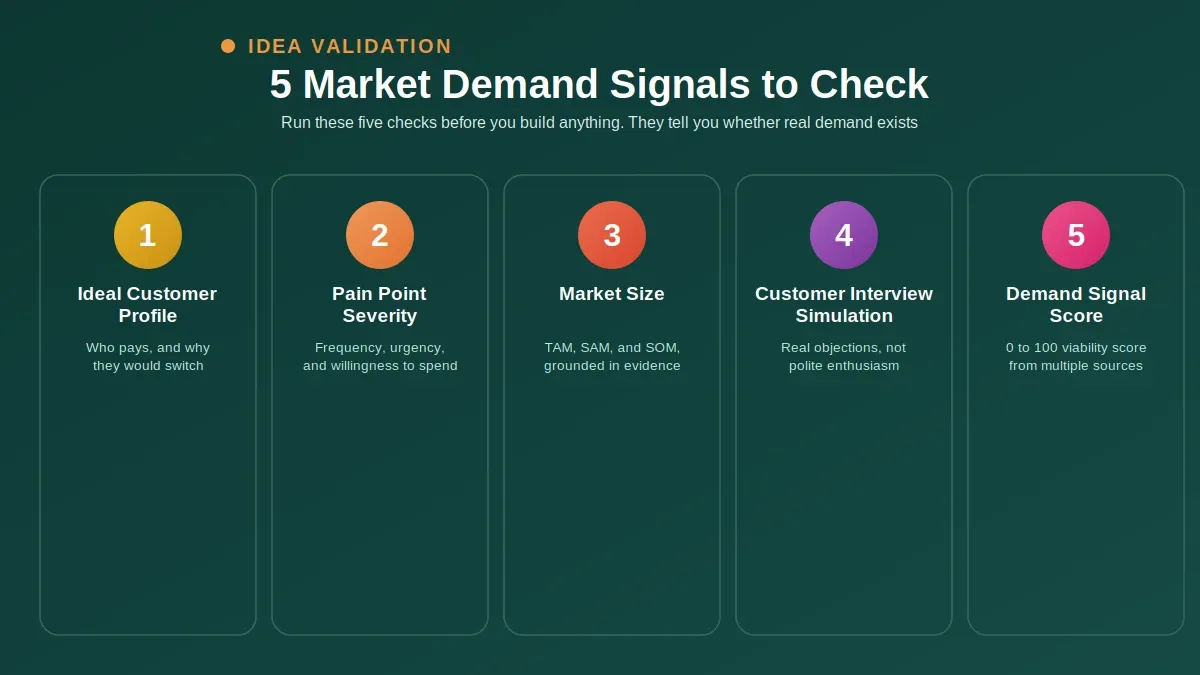
The five demand signals these prompts surface are each a filter that separates real opportunities from wishful thinking.
Prompt 4: Target Customer Interview Simulator
"Simulate 5 customer conversations with different potential customers for my idea:[describe idea]. Each simulated target customer should have a different occupation, income level, and relationship to the problem. Have them express genuine objections, concerns about pricing, and honest reactions, including apathy. Include at least one customer who says they would not buy and explain the reason why."
This prompt generates early customers' likely responses without requiring you to schedule 30 interviews. It helps you anticipate objections before real customer conversations happen and tells you where the real problem areas live.
Prompt 5: Demand Signal Validation
"Research whether people are actively searching for solutions related to [your idea]. Check Google Trends patterns, identify if communities on Reddit or forums discuss this problem, and determine whether competitors already validate market demand through their existence. Provide a viability score from 0 to 100 based on real demand signals from multiple sources."
A viability score below 40 means the demand is not strong enough. Above 70 means people are actively searching and spending money to fix this problem today. Learning how to do market research and validate a business idea can go deeper into audience segmentation after this initial signal check.
Competitive Research and Positioning Prompts
These four prompts map your competitive landscape and reveal gaps you can fill. Knowing who your top competitors are and where they fail their target customers is what separates validated startup ideas from wishful thinking.
Prompt 6: Competitive Landscape Mapping
"List the top 10 competitors for a product that [describe what your idea solves]. For each competitor, provide their pricing model, primary strengths, biggest weaknesses based on customer feedback, and the target market they serve. Organize this as a competitive analysis with clear competitor insights about what each company does well and where they leave gaps."
Understanding where incumbents are weak gives you a direct path to differentiation. Every market has gaps that customers complain about in reviews and forums, and these are your market opportunities. For a deeper look at how competitive intelligence informs product decisions, see how Rocket's Intelligence layer decodes competitor pricing.
Prompt 7: Competitor Intel Deep Analysis
"Act as a competitive research analyst. For my business idea [describe idea], identify3 top competitors and analyze their position in the competitive landscape. What specific features do customers complain about? Where do their products fail? What market opportunities exist that none of them address? Provide competitor intel that tells me exactly where to position my new business."
This prompt goes beyond surface-level competitor analysis. It asks for the competitor insights that actually inform your product decisions and help you find where to stand apart from the competition.
Prompt 8: Differentiation and Value Proposition Builder
"My startup idea is [describe idea]. My top competitors are [list competitors]. Generate 5 unique angles for differentiation that a small team could realistically execute. For each angle, explain the customer pain points it addresses, why competitors have not solved them, and whether it creates a defensible unique value proposition or just a temporary advantage."
As Jano le Roux wrote in his 2026 AI validation framework: "42% of startups fail because they built something nobody wanted. Not because of bad code. Not because the design was ugly. Because they never stopped to ask the one question that actually matters: does anyone want this?" Your differentiation must address what people actually want, not what sounds clever.
Prompt 9: Competitor Weakness Exploitation
"Analyze the negative reviews and customer feedback for [list 3 competitors]. What recurring complaints appear across all three? Where do these competitors underperform relative to their pricing? Identify specific weaknesses I can target with my value proposition and suggest ways my idea solves what they cannot."
When you validate your idea and deploy faster, acting on competitor weaknesses before those gaps close is what gives startups their speed advantage over large incumbents. Founders who move from research to product quickly win the market opportunities that slow-moving competitors leave open.
What Makes a Good Pricing and Willingness-to-Pay Prompt?
These prompts test whether your target customers will actually pay for your solution. Many ideas solve real problems, but the business model falls apart because the perceived value does not justify the price point most founders want to charge.
Prompt 10: Willingness to Pay Assessment
"For my product idea [describe idea], analyze willingness to pay across my target market segments. What price points do similar products charge? At what price point do potential customers say the product is too expensive versus a good value? Identify the pricing sweet spot where the value proposition feels strong, and buyers proceed to purchase without hesitation."
If people love the idea but would not pay $10 per month for it, your business plan needs rethinking. This prompt separates genuine interest from polite enthusiasm. Understanding pricing dynamics early is one of the most underrated parts of startup idea validation.
Prompt 11: Business Model Viability Test
"Evaluate the business plan viability for [describe idea]. Consider subscription, one-time purchase, freemium, and marketplace business models. For each model, estimate customer lifetime value, expected churn, and the marketing budget required to acquire target customers profitably. Give me a viability score for each and recommend which model best fits my ideal customer profile."
The right business model multiplies the value of a good idea. The wrong one kills it slowly. This prompt forces you to test multiple approaches before you commit to one pricing strategy that may limit your market size.
Prompt 12: Revenue Feasibility and Key Benefits Validation
"My idea is [describe idea] targeting [target audience]. Validate whether this concept can realistically generate $10K monthly recurring revenue within 12 months. Analyze the key benefits that would drive purchase decisions, the competitive analysis of pricing in this space, and what product-market fit signals I should watch for after launch. Be brutally honest about whether this idea is worth building as a new business."
This prompt acts as a reality check. It combines pricing, key benefits, and feasibility into one assessment that tells you whether your idea's potential matches your revenue goals. For a deeper look at how pricing signals inform product strategy, explore how Rocket's Intelligence informs pricing decisions.
Can These Prompts Kill Bad Ideas Before They Drain Your Budget?
The final three prompts are designed to kill bad ideas fast. They force AI to find holes in your logic, challenge your assumptions, and tell you directly whether your concept is worth pursuing or worth abandoning.
Prompt 13: The Idea Killer Prompt
"Act as a venture capitalist who has rejected 10,000 startup ideas. My idea is[describe idea]. Give me 10 reasons this idea will fail. For each reason, explain whether it is a fixable problem or a fundamental flaw. Be specific about market demand gaps, competitive threats, customer feedback patterns that would signal failure, and potential obstacles I have not considered. Do not hold back. Kill bad ideas fast."
This prompt is uncomfortable. That is the point. If your idea survives 10 targeted criticisms and you can address each one with evidence, it is worth pursuing. If you cannot counter even half, walk away before you waste months building the wrong thing.
What a real Prompt 13 output looks like: When the Rocket team ran this prompt on a B2B scheduling tool concept, the AI returned three fundamental flaws: market saturation, low switching cost, and a pricing ceiling imposed by free-tier competitors, plus seven fixable issues around positioning and target segment. That single output redirected the concept toward a vertical-specific niche before a single line of code was written.
Prompt 14: Assumption Audit
"List every assumption buried in my business idea: [describe idea]. For each assumption, rate how confident I should be on a scale of 1 to 10 based on available evidence. Identify the 3 riskiest assumptions that could kill this startup idea if they are wrong. For each risky assumption, suggest one specific test I can run in under a week to validate or invalidate it with customer feedback from real people."
Most founders do not realize how many assumptions hide inside a single idea. This prompt surfaces blind spots that no amount of excitement will fix. It forces you to test before you build, not after.
Prompt 15: The Go/No-Go Decision Framework
"Based on everything we discussed about my idea [describe idea], create a go/no-godecision framework. Score the following on a 1 to 10 scale with evidence: market demand strength, competitive differentiation, willingness to pay, founder-market fit, and execution feasibility. Give me an overall viability score and a clear recommendation: Proceed to build, pivot the concept, or kill the idea entirely. Tell me the truth, even if it is not what I want to hear."
This is your final prompt. It synthesizes everything into one decision. A viability score above 7 across all dimensions means you have strong validation. Below 5 on any single dimension means that dimension needs more work before you commit to building. As Forbes reports, the founders who test relentlessly before investing money are the ones whose ideas survive contact with the real market.
For founders ready to move from a validated idea to a live product, the best AI MVP builders can compress weeks of development into days.
How Rocket Turns Validated Concepts Into Deployed Products
Most idea validation tools stop at research. They give you a score and a report, then leave you to figure out the building part on your own. That gap between validation and execution is where most founders stall for weeks or months.
Rocket.new is structured as three connected pillars: Solve (research and validation), Build (app generation), and Intelligence (continuous competitor monitoring), designed so that what you learn in validation flows directly into what you build, without losing context at the handoff.
What Rocket's Solve does:
- Turns any business question into a structured, evidence-backed report with an executive summary, analysis, and recommendations
- Covers market sizing, competitive teardowns, pricing strategy, and product direction
- Exports as PDF or PPTX for sharing with stakeholders or investors
- Carries validated context directly into Build, so the product Rocket generates already reflects your research
What Rocket's Build delivers once you validate:
- Production-ready Next.js web apps and Flutter mobile apps, not prototypes
- One-click deployment so validated ideas reach real users fast
What Rocket's Intelligence layer adds continuously:
- Tracks competitors across pricing, hiring, product changes, reviews, and social signals automatically
- Surfaces the gaps your validation prompts identified, so the product you ship already accounts for where incumbents are weakest
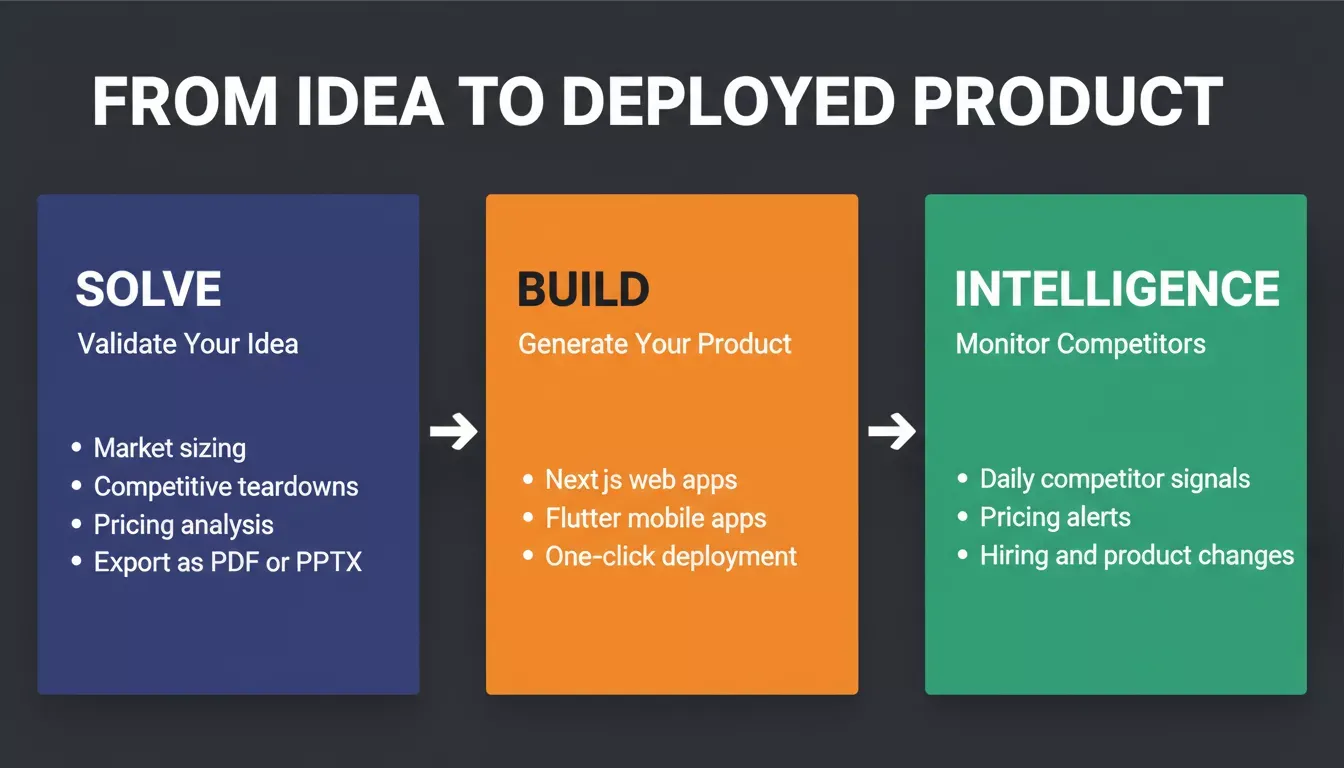
Rocket's Solve, Build, and Intelligence pillars work together so validated ideas become deployed products without losing research context.
The result: the research you do in Solve informs the product Build generates, and Intelligence keeps that product competitive after launch. For founders building their first product, how Rocket takes market validation to product deployment, walking through the full workflow end to end.
Start Testing Before You Start Building
The difference between the 43% of startups that fail from poor market fit and those that succeed comes down to one habit: testing assumptions with real data before committing resources. These 15 prompts give you that testing framework for free, in minutes, without hiring consultants or spending months on traditional research.
Your next idea deserves better than a gut-feel launch. Run it through these best AI prompts to validate an idea before you build, read the AI's honest assessment, then decide with confidence whether to build, pivot, or move on to the next concept.
Ready to take a validated idea from concept to deployed product? Rocket.new connects your validation research directly to the build through Solve, so nothing gets lost between testing and shipping.
Table of contents
- -Why Do 43% of Startups Fail Before They Test a Single Idea?
- -Why Traditional Idea Validation Fails Most Founders
- -How Should You Structure AI Prompts for Brutally Honest Validation?
- -Market Demand and Target Audience Prompts
- -Prompt 1: Ideal Customer Profile Discovery
- -Prompt 2: Pain Point Severity Assessment
- -Prompt 3: Market Size and Growth Signals
- -Prompt 4: Target Customer Interview Simulator
- -Prompt 5: Demand Signal Validation
- -Competitive Research and Positioning Prompts
- -Prompt 6: Competitive Landscape Mapping
- -Prompt 7: Competitor Intel Deep Analysis
- -Prompt 8: Differentiation and Value Proposition Builder
- -Prompt 9: Competitor Weakness Exploitation
- -What Makes a Good Pricing and Willingness-to-Pay Prompt?
- -Prompt 10: Willingness to Pay Assessment
- -Prompt 11: Business Model Viability Test
- -Prompt 12: Revenue Feasibility and Key Benefits Validation
- -Can These Prompts Kill Bad Ideas Before They Drain Your Budget?
- -Prompt 13: The Idea Killer Prompt
- -Prompt 14: Assumption Audit
- -Prompt 15: The Go/No-Go Decision Framework
- -How Rocket Turns Validated Concepts Into Deployed Products
- -Start Testing Before You Start Building