
Rocket.new treats the product brief as a starting hypothesis, not a fixed plan. Real market signals like user behavior, pricing response, and competitor moves continuously reshape the product. The result: products that reflect real demand, not just internal assumptions.
Does the product your builders ship ever look different from what the brief said?
At Rocket.new, that gap is intentional. The brief captures a hypothesis. The market delivers evidence. When the two conflict, the evidence wins.
According to Founders Forum Group, 42% of startups fail because they build products nobody needs, all while following perfectly written internal documents.
That stat explains why does the product that Rocket.new ships reflect the market and not just the brief the team originally wrote.
The Brief is a Starting Point, Not a Final Word
Founders spend weeks crafting a brief. So why does the shipped product so often look different?
What a Brief Actually Captures
A brief captures what builders know before the market has said anything back. It is a foundation, not a finish line.
-
Target segment: those the company believes will benefit most.
-
Problem statement: the specific pain the product will address.
-
Early success metrics: measurable goals like "improve website activation by 15%."
-
Non-negotiables: hard constraints like a Q3 launch or a website performance benchmark.
-
Business objective: the core outcome the company wants to achieve.
A good creative brief is single-minded and should inspire the creative team, serving as a platform for the creative journey. It should contain a single-minded proposition that articulates one clear thought without ambiguity, enhancing focus and creativity.
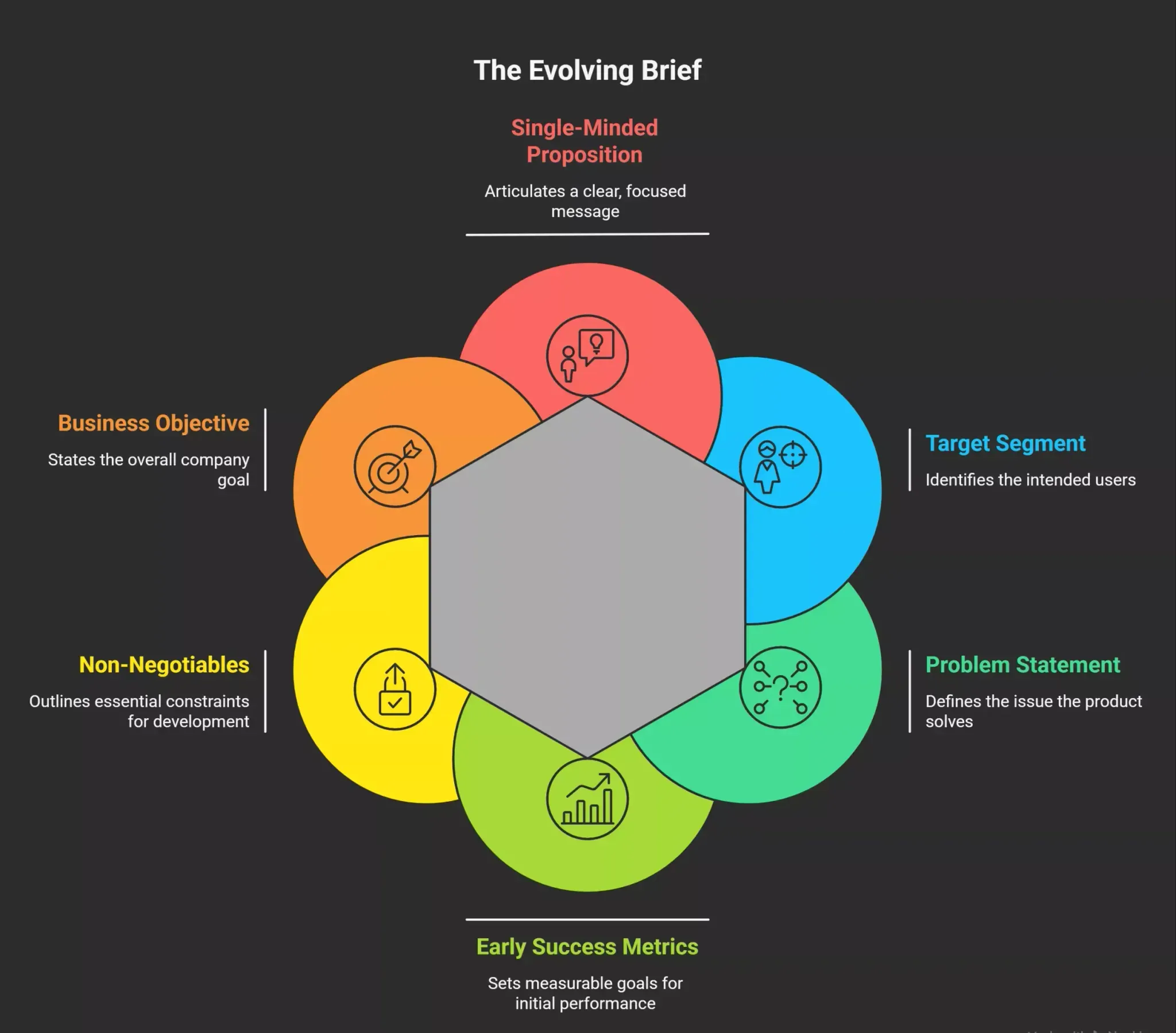 A well-crafted brief significantly influences project outcomes by providing clarity and direction, helping builders avoid creative stagnation. The process of writing a brief is a creative task: marketers must embed insights that stimulate the process.
What the Brief Does Not Lock In
The brief is not a contract. Importantly, it does not finalize:
-
Feature specifications or scope
-
Website UX patterns and interaction flows
-
Pricing tiers and pricing line
-
Final ICP details
-
Strategies for responding to the competition
A creative brief should be concise; overly lengthy documents can lead to confusion and dilute the intended message, making it harder for the creative team to focus. Its job is to create direction, not deliver a finished spec.
How Market Signals Rewrite the Brief
The "market" is not abstract. It is concrete user actions and numbers that arrive weekly once beta website traffic begins. These signals reshape what gets built and how the company invests its resources.
The Signals That Matter Most
Each of these signals gets reviewed every sprint:
-
Cohort retention curves: do week-one website users still return in week four?
-
Website heatmaps: where do users spend time on the product website?
-
Sales call notes: what objections and requests surface with real customers?
-
Competitor website monitoring: what moves are competitors making on their website?
-
Pricing experiments: what do users actually convert at versus what the brief predicted?
-
Website performance metrics: which website flows drive activation and which create drop-off?
Why These Signals Override Initial Predictions
The world outside the company contains more information than any internal document.
Rocket.new's Intelligence pillar delivers daily briefs on competitor website changes, pricing shifts, and new feature launches. It monitors across five signal categories: news, website, customer, people, and social.
The research phase in Rocket covers competitor pricing, reviews, and market signals before any programming starts.
Direct feedback and economic and environmental constraints drive product changes at every stage.
From Fixed Brief to Living Hypothesis
Instead of treating the brief as "the plan," Rocket.new frames it as version 0.1, designed to create a hypothesis against real customers.
Translating Brief Language Into Testable Hypotheses
An original brief might center on an idea like: "Build a collaboration dashboard for SaaS founders." The translated hypothesis: "If we launch collaboration features by Q2 2026, weekly active users will increase by 25%."
Each hypothesis ties to a specific website and performance metrics:
-
Website trial-to-paid conversion rate
-
Website feature adoption percentages
-
Website performance scores from design partners
The Metrics That Drive Brief Revisions
After 4 to 6 weeks of live website usage, builders revisit the brief:
-
Validated sections stay in place
-
Sections that website performance metrics contradict get rewritten
-
Resources redirect to what the market has shown works
Intelligence delivers daily briefs on competitor moves throughout every sprint. Research context carries directly into Build, so development starts from prior findings, not a blank prompt.
Builders who focus on developing faster feedback cycles produce stronger products.
When Builders Formally Revisit the Brief
One concrete example: a brief targeting "founder persona" users found agency operations managers converting 3x better. The brief changed. That is what developing genuine market expertise looks like.
The Product Roadmap as a Living Document
Product strategy is not static; it evolves like a GPS navigating changing conditions. A well-defined product strategy helps teams make informed decisions about product features, pricing, and positioning, ensuring alignment towards common goals. The evolution of product strategy involves continuous learning and iteration, allowing teams to adapt their approach based on real-world feedback and changing market dynamics.
At Rocket.new, the roadmap helps the company allocate resources efficiently and stay ahead of the competition.
Roadmap Components That Stay Constant
These elements do not change mid-cycle regardless of what market signals arrive:
-
The business goal for the current cycle (for example: "increase successful launches per customer by 20% in H2 2026")
-
Security and compliance requirements
-
Core brand promises and brand performance standards
-
Mission-critical website performance benchmarks
Importantly, maintaining these constants lets everything else flex without the company losing direction.
Roadmap Components That Stay Flexible
These components are explicitly labeled as negotiable from day one:
-
Feature list and scope
-
Website UX details and interaction patterns
-
ICP nuances and segment focus
-
Pricing tier structures and pricing line
-
Website content and onboarding flows
Rocket development is increasingly driven by market demands due to the need for cost-efficient, reusable technologies and rapid AI integration. For example, a website activation drop can create a need to revise onboarding without changing the business goal.
How Builders Prioritize Which Signals Deserve a Pivot
Not every signal earns a pivot. Rocket uses structured frameworks to decide which changes get resources:
-
RICE scoring: Reach, Impact, Confidence, Effort for every competing initiative
-
Post-sprint review gates that notice when a signal repeats across multiple website performance reports
Four Scenarios Where the Market Overrode the Original Plan
Scenario 1: The Adoption Surprise
The brief targeted bootstrapped SaaS founders. Website sign-up results from April to May 2026 showed higher activation among agency managers on the website.
-
The team shifted onboarding flows, website messaging, and feature prioritization to serve agencies
-
Website retention performance confirmed the decision post-launch
Scenario 2: Feature Inversion
The brief positioned the "automation builder" as the hero feature, justifying premium website pricing. Early website users spent 70% of their time in a simple "launch checklist" that the brief barely mentioned.
-
The checklist moved to the center of the website UI
-
The automation builder was deferred to a future release
Scenario 3: Pricing Reality Check
The brief set the entry tier at $99 per month based on competitive analysis of competitor website pricing. Willingness-to-pay research in mid-2026 revealed a ceiling of around $39 per month. Website conversion performance confirmed the gap.
-
The product line and pricing line were adjusted to match what website users would pay
-
For example, some features moved to higher tiers while the company adapted to real research findings
Scenario 4: Competitor Shock
The brief called for a full-featured MVP launching Q3 2026. A direct competitor launched at a major trade show.
Companies often align product launches with major trade shows to maximize media coverage and visibility, as these events attract relevant media and industry stakeholders. Launches are frequently timed to coincide with market trends or significant events, allowing companies to leverage heightened consumer interest. The timing of product launches can be influenced by competitive dynamics, where companies aim to announce their products in a way that outshines their competitors' offerings.
-
Rocket.new narrowed scope and shipped a focused slice of the vision sooner
-
The brand competed on focus and quality rather than feature breadth
The Feedback Loops That Let the Market Lead
Rocket.new runs structured feedback loops built directly into the process. These are scheduled and tied to brief revisions.
Core Feedback Loop Types
| Loop Type | Frequency | What It Reveals |
|---|---|---|
| User interviews | Weekly | The "why" behind website user behavior |
| Website analytics reviews | Per sprint | Website usage patterns and performance |
| Design partner programs | Ongoing | Deep insights from early adopters |
| Sales discovery calls | Continuous | Real objections from customers |
| Post-sprint website experiments | 2 to 3 week cycles | What actually performs better |
User interviews reveal motivation that website metrics miss. Sales calls surface use cases the brief never anticipated. Every loop feeds findings back so builders can track where market signals confirm initial predictions and where evidence overrules them.
Anticipating and Mitigating Risks
A market-driven approach means accepting that change is constant across every sprint.
Continuous Monitoring and Research
Risk mitigation begins with thorough research and analysis, run continuously:
-
Continuous monitoring tracks competitor website changes, price shifts on each competitor website, and new website features entering the market
-
Regular post-release reviews confirm that brand standards stay consistent as features evolve
Challenging initial assumptions is how the company stays ahead of the competition.
What This Means Across Stakeholders
For Customers
-
Rapid iteration means frequent website and UX changes between versions
-
Features evolve in response to actual website usage rather than static roadmaps
-
The conclusion for customers is clear: the product increasingly serves real workflows, not theoretical ones
For Internal Teams
Performance evaluations shift toward:
-
Speed of learning from the website and market signals
-
Capabilities for developing market awareness alongside building the product
What People Are Saying
This post from r/ProductManagement captures it well:
"Realize there is no one 'right' way to do product management or even to run a business. Being comfortable with uncertainty and a bit of chaos is one of the rites of passage for PMs." - Source: CareerFoundry
Uncertainty is not a bug. It is how market reality replaces outdated brief predictions. The best builders in the world treat instability as evidence, not as a threat.
The Product Rocket.new Ships Reflects the Market, Not Just the Brief
Rocket.new is an AI-first platform. The research phase shapes what to build before any code is written, and that context carries directly into Build with no re-explaining required.
The platform's design eliminates the handoff gap between research and development, prioritizing market feedback over initial briefs. Rocket's focus has shifted toward delivering production-ready tools rather than isolated experiments in response to market demand.
Build ships production-grade web and mobile apps, with Stripe for payments and Supabase for database management available as integrations.
The rise of companies like SpaceX and Blue Origin has shifted focus from high-cost rockets to reusable, lower-cost vehicles. Innovations in AI and hybrid product development necessitate updating initial plans to remain competitive. This architecture lets Rocket create a direct path from market signal to shipped feature.
Rocket.new Features Built for Market-First Development
-
Vibe-solutioning platform: explore the problem before writing a line of code
-
25k+ templates library, free to use: start from proven website and product patterns, not blank screens
-
No re-explaining between research and build phases: full context carries from the research output into code, no decisions lost
-
Flutter for mobile apps, web apps from prompt, Figma, or existing Next.js codebases: build production-grade apps without switching tools
-
Collaboration features built in: shared workspaces, projects, and role-based access for the whole team
-
3 Products, One Platform: Solve, Build, and Intelligence: Solve handles research, Build generates production-ready website and app code, and Intelligence monitors competitor websites and market signals continuously
Use Cases: How Market-Driven Builders Use Rocket
-
Tracking competitor websites: Intelligence monitors every competitor website for price changes, new website features, and positioning shifts so Rocket can notice and respond before the next sprint
-
Brief-to-build pipeline: Solve turns the initial brief into structured research, and Build takes that research directly into production-grade website and app development, with no handoff gap
-
Market signal integration: Rocket creates automated daily reports on competitor website changes, pulling the world's market signals into the process so builders can advance from real evidence
The Market, Not the Brief, Defines the Shipped Product
Why does the product that Rocket.new ships reflect the market and not just the brief the team originally wrote? Because the brief captures what builders believed before the market responded, and the market always knows more.
Live website behavior and real performance results determine where it lands. Every product leader who treats the brief as a hypothesis helps their company achieve success with products the world actually needs. Rocket.new makes that shift fast and repeatable.
Start building what the market actually wants.
Table of contents
- -The Brief is a Starting Point, Not a Final Word
- -What a Brief Actually Captures
- -What the Brief Does Not Lock In
- -How Market Signals Rewrite the Brief
- -The Signals That Matter Most
- -Why These Signals Override Initial Predictions
- -From Fixed Brief to Living Hypothesis
- -Translating Brief Language Into Testable Hypotheses
- -The Metrics That Drive Brief Revisions
- -When Builders Formally Revisit the Brief
- -The Product Roadmap as a Living Document
- -Roadmap Components That Stay Constant
- -Roadmap Components That Stay Flexible
- -How Builders Prioritize Which Signals Deserve a Pivot
- -Four Scenarios Where the Market Overrode the Original Plan
- -Scenario 1: The Adoption Surprise
- -Scenario 2: Feature Inversion
- -Scenario 3: Pricing Reality Check
- -Scenario 4: Competitor Shock
- -The Feedback Loops That Let the Market Lead
- -Core Feedback Loop Types
- -Anticipating and Mitigating Risks
- -Continuous Monitoring and Research
- -What This Means Across Stakeholders
- -For Customers
- -For Internal Teams
- -What People Are Saying
- -The Product Rocket.new Ships Reflects the Market, Not Just the Brief
- -Rocket.new Features Built for Market-First Development
- -Use Cases: How Market-Driven Builders Use Rocket
- -The Market, Not the Brief, Defines the Shipped Product