
AI market research platforms compress weeks of manual research into hours by automating data collection, sentiment analysis, and competitive monitoring, giving teams the intelligence to make faster, better-informed strategic decisions.
Why does market research still take six to eight weeks when 88% of organizations already use AI in at least one business function?
According to McKinsey's 2025 State of AI survey, revenue increases from AI are most commonly reported in marketing and sales use cases. Yet the gap between available technology and actual research workflows remains wide.
Most teams still rely on manual surveys, slow focus groups, and spreadsheet-heavy data interpretation. These methods eat budgets and delay strategic decisions. The organizations moving fastest are the ones that replaced those bottlenecks with an AI market research platform built for real-time consumer insights.
Why Traditional Research Methods Are Falling Behind
The market research process built around traditional methods was designed for a slower world. Research teams would spend weeks on survey creation, recruit participants through panels, and run focus groups in person. They would then wait for human researchers to code and categorize qualitative data manually.
-
Data collection alone takes too long. A typical survey-based study requires two to four weeks just for fieldwork. That timeline stretches further when you factor in screener questions, panel logistics, and data cleaning.
-
Human error compounds at scale. When research teams manually process survey data from hundreds of respondents, inconsistencies in data interpretation become unavoidable. Bias creeps in through coding decisions that vary from one analyst to the next.
-
Focus groups capture a handful of opinions. Traditional qualitative research through focus groups typically gathers insights from fewer than fifty participants. That makes it difficult to spot emerging trends or shifts in consumer behavior across multiple markets.
-
Reports arrive after the window closes. By the time a traditional research report lands on a decision maker's desk, market conditions may have already shifted.
-
Tools do not talk to each other. Strategy teams research in one tool, hand off to product in a document, and product reads 60% before writing a PRD from memory. Engineering then misses two nuances. Three handoffs, three context compressions. The original insight is unrecognizable by the time it reaches execution.
These constraints do not reflect a failure of research teams. They reflect the limits of manual work in a market that moves faster than traditional methods can keep up with.
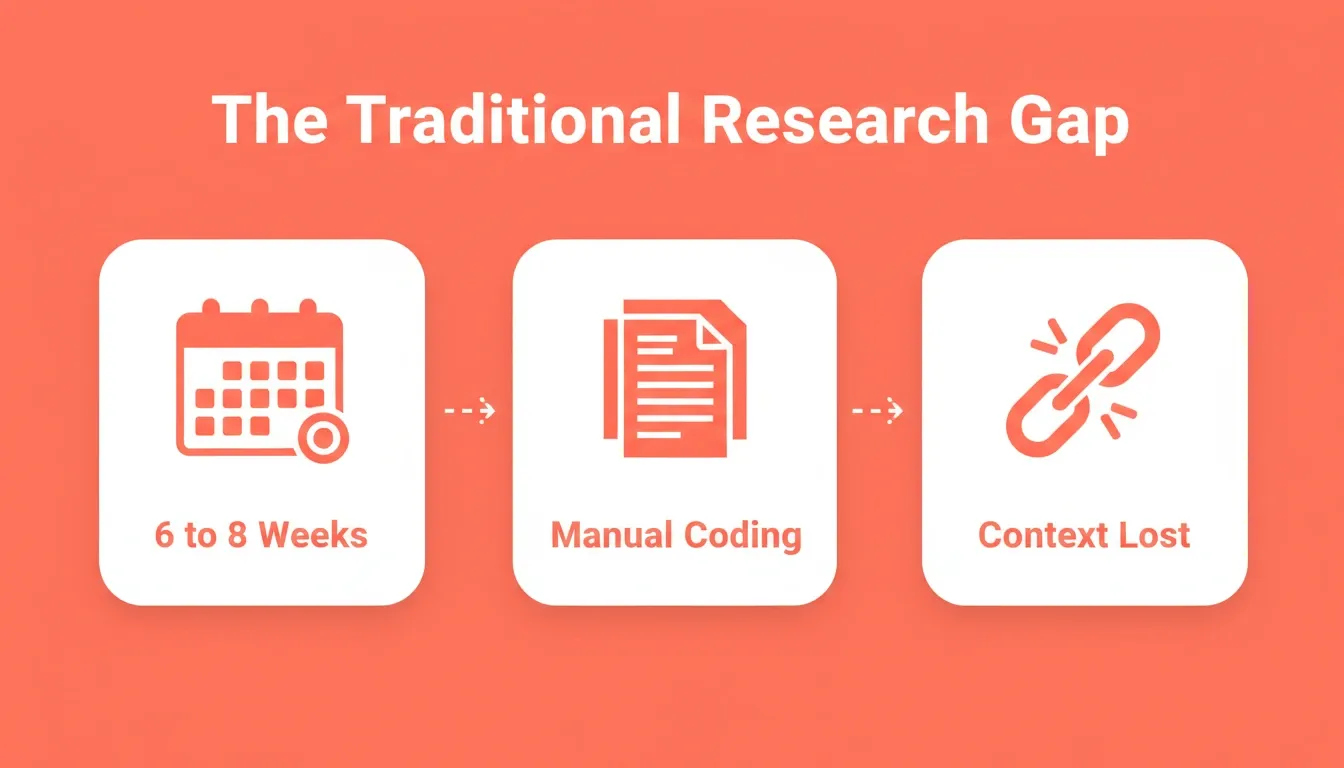
The three structural bottlenecks that make traditional market research too slow for modern strategic decisions
What Makes an AI Market Research Platform Different?
An AI market research platform solves the speed problem without forcing a trade-off on data quality. Rather than replacing human expertise, these platforms handle the repetitive, time-consuming parts of the research process. That frees researchers to focus on strategic decisions.
-
Sentiment analysis at quantitative scale. Natural language processing models analyze thousands of customer interviews, social data feeds, and consumer feedback sources in minutes. What used to require a team of coders reading transcripts now happens through AI tools that identify patterns humans would miss.
-
Predictive analytics for future trends. Machine learning models trained on historical data forecast consumer behavior shifts, emerging trends, and market movements before they become obvious to competitors.
-
Survey automation and survey creation. AI-powered market research tools generate screener questions, adapt survey design based on real-time responses, and analyze survey results immediately after data collection closes.
-
Structured, decision-ready output. The best platforms do not just surface data. They deliver structured reports with findings tagged by signal strength, conflicting signals called out explicitly, and actionable recommendations at the top.
-
Context that carries forward. Unlike standalone tools that reset every session, a true AI market research platform retains research context. Every subsequent task, from PRD writing to competitive analysis, inherits the full intelligence of everything that came before.
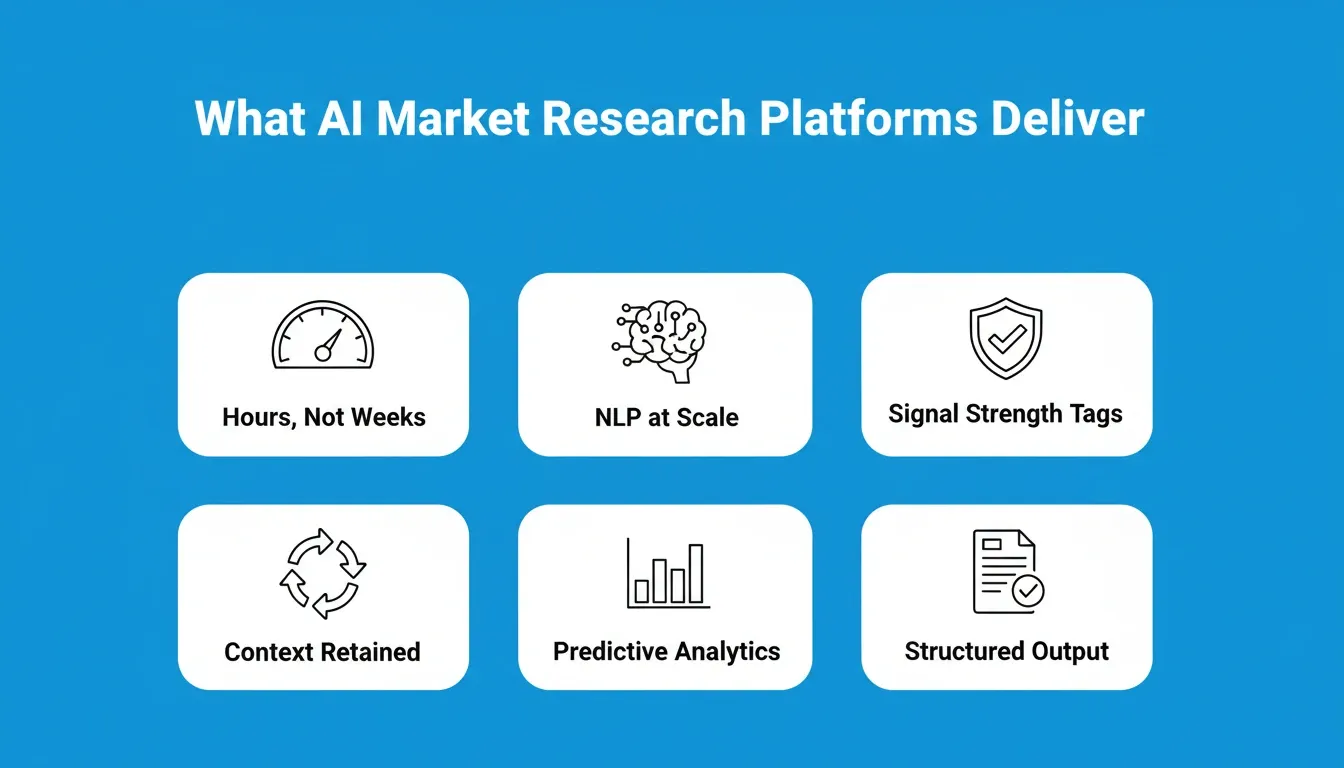
Six core capabilities that separate an AI market research platform from traditional survey tools and general AI assistants
| Capability | Traditional Methods | AI Market Research Platform |
|---|---|---|
| Data collection speed | 2 to 4 weeks | Hours to days |
| Sentiment analysis | Manual coding by researchers | Automated NLP at scale |
| Report generation | 1 to 2 weeks of analyst work | Structured output in 60 to 90 minutes |
| Competitive intelligence | Quarterly benchmarks | Continuous real-time monitoring |
| Qualitative research scale | 8 to 50 participants | Hundreds via AI-moderated interviews |
| Context retention | Lost at every handoff | Persistent across all tasks |
| Cost per insight | High (research teams and panels) | Fraction of traditional cost |
The right AI tool for your research needs depends on whether you need competitive intelligence, consumer insights, or both. Many market research tools specialize in one area. A platform built for the full research-to-execution workflow covers the entire spectrum without context loss between steps.
How Competitive Intelligence Works With AI
Competitive intelligence is no longer a quarterly report that sits in a shared drive. An AI market research platform turns it into a continuous signal that feeds directly into strategic decision making.
-
Monitoring competitor pricing, messaging, and positioning happens automatically through data extraction across public sources. AI models process competitor job postings, product launches, and marketing campaigns to identify emerging trends before they reach industry press.
-
Real-time alerts replace delayed updates. Research teams set triggers for specific competitive intelligence signals. These include a competitor changing their pricing model, launching a new product category, or shifting hiring patterns. Teams receive insights within hours rather than weeks.
-
Nine pillars of competitor intelligence. The most capable platforms monitor competitors across website changes, social media activity, news coverage, GTM strategy, web traffic, product updates, people and hiring, business and finance signals, and customer reviews. All of this happens simultaneously and automatically.
-
Market insights from unstructured sources. Social listening, Reddit threads, review sites, and community forums contain valuable consumer insights. AI tools parse this unstructured data using natural language processing and surface the market insights that matter for strategy.
-
Absence is a signal too. When a competitor goes quiet, stops publishing, slows hiring, or pulls back ad spend, that silence is as strategically significant as activity. The best AI platforms detect both.
Mermaid
A modern AI market research platform monitors competitors across nine signal pillars simultaneously, interpreting what changes mean, not just that they happened
This kind of predictive competitive intelligence goes beyond tracking what competitors did. It helps research teams understand what competitors are likely to do next, enabling proactive rather than reactive strategic planning.
How Rocket's Solve Turns Any Business Question Into a Research Report
Most AI tools respond to questions. Rocket's Solve resolves them. It delivers a complete, structured output that is ready to act on, present, or build from.
You describe your situation in plain language. Solve then runs thousands of queries across 150+ sources simultaneously. Within 60 to 90 minutes, it delivers a structured analytical report covering 8 to 12 sections. What would have taken a research team days or a strategy firm weeks is complete. Findings are tagged by signal strength (HIGH, MEDIUM, or LOW), and conflicting signals are called out explicitly rather than smoothed over.
Solve surfaces what you did not ask for but needed to know. If research uncovers a structural risk, a regulatory deadline, or a competitor move not mentioned in the prompt, it appears in the output with reasoning for why it matters. You can also upload internal files, such as financial models, board decks, and customer research. Solve reads them structurally, not as flat text.
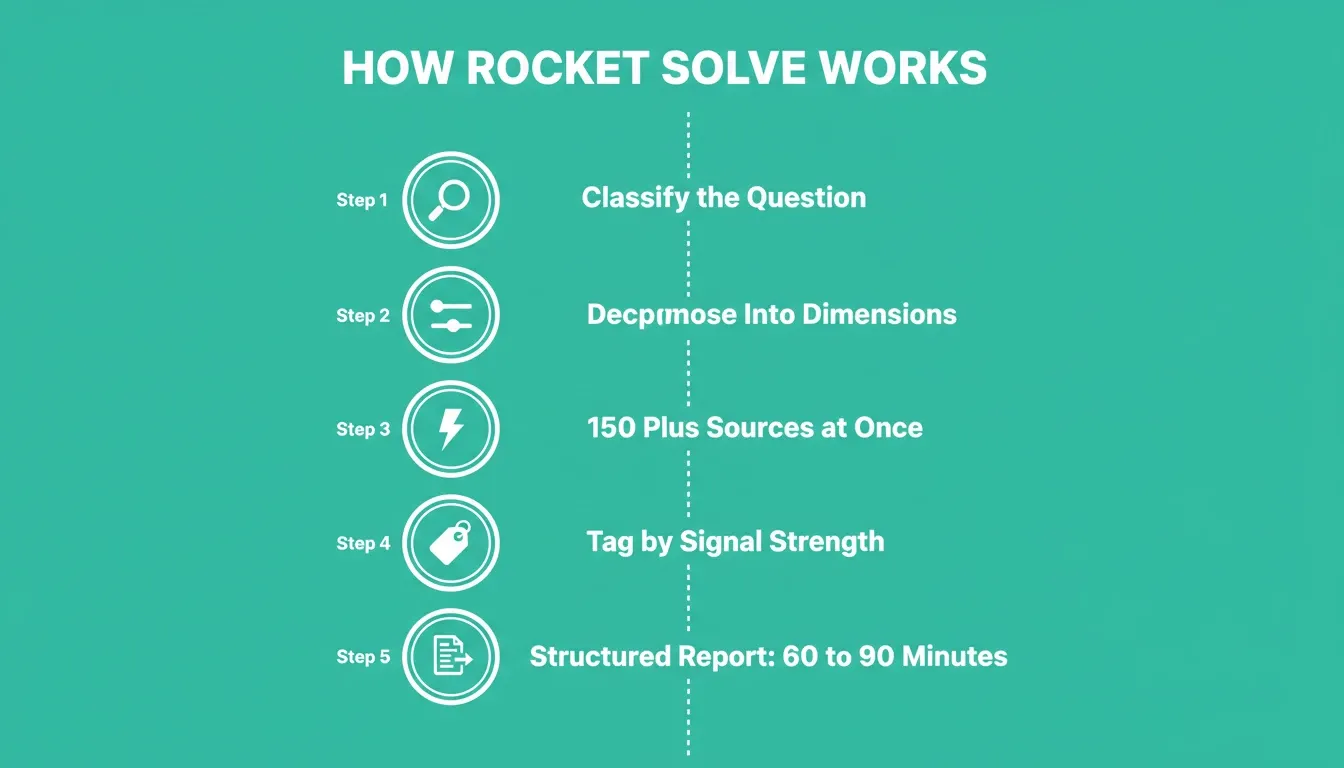
Rocket's Solve runs a five-step research pipeline across 150+ sources simultaneously, delivering a structured report in 60 to 90 minutes
What Solve Produces by Research Type
| Research Type | Key Sections | Typical Length |
|---|---|---|
| Market analysis | Market sizing, growth drivers, competitive landscape | 800 to 1,500 words |
| Competitive teardown | Feature matrix, SWOT, gap analysis | 1,000 to 2,000 words |
| Pricing strategy | Pricing tables, model analysis, recommendations | 600 to 1,200 words |
| Product direction | Prioritization framework, evidence, tradeoffs | 800 to 1,500 words |
| M&A and investment analysis | Thesis, financials, risk matrix, recommendation | 1,000 to 2,000 words |
Export the final report as a comprehensive PDF or generate a full presentation deck with one command. The output does not disappear after export. Instead, it becomes the foundation of everything that follows in the project. To get the most from structured research outputs, see how to use AI prompts for market research validation.
Can AI Handle Qualitative Research at Scale?
One of the strongest arguments for an AI market research platform is its ability to bring qualitative research to quantitative scale. Traditionally, qualitative insights came from small focus groups or a handful of customer interviews. Today, AI-moderated interviews can run hundreds of conversations simultaneously across multiple markets.
-
AI-moderated interviews adapt in real time. Unlike static survey design, these conversations adjust follow-up questions based on participant responses. The result is richer qualitative insights at a fraction of the time and cost.
-
Synthetic data fills gaps responsibly. When research teams cannot access specific demographic panels, synthetic data generated from AI models can simulate consumer feedback patterns. This is not a replacement for real people. Rather, it helps during early-stage exploration before committing to expensive fieldwork.
-
Survey analysis becomes immediate. Rather than waiting weeks for human researchers to code open-ended responses, AI tools categorize themes, extract key findings, and flag outliers within minutes of survey data arriving.
"AI isn't replacing the researcher. It's replacing the spreadsheet. The thinking, the strategy, the 'so what' still needs a human brain." — Insight professional on LinkedIn discussing AI in market research
Research teams that use AI market research tools for qualitative research consistently report faster time to insight without sacrificing methodological rigor. The key takeaway from early adopters: start with structured data automation, then layer in qualitative insights as your team builds confidence with the tools.
Who Benefits Most From an AI Market Research Platform?
An AI market research platform is not a single-persona tool. The same platform serves fundamentally different users depending on what they need to accomplish.
Founders and Product Teams
Founders use AI market research to validate ideas before committing engineering time. A Solve task returns a complete market entry assessment covering regulatory environment, competitive landscape, partnership models, and entry sequence, all structured for board presentation. Product managers use it to write engineering-ready PRDs from accumulated project context in under an hour instead of a week. For a deeper look at how this fits into the full product lifecycle, see how to do market research and validate a business idea.
Sales and Marketing Leaders
Sales teams use continuous competitive intelligence to prepare for every deal. That includes current pricing, recent product changes, and hiring signals that imply what competitors are building next. Marketing leaders use it to track messaging shifts, campaign themes, and content gaps across competitors in real time.
Enterprise Strategy Teams
Enterprise strategy leaders use AI market research platforms to run continuous competitive monitoring across dozens of competitors and multiple markets simultaneously. What used to require a team of analysts producing quarterly reports now runs automatically. Daily briefs, signal clusters, and strategic alerts are delivered where the team already works.
Researchers and Analysts
Market researchers and industry analysts use AI platforms to produce structured deliverables, including reports, briefings, and white papers, faster and at higher quality than manual synthesis allows. The platform handles multi-source research and structured output. The researcher handles interpretation and judgment.
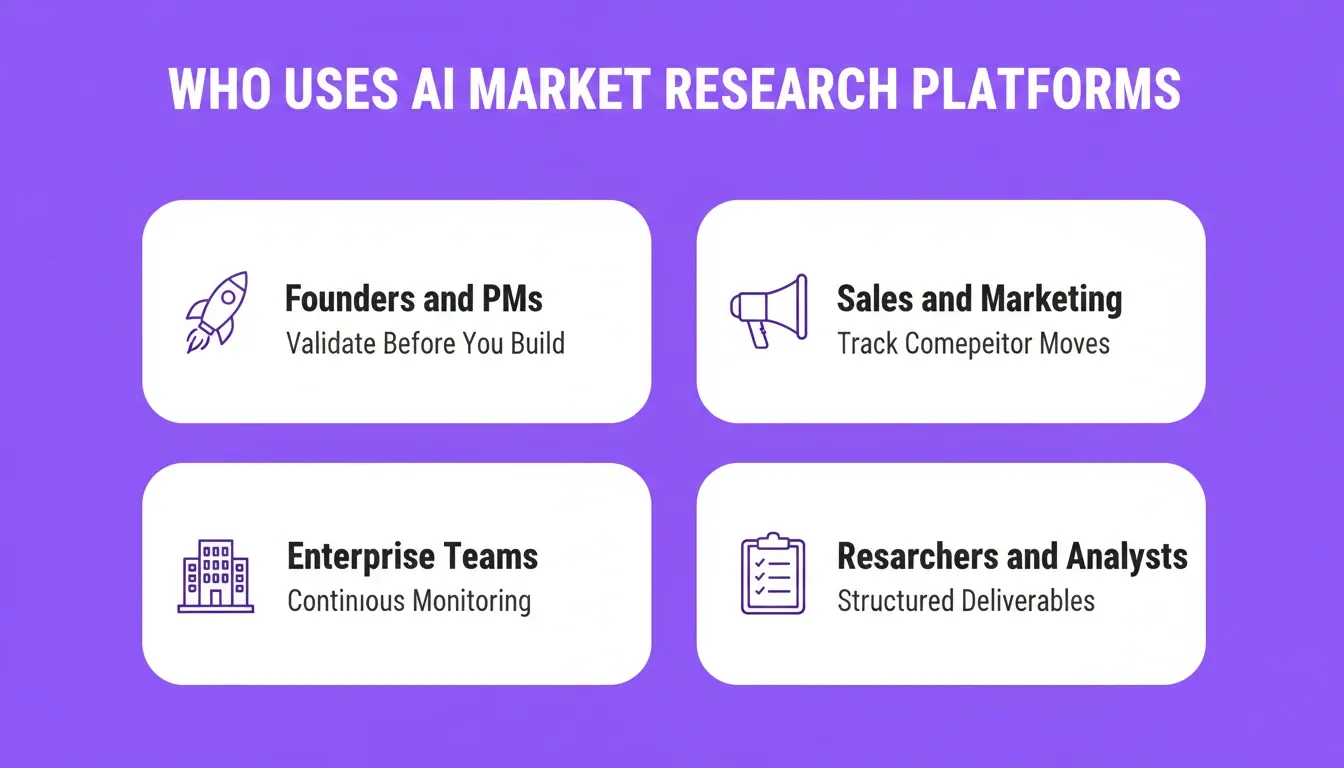
Four distinct user types who benefit from an AI market research platform, each using the same platform for fundamentally different outcomes
The Compound Context Advantage
Most AI tools share a fundamental architectural problem: they start from zero every session. You re-explain your market, your competitors, your product positioning, and your customer segments every time. The intelligence you built in the last session is gone.
A true AI market research platform works on the opposite architecture. Add your context once, including pitch decks, financial models, customer research, competitive analyses, and strategy documents, and every task that follows already knows everything. In Rocket, this is called compound context.
The research from a Solve task last week is available when a Build task starts today. The competitive brief is present when the landing page is written. A decision made in one task becomes the foundation for the next. Work compounds across a project, not just within a session, but across every action the entire team takes. As a result, the handoff is not improved. It is eliminated.
What AI-Powered Data Analysis Looks Like in Practice
Data analysis through an AI market research platform looks nothing like the spreadsheet-heavy process most research teams are used to. Modern platforms handle everything from data collection to data interpretation in a connected pipeline.
-
Real-time sentiment analysis across channels. Consumer insights no longer arrive quarterly. AI tools monitor brand health signals, social listening feeds, and review platforms continuously, surfacing shifts in consumer behavior the moment they happen.
-
Predictive analytics for campaign optimization. Research teams test messaging and positioning before committing budget to campaigns. Predictive analytics models estimate how target customers will respond based on historical data and current market trends.
-
Actionable insights without data science degrees. The best AI market research platforms translate complex data analysis into plain language recommendations. Data-driven decision making becomes accessible to marketing teams, product marketers, and decision makers who need answers, not raw datasets.
-
Trend analysis that spots what matters. Not every signal is a trend. AI-powered data analysis separates noise from real shifts by identifying patterns across vast datasets and flagging only the emerging trends that match your competitive intelligence parameters.
For organizations still running market research the old way, these capabilities represent a significant reduction in time to insight. Research that took a full quarter to complete now happens within days. See how AI integration strategies drive real business growth for teams making this shift.
Turning Insights Into Action Before Your Competitors Do
The organizations gaining ground right now are not the ones with the most data. They are the ones who act on market research fastest, turning consumer insights into strategic decisions while competitors are still waiting for their quarterly reports to finish.
According to McKinsey's 2025 State of AI survey, 88% of organizations already use AI in at least one business function. Revenue increases from AI use are most commonly reported in marketing and sales, strategy and corporate finance, and product and service development. AI market research platforms have moved from a nice-to-have to the foundation of how competitive companies operate. Whether your research needs center on competitive intelligence, consumer behavior analysis, or predictive analytics for new market entry, the speed advantage is real and growing.
The three-step workflow that separates fast-moving teams from slow ones:
-
Research before you build. Use Solve to validate the market, understand the competitive landscape, and scope the right product direction before a single line of code is written.
-
Monitor while you build. Use Intelligence to track competitor moves continuously. When a significant signal surfaces, create a Solve task to analyze the implications and update your product direction accordingly.
-
Build from the intelligence. Every build task inherits the full context of the research that preceded it. The PRD is present when the developer opens the build task. The competitive brief is present when the landing page is written.
The Future of AI Market Research Is Already Here
AI market research platforms are no longer an advantage. They are the baseline. Teams that still rely on quarterly reports and manual synthesis are not just slower. They are making decisions on information their competitors already acted on weeks ago.
The shift is structural. As AI models improve, research that once required weeks of analyst time will compress further. Competitive intelligence will move from daily briefs to real-time signals. Qualitative research at scale will become the norm, not the exception. The platforms that connect research, competitive monitoring, and product execution in one shared context will define how serious teams operate.
1.5 million people have tried Rocket across 180 countries. Type any business question into Solve, get a structured report in 60 to 90 minutes, and build from that intelligence without switching tools or losing context. Start free on Rocket.new. No credit card needed.
Table of contents
- -Why Traditional Research Methods Are Falling Behind
- -What Makes an AI Market Research Platform Different?
- -How Competitive Intelligence Works With AI
- -How Rocket's Solve Turns Any Business Question Into a Research Report
- -What Solve Produces by Research Type
- -Can AI Handle Qualitative Research at Scale?
- -Who Benefits Most From an AI Market Research Platform?
- -Founders and Product Teams
- -Sales and Marketing Leaders
- -Enterprise Strategy Teams
- -Researchers and Analysts
- -The Compound Context Advantage
- -What AI-Powered Data Analysis Looks Like in Practice
- -Turning Insights Into Action Before Your Competitors Do
- -The Future of AI Market Research Is Already Here