
Gartner costs $25,000–$150,000 per year and was built for enterprise IT buyers, not founders. This blog compares the top Gartner alternatives and shows how Rocket.new founders get structured market intelligence in 60–90 minutes without an analyst subscription. Start with Rocket.new Solve*
What Is a Gartner Alternative?
A Gartner alternative is any research tool, platform, or process that gives founders structured market intelligence without the cost, timeline, or enterprise scope of a Gartner subscription.
The Gartner model was built for IT leaders at large organizations evaluating vendors across multi-year procurement cycles. According to CB Insights analysis of startup post-mortems, 42% of startups fail from building a product with no market need. Most of those founders did research. The problem was that the research was never structured to ask the right question.
A genuine gartner alternative for founders does three things: it answers specific business questions, it returns results in hours not months, and it costs a fraction of a $25K–$150K annual analyst subscription.
What Gartner Provides: Advisory Services, Magic Quadrant, and Market Intelligence
Understanding where Gartner falls short for founders starts with understanding what Gartner actually offers technology buyers and IT leaders.
-
Gartner Magic Quadrant: A vendor evaluation framework placing technology vendors on a two-axis grid of Ability to Execute and Completeness of Vision. Published annually for enterprise software categories. Enterprise technology buyers use it as a procurement benchmark across various industries.
-
Gartner Hype Cycle: A research framework tracking emerging technologies through five maturity stages, used by technology vendors as a market positioning benchmark.
-
Gartner Peer Insights: A peer review platform aggregating verified user reviews of enterprise software vendors, used alongside the Magic Quadrant during vendor evaluation by technology buyers.
-
Advisory Services: Direct analyst access for inquiry calls, benchmarking, and strategic guidance. The most expensive component of any Gartner subscription, designed for IT leaders and senior executives at large enterprises.
-
Research Reports: Analyst-written market analysis covering vendor positioning, technology trends, and market data across thousands of enterprise technology categories.
Gartner advisory services and consulting services deliver real value in one context: enterprise technology procurement. For founders who need to research less and ship more, that context does not apply.
How Does a Gartner Alternative Help You Research Less and Ship More?
The right gartner alternative gives founders structured, decision-ready intelligence without the enterprise price tag or the multi-month wait. Sound familiar? Most early-stage teams have felt this gap.
Here is what it covers:
-
Specific market questions: Is this market real? Who are the relevant competitors? What are buyers paying today?
-
Speed: Research output in 60–90 minutes, not weeks.
-
Cost: From $25/month, not $25K–$150K per year.
-
Compounding context: Research that stays connected to every subsequent decision rather than sitting in a downloads folder.
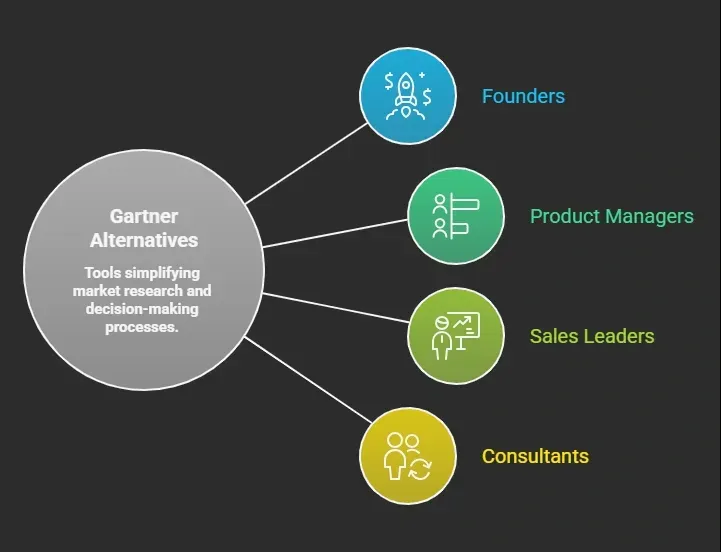
Who benefits by role:
Top Alternatives to Gartner: Forrester Wave, CB Insights, IDC, and More
Gartner is the most recognized analyst firm, but founders encounter several research and advisory alternatives when doing market research. Here is how each compares for founders who want to research less and ship more.
Forrester Wave: The Enterprise Gartner Alternative
The Forrester Wave is Forrester's vendor evaluation framework for technology buyers. Like the Gartner Magic Quadrant, it positions technology vendors as Leaders, Strong Performers, Contenders, or Challengers. Forrester subscriptions run tens of thousands of dollars annually and follow the same annual research cycle.
Forrester covers different enterprise technology categories than Gartner but operates on the same model, with the same structural limitations for founders looking for a practical gartner alternative.
CB Insights: Data-Forward Market Intelligence
CB Insights takes a more data-driven approach than traditional analyst firms. It aggregates data on private company funding rounds, investor activity, market maps, and emerging technology categories.
CB Insights is useful for startup market data, competitor funding signals, and industry investment trends. Pricing starts lower than Gartner but still runs several thousand dollars per month for meaningful research access.
International Data Corporation and Everest Group
International Data Corporation (IDC) publishes market share data, MarketScape vendor assessments, and technology spending forecasts. IDC is useful for macro market sizing and widely cited in investor materials. The Everest Group publishes PEAK Matrix research on IT services vendors. Both are enterprise-oriented and neither serves founders who need to research less and ship more.
Gartner Magic Quadrant Limitations for Founder Market Research
The Gartner Magic Quadrant produces a distorted picture for founder market research for three specific reasons.
-
Revenue thresholds exclude the most relevant vendors. Magic Quadrant qualification requires vendors to meet revenue thresholds that favor North American companies at enterprise pricing levels. A company with 100,000 users at emerging-market pricing can be excluded despite outsizing Magic Quadrant-listed vendors by adoption.
-
Annual publication cycles miss weekly market shifts. In fast-moving categories like AI tools, SaaS platforms, and developer infrastructure, market conditions shift faster than any annual research cycle can capture. The Magic Quadrant for AI Code Assistants ranked Cursor below Amazon Q and GitLab despite Cursor having significantly stronger real-world developer adoption.
-
Vendor relationships influence research output. Vendors that pay for Gartner advisory services have structural advantages in Magic Quadrant positioning, which produces market data that reflects enterprise procurement dynamics rather than actual market performance.
Gartner vs. Alternatives: A Practical Comparison for Founders
Here is a direct comparison for founders who want to research less and ship more.
| Research Source | Type | Typical Cost | Best For | Limitation for Founders |
|---|---|---|---|---|
| Gartner | Research and advisory services | $25K–$150K/year | Enterprise vendor evaluation | Too expensive, too slow, wrong market |
| Forrester Wave | Research and advisory | $30K–$100K/year | Enterprise technology buying | Same model as Gartner |
| CB Insights | Market intelligence data | $15K+/year | Startup and funding market data | Not decision-ready output |
| IDC | Market research firm | $10K–$60K/year | Macro market sizing data | Not actionable for builders |
| G2 / Gartner Peer Insights | Peer review platforms | Free | Product-level user reviews | No competitive analysis output |
| Rocket.new Solve | AI market intelligence | From $25/month | Founder-specific market research | No enterprise procurement validation |
What Founders and Practitioners Say About Gartner
Founders and IT professionals who have evaluated Gartner as part of their research process share a consistent experience: the pricing and scope were built for a different buyer entirely.
"I know Gartner is a research company for vendors and buyers in the IT space. I know they have their Magic Quadrant tool that they market pretty aggressively to their clients."
— u/ProfessorH4938, IT professional evaluating Gartner, r/sysadmin, December 2023
The pattern is consistent. Gartner is a procurement tool for IT leaders at large enterprises. For founders who need to research less and ship more, the pricing, cycle, and scope all point in the wrong direction.
Rocket-Powered Research: How Rocket.new Founders Research Less and Ship More
Rocket.new was built around one conviction: the most expensive mistake in any business is a good execution of the wrong thing. Research, competitive intelligence, and building live in the same platform, connected through shared context so every market insight feeds directly into what gets built next.
Solve: Advisory Services-Level Research in 60–90 Minutes
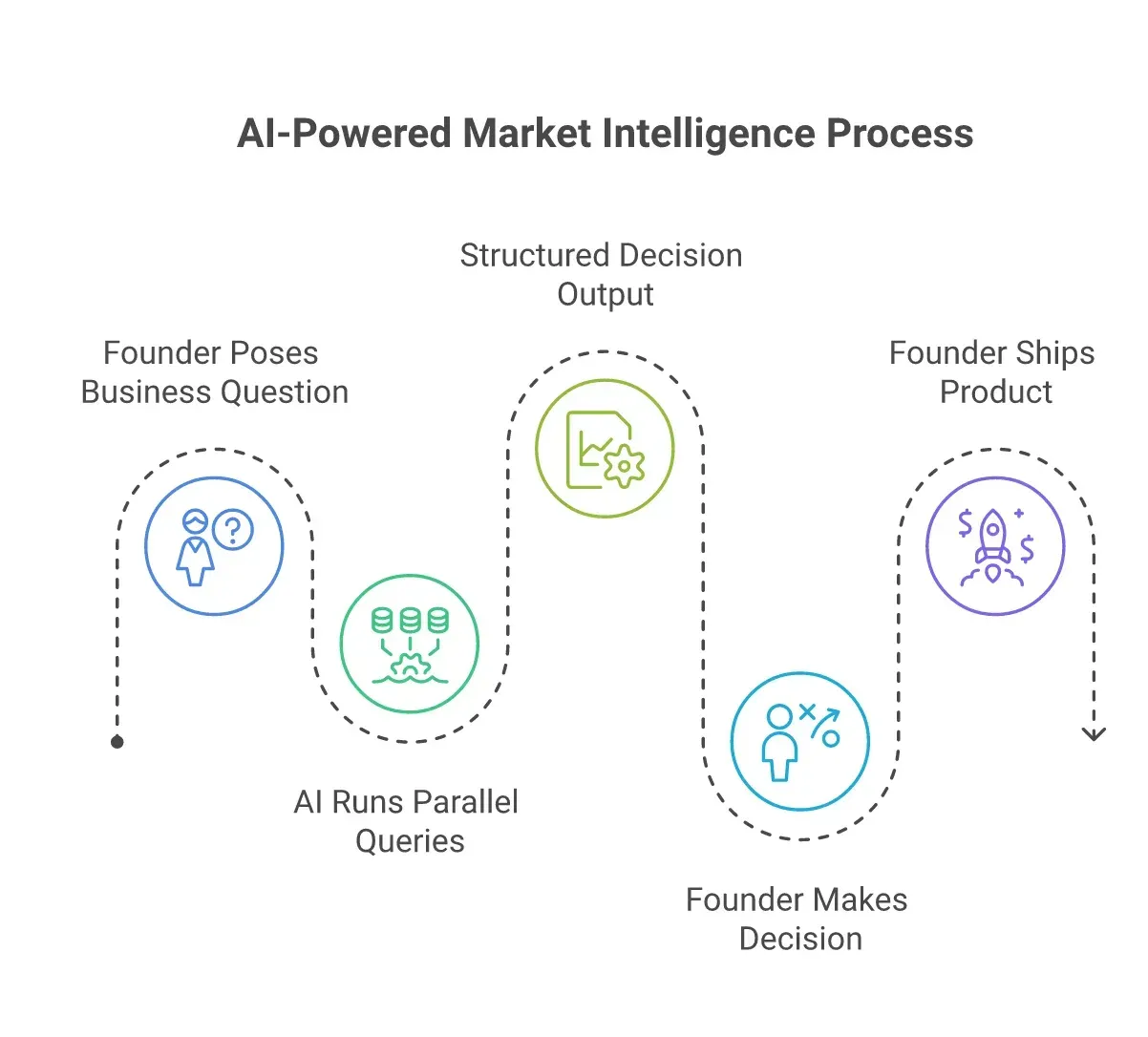
Rocket.new Solve is the AI market research engine. Describe any business question in plain language and Solve returns a complete, structured analytical deliverable in 60 to 90 minutes. No analyst subscription required.
-
Runs thousands of parallel research queries across 150+ sources: market data, competitor signals, analyst opinions, peer insights, pricing benchmarks, and live web sources.
-
Output structured across 8–12 sections: a direct verdict at the top, core market findings tagged by signal strength (HIGH / MEDIUM / LOW), competitor analysis, risk matrix, and execution recommendations.
-
Answers your specific question rather than a predefined Gartner or Forrester research category.
-
Surfaces intelligence you did not know to ask for: structural risks, regulatory changes, competitor moves not in the original prompt.
-
Every output stays permanently in the project as the research foundation for every subsequent product, sales, and strategy decision.
| Capability | Gartner Advisory | Rocket.new Solve |
|---|---|---|
| Response time | Weeks to months | 60–90 minutes |
| Annual cost | $25K–$150K | From $25/month (Pro plan) |
| Output format | PDF report | Structured deliverable, exportable PDF or PPT |
| Decision-ready output | Requires interpretation | Verdict at the top, recommendations at the end |
| Specific to your question | Predefined research categories | Any question in plain language |
| Geographic bias | North American, enterprise focus | Global, source-agnostic |
| Research compounds | No, each engagement separate | Yes, research persists across every task |
Intelligence: Continuous Monitoring That Replaces Gartner's Annual Cycle
Rocket.new Intelligence monitors every public signal competitors publish, continuously, across six signal categories: website changes, social media activity, news coverage, reviews and reputation, people and hiring signals, and performance marketing.
A daily brief arrives every morning covering what changed, what it signals about competitor strategy, and what your business should do about it. Intelligence reads signal clusters, not individual events. A pricing page update alongside enterprise-focused hiring and defensive review responses becomes one clear strategic signal.
It serves four functions from one setup: sales intelligence, marketing intelligence, product intelligence, and strategic intelligence. Where Gartner publishes vendor analysis once a year, Intelligence delivers a daily brief.
Context: Research That Does Not Disappear
The structural gap in working with Gartner and traditional analyst firms is that research lives in documents. Reports get emailed, partially read, and lost. Rocket.new's Projects architecture means research compounds instead.
Run a market analysis this week and that output is present when you build the landing page, prep a sales conversation, or scope the next product feature. Team members who join the project inherit every market insight the team has established. No re-briefing. No lost competitive context.
For a full breakdown of how Rocket.new replaces market research consultants, see the dedicated guide.
How to Use a Gartner Alternative in Practice: A Step-by-Step Example
Scenario: A SaaS founder is entering the project management software market and needs a competitive picture before committing to build.
Step 1 — Open a Rocket.new project. Name it for the product and add any background files: a rough spec, a competitor list, a pricing reference. These become the persistent research foundation for every subsequent task.
Step 2 — Run a Solve question in plain language. Type the business question directly: "What is the competitive market for project management tools targeting remote-first teams under 50 people? Who are the real competitors, what do buyers pay, and where are the gaps?" Solve classifies the question type and begins parallel research across 150+ sources.
Step 3 — Review the structured output in 60–90 minutes. The output arrives as a complete deliverable: market sizing, competitor analysis with positioning, pricing benchmarks, risk matrix, and a direct recommendation at the top. Export as PDF or PPT if needed.
Step 4 — Set up Intelligence monitoring. Add three to five competitors by URL. Intelligence maps every public signal they produce and begins delivering daily briefs. The first full brief arrives within 24 hours.
Step 5 — Build from the research foundation. Open a Build task in the same project. Rocket.new carries the full Solve output and Intelligence context into the build automatically. No re-briefing. No context lost between research and execution.
That is what it means to research less and ship more.
Choosing the Right Gartner Alternative by Founder Stage
Use the tables below to match the right gartner alternative to your specific goal and growth stage.
Goal-to-Action
| Goal | Best Option | Why |
|---|---|---|
| Validate if a market exists | Rocket.new Solve | Market sizing, demand signals, and competitor benchmarks in 60–90 minutes |
| Analyze competitors before launch | Rocket.new Solve | Competitor analysis matched to your exact product context |
| Monitor the competitive market continuously | Rocket.new Intelligence | Daily briefs on every public signal competitors publish |
| Replace quarterly analyst research cycles | Rocket.new Intelligence | Continuous monitoring replaces the annual Gartner cycle |
| Validate enterprise procurement credibility | Gartner Peer Insights + Rocket.new | Use peer reviews for procurement validation; Rocket.new for all other research |
By Founder Stage
| Stage | Market Research Need | Best Gartner Alternative |
|---|---|---|
| Pre-idea / validation | Market sizing, demand signals, competitor scan | Rocket.new Solve |
| Pre-product | Competitor analysis, buyer personas, market data | Rocket.new Solve + Intelligence |
| Early traction | Competitor tracking, market positioning | Rocket.new Intelligence |
| Growth / scaling | Multi-competitor monitoring, sales research briefs | Rocket.new Intelligence (team plan) |
| Enterprise sales | Vendor evaluation credibility, peer insights validation | Gartner Peer Insights + Rocket.new |
By User Type
| User Type | What They Research | How Rocket.new Helps |
|---|---|---|
| Startup founder | Market sizing, competitive picture, demand validation | Solve returns decision-ready market research in 60–90 minutes |
| Freelance consultant | Client sector onboarding, competitor benchmarks | Solve compresses days of sector research into one structured session |
| Small business owner | Local competitor tracking, pricing intelligence | Intelligence monitors competitor pricing and positioning shifts daily |
| Product manager | Roadmap prioritization, feature gap analysis | Intelligence signals what competitors are building before announcements |
| Early-stage startup team | Full competitive picture before fundraising | Solve and Intelligence together cover research, monitoring, and compound context |
For a deeper look at competitive intelligence software and how it connects to product strategy, the dedicated guide covers signal interpretation across all six monitoring categories.
The Gartner Alternative That Helps Founders Research Less and Ship More
Founders do not have a research problem. They have a speed and cost problem that Gartner was never designed to solve.
The traditional analyst model: subscribe to a research firm, wait months for a report, read 80 pages of enterprise vendor analysis. Founders who need to research less and ship more cannot operate on that timeline or that budget.
The real gartner alternative is a fundamentally different research process: structured, AI-powered intelligence that starts from your specific business question, returns decision-ready output in under two hours, and compounds across every decision so no market research is ever wasted. Rocket.new brings research, competitive intelligence, and building into one platform so founders can research less and ship more.
Table of contents
- -What Gartner Provides: Advisory Services, Magic Quadrant, and Market Intelligence
- -How Does a Gartner Alternative Help You Research Less and Ship More?
- -Top Alternatives to Gartner: Forrester Wave, CB Insights, IDC, and More
- -Forrester Wave: The Enterprise Gartner Alternative
- -CB Insights: Data-Forward Market Intelligence
- -International Data Corporation and Everest Group
- -Gartner Magic Quadrant Limitations for Founder Market Research
- -Gartner vs. Alternatives: A Practical Comparison for Founders
- -What Founders and Practitioners Say About Gartner
- -Rocket-Powered Research: How Rocket.new Founders Research Less and Ship More
- -Solve: Advisory Services-Level Research in 60–90 Minutes
- -Intelligence: Continuous Monitoring That Replaces Gartner's Annual Cycle
- -Context: Research That Does Not Disappear
- -How to Use a Gartner Alternative in Practice: A Step-by-Step Example
- -Choosing the Right Gartner Alternative by Founder Stage
- -The Gartner Alternative That Helps Founders Research Less and Ship More