
Most founders either skip product research or drown in it. This post breaks down how Rocket.new founders use jobs to be done research to validate ideas fast, build the right thing, and keep a continuous intelligence loop running after launch all inside one platform.
What if the reason your last product didn't land had nothing to do with the code, the design, or the launch timing? What if it was simply that you built the wrong thing?
That's the uncomfortable answer sitting behind most product failures. According to Founders Forum, 42% of startups collapse because they misread market demand creating products nobody actually wants or needs. The build was fine. The foundation was not.
Most founders understand this intellectually. The real challenge is doing enough research to avoid it without spending so long in research mode that you never ship. That tension between knowing enough and moving fast is what jobs to be done research is designed to solve. And it's exactly what Rocket.new founders have built their entire platform around.
Why Most Startups Build the Wrong Thing
The data here is pretty hard to ignore. Startup failure isn't a mystery it's a pattern, and it almost always starts before anyone writes a single line of code.
-
90% of startups fail overall, and the most common cause isn't poor execution it's building the wrong thing entirely.
-
34% of startup failures trace back to poor product-market fit the gap between what customers actually need and what founders assumed they needed.
-
That's not a technical problem. That's a research problem.
-
Most founders either skip research entirely, relying on gut instinct and raw speed, or over invest in it and never get to building.
-
The startup graveyard has equal numbers of both types.
-
What separates founders who ship the right thing from those who don't isn't the volume of research it's how directly that research connects to what they actually build.
The pattern is consistent across industries, company stages, and geographies. The fix isn't more research or less research. It's better-connected research.
What Jobs to Be Done Research Actually Means
The jobs to be done framework was popularized by Clayton Christensen, and the core idea is simple enough to write on a sticky note: customers don't buy products they hire them to do a job.
-
When someone signs up for a project management tool, they're not buying software. They're hiring something to solve "my team doesn't know who is doing what."
-
When a founder starts using a competitive intelligence platform, they're hiring something to answer "what are my competitors doing that I'm about to miss?"
-
Traditional market research focuses on demographics, features, and purchase patterns — useful, but shallow.
-
JTBD research asks three deeper questions:
◦ What situation pushed the customer to look for a solution at all?
◦ What were they doing before, and why wasn't that working?
◦ What does success actually look like once the job is done?
-
That kind of insight is far more valuable for product teams than knowing "30% of your users are 25–35 and work in tech."
-
Yet most early stage founders never get there not because they're lazy, but because their research process is disconnected from the build process.
The job is the thing. The product is what gets hired to do it. Get that wrong, and no amount of good execution fixes the outcome.
The Research Trap That Slows Most Founders Down
Here's a pattern that plays out constantly across early stage startups. A founder has an idea, knows they should validate it, and starts doing market research only to watch weeks disappear before a single line of code gets written.
-
The founder reads industry reports, scopes competitors, sets up customer interviews, and builds a survey.
-
Weeks pass. The data keeps coming in. The picture gets more complex, not simpler.
-
By the time they feel "ready" to build, three months have gone by and the window has shifted.
-
The thing they originally wanted to build no longer maps cleanly to the customer insight they gathered.
-
There's a deeper issue too: most research tools don't help you act on what you find.
◦ You gather intelligence in one place. You build somewhere else.
◦ The context gets summarized, translated, and compressed at every handoff.
◦ By the time a developer is building the feature, they're working from a third-generation version of the original insight.
-
Most founders end up stuck in one of two failure modes:
◦ Building too fast with no real customer understanding.
◦ Researching so long they either never ship or ship something outdated.
Neither works. Rocket.new was built specifically to close the gap between those two failure modes without forcing founders to choose one over the other.
How Traditional Research Compares to the Rocket.new Approach
| Research Activity | Traditional Founder Stack | Rocket.new Approach |
|---|---|---|
| Market analysis | Multiple tools, 1–3 weeks | Solve — structured output in hours |
| Competitive analysis | Manual, one-time review | Intelligence — continuous, automated |
| Customer insight | Separate docs, spreadsheets | Shared project context |
| Handoff to build | Context lost in translation | Same workspace, zero handoff |
| Production grade build | Separate dev tools, bad code risk | Build in Next.js (web) / Flutter (mobile) |
| Post-launch monitoring | Ad hoc manual check-ins | Intelligence briefs, ongoing |
The difference isn't just speed. It's that research and building happen on a single platform with shared context that doesn't degrade between steps.
Vibe Solutioning: The Approach Rocket.new Founders Pioneered
Rocket.new's founding belief is direct: "The work is only as good as the thinking before it." The founders didn't just build a faster app builder they built a new category.
-
Vishal Virani, Co-founder and CEO, put it plainly when launching Rocket 1.0: "Vibe coding solved the last mile of building. Vibe Solutioning solves the first mile. The mile where most products actually fail."
-
Vibe Solutioning is the first AI platform that covers the full arc from strategic research to execution to ongoing competitive monitoring all in one place.
-
Shared compound context runs through every step, so nothing gets lost between the research phase and the build phase.
-
The reception has been real: Rocket.new now has 1.5 million users across 180 countries reached almost entirely through organic product-led growth.
"Most AI tools are obsessed with helping you build faster. Vishal Virani, Co-founder and CEO of Rocket AI, is asking a different question entirely: should you be building this at all?" Analytics India Magazine, April 2026
That question should you be building this at all is the JTBD question. And Rocket.new founders answer it before a single line of code gets written.
How Rocket.new Founders Handle JTBD Research in Practice
The platform has three core capabilities that together replace the broken research-to-build process that most founders are stuck with. Each one maps directly to a stage of the jobs to be done research cycle.
Solve: Structured Research That Doesn't Eat Your Weeks
Solve takes any business question and returns a complete, structured analysis with findings, evidence, and clear recommendations. It's not a search summary. It's the kind of output that used to take a research team a week.
-
Founders ask questions like "what core problem are my target customers trying to solve in this market?" and get structured market evidence back in hours.
-
It identifies where competitors are falling short with their current users revealing the jobs customers are still trying to hire nobody to do well.
-
Outputs can be scoped against market realities before committing months to a build direction.
-
Every Solve output exports as a PDF or PPT, and inside Rocket.new flows directly into the project workspace for the build phase.
Solve turns the JTBD discovery phase from a weeks-long research sprint into a structured, shareable deliverable that the rest of the platform can actually act on.
Intelligence: Market Research That Runs While You Build
JTBD research doesn't end at product launch. Customer jobs shift. Competitor moves signal what the market is rewarding and what it's punishing often before any analyst writes about it.
-
Intelligence monitors every public platform a competitor operates on: websites, social media, pricing pages, job postings, and ad activity all tracked simultaneously.
-
It doesn't just flag changes. It interprets what the combination of signals means for your business specifically.
◦ A pricing page update alone is noise.
◦ That same update, alongside four enterprise-focused posts and three senior sales hires, is one clear signal.
-
Teams receive daily, weekly, and monthly briefs delivered where they already work not in a separate dashboard they have to remember to check.
-
For product teams, this acts as a continuous JTBD signal feed, surfacing what customers are hiring competitors to do and where those competitors are coming up short.
Intelligence turns ongoing market research from a manual chore into a background process that keeps your product decisions grounded in what's actually happening right now.
Shared Context: Where Research Actually Meets the Build
The most persistent problem in startup product development is context loss at the handoff between research and execution. Most platforms don't solve this they just move it.
-
In a traditional setup, a founder does two weeks of customer research and writes a summary document. The developer reads it but doesn't have the underlying thinking. The product that gets built reflects maybe 60% of what the research actually revealed.
-
Rocket.new's shared context architecture solves this directly:
◦ Every Solve output, every Intelligence brief, and every file added to a project is present inside every task in that project.
◦ When the build phase starts, the research isn't in a separate document it's in the same workspace.
◦ The developer building the feature can see the JTBD insight that drove the decision to build it.
-
Context compounds over time: the first task in a project knows what you shared; the tenth task knows everything the first nine established.
-
Nothing resets between sessions, between team members, or between capabilities.
The handoff doesn't get better with shared context it disappears entirely.
The Research-to-Build Flow: From Question to Production
Here's how the Rocket.new research-to-build cycle works for a founder validating and shipping a new product:
-
Start with a business question or product idea
-
Run Solve to get a structured JTBD analysis
-
Decide: is this worth building?
-
If yes, set up Intelligence for competitor monitoring
-
Add research and files to the project context
-
Use Build to generate a production grade product
-
Launch and deploy to a live URL
-
Intelligence continues monitoring the market
-
New signals feed back into the project context for the next product decision
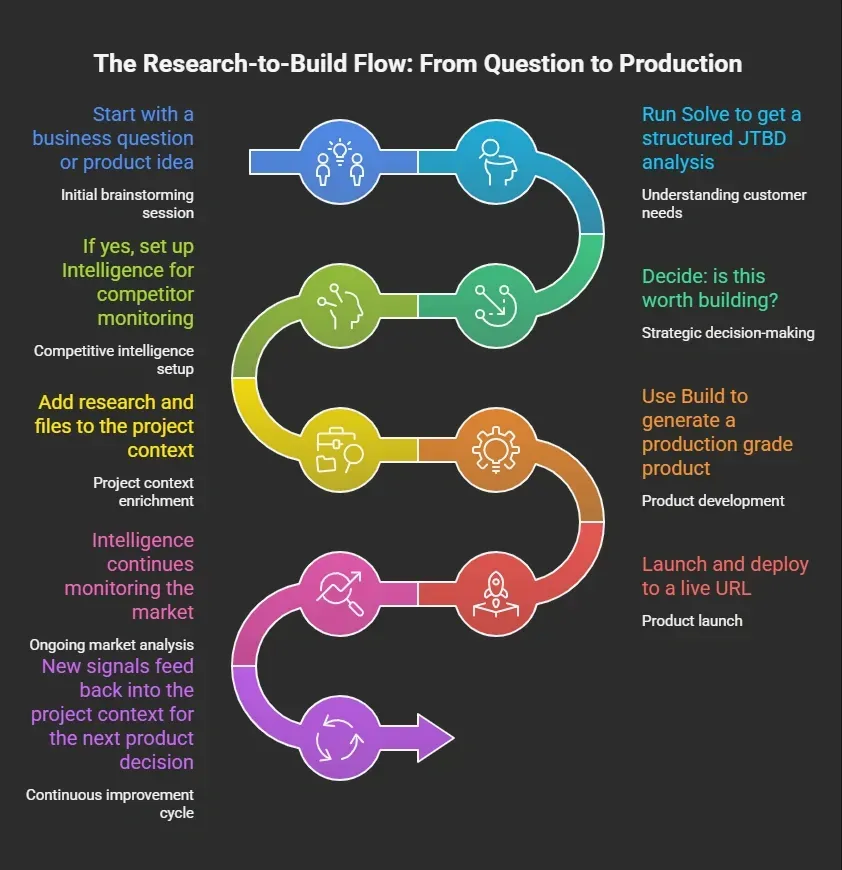 The feedback loop is the key detail. Most founders treat research as a one-time event before the build. Rocket.new treats it as a continuous loop the intelligence that runs after launch feeds back into the project context and informs the next product decision.
Rocket.new vs. Other AI Builders
Low code platforms like Lovable, Bolt, and v0 are genuinely capable at the build step. But they all start from the same assumption: you already know what to build. They build what you tell them to build.
-
Rocket.new starts one step earlier with the research and strategic thinking that determines whether the build is worth doing at all.
-
The approved positioning: "They build what you tell them to build. Rocket figures out what's worth building then builds it."
-
The structural gaps in tools like Lovable and Bolt:
◦ No pre-build intelligence or idea validation layer.
◦ No shared memory across the research and build phases.
◦ No continuous market monitoring after launch.
◦ You get a fast build on an uncertain foundation.
-
For non-technical founders and early stage product teams without a dedicated research function, this is the critical difference.
-
Rocket.new is the single platform where the thinking and the building both happen and where neither loses context because of the other.
Speed is only an advantage when you're going in the right direction. Tools that skip the first mile of product development are fast in the wrong way.
Who Benefits Most From This Approach
Not every team needs the same thing from a platform. But the JTBD research workflow in Rocket.new matters most for three kinds of builders.
-
Early stage founders and startups validating ideas and moving fast without skipping the thinking phase:
◦ Solve replaces the weeks-long research sprint that typically precedes a product decision.
◦ The result is an idea validation process that takes hours, not months.
-
Non-technical founders who can't rely on a full engineering team to interpret research and turn it into a build plan:
◦ Research and production grade builds happen on the same platform.
◦ No developer is needed to translate customer insight into technical requirements.
-
Product teams managing multiple product decisions and needing competitive intelligence that stays current:
◦ Intelligence acts as a continuous JTBD signal feed running in the background.
◦ Product decisions stay grounded in live market data, not last quarter's research.
Each user type solves the same core problem differently but they all benefit from research and building happening in the same place, with the same shared context.
Launch With Rocket.new: What You Actually Get
Rocket.new is the world's first Vibe Solutioning platform. For founders who want to research smarter and ship faster, here's what the platform delivers from day one.
-
Solve: Any business question to a complete, structured analysis with findings and recommendations. Export as PDF or PPT.
-
Intelligence: Continuous monitoring of every public platform competitors operate on. Daily, weekly, and monthly briefs.
-
Build: Production grade web apps in Next.js and mobile apps in Flutter with real design systems, WCAG compliance, and SEO-ready structure built in.
-
Context: Add files, research, and decisions once. Every task in the project inherits them automatically.
-
Landing Pages: Conversion-focused landing pages built directly from your project research and competitive context.
-
Collaborate: Shared workspaces with three-level role access, so product teams, non-technical founders, and developers all work from the same accumulated context.
-
Human Help: When the AI reaches its limit, Rocket's Success team steps in inside the platform with your permission to finish the job. No tickets, no email chains.
Nidhi Desai, Director of Engineering at Rocket.new, has been central to building the architecture where research and building aren't sequential activities they're parallel, with the same context informing both from the start.
Every capability is connected through that shared context architecture. Nothing is a standalone tool with a separate login. It all compounds.
Build the Right Thing, the Right Way
The real problem most founders face isn't too much research or too little. It's that research and building are disconnected and the insight gets compressed at every handoff between them. The JTBD framework gives you the right questions to ask. Rocket.new gives you the platform where those questions connect directly to what actually gets built.
Research less, ship more: how Rocket.new founders handle jobs to be done research comes down to one architectural choice keeping the thinking and the building in the same place. When your JTBD research lives in the same project workspace as your build, your product reflects actual customer insight, not a summary of it. Startups fail for a lot of reasons. Building the wrong thing because the research never made it into the product shouldn't be one of them.
Table of contents
- -Why Most Startups Build the Wrong Thing
- -What Jobs to Be Done Research Actually Means
- -The Research Trap That Slows Most Founders Down
- -How Traditional Research Compares to the Rocket.new Approach
- -Vibe Solutioning: The Approach Rocket.new Founders Pioneered
- -How Rocket.new Founders Handle JTBD Research in Practice
- -Solve: Structured Research That Doesn't Eat Your Weeks
- -Intelligence: Market Research That Runs While You Build
- -Shared Context: Where Research Actually Meets the Build
- -The Research-to-Build Flow: From Question to Production
- -Rocket.new vs. Other AI Builders
- -Who Benefits Most From This Approach
- -Launch With Rocket.new: What You Actually Get
- -Build the Right Thing, the Right Way