
Rocket.new helps businesses identify competitor repositioning early by analyzing signals beyond website updates, enabling faster strategic decisions, proactive adjustments, and a stronger competitive edge in dynamic markets.
Why Rocket.new catches competitor repositioning before it becomes obvious?
It reads early signals, not just final updates. Most competitors don’t suddenly change direction. They show hints weeks before updating their homepage. These hints appear in small places like hiring trends, product tweaks, and messaging experiments. Smart tools track these patterns instead of waiting for the final launch.
Competitive intelligence works like an early warning system, giving teams time to prepare before changes hit the market. This is exactly why tracking early signals matters. When teams notice shifts in hiring, messaging, or product direction early, they don’t just react.
They plan. That timing advantage is what separates teams that follow competitors from those that stay one step ahead.
This blog will help you understand how to spot early signals and act on them before your competitors do.
Signals show up before the website changes
Most competitors don’t suddenly change their positioning overnight. The shift builds step by step, and the early signs appear long before any public update.
-
Hiring signals show new direction and plans
-
Product tweaks hint at what’s coming next
-
Messaging drafts start shifting in smaller channels
-
Public launch happens only after everything is ready
Teams that rely only on visible updates react late. Even a one week delay can impact decisions, while early signals give teams the chance to act with clarity.
Where early signals actually come from
Well, early signs are everywhere if you know where to look. Here are a few common places where competitors leak their intent:
| Signal Source | What It Reveals | Timing Before Launch |
|---|---|---|
| Job postings | New direction or product focus | 3 to 6 week |
| Product updates | Feature priorities | 2 to 4 week |
| Messaging drafts | Positioning experiments | 1 to 3 week |
| Community chatter | User expectations and feedback | 1 to 2 week |
These signals give context. They help teams understand not just what competitors are doing, but why they are doing it.
Still, manually tracking all this? That’s messy. It takes time, and it breaks easily.
Why traditional research falls short?
Most teams rely on multiple tools to manage competitive intelligence, but this approach often creates more confusion than clarity.
-
Tool fragmentation creates silos: separate platforms for market research, product tracking, and notes split the flow of information
-
Disconnected insights reduce clarity: data is collected, but not linked into a clear, usable narrative
-
Lack of context impacts product teams: entering calls without proper background for the call weakens discussions
-
Gaps during key moments affect sales teams: missing signals make it harder to respond in real time
When data stays scattered, clarity drops. Teams spend more time collecting information than using it, and that’s where the process starts to break.
A different way to track competitor moves: Rocket.new
Rocket is the first vibe solutioning platform that focuses on connecting scattered signals into one place. Instead of chasing data, it builds a clear picture.
-
Signal aggregation in one flow: rocket.new connects competitor signals, research inputs, and internal context into a single platform
-
Structured output over raw data: rocket intelligence turns scattered inputs into clear, structured insights
-
Reduced noise and guesswork: only relevant signals are surfaced, making decisions easier
-
Faster team alignment: teams move faster because everything is available in one place
This shift changes how teams build strategy and respond to competitor moves.
How Rocket.new actually works?
So, how does it do that? Rocket tracks signals in real time. It pulls from job postings, product updates, messaging shifts, and more.
Then it builds a structured brief.
This brief includes:
-
Key changes in competitor strategy
-
What those changes mean
-
Suggested next steps
It gives teams clarity before competitors even launch their updates.
And here’s something interesting. The system reduces manual effort and saves up to 80 percent of research time. That’s not a small gain.
Features that make Rocket stand out
Let’s break this down a bit more. Rocket includes several features that support this process:
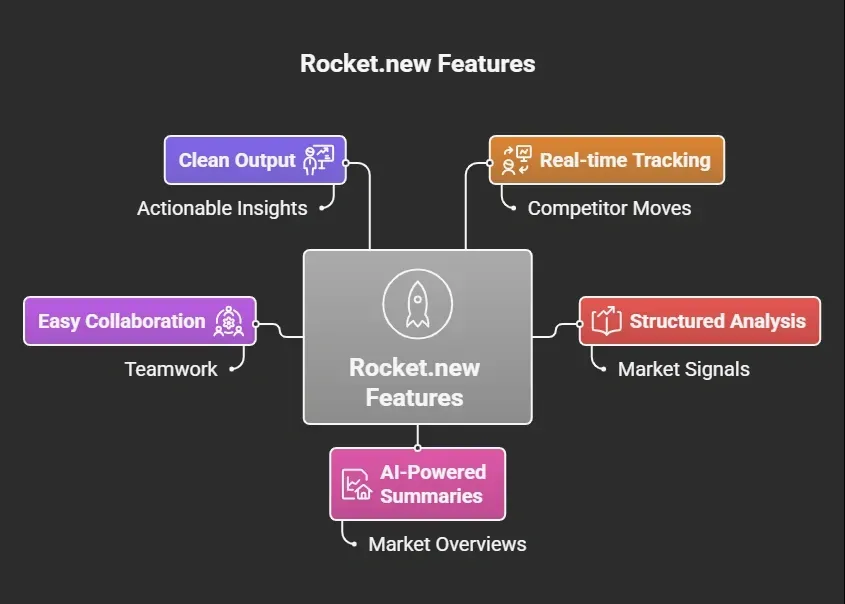 It also supports mobile and Next.js environments, making it flexible for modern workflows.
Accessibility is simple. The platform is free to use for basic access, which makes it easier for smaller teams to start building without friction.
Why timing matters more than perfection?
The real shift comes down to one simple idea. Acting early matters more than getting everything perfect.
-
Speed creates advantage: early action helps teams respond before competitors make their move
-
Waiting reduces impact: delaying for complete data often means missing the right moment
-
Signals drive quick decisions: Rocket turns early inputs into clear next steps without delay
-
Faster execution improves outcomes: teams that act sooner adjust plans while others are still stuck in research
Perfection slows things down. Teams that focus on timing stay ahead, while others keep waiting for answers that come too late.
A real example of early repositioning
Let’s look at how repositioning actually unfolds in real scenarios.
-
Week 1: Hiring signals appear: A competitor starts hiring for AI-focused roles, hinting at a shift in direction
-
Week 2: Messaging begins to change: Subtle updates show up in smaller channels, reflecting new positioning
-
Week 3: Product page gets updated: The final change becomes visible to everyone
-
Pattern insight: By the time the website updates, the repositioning has already been in motion for weeks
Rocket tracks this entire chain early. It doesn’t wait for the final change, which gives teams time to understand, plan, and respond before competitors make it obvious.
How Rocket connects directly with the idea?
Rocket fits into this idea by focusing on one thing clearly. Catching repositioning early and turning that into usable insights for teams before competitors make it obvious.
-
Early signal connection across sources: rocket intelligence connects hiring signals, messaging shifts, and product changes into one continuous flow
-
Context-driven insights instead of raw data: signals are not just tracked, they are explained with clear context so teams understand what’s actually changing
-
One platform replaces scattered tools: everything moves into one place, removing the need to switch between multiple systems
-
Faster decision support for teams: insights are ready when needed, helping teams act without delay
-
Clear visibility into competitor direction: teams don’t just see updates, they understand the intent behind competitor moves
By connecting signals early and presenting them with clarity, Rocket helps teams stay ahead of changes instead of reacting late. That shift leads to faster and more confident decisions.
For teams and founders
This shift changes how teams and founders approach decisions, planning, and execution across the board.
-
Proactive strategy for founders: founders move from reacting to competitors to planning ahead with clearer direction
-
Better planning clarity for product teams: decisions are based on real signals, not assumptions or scattered inputs
-
Stronger conversations for sales teams: better context improves how teams handle discussions and objections
-
Reduced guesswork across teams: signals replace uncertainty, making actions more focused and aligned
-
Aligned execution across the group: teams work with the same insights, which keeps everyone on the same page
When teams rely on clear signals instead of assumptions, they don’t guess. They plan, align, and act with confidence.
Why this approach works better?
Let’s break it down simply.
Traditional approach:
-
Manual research
-
Scattered tools
-
Late insights
Rocket approach:
-
Automated tracking
-
Structured analysis
-
Early insights
This difference directly shapes outcomes. Teams using the right approach act earlier, stay aligned, and make better decisions.
A quick look at real use cases
These are some of the most common ways teams use the platform in day-to-day work.
-
Preparing for sales calls
-
Tracking competitor strategy
-
Planning product updates
-
Supporting market research
All of this comes together in one place, giving teams clarity and saving time across different workflows.
Catching Competitor Repositioning Early with Rocket.new
Teams often rely on visible updates and miss early signals. Research gets scattered across tools, which slows down decisions. By the time changes appear publicly, competitors are already ahead. This creates gaps in strategy and weakens how teams respond in critical moments.
Rocket solves this by bringing everything into a single platform. It tracks signals, builds structured insights, and gives teams early clarity. That helps teams act before changes become public and build stronger strategy with better timing.
Want to catch competitor repositioning before it becomes obvious? Start using Rocket.new and stay one step ahead.
Table of contents
- -Signals show up before the website changes
- -Where early signals actually come from
- -Why traditional research falls short?
- -A different way to track competitor moves: Rocket.new
- -How Rocket.new actually works?
- -Features that make Rocket stand out
- -Why timing matters more than perfection?
- -A real example of early repositioning
- -How Rocket connects directly with the idea?
- -For teams and founders
- -Why this approach works better?
- -A quick look at real use cases
- -Catching Competitor Repositioning Early with Rocket.new