
AI content management platforms automate tagging, approvals, and distribution so content teams publish faster, maintain brand consistency, and scale output without adding headcount, all from a single connected system.
Why do most content teams still route approvals through email chains?
When content teams ask how to build a content management platform with AI, they are asking two questions at once: how to stop drowning in manual tasks, and how to ship a platform that works at scale.
1.5 million people have tried Rocket across 180 countries, from solo founders to enterprise teams. The teams that move fastest are the ones who stopped stitching together disconnected tools and started building with AI from the foundation up.
What is an AI Content Management Platform?
An AI content management platform is a system where artificial intelligence handles the repetitive, rules-based work of content operations such as tagging, routing, classifying, and distributing, so that human teams focus on strategy and creative judgment instead.
The distinction from a traditional CMS is architectural, not cosmetic. A traditional CMS stores and serves content. An AI CMS, on the other hand, understands content: it reads what a piece is about, routes it through the right approval chain, checks it against brand guidelines, and delivers it to the right channel in the right format. No human touches each step.
The practical result: content teams that previously needed five or six people to manage volume can operate with two or three. The AI handles the coordination layer that used to consume most of the working day.
Why Traditional Content Management Systems Struggle Today
Content operations have grown more complex than most legacy CMS platforms can handle. Marketing teams now manage content across websites, apps, email campaigns, social media channels, and partner portals. They do all of this while maintaining brand consistency and meeting compliance requirements.
The problem is not a lack of content. The problem is that traditional content management systems were built for a simpler era, one where a single editor published pages on one website and called it done.
-
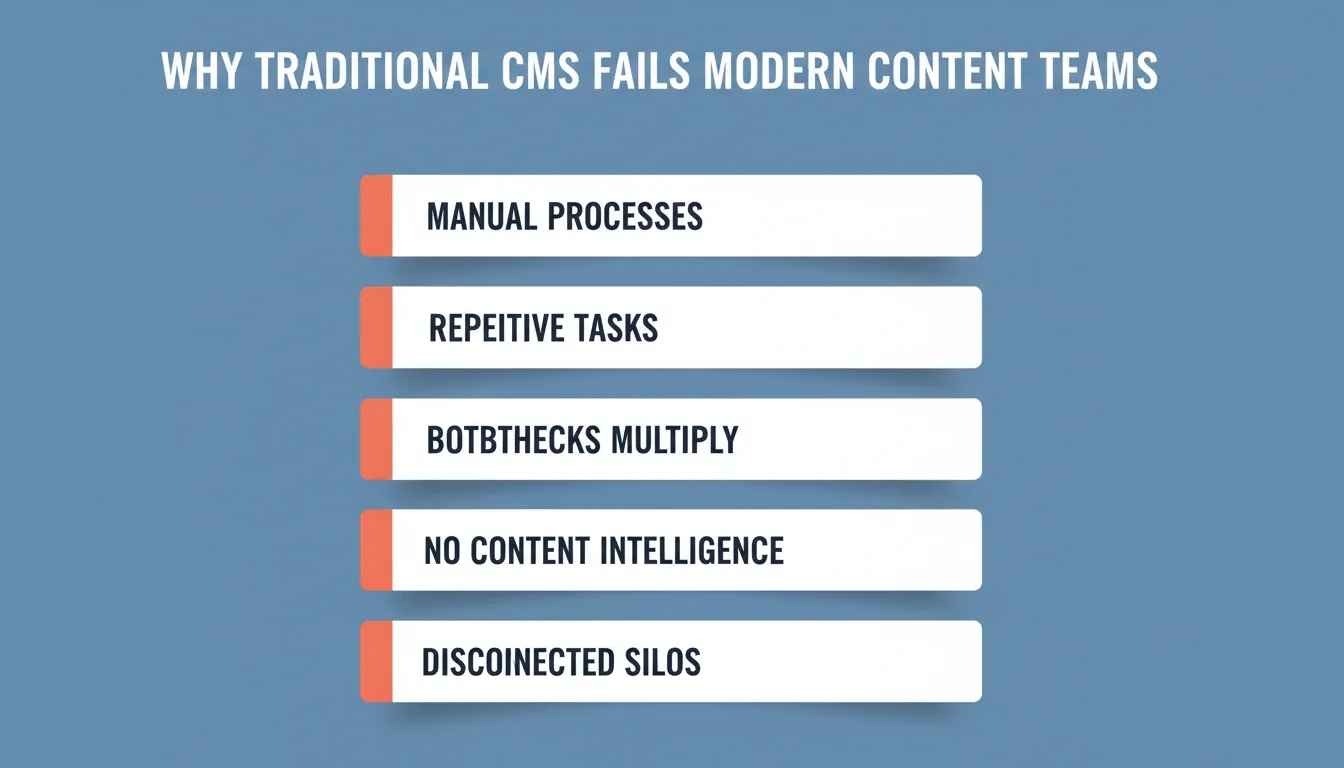
Manual processes dominate: Most content teams still copy text between tools, manually tag assets, and chase approvals through email threads that stretch for days
-
Repetitive tasks drain creative energy: Formatting, resizing, metadata entry, and channel-specific adjustments eat hours every week without adding creative value
-
Content operations bottlenecks multiply: As teams scale output, manual tasks create delays that compound, making deadlines harder to meet and reducing content velocity
-
Legacy systems lack intelligence: Older platforms store content but do not understand it, leaving teams relying on manual processes for search, classification, and personalization
-
Disconnected workflows create silos: Content sits fragmented across tools with no single source of truth for what has been published, what is in progress, and what needs updating
These friction points explain why so many organizations now look to AI powered solutions for content management. When your CMS cannot keep pace with demand, you either hire more people or you rethink the system itself.
Teams that want to go deeper on this can start with a practical look at how to automate product development using AI. The same principles apply directly to content operations.
How AI Reshapes Content Operations from Planning to Publication
According to McKinsey's global AI survey, 78% of organizations now use AI in at least one business function. The single biggest driver of bottom-line impact is redesigning workflows around AI. For content operations, this means moving from linear, human-bottlenecked pipelines to AI powered content creation flows where machines handle the predictable and humans focus on the creative.
Here is how a traditional CMS workflow compares to an AI powered content workflow in practice:
| Capability | Traditional CMS | AI CMS Platform |
|---|---|---|
| Content drafting | Writer starts from scratch | AI generates structured first drafts from prompts |
| Metadata and tagging | Manual data entry per asset | Auto-classification with AI algorithms |
| Approval routing | Email chains, manual tracking | Automated workflows based on rules and context |
| Personalization | Static templates, one-size-fits-all | AI driven personalization using customer data |
| Multi-channel delivery | Separate uploads per channel | Simultaneous delivery with format adaptation |
| Performance insights | Periodic reports pulled manually | Real time insights with predictive analytics |
| Brand consistency | Style guides and manual review | AI checks tone, voice, and brand guidelines automatically |
The specific capabilities that drive this shift include the following:
-
AI powered content creation accelerates ideation and drafting: Generative AI tools produce first drafts, headlines, and variations in seconds, giving content creators a starting point rather than a blank page
-
Intelligent tagging and classification: AI agents analyze content automatically, applying metadata, relevant tags, and taxonomy labels without manual data entry
-
Sentiment analysis and tone checking: Natural language processing reviews every piece before publication to flag inconsistencies in voice, sentiment, or brand messaging
-
Predictive analytics for content strategy: AI algorithms analyze audience engagement patterns and predict which content types, topics, and formats will perform best based on customer data and individual user behavior
-
Workflow automation that adapts: AI CMS platforms route content through approval chains based on content type, sensitivity level, and team availability, reducing delays and keeping production moving
-
Automated content distribution: Once approved, AI systems publish and deliver content to multiple languages and channels simultaneously, adapting format and messaging for each destination
HubSpot's 2025 AI report found that 79% of marketers agree AI and automation tools help them spend less time on manual tasks. In addition, 91% of marketing leaders confirm that employees at their organizations use AI to assist them in their jobs. These numbers reflect a clear shift: AI content management is no longer experimental, it is operational.
Core Features Every AI CMS Platform Needs
Not every AI CMS platform delivers the same value. The difference between a CMS with a few AI add-ons and a genuinely AI powered content management system comes down to how deeply intelligence is woven into the platform architecture.
Here are the features that separate an AI ready CMS from a traditional system:
-
AI content generation built into the editor: Not a third-party plugin, but a native AI assistant that understands your brand voice, content templates, and style requirements to generate consistent messaging at scale
-
Smart asset management with auto-tagging: AI systems classify images, documents, video, and audio files by content type, topic, and usage rights, making retrieval instant rather than a search through folders
-
Version control with AI-powered diff tracking: Every edit creates a clear audit trail, and AI highlights meaningful changes versus cosmetic ones, making review faster for editors and stakeholders
-
Brand consistency engine: AI tools continuously monitor content against brand guidelines, flagging drift in tone, terminology, or visual identity before publication rather than after
-
Content intelligence dashboards: Real time visibility into content performance, production velocity, and team bottlenecks, with AI providing actionable insights and recommendations rather than raw data
-
Enterprise governance and compliance: Role-based permissions, AI governance rules, retention policies, and audit trails that help large organizations manage access to sensitive content while maintaining operational speed
-
API-first architecture for integration: Modern AI CMS platforms connect to CRM systems, analytics tools, marketing automation, and third-party services, creating a composable architecture that scales with business needs
The feature stack of a modern AI CMS platform works as an interconnected system rather than isolated modules. Each AI capability feeds the others, creating compound value over time.
For teams building workflow-heavy platforms, the best AI workflow builder solutions guide covers the automation layer in detail.
Rocket's Vibe Solutioning loop: validate strategy with Solve, build the platform, deploy, monitor with Intelligence, and iterate, all in one shared-context workspace.
How Rocket Builds Your AI Content Management Platform
Most teams know they need an AI powered content management platform. The challenge, however, is building one without spending months on development, hiring specialized engineers, or stitching together disconnected tools that create more complexity than they solve.
Rocket is a Vibe Solutioning platform, the first platform where strategic research, AI app building, and competitive intelligence happen in the same place. You describe what your content team needs. Rocket then generates a production-ready web application with those features built in from the first deployment.
What Rocket actually generates:
-
Production-grade web apps in Next.js: Not wireframes or mockups. The first generation is a working, deployable product with real UI, navigation, logic, and code. Most apps generate in 1 to 3 minutes.
-
Shared context architecture: Add your brand guidelines, content taxonomy, approval rules, and competitive research once inside a Rocket Project. Every build task that follows already knows everything, automatically. No re-explaining, no context loss between sessions.
-
25+ integrations that flow into every build: Stripe, Supabase, Notion, Airtable, Linear, Mailchimp, Mixpanel, Typeform, Strapi, Directus, and more. Authenticate once and they connect into the platform you build.
-
WCAG 2.1 AA, GDPR, and CCPA compliance by default: Every Rocket build ships production-ready for accessibility standards and privacy regulations. These are the baseline, not optional extras.
-
Role-based access control built in: Admin, Creator, and Viewer roles with per-user credit allocation and unified billing for team workspaces.
-
Built-in analytics after launch: Visitors, conversions, accessibility scores, and Core Web Vitals tracked from day one, without additional tools.
What the build process looks like in practice:
A content team needs an AI-powered editorial platform with intake forms, approval workflows, multi-channel publishing, and a brand consistency checker. With Rocket, the process runs like this:
-
Run a Solve task to validate the feature set and understand what similar platforms get wrong
-
Open a Build task inside the same project. It already has the Solve findings, brand guidelines, and integration requirements as context.
-
Describe the platform in plain language: "Build an editorial workflow platform with intake forms, three-stage approval routing, brand tone checking, and Notion integration for content briefs"
-
Rocket generates the full Next.js application. A live preview appears in 1 to 3 minutes.
-
Iterate through chat, visual editing, or direct code access. There is no change limit.
-
Connect Notion, Airtable, and Mailchimp with one-click authentication.
-
Deploy to a live URL with one action. Staging and production environments are included.
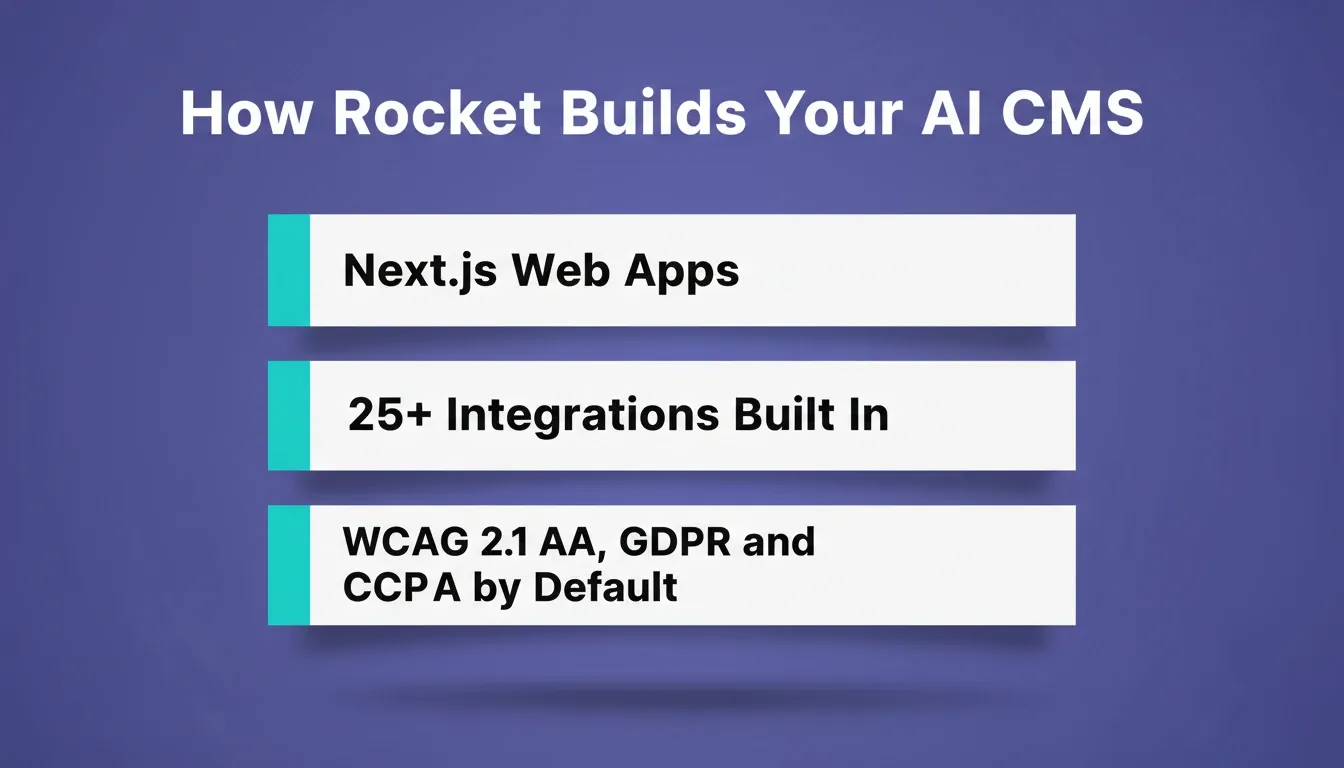
Rocket's three core production defaults: Next.js apps generated in minutes, 25+ integrations, and compliance built in by default.
Where traditional CMS platforms like WordPress or Drupal require plugins, custom code, and months of configuration to add AI capabilities, and where enterprise systems like Sitecore or Adobe Experience Manager demand large teams and six-figure budgets, Rocket delivers a production-ready AI content platform from a single prompt to a live deployment in the same session.
Can AI Agents Handle Enterprise Content at Scale?
Enterprise content teams deal with challenges that most small-team CMS platforms never face: thousands of content assets across multiple languages, strict compliance requirements, distributed teams working in different time zones, and the need to deliver content to millions of customers with varying preferences.
The question is whether AI agents and AI systems can handle this complexity reliably, or whether they break down at scale. The evidence, however, suggests they are ready.
-
AI agents process unstructured data at volume: Enterprise organizations generate vast amounts of unstructured content such as documents, emails, chat transcripts, and support tickets that AI systems can now classify, summarize, and route without human intervention
-
Intelligent automation handles complex workflows: AI agents manage content routing through multi-step approval processes, handling branching logic, escalation rules, and deadline tracking that would overwhelm manual processes at scale
-
AI driven content management maintains quality at volume: Machine learning models trained on brand guidelines and quality standards review content at a pace that human agents cannot match, catching errors in seconds rather than hours
-
Content platforms scale horizontally: Modern AI CMS platforms handle high volumes of concurrent users, content operations, and API calls without degradation, supporting large enterprises and their growing content demands
-
Predictive analytics improve with more data: The more enterprise content flows through an AI CMS, the smarter its predictions become about audience engagement, content performance, and resource allocation
According to MarketsandMarkets research, the web content management market will reach $24.97 billion by 2029, growing at 18.6% CAGR, driven largely by AI integration into enterprise content platforms. This growth reflects organizations investing in AI solutions that scale with their operations rather than fighting against legacy limitations.
"35% of marketers say there are too many AI tools that all do the same thing but don't connect to one another, creating more complications when adopting new ones into their workflow." — HubSpot State of AI 2025, based on responses from 1,000+ marketing professionals
This finding highlights why building an AI CMS as a unified platform matters more than assembling disconnected AI tools. Teams that consolidate their content operations into one AI powered system avoid the tool sprawl that slows so many organizations down.
Teams building internal dashboards and content portals at scale can also explore how to build internal tools with AI without a developer for a practical starting point.
Build vs. Buy: How to Choose the Right AI CMS Approach
One of the most common questions content teams face is whether to buy an existing AI CMS tool or build a custom platform tailored to their workflows.
The answer depends on three variables: how specific your approval and distribution workflows are, how tightly your content operations connect to your CRM and analytics stack, and how much you are willing to pay for a system that still does not quite fit.
| Consideration | Off-the-Shelf AI CMS | Custom AI CMS Built with Rocket |
|---|---|---|
| Time to first use | Hours to days | 1 to 3 minutes to first working app |
| Workflow customization | Limited to vendor roadmap | Fully custom, built to your exact process |
| Integration depth | Pre-built connectors only | 25+ integrations, authenticate once |
| Compliance defaults | Varies by vendor | WCAG 2.1 AA, GDPR, CCPA by default |
| Context continuity | Starts fresh each session | Shared context carries across every task |
The teams that benefit most from building custom are those with non-standard approval chains, multi-brand operations, or content workflows that cross into product, sales, and customer success. For those teams, a generic CMS will always be a partial fit.
Steps to Plan and Launch Your AI Content Management Platform
Building an AI CMS does not require starting from zero or hiring a full development team. The process works best when you approach it with clear priorities, a structured plan, and the right foundation underneath your content strategy.
-
Audit your current content operations: Identify where manual tasks, repetitive processes, and bottlenecks exist in your workflow today. These are the first targets for AI automation and the starting points for measuring improvement.
-
Define your AI readiness requirements: Determine what structured data you already have such as content taxonomies, brand guidelines, and approval rules, and what unstructured content needs organizing before AI systems can use it effectively.
-
Choose between build and buy: Evaluate whether existing CMS platforms with AI add-ons meet your specific business needs, or whether building a custom AI CMS through a platform like Rocket gives you the architectural flexibility your content teams actually need.
-
Start with one high-impact workflow: Rather than trying to automate everything at once, pick the content operation that causes the most delays, often approval routing or multi-channel publication, and build your AI CMS around solving that first.
-
Integrate with existing tools: Connect your AI CMS to the CRM systems, analytics platforms, and marketing automation tools your teams already use, creating automated workflows that flow data between systems without manual work.
-
Train your content teams: AI powered content platforms work best when non-technical users understand how to use AI assistant features effectively. Invest in onboarding that shows teams how to reduce manual tasks.
-
Measure, iterate, and expand: Track content velocity, team productivity, and content quality metrics after launch. Then use those data driven decisions to optimize workflows and expand AI capabilities into additional content operations.
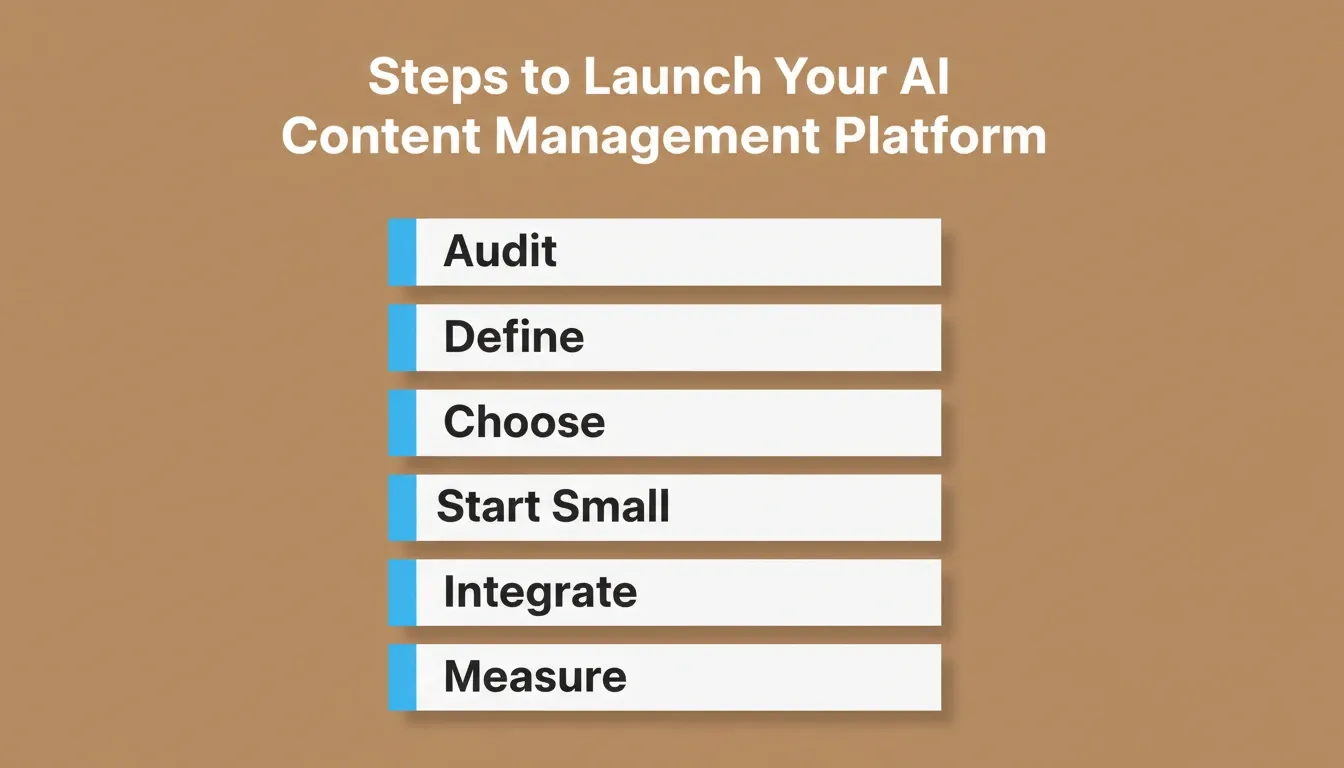
Seven steps from content operations audit to a live, expanding AI content management platform.
The organizations seeing the fastest results from AI content management are those that treat the platform as a living system rather than a one-time project. Every piece of content that flows through the AI CMS makes the system smarter through better predictions, more accurate classification, and improved content recommendations over time.
For teams building the distribution layer alongside their CMS, the guide to building a marketing automation platform with AI covers the publishing and campaign side in detail.
The Shift Has Already Started
The teams that build content management platform with AI today are compounding advantages that widen every month: faster publication cycles, stronger brand consistency, better audience engagement, and creative capacity freed from coordination work.
As AI content management matures, the gap between teams running on manual processes and those running on connected, intelligent platforms will only grow. The question is not whether to make the shift. It is how quickly you can get a working system in place.
You type what your content team needs. Rocket handles the research, the architecture, the code, and the deployment. Start building on Rocket.new and ship your AI content management platform today.
Table of contents
- -What is an AI Content Management Platform?
- -Why Traditional Content Management Systems Struggle Today
- -How AI Reshapes Content Operations from Planning to Publication
- -Core Features Every AI CMS Platform Needs
- -How Rocket Builds Your AI Content Management Platform
- -Can AI Agents Handle Enterprise Content at Scale?
- -Build vs. Buy: How to Choose the Right AI CMS Approach
- -Steps to Plan and Launch Your AI Content Management Platform
- -The Shift Has Already Started