
This blog covers the build-measure-learn loop as the foundation of effective customer research, why AI has made skipping the loop easier, and how Rocket.new connects research, building, and measurement in one platform with shared context at every step.
What if the biggest reason your product fails has nothing to do with the product itself?
Most teams start with a broken assumption: that building is the first step. The result is a product that works beautifully for a problem nobody actually has.
According to Harvard Business School professor Clayton Christensen, nearly 30,000 new products are introduced each year - and 95% of them fail. That number has barely moved in decades.
The answer is not faster building. It is better thinking before you build. And the framework that drives that thinking is the build-measure-learn loop, the core engine behind the lean startup methodology, and every product team that consistently ships things customers actually want.
Why Most Teams Build Before They Are Ready
There is a comfortable lie most product teams tell themselves: "Let's just ship something and see what happens." The problem is that "see what happens" is not a research strategy.
-
Data from Founders Forum Group shows that 42% of startups collapse because they misread market demand - creating products nobody wants or needs.
-
This rarely happens because teams are not talented. It happens because the research that should have come before the first line of code was skipped, rushed, or replaced with assumptions.
-
Most founders do not ignore customers on purpose - they talk to a handful of friends who react positively and mistake enthusiasm for validated learning.
-
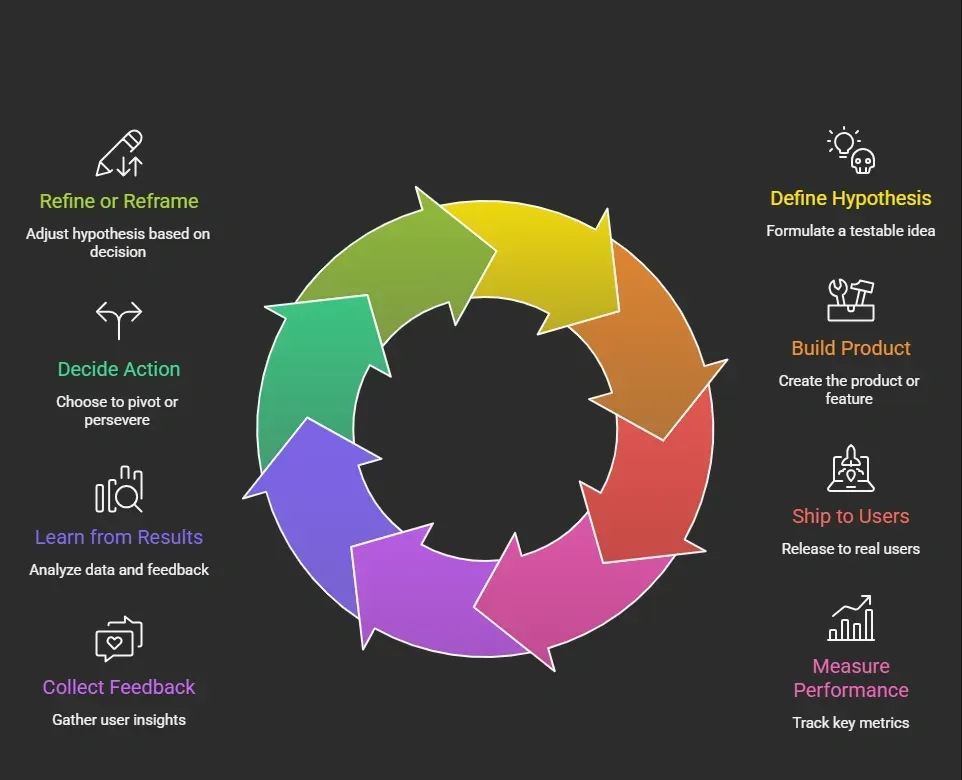
The lean startup methodology exists to fix this. At its core is the build-measure-learn loop: a continuous cycle of building a small thing, measuring how real users respond, and learning what to do next.
Every failed product has the same origin story: a decision made before enough was known. The loop is designed to change that.
The Build-Measure-Learn Loop: How It Actually Works
The build-measure-learn loop is not a project timeline. It is a way of gathering knowledge and testing hypotheses as quickly as possible and it moves through three distinct phases.
Build-Measure-Learn Cycle
The Build Phase: Your Hypothesis Made Visible
In the build phase, you are not shipping a finished product. You are creating the minimum viable product needed to test one specific hypothesis.
-
Most teams overbuild in the first cycle, adding features to cover edge cases before they know if the core idea even works.
-
A better question to ask first: what is the smallest thing we can build that will tell us whether this direction is worth pursuing?
-
That might be a landing page with a sign-up form, a working prototype with three screens, or a survey sent to 50 people in your target market.
-
The goal is speed of learning, not completeness of the product.
A working prototype that teaches you something real is worth more than a polished product built on the wrong assumptions.
The Measure Phase: Tracking What Actually Matters
Once something is in front of real users, you measure. But here is where most teams fall into a trap, measuring the wrong things.
-
Vanity metrics look impressive and tell you very little page views, total sign-ups, and app downloads feel good but rarely predict whether customers will pay and keep coming back.
-
The right metrics track behavior that signals real value: Are users completing the core action? Are they returning? Are they telling others?
-
Qualitative data and behavioral analytics work together here - numbers tell you what is happening, user interviews tell you why.
-
Collecting feedback through a mix of surveys and direct conversations gives you the full picture of how the target audience actually experiences the product.
You cannot improve what you do not measure and measuring the right metrics is what makes each next iteration smarter.
The Learn Phase: Where Direction Changes
The learn phase is where all the data comes together. You look at what the metrics and qualitative feedback are telling you, then decide what to do next.
-
This is what Eric Ries called the pivot-or-persevere decision keep going in the same direction, adjust the approach, or change course entirely.
-
The decision only works if you were honest about your hypothesis in the build phase. If you were not testing a specific assumption, there is nothing to confirm or disprove here.
-
Validated learning means you can point to real evidence from real users that either supports or challenges the idea you started with.
-
After the learn phase, the loop starts again and each next iteration builds on what you just learned.
Each cycle through the loop makes your product sharper, your assumptions clearer, and your path to product market fit shorter.
AI Made the Old Mistake Faster
AI app builders changed the product development process dramatically. You can now scaffold a full-stack web app in an afternoon - and that speed has a side effect most teams do not see coming.
-
Authentication, payments, and dashboards can be production-ready before you have had a single real conversation with a real user.
-
This sounds like progress. In practice, it is the old mistake running at a much higher speed.
-
Most teams mistake fast building for fast learning - they are not the same thing.
-
Skipping the research and measure phases does not look like skipping. It looks like velocity.
"AI just made the oldest startup mistake 10x easier to make. Paul Graham's hardest lesson to teach founders was always this: Build for 10 users. Not 10 million. You can now scaffold a full-stack app in an afternoon. Auth, payments, dashboards, APIs. Production-ready before you've had one real conversation with a real user. The feedback loop that was supposed to save you? It's now easy to skip. Because skipping it looks like velocity."- Raahul Seshadri, LinkedIn
Speed without a validated direction is just a faster path to the wrong destination and in the age of AI, that path has never been easier to take.
Customer Research as the Foundation of the Loop
Good customer research is not just surveys. It is a structured approach to testing assumptions at every stage of the product development process - and different methods serve different moments in the loop.
| Research Method | When to Use It | What It Reveals |
|---|---|---|
| User interviews | Early discovery | Real pain points, jobs-to-be-done |
| Surveys | Validating patterns at scale | Whether a hypothesis holds across a wider target audience |
| Landing pages with CTAs | Pre-build demand testing | Whether people want the solution enough to act |
| Prototype testing | Post-build phase | Whether users can use what you built |
| Behavioral analytics | Post-launch | What users do vs. what they say |
| Competitive market research | Ongoing | Where gaps exist relative to competitors |
-
The best product teams run several of these in parallel user interviews surface qualitative data that surveys miss, and prototype testing reveals things interviews do not cover.
-
Each research layer adds depth to the next iteration of the loop.
-
Cross-functional collaboration plays a big role too when product, engineering, and customer success teams share the same data and customer insights, decisions move faster.
-
The gap between what was learned and what gets built stays tight when the whole team works from the same context.
Research is not a phase that ends before the build begins. It runs through every cycle of the loop.
Where Existing Customer Research Tools Fall Short
Most research tools are built for one moment in the product development process: after you have already decided what to build.
-
You design a survey in one tool, run user interviews in another, and track post-launch behavior in a third.
-
The insights from those tools live in separate dashboards, summarized in different formats, shared across Slack threads and slide decks.
-
Someone has to pull all of that together into a product decision - that synthesis takes time, and the next iteration slows down.
-
The build-measure-learn cycle stretches from weeks into months as a result.
-
There is a deeper problem underneath this: context is lost between steps. The research gathered before the build rarely makes it cleanly into the build itself.
-
Teams build from a brief that is already one translation away from what customers actually said - and that gap compounds with every cycle.
Fragmented tools create fragmented loops. And a fragmented loop is not really a loop at all.
Your Loop on Rocket.new: Research, Build, and Measure in One Platform
Vibe coding solved how to build. It never solved what to build, or why. Rocket.new was built to close that gap connecting research, building, and measurement in one continuous flow with shared context at every step.
"Vibe coding solved how to build. It never solved what to build, or why. That's the harder problem and the one where most products actually fail. Rocket 1.0 connects the thinking and the building in one platform. Solve your hardest business question. Build from what you solved. Watch your competition while you work. Everything shares one context. Nothing resets between sessions."- Vishal Virani, LinkedIn
Rocket.new is the world's first Vibe Solutioning platform 1.5 million people across 180 countries have tried it, from solo founders validating ideas to enterprise teams running strategy and execution in the same place.
Solve: Structured Customer Research Before You Build
Solve is Rocket.new's decision intelligence layer - designed to answer the most expensive question in any product development process: is this worth building?
-
Describe a business question, a market problem, or a hypothesis you want to validate Rocket.new works through it with structured analysis, citations, and clear recommendations.
-
Output is exportable as PDF or PPT, ready to share with stakeholders or feed directly into the build.
-
The research and customer insights produced by Solve become the shared foundation for everything built inside the same project.
-
The kind of market research that once took a consultant a week now takes minutes and it flows into the next build without being re-explained or re-translated.
Solve does not just answer questions. It gives you the foundation to build from.
Build: From Validated Research to a Working Product
Once you have validated hypotheses and clear customer insights, Rocket.new's Build module turns them into a production-grade product - fast.
-
Web apps come out in Next.js. Mobile apps in Flutter with real design systems, dark and light theming, and production-quality animations.
-
Most apps generate in one to three minutes from a plain-language description, an existing Figma file, or a GitHub repository.
-
After the first generation, you iterate through natural language chat, visual editing, or direct code access - with no change limit.
-
Every product ships with SEO-ready structure, WCAG accessibility compliance, GDPR coverage, and performance standards by default.
"Just built a full working app in 15 minutes - without writing a single line of code. No, this isn't a gimmick. I used Rocket (by DhiWise) and it changed the way I think about app development. Rocket is not a drag-and-drop tool. It's an AI-powered builder that turns your idea into a real app with both frontend and backend - from just one prompt."- Markandey Sharma, LinkedIn
The build phase in the loop is no longer a bottleneck which means your learning cycles can run as fast as your research can keep up.
Intelligence: Continuous Monitoring After You Ship
Shipping is not the end of the loop. It is the beginning of the measure phase and Rocket.new's Intelligence module is built exactly for that moment.
-
Intelligence monitors every public platform your competitors operate on and interprets what those signals mean for your product direction.
-
New feature announcements, pricing changes, and customer sentiment shifts are tracked continuously and translated into actionable product signals.
-
Those signals feed back into the next iteration of Solve and Build, keeping the loop tight and the direction current.
-
Built-in analytics track visitors, conversions, accessibility, and Core Web Vitals after launch - giving you behavioral data on your own users at the same time.
The measure phase works best when you are watching both your own data and what the market around you is doing.
Context: Nothing Gets Lost Between Loops
The Context architecture is what makes the build-measure-learn loop inside Rocket genuinely compound over time.
-
Every research report, customer insight, design decision, and competitive signal added to a project carries into every future task - without being re-explained or re-uploaded.
-
Most product teams lose this context between iterations the customer interview from last month lives in someone's notes, the competitive analysis sits in a folder nobody opens before the next sprint starts.
-
Rocket.new keeps it all live, shared, and accessible across the whole team at every stage of the development process.
-
Team members work from the same accumulated context regardless of when they joined, so nothing resets between sessions.
Context is not a feature. It is the infrastructure that makes every loop smarter than the last.
Rocket.new vs Build-First Tools
Here is a direct comparison of what Rocket.new covers versus vibe coding tools that focus on the build step alone:
| Capability | Lovable / Bolt / v0 | Rocket.new |
|---|---|---|
| Pre-build customer research | Not included | Solve - structured decision intelligence |
| Shared context across tasks | No shared memory | Persistent context across all tasks |
| Competitive monitoring | Not included | Intelligence module |
| Build quality | Functional, generic-looking output | Production-grade with intentional design |
| Platform management | User manages all configuration | Fully managed platform |
| Context between loops | Starts fresh each session | Everything carries forward |
Tools like Lovable, Bolt, and v0 build what you tell them and they do that well. The gap is everything before and after the build. With Rocket.new, none of that falls on you.
Build Right, Not Just Fast
Most customer research is broken not because teams lack curiosity but because the tools they use fragment the process. Research happens in one place, building in another, measurement in a third. The loop never quite closes.
The Rocket.new approach to customer research - build, measure, iterate treats the full cycle as one continuous flow. When research feeds directly into the build, and the build connects directly to measurement, each iteration gets sharper because the last one carried forward. Product teams that win in this environment are not the ones who ship fastest. They are the ones who learn fastest and act on that learning without losing it between sessions.
Table of contents
- -Why Most Teams Build Before They Are Ready
- -The Build-Measure-Learn Loop: How It Actually Works
- -The Build Phase: Your Hypothesis Made Visible
- -The Measure Phase: Tracking What Actually Matters
- -The Learn Phase: Where Direction Changes
- -AI Made the Old Mistake Faster
- -Customer Research as the Foundation of the Loop
- -Where Existing Customer Research Tools Fall Short
- -Your Loop on Rocket.new: Research, Build, and Measure in One Platform
- -Solve: Structured Customer Research Before You Build
- -Build: From Validated Research to a Working Product
- -Intelligence: Continuous Monitoring After You Ship
- -Context: Nothing Gets Lost Between Loops
- -Rocket.new vs Build-First Tools
- -Build Right, Not Just Fast