
Traditional market research relies too heavily on assumptions, reports, and theoretical market sizing. The build-measure-learn loop replaces guesswork with validated learning from real user behavior. Rocket.new helps founders rapidly build, test, and iterate working products to validate market demand faster.
What if your market research could give you real answers in days instead of months?
That is exactly what the build-measure-learn loop makes possible. Rather than stacking assumptions on top of industry reports, the lean startup methodology pushes you to put something real in front of real users and watch what happens.
According to Exploding Topics, 34% of startup failures come down to poor product market fit, while 42% of startups collapse from simply misreading what the market actually wants. The guesswork is expensive and avoidable.
Why Traditional Market Research Gets Founders in Trouble
Most founders treat market sizing like a research project. You pull some industry reports, build a spreadsheet with total addressable market (TAM) and serviceable addressable market (SAM) numbers, write a deck, and move on. The problem is that none of that gets tested against real customer behavior.
The Standard Approach Leaves Critical Assumptions Untested
-
Your target market exists only on paper
-
Your assumptions about what your customer will pay, prefer, or even notice have never seen daylight
-
Your SAM estimate is based on who could theoretically use your product, not who will actually buy it
That is not market analysis. That is structured guesswork.
Most AI Research Tools Fall Into the Same Trap
Most AI tools that promise faster market research report on what has already happened in a market, not what your specific target users will do when your product lands in front of them. They surface data quickly, but speed is not the same as accuracy. The underlying problem remains: you are still working from assumptions that have never been tested against real customer behavior.
Where the Lean Startup Approach Changes Everything
Rooted in lean manufacturing principles first applied to software by Eric Ries, the lean startup methodology borrows directly from the Toyota Production System. The core instructions are simple:
-
Eliminate waste at every stage of the product development process
-
Validate fast by getting your minimum viable product in front of real users
-
Build only what the market actually needs, not what you assume it needs
Entrepreneurial management under this model means treating every product decision as a testable hypothesis rather than a fixed plan. Instead of defending your assumptions in a deck, you go out and disprove them as quickly and cheaply as possible.
What is the Build Measure Learn Loop?
The build-measure-learn loop is a cyclical, iterative process in product development that emphasizes creating a product, measuring its real-world performance, and using the insights to refine it. This feedback loop, central to the lean startup methodology, is designed to foster continuous improvement.
The core principle of the build-measure-learn cycle is to turn assumptions into knowledge by building the smallest thing that can test a hypothesis, measuring the right outcomes, and learning whether to continue, adjust, or abandon the idea.
The build-measure-learn loop helps startups reduce uncertainty by validating their ideas with real user feedback, enabling product teams and product managers to make informed decisions at every stage.
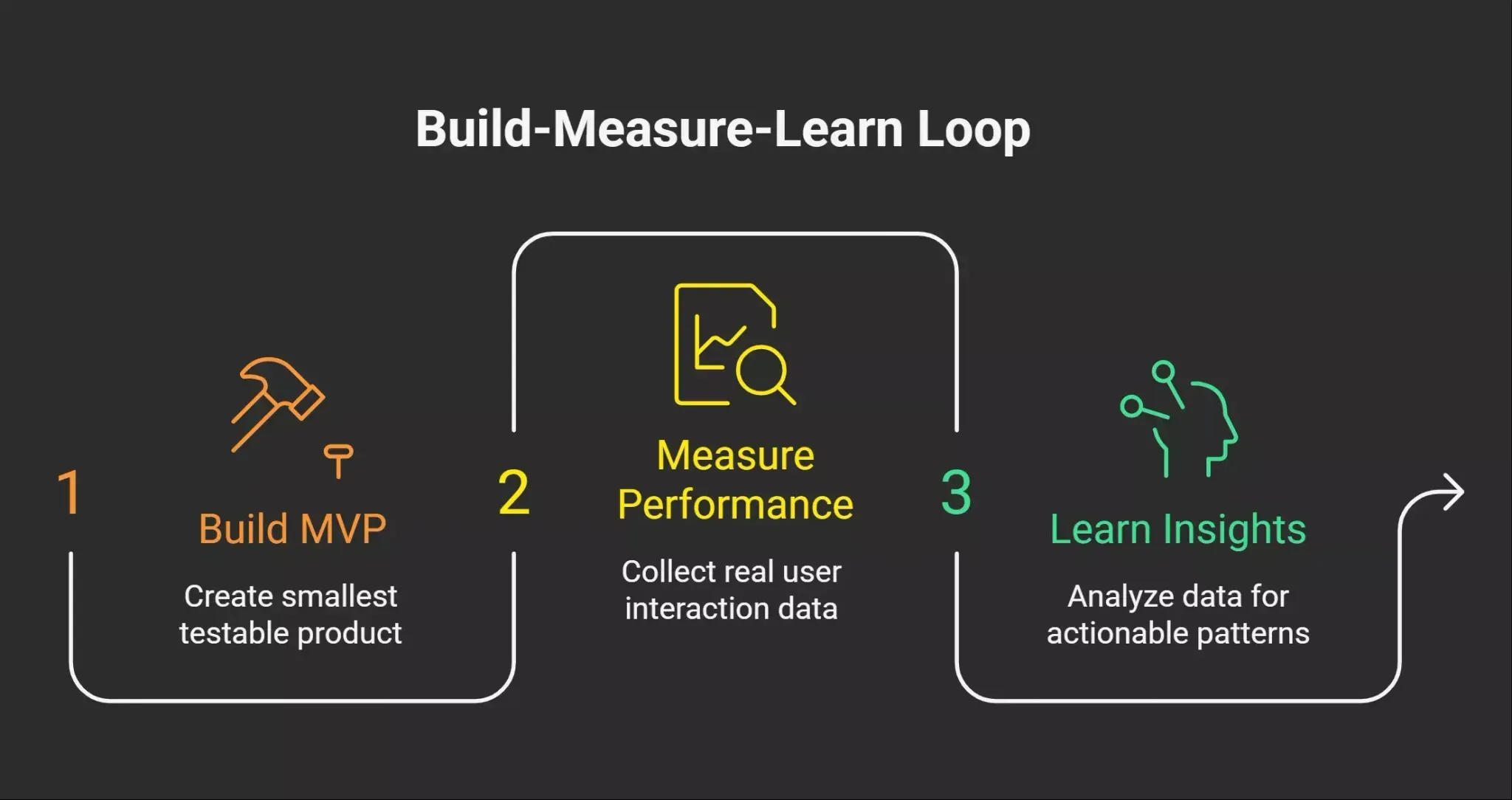 Here is how the three phases work in practice:
The Build Phase
In the build phase, you create a minimum viable product (MVP), the smallest and simplest version of a product that allows you to test a hypothesis and gather user feedback. The goal is to build with the least effort possible, not to impress, but to learn. A minimum viable product could be a landing page, a single-feature app, or a clickable prototype aimed at a narrow customer segment.
The MVP development process involves ideation, feature selection, and iterative development focused on the core features that deliver value to early adopters. Creating an MVP allows startups to validate their business ideas with minimal resources, reducing the risk of investing in untested concepts.
The Measure Phase
In the measure phase, you collect data from real users interacting with your MVP. This is where actionable metrics matter more than vanity metrics. Sign-ups, drop-offs, click-through rates, time on page, and conversion rates tell you far more than survey data ever will.
Collecting customer feedback through in-app surveys and user interviews is an effective way to understand user expectations and identify opportunities for improvement.
Usability tests are essential for validating hypotheses and identifying potential user experience issues during the product development process. Innovation accounting, a concept from Eric Ries's lean startup framework, provides the structure for deciding which actionable metrics actually measure progress toward your business goals.
The Learn Phase
The learn phase is where validated learning happens. Analyzing both quantitative and qualitative data collected during the measure phase helps you identify patterns and draw actionable insights that inform future product decisions.
In the learn phase, you decide whether to pivot or persevere. The decision to pivot or persevere is based on insights gained from the build-measure-learn loop, where startups analyze data to determine whether to change their business model or continue refining their current approach.
Pivoting involves changing a fundamental aspect of your business model based on feedback, while persevering means continuing with minor adjustments, both informed by user behavior and real data.
What Good Market Research Actually Looks Like in 2025
Good market research today is not about reading 80-page industry reports and hoping they apply to your specific niche. The global market research services market reached $93.37 billion in 2025, and a growing share of that spend is shifting toward real-time, iterative research methods aligned with the lean startup method.
The strongest market analysis combines fast qualitative signals with structured quantitative data:
| Research Method | What It Tells You | Speed |
|---|---|---|
| Landing page test | Early demand signals, willingness to click | Hours |
| Customer feedback interviews | Pain points, language, user needs | Days |
| Competitor teardown | Gaps in the competitive landscape | Days |
| Prototype testing | Feature validation, drop-off analysis | Weeks |
| Industry reports | Macro SAM and TAM sizing | Weeks |
Starting with landing pages and customer conversations gives you fast, cheap signals about your core value proposition. Industry reports help frame the bigger picture. The mistake most founders make is relying on only one or the other.
Using secondary data can help reduce the risk of investments by informing primary research designs before expensive studies are commissioned. Cost-effectiveness in research is achieved by leveraging existing internal and external sources to create value before significant capital expenditure.
The Most Common Mistake: Skipping the Middle Step
Most founders build something and then jump straight to scale without actually measuring what worked. When that happens, the target market turns out to be the wrong thing. The product differentiation does not land the way they expected. The SAM estimate was off because they counted everyone who could theoretically use the product instead of the customer segment willing to pay for it today.
Skipping the Measure Phase is Not a Shortcut
The build measure learn cycle is iterative and cyclical, allowing startups to go through multiple rounds of learning and adjustment to find product-market fit more efficiently. Skipping the measure phase is not a shortcut. It is the single fastest way to build the wrong thing.
The Risk of Analysis Paralysis
The emphasis on continuous data analysis and user feedback in the lean startup methodology can sometimes lead to analysis paralysis, bogging down decision-making processes and delaying development. The fix is not to collect less data, but to define your actionable metrics upfront so the learn phase produces a clear answer: pivot or persevere.
The Risk of Team Burnout
The build-measure-learn loop encourages rapid iteration and customer-centric development, but it can lead to team burnout if the pace of innovation is not managed effectively over extended periods. Product teams that treat the build-measure-learn cycle as a sprint rather than a steady rhythm will burn out before they find product-market fit.
Benefits and Pitfalls of the Build Measure Learn Approach
The build-measure-learn feedback loop helps prevent unnecessary expenditure of time, finances, and effort on digital products that may not meet market needs. It facilitates market validation through direct engagement with actual customers rather than assumptions.
However, one major pitfall of the build-measure-learn loop is the risk of developing a minimum viable product that does not align with market needs, ultimately leading to unreliable outcomes and wasted resources. This is why defining the right hypothesis before the build phase matters as much as the build itself.
The lean startup method is a flexible approach. It is not a rigid system architecture. It adapts to different stages of your business, from testing a new feature with early adopters to re-entering a different customer segment after a pivot.
Research from the Startup Genome Project found that startups benefit most from one or two targeted pivots based on validated learning. Too few build-measure-learn cycles means you are still working from assumptions. More than two major pivots often signal a deeper product-market fit issue worth addressing at the research level first.
The Rocket.new Approach to Secondary Market Research: Build, Measure, Iterate
This is where the Rocket.new approach to secondary market research build measure iterate changes in how founders and teams approach market sizing. Rocket.new is a vibe solutioning platform that takes you from idea to working app in minutes, no code required. That matters enormously for market research because it means you can build a real test of your market hypothesis and collect real user feedback fast.
Most AI tools stop at analysis. Rocket.new gives you a functioning app you can actually put in front of customers. Researchers test findings against reality by measuring alignment between secondary data and real-world interactions, and Rocket.new closes that gap by making the build phase take minutes instead of weeks.
What the Build-Measure-Learn Cycle Looks Like on Rocket.new
Rocket.new enables a complete lean startup approach in one platform, covering every stage from idea to deployable product without switching tools.
One Platform, Full Stack
Most AI app development tools lock you into a single tech stack. Rocket.new covers Flutter mobile, Next.js web, and full backend in one place, meaning faster iteration at every stage of your product development process.
Real Apps, Not Mockups
Ship a functional product to a narrow target audience and measure actual user behavior, not survey responses. This is competitive intelligence you can act on immediately.
Landing Pages as Market Probes
Quick-launch landing pages let you test demand signals before committing to a full build, one of the fastest ways to validate a customer segment before writing a single line of production code.
AI Agents That Keep You Moving
When you iterate based on what you learned in the measure or learn phase, Rocket.new's AI agents handle the technical changes in context. You stay focused on the insights, not the system architecture.
Rocket's approach emphasizes efficiency by layering real user feedback on top of existing data through rapid iteration, allowing teams to continuously improve their strategies based on what real markets actually show.
Building Competitive Intelligence Through the Learn Loop
When you ship something real, you gather competitive intelligence passively with Rocket.new Intelligence. You see which competitors your early adopters mention, which core features they compare you against, and where they drop off, revealing gaps that no industry report would have flagged.
Over two or three build-measure-learn cycles, your competitive positioning sharpens from "we are better than X" to "we are the only product that solves Y for this specific target market." That is a meaningful difference when setting your pricing model or pitching to investors.
This is lean methodology in practice: build only what data supports, measure the right outcomes, and let the learning loop guide your next move.
What the Build Measure Learn Loop Does for Market Sizing
Run build measure learn cycles consistently, and your market sizing stops being a one-time estimate and becomes a living picture of real demand:
-
SAM narrows to reflect verified demand, not assumed demand
-
The target market gets defined by who converts, not who you hoped would
-
Core value proposition gets sharpened by what actually resonates with real users
-
Competitive landscape view moves from theoretical to evidential
According to McKinsey's State of AI 2025, 64% of organizations say AI is enabling their innovation, but most are still in the experimentation phase. The teams that close the loop between research, building, and measuring will pull ahead.
What Assumption Are You Still Guessing At?
Stop guessing. Start building with Rocket.new. Go from hypothesis to working app in minutes, so your next learn loop begins today, not next quarter.
Table of contents
- -Why Traditional Market Research Gets Founders in Trouble
- -The Standard Approach Leaves Critical Assumptions Untested
- -Most AI Research Tools Fall Into the Same Trap
- -Where the Lean Startup Approach Changes Everything
- -What is the Build Measure Learn Loop?
- -The Build Phase
- -The Measure Phase
- -The Learn Phase
- -What Good Market Research Actually Looks Like in 2025
- -The Most Common Mistake: Skipping the Middle Step
- -Skipping the Measure Phase is Not a Shortcut
- -The Risk of Analysis Paralysis
- -The Risk of Team Burnout
- -Benefits and Pitfalls of the Build Measure Learn Approach
- -The Rocket.new Approach to Secondary Market Research: Build, Measure, Iterate
- -What the Build-Measure-Learn Cycle Looks Like on Rocket.new
- -One Platform, Full Stack
- -Real Apps, Not Mockups
- -Landing Pages as Market Probes
- -AI Agents That Keep You Moving
- -Building Competitive Intelligence Through the Learn Loop
- -What the Build Measure Learn Loop Does for Market Sizing
- -What Assumption Are You Still Guessing At?