
Competitor job postings reveal strategic investments months before public launches or announcements. Rocket.new connects hiring data with pricing, product, review, and advertising signals to identify real competitive shifts. Teams use Rocket Intelligence to replace fragmented market research with real-time strategic monitoring and execution insights.
What Do Job Postings Actually Reveal About Competitors?
A competitor's open roles are among the earliest public signs of where that company is investing next.
When a company starts hiring five machine learning engineers and a Head of AI Products in the same quarter, that tells your teams something the blog and the product page have not announced yet.
-
According to Bain and Company's Technology Report 2025, companies pairing AI with end-to-end process changes report 25% to 30% productivity gains.
-
Many of those shifts appear in job postings months before any public disclosure.
Rocket.new Intelligence reads those postings, connects them with other competitive signals, and delivers one clear picture your teams can act on.
Why Hiring Patterns Are the Earliest Competitive Signals
Hiring is expensive. Companies do not post roles without a budget behind them.
-
Every open position represents a commitment: money, timeline, and a bet on where the project is heading.
-
A sudden cluster of "Senior Blockchain Developer" listings from a fintech competitor tells product teams something no press release has said yet.
What Separates Noise From Real Data
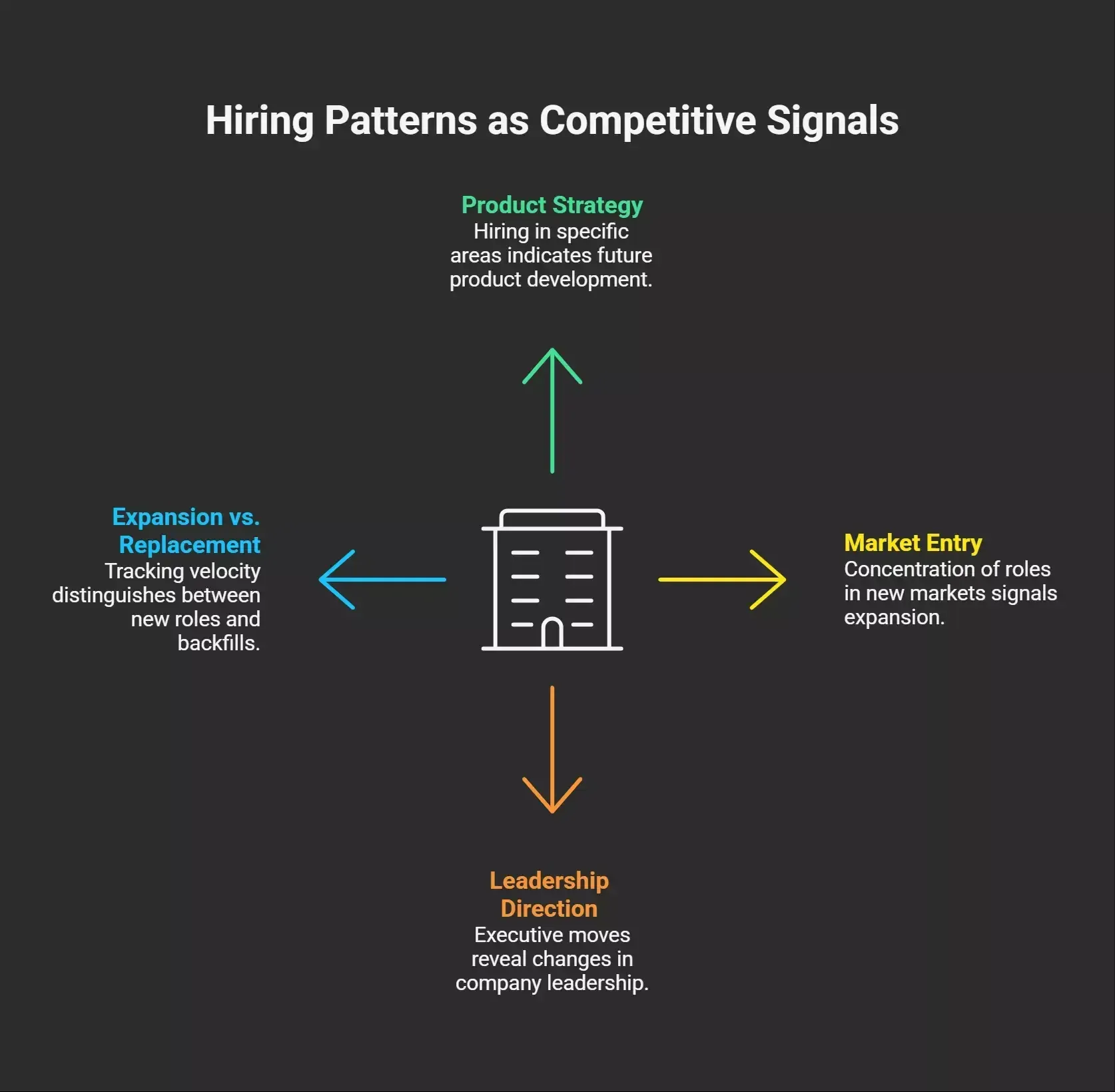
A single posting could mean a backfill. The signal shows up when you track concentration and velocity across multiple roles.
-
Rocket.new tracks hiring velocity to separate replacement hiring from coordinated expansion.
-
Aggregating signals over time reveals patterns your teams would miss in a one-time market research sprint.
How Hiring Maps to Execution
Hiring concentration in a new area signals a pivot. Six "Trust and Safety" roles in two months?
That competitor is preparing for regulated market entry. A new VP of enterprise sales means an upmarket shift. Executive moves tell you about leadership direction.
Rocket.new turns these patterns into real-time alerts so your teams see the shift the day it happens.
The Six Signal Categories Behind Every Competitor Brief
Rocket.new Intelligence monitors competitors across six signal categories. Hiring is one. The real data becomes actionable when you connect all six.
| Signal Category | What It Captures | Example |
|---|---|---|
| Website Changes | Pricing page updates, feature edits | Competitor removes free tier |
| Product Signals | Launches, deprecations, pivots | New API docs appear quietly |
| Hiring Signals | Role volume, velocity, executive moves | ML role cluster in two weeks |
| Social and News | Press releases, founder posts | CTO posts about compliance |
| Customer Reviews | Sentiment on G2, App Store | Spike in removed-feature complaints |
| Advertising | Ad copy, positioning changes | "Enterprise" appears in paid search |
-
When Rocket sees a hiring cluster in AI roles, a website change mentioning "intelligent automation," and a social media post from their CTO about agentic workflows, those three data points form one clear signal: the competitor is building an AI product.
-
The six signal categories work together. One category alone is a hint. All six give your teams a pattern to act on.
How Product Teams and Strategy Teams Build Project Plans From Competitor Data
Product teams and strategy teams need signals on competitor activity before a project kickoff or roadmap session, not after.
-
A strategy team preparing for quarterly planning needs background for the call: what competitors shipped, where they hired, and whether any strategy shift happened around pricing.
-
Rocket.new delivers daily briefs covering every competitor you monitor, so your teams walk in with shared context and real data.
From Scattered Research to a Unified Platform
Most teams gather competitor data across multiple tools: job boards, competitor websites, and review platforms. The entire workflow is fragmented and lacks context.
-
Rocket.new turns that entire workflow into one place. Set up Intelligence once, and every competitor change reaches your project dashboard.
-
Structured insights save product teams and strategy teams up to 80% of the time spent on manual market research, leaving more capacity for decision-making.
Connecting Signals to Project Execution
Knowing a competitor's new product direction helps budding entrepreneurs and established teams choose where to compete.
-
The four criteria for competitive advantage, cost, differentiation, speed, and focus, all depend on understanding where competitors place bets.
-
A good response to a competitor shift is informed execution based on continuous competitive monitoring, not a one-time competitive analysis sprint. The competitive landscape rewards teams that track signals daily.
-
Rocket Intelligence keeps your strategy team current. Teams make decisions based on what competitors did this week, not what someone remembers from a project review last quarter.
Where Gaps Exist in the Competitive Landscape
Most competitive intelligence tools give you a snapshot: a consultant's report, a spreadsheet, a competitor screenshot. By the time it reaches your team, the competitive landscape has moved.
-
Research from Pendo found that companies combining in-app feedback with detailed product analytics achieved 109% higher annual product revenue compared to companies that did not.
-
Customer feedback lives in too many places. Support tickets, NPS responses, sales call notes, and review platforms. One ticket is noise.
-
A pattern across tickets and reviews is a signal your project plan should reflect. Every shift in the competitive landscape that your strategy team misses is ground your competitors gain.
What People Are Saying
"Job postings expose hiring strategy. A cluster of senior ML engineers plus a 'head of agents' requisition tells you the AI roadmap before any blog post does." - Source: Elevated Signal, Competitive Intelligence Reports
-
This matches what teams see in practice. Hiring patterns are the closest thing to reading a competitor's project roadmap.
-
Rocket.new automates this. Instead of manually scanning job boards for every competitor, you get an alert when hiring velocity spikes.
-
Analyzing competitor website structure, including careers pages, helps teams build a targeted strategy. Related questions about link analysis connect here: a competitor's public web presence is real data, and Rocket monitors it.
How Rocket.new Handles Competitive Intelligence From Hiring Data
Rocket.new is the only AI app and vibe-solutioning platform where market research, build capabilities, and competitive intelligence with monitoring share one workspace. What makes Rocket.new different from tools like Crayon or Klue is this: Rocket puts strategy, build, and intelligence in the same project.
Rocket.new Core Capabilities
-
Vibe-solutioning platform: describe a problem in natural language and get a structured brief with real data and recommendations
-
25,000+ templates library, free to use, covering web apps, mobile apps, and SaaS project types
-
Supports Flutter for mobile and Next.js for web
-
Collaboration features built in, so strategy teams and product teams share one project workspace
-
3 Products, one platform: Solve (strategy and research), Build (ship apps), and Intelligence (continuous monitoring)
Call to Action Section
-
Start building your competitive monitoring project today. Rocket.new turns competitor signals, from job postings to product signals, into one clear daily brief your teams act on.
-
A strategy team running a project can use Rocket Solve for competitive research, Rocket Build for app development, and Rocket Intelligence to track every competitor in real time on a single platform.
Turning Competitive Data into Decisions
How does Rocket.new connect a competitor's open roles to the strategic direction they have not yet announced?
By reading job postings as one signal among six signal categories, connecting them with product signals, website changes, reviews, and advertising data, and then delivering a structured brief that your teams can act on.
Rocket.new turns scattered data into one clear view that helps teams shift from research to execution inside one project. The decorative background noise of quarterly snapshots is gone. What remains is real data, delivered in real time, that your strategy team acts on.
start tracking competitor hiring signals with Rocket.new and turn hidden market movements into an actionable strategy.
Table of contents
- -What Do Job Postings Actually Reveal About Competitors?
- -Why Hiring Patterns Are the Earliest Competitive Signals
- -What Separates Noise From Real Data
- -How Hiring Maps to Execution
- -The Six Signal Categories Behind Every Competitor Brief
- -How Product Teams and Strategy Teams Build Project Plans From Competitor Data
- -From Scattered Research to a Unified Platform
- -Connecting Signals to Project Execution
- -Where Gaps Exist in the Competitive Landscape
- -What People Are Saying
- -How Rocket.new Handles Competitive Intelligence From Hiring Data
- -Rocket.new Core Capabilities
- -Call to Action Section
- -Turning Competitive Data into Decisions