
Rocket.new intelligence continuously learns from your team’s behavior, improving accuracy, insights, and automation over time. The more it’s used, the better it adapts to workflows and enhances productivity.
Why does Rocket.new Intelligence get stronger over time?
Because it learns from every action your teams take, every decision, every bit of context, and every execution step. Within weeks, it stops acting like just another tool and starts behaving like a living system that understands your workflow, your market, and your product ideas.
A McKinsey report shows that AI can significantly improve productivity, with some use cases delivering up to 40% gains and faster development cycles.
This shift is exactly where Rocket.new Intelligence comes into the picture.
This blog will help you understand how that intelligence grows over time and how your teams can use it to build better products with more clarity and less effort.
The Shift From Static Tools to Learning Systems
Most tools stay the same no matter how much you use them. That’s where the problem starts.
Traditional tools don’t adapt, and that creates a gap between your ideas and execution. Rocket changes that by introducing a system that grows with your teams.
Here’s how that shift happens:
-
Traditional tools stay fixed and don’t evolve with usage
-
Rocket.new Intelligence builds context over time
-
Every workflow adds value to the system
-
Every research step improves future outcomes
-
Every code output strengthens the overall intelligence
-
Teams reduce manual work as the system learns
-
Momentum builds instead of restarting from scratch
So, instead of just using tools, teams start growing with the platform and moving faster with better clarity.
Why Intelligence Compounds Over Time?
It usually starts simple.
Teams use Rocket with basic prompts, maybe a small app idea, or a quick landing page. The system generates a working app using full-stack logic, and things feel smooth right away.
Then the system begins to learn and build context in the background.
Here’s what Rocket.new Intelligence starts tracking and improving over time:
-
User behavior
-
Market signals
-
Competitors
-
Feature usage
-
Execution patterns
-
Suggests better features
-
Identifies feature gaps
-
Improves code output
-
Speeds up app building
As this context builds, the system becomes sharper with every use. So instead of starting fresh each time, teams keep moving forward with better output and smarter execution.
How Rocket.new Intelligence Works?
Rocket is built as one platform that connects research, development, and execution.
Here’s a quick breakdown:
| Step | What Happens |
|---|---|
| Input | Users give a natural language prompt |
| Research | AI tools scan market trends, competitors, and data |
| Build | Full stack code is generated |
| Refine | Teams adjust features and workflow |
| Learn | System stores context for future execution |
This system supports both web apps and mobile apps, and it reduces the need for multiple tools. Instead of jumping across platforms, teams stay in one place.
Core Features That Keep Getting Smarter
Once teams spend some time on Rocket, the difference starts to show. The platform doesn’t stay static. It keeps learning from usage, which makes every feature more useful over time.
Here’s a closer look at what’s happening under the hood:
1. Context-Aware Intelligence
The system builds context from every action your teams take. This includes research, code edits, feature decisions, and even small changes in workflow. Over time, this context helps the platform understand what your users actually need, so the output becomes more relevant and accurate.
2. AI Agents
AI agents support teams during execution, not just at the start. They assist with research, generate code, and help solve build challenges in real time. As they interact more with your workflow, they get better at suggesting the right direction.
3. Full Stack Generation
Rocket handles frontend, backend, and database together. That means teams don’t have to switch between multiple tools. The system also improves how it structures code over time based on past builds, which leads to cleaner and faster output.
4. Competitive Intelligence
The platform keeps track of competitors and changes in the market. It uses that data to guide feature suggestions and product decisions. So instead of doing separate research, teams get insights directly inside their workflow.
5. Workflow Memory
Every workflow is stored and reused. This reduces manual work and avoids repeating the same steps. As more workflows are created, the system becomes better at predicting what comes next.
This is where Rocket's ability stands out. It doesn’t reset after each project. It builds on everything your teams have already done, making the system smarter with every step.
From Idea to Working App Without the Chaos
Most teams hit a point where things slow down. Ideas are there, but execution feels messy or stuck. That gap between thinking and building is where problems usually begin.
Rocket simplifies that entire journey by keeping everything in one smooth flow.
Here’s how the process works:
-
Start with a simple app idea
-
Use simple prompts to describe what you want
-
The system generates a working app using full stack logic
-
Teams refine features and structure based on needs
-
The system learns from each refinement
-
Output improves with every iteration
-
Workflow stays consistent without breaking momentum
So instead of getting stuck between ideas and execution, teams keep moving forward with clarity, better output, and a smoother build process.
Why Teams Stick With Rocket?
There’s a reason teams don’t leave once they start using it. Rocket reduces complexity.
Instead of using multiple tools, everything happens in one platform. That includes research, code, and deployment.
For product teams, this means:
-
Faster execution
-
Better coordination
-
Less confusion
For small teams and solo creators, it means:
-
No need for large dev teams
-
Less dependency on coding
-
Faster product launches
And for large organizations, it means scaling without chaos.
Pricing That Grows With Usage
Rocket keeps pricing simple so teams can start free and scale as their needs grow.
This makes it easy for users to begin without pressure and then upgrade only when their workflow, usage, and execution demands increase.
| Plan Type | What You Get |
|---|---|
| Free Plan | Basic features, limited usage |
| Paid Plans | Advanced AI tools, better execution |
| Enterprise | Full access, deeper intelligence |
As teams continue using Rocket, they naturally move toward paid plans because their needs expand. More projects, deeper research, and better execution require stronger support.
Since the intelligence layer keeps improving with usage, the overall value grows over time, making the shift feel natural rather than forced.
Use Cases That Show the Growth
Rocket is not limited to one type of project. As teams build different products, the system keeps learning from each use case, which adds more context and improves future output.
Here’s how that looks across common use cases:
eCommerce: Build full stack stores with product pages, checkout systems, and user flows. Each build helps the system understand buying behavior and feature needs.
SaaS Tools: Create dashboards, user systems, and internal tools. The system learns how teams structure features and workflows in real scenarios.
Content Platforms: Generate landing pages and web apps for content-driven ideas. This improves how the system handles layout, engagement, and user flow.
As more projects are built, the system becomes sharper. Each new use case adds context, so every next build becomes faster, cleaner, and more aligned with what teams actually need.
Why Rocket Makes Sense in Today’s Market?
The market is moving fast, and teams need both speed and accuracy to keep up. Traditional development often slows things down with delays, handoffs, and scattered workflows.
Rocket simplifies that by bringing everything together.
Here’s what it combines:
-
Research
-
Code generation
-
Execution
All of this happens inside one platform. So teams don’t waste time switching tools or managing disconnected processes. They stay focused on building and moving forward with clarity.
In a fast-moving market, this kind of setup just makes sense.
Breaking Down the Workflow Advantage
Rocket keeps the workflow clean and connected. Instead of splitting work into different stages across different tools, everything stays in one continuous loop.
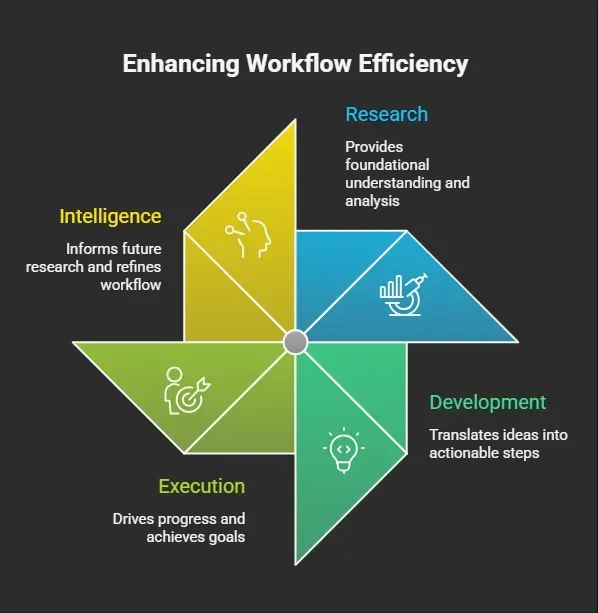 Each step improves the next. The system keeps learning from the process, which means teams don’t lose context or restart from scratch.
They keep building on what’s already been done, making every step more efficient over time.
Where Other Tools Fall Short
Most tools are built to solve one specific problem. That creates limitations when teams try to connect everything.
Here’s where other tools struggle:
-
Require manual setup
-
Don’t learn from usage
-
Create gaps in workflow
Rocket removes that gap by connecting everything into one system. Research, development, and execution all work together instead of staying separate.
That’s why teams prefer one platform over juggling multiple tools.
Rocket.new Intelligence
Teams often depend on static tools that don’t evolve, which creates gaps across research, development, and execution. This slows progress and leads to repeated manual work. Rocket.new Intelligence changes that by building a system that learns from every action. It connects research, code, and workflow inside one platform, helping teams reduce effort while improving output over time.
As teams continue using Rocket, the system builds context and becomes smarter with every step. This leads to better execution, clearer direction, and faster progress. The more it’s used, the more valuable it becomes.
Try Rocket.new today and see how your workflow turns into a smarter, evolving system with every build.
Table of contents
- -The Shift From Static Tools to Learning Systems
- -Why Intelligence Compounds Over Time?
- -How Rocket.new Intelligence Works?
- -Core Features That Keep Getting Smarter
- -1\. Context-Aware Intelligence
- -2\. AI Agents
- -3\. Full Stack Generation
- -4\. Competitive Intelligence
- -5\. Workflow Memory
- -From Idea to Working App Without the Chaos
- -Why Teams Stick With Rocket?
- -Pricing That Grows With Usage
- -Use Cases That Show the Growth
- -Why Rocket Makes Sense in Today’s Market?
- -Breaking Down the Workflow Advantage
- -Where Other Tools Fall Short
- -Rocket.new Intelligence