
Quarterly competitive reports become outdated the moment they are created, leaving strategy teams reacting too late. Rocket.new’s Intelligence continuously monitors competitor activity, pricing, hiring trends, and messaging shifts in real time. Instead of static snapshots, businesses gain living intelligence that compounds daily and drives faster, smarter decisions.
Why Does Your Competitive Intelligence Arrive Already Expired?
How many competitive decisions has your team made this quarter based on data that was already two months old?
According to the Competitive Intelligence Alliance, 60% of CI teams now use AI tools daily, and AI adoption in competitive intelligence grew 76% year over year. The reason is simple: Quarterly reports freeze market data into a snapshot that starts decaying the moment someone exports it to a PDF.
Businesses that depend on static reports are running a strategy on yesterday's intelligence. AI-powered competitive intelligence changes that by replacing fixed cycles with continuous monitoring that catches competitor moves as they happen.
Why Quarterly Reports Break Down Before They Reach Your Team
The 90 Day Reset Problem
-
Traditional intelligence resets every 90 days, losing the context your strategy teams spent weeks building
-
By the time a quarterly report lands on your desk, your competitors have already shipped new features, adjusted pricing, and tested new messaging
-
The competitive landscape does not pause while your team schedules a review meeting
Most businesses treat competitive analysis as a project with a start date and an end date. A team member spends two weeks pulling competitor data, compiling it into slides, and presenting findings. The moment that the presentation wraps, the data starts aging.
Competitive intelligence gathered this way turns into static information. It captures what happened, not what is happening right now or what might happen next. And the next cycle starts from near zero, because nobody maintained the context in between.
Static Reports Miss What Moves Between Cycles
-
A competitor changes pricing on a Tuesday afternoon, but your next quarterly report is six weeks away
-
Hiring trends shift as a competitor posts 15 new engineering roles in a vertical you were planning to enter
-
Product launches, messaging pivots, and ad spend changes all happen between reports
The real value of competitive intelligence is not in recording what competitors did last quarter. The real value sits in catching competitor activity the same day it happens and connecting it to what your team should do next.
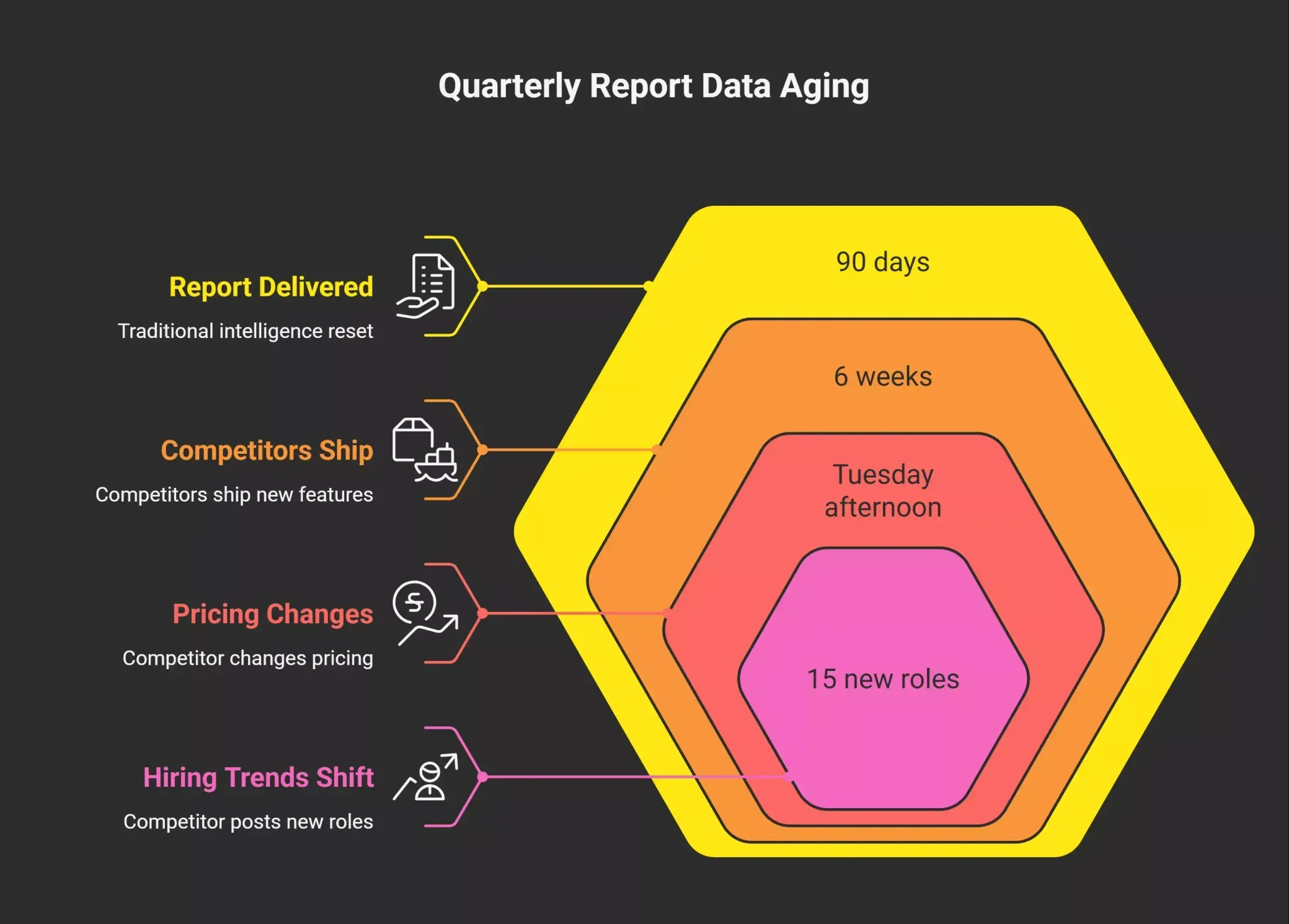 Static reports create a false sense of completeness. Your strategy teams think they have the full picture, but the competitive landscape kept moving while the report sat in someone's inbox.
What Competitive Intelligence Gathering Looks Like in 2026
From Manual Research to Continuous Monitoring
-
Manual research means one team member opens competitor websites, reads review sites, scans social media activity, and assembles findings by hand
-
That process takes 8 to 12 hours per month per sales rep, according to Arise GTM's CI automation research
-
Continuous monitoring of competitor activity replaces that old model by tracking competitor signals such as pricing shifts, hiring patterns, product launches, and ad spend changes from multiple sources at the same pace as the market itself
The competitive intelligence tools market hit $557.6 million in 2026 and is projected to reach $1.28 billion by 2033. That growth reflects a shift: businesses stopped asking whether they need competitive intelligence and started asking how fast they can get it.
AI tools are the reason that the shift accelerated. Where a team member once spent a full day on competitor analysis, AI tools handle the data collection and surface only the signals that matter. Artificial intelligence applied to competitive intelligence is not a nice-to-have anymore. It is the competitive advantage that separates teams who react from teams who anticipate.
The Four Pillars of AI-Powered Competitive Intelligence
Modern AI competitive intelligence operates on four foundational pillars that create continuous feedback loops capturing competitive movements as they happen:
-
Automated data collection pulls from competitor websites, patent filings, review sites, social media activity, job boards, and news outlets without anyone opening a browser
-
Real-time analysis processes that raw data into structured data that strategy teams can read and act on within minutes
-
Predictive modeling uses historical data and pattern recognition to forecast competitor moves before they happen publicly
-
Actionable alerting pushes the right signal to the right team member at the right moment, eliminating noise
These feedback loops run around the clock. They do not wait for a quarterly cadence. Every new signal compounds on top of previous signals, building a system that gets sharper over time.
What AI Tools Handle That Strategy Teams Cannot Do Alone
Pattern Recognition Across Competitor Activity
-
AI tools identify patterns in competitor behavior that a human analyst scanning ten open browser tabs would miss
-
When a competitor hires three solutions engineers with healthcare experience in the same month, an AI system flags it as a vertical expansion signal
-
When competitor websites shift messaging from "automation" to "AI-powered" across 15 pages over two weeks, the system detects a repositioning move
Pattern recognition at this scale requires monitoring hundreds of data points simultaneously. AI agents process social media activity, patent filings, job postings, product page edits, and pricing changes into one system. Strategy teams can then focus on interpretation and decision-making instead of data collection.
Pricing Changes and Hiring Trends in Real Time
-
Real-time data on pricing changes gives your sales team the ability to adjust positioning before a deal closes, not after you lose it
-
Hiring trends reveal where competitors plan to invest six months from now, giving you early access to strategic decisions you would otherwise learn about at launch
-
Monitoring competitor websites for feature list updates shows you what competitors are building before they announce it
One practical example: a SaaS company's AI competitive intelligence system detected a competitor hiring solutions engineers with healthcare vertical experience. The company accelerated its own healthcare roadmap, launched first, and won three deals before the competitor shipped. That kind of intelligence never shows up in quarterly reports.
Data Collection at Scale
-
An AI-powered system collects data from review sites, competitor websites, social media, patent filings, news outlets, and earnings transcripts simultaneously
-
The data collection runs continuously, so the system never goes dark between analysis cycles
Where most businesses rely on Google Alerts and manual check-ins, AI-powered intelligence watches every signal source at once and filters noise automatically.
How Structured Data Transforms Decision Making
Turning Raw Data Into Strategic Decisions
-
Structured data transforms raw data into organized insights that help product teams make informed decisions during planning sessions
-
Product teams that synthesize customer feedback into structured insights can identify patterns that inform product development and strategy
-
Using structured data allows teams to prioritize initiatives based on impact, urgency, and differentiation
The gap between raw data and a strategic decision is where most competitive intelligence programs stall. AI writes the synthesis layer that turns 500 competitor signals into one clear recommendation your team reads in five minutes.
Customer Research and Feedback Loops
-
Customer feedback arrives through support tickets, NPS surveys, sales call transcripts, social messaging channels, and review sites
-
The lack of structure in that feedback is the common problem: insights are trapped in individual conversations
-
Research from Bain and Company found that 80% of companies believe they are customer-centric, while only 8% of customers agree
That disconnect shows why competitive intelligence cannot live in isolation from customer experience data. That feedback, combined with competitor activity data, creates a competitor analysis that actually supports decision-making. Effective continuous monitoring requires systematic frameworks. Ad hoc monitoring produces information overload. Structured frameworks yield valuable insights.
| Approach | Update Frequency | Context Retention | Signal Sources | Action Speed |
|---|---|---|---|---|
| Quarterly Reports | Every 90 days | Resets each cycle | 2 to 4 manual sources | Weeks to act |
| Google Alerts | Daily emails | None | Keyword matches only | Days to act |
| AI-Powered Intelligence | Continuous | Persistent memory | 1,000+ sources | Minutes to act |
| Dedicated CI Platform | Near real-time | Partial | 35+ sources | Hours to act |
The Sales Team Advantage: Real-Time Intelligence Over Static Reports
Giving Your Sales Team the Right Message at the Right Moment
-
Sales teams face direct competition in 68% of their deals, yet Crayon's 2025 State of CI shows they rate their competitive selling preparedness at just 3.8 out of 10
-
That gap costs mid-market companies an estimated $2 to $10 million per year in lost revenue
-
Real-time data enrichment enables 25% faster decision-making and drives 30% higher revenue growth, according to the Competitive Intelligence Alliance
Your sales team needs competitor intelligence in their inbox before a call, not in a slide deck they forgot to open from last quarter. When a competitor shifts messaging or drops pricing, your sales team should know before the prospect brings it up.
AI-powered competitive intelligence delivers that. It pushes the right message to the right team member based on which competitor appears in an active deal. No manual research. No searching through old quarterly reports.
Predictive Analytics and Competitor Moves
-
Predictive analytics uses historical data and current signals to forecast what competitors will do next
-
Predictive intelligence combines hiring trends, patent filings, product page changes, and ad spend patterns to surface strategic moves weeks before they become public
-
The AI combines multiple signals to form one actionable strategic insight
When a competitor simultaneously increases ad spend in a new region, hires sales reps fluent in that region's language, and updates their website with region-specific landing pages, predictive analytics connects those signals. Your team learns a competitor is expanding into a new market weeks before the public announcement.
Follow Ups and Customer Experience: Signals Quarterly Reports Ignore
Competitor Moves and Customer Experience Gaps
-
Competitor follow-ups on product launch announcements reveal what customer segments they target and how they sequence messaging
-
Customer experience signals from competitor review sites show you where the market expects more
-
Market changes at this speed only show up in real-time monitoring systems
When your intelligence system tracks social media activity alongside website changes and hiring trends, each data point adds context. Context is just what quarterly reports fail to provide.
What People Are Saying
Bryn Harrington, Product Marketing Lead at Oura, explained her team's shift toward AI-powered competitive intelligence:
"I use AI really frequently for competitive analysis and market insights. So, trying to understand what our competitors in the consumer wearable space are doing and looking at new market entries... I'll really use that to get a general sense of the market and of competitive trends and then hone in on specific use cases there." - Source: Competitive Intelligence Alliance
That approach reflects how modern strategy teams operate. They use AI tools to scan the competitive landscape first, then go deeper based on what the AI surfaces. The days of quarterly research sprints are fading for teams that adopt continuous monitoring.
How Rocket.new's Intelligence Delivers What No Quarterly Report Can
Rocket.new's Intelligence is a continuous, real-time monitoring system that connects competitive signals directly into the same platform where your team researches markets and builds products. Where traditional competitive intelligence lives in spreadsheets and slide decks that go stale, Rocket keeps all past signals and decisions in one workspace, avoiding loss of context.
Rocket eliminates the need for manual, one-time research sprints by running continuous monitoring across competitor websites, social media, review sites, pricing pages, and hiring signals. Every new signal strengthens long-term strategic understanding rather than replacing the previous quarter's data. Rocket builds a persistent memory where intelligence compounds over time instead of resetting every 90 days.
The platform synthesizes daily briefs that connect scattered signals into one coherent strategic picture. It connects disparate data points into a single cohesive analysis, so your team reads one brief instead of scanning ten dashboards.
Rocket's platform replaces "vibe coding" with vibe solutioning, so products are based on real-time market data rather than guesses.
Rocket.new's top features:
-
Vibe solutioning platform: research the market, decide what to build, ship it, and track competitors in one system
-
25,000+ templates library, free to use, covering web apps, mobile apps, landing pages, and SaaS products
-
Supports Flutter for mobile and Next.js for web, with production-grade output
-
Collaboration features built in, including workspace-level sharing and team notifications
-
Three products, one platform: Solve (strategic research), Build (production code), and Intelligence (continuous competitor monitoring)
Rocket allows users to go directly from insight to action within the same platform. A competitive signal about a competitor's pricing change turns into a Solve research task, which feeds into a Build project for a repositioned landing page, all without switching tools or re-explaining context.
Use cases connecting competitive intelligence to Rocket.new:
-
A small team of two uses Intelligence to track four competitors' pricing changes, then uses Solve for competitor analysis and Build to ship a repositioned landing page the same week
-
A sales team connects Intelligence alerts to their deal prep workflow, getting competitor briefs before every call
-
A product team feeds Intelligence signals about competitor feature launches into a Solve task to generate a PRD, then takes it directly into Build
-
Strategy teams replace their quarterly competitor review with daily briefs, saving two weeks of manual research per quarter
You can set up a free account and start Intelligence monitoring in under ten minutes. Your first brief arrives within 24 hours.
Building Your Competitive Intelligence System From Scratch
Small Teams and the Free Account Path
-
Small teams do not need enterprise budgets to start competitive intelligence
-
Rocket.new's free account includes Intelligence setup, so a team of one can monitor competitors from day one
-
The CI tools market for SMBs is climbing from $2.56 billion in 2023 to $6.02 billion by 2030
A single team member can configure Rocket's Intelligence wizard in five steps, add competitor URLs, choose signal categories, and receive the first brief within 24 hours.
From Google Alerts to AI Agents
-
Google Alerts catch keyword matches but lack context, miss pricing changes, and cannot identify patterns across sources
-
AI agents scan thousands of data sources simultaneously and filter noise before it reaches your team
Most businesses start with Google Alerts because the cost is zero. The problem is that Google Alerts deliver volume without context. AI agents connect signals from separate sources into one system that produces a clear, informed view of the competitive landscape.
Why Most Businesses Still Rely on Outdated Intelligence
The Feedback Loops That Keep Strategy Teams Behind
-
Quarterly reports create a feedback loop where teams only look at competitors every 90 days, which means competitor activity between cycles goes unnoticed
-
When teams review competitors, they start from scratch because the previous quarter's context was not preserved
If you review competitors every 90 days, you respond to competitor moves every 90 days. Your competitors who use continuous monitoring respond in hours. That speed gap is the competitive advantage that compounds over time. Breaking that cycle requires switching from a project-based approach to an always-on system. AI-powered tools with feedback loops that capture competitive movements continuously are the alternative. AI initiatives in competitive intelligence are no longer optional for businesses that want to stay ahead.
The Real Value of Knowing What Competitors Did Today
Predictive intelligence is the difference between reading a competitor's annual report six months late and knowing they are about to enter your market segment next month.
-
Each signal builds on the previous one
-
Each pattern recognition triggers a follow-up that human analysts would miss
-
Each day of continuous monitoring adds depth that a quarterly report can never accumulate
Rocket.new's systems learn continuously, enabling the AI to strengthen strategic recommendations as data compounds over time. That compounding effect separates static information from living intelligence.
Stop Waiting for Quarterly Reports to Tell You What Already Changed
What does Rocket.new's intelligence tell you that a quarterly competitive report can never tell you comes down to one thing: context that compounds. Quarterly reports deliver a frozen snapshot.
Rocket's Intelligence delivers a living system that learns from every signal and keeps your team operating at the same pace as the market. The businesses that win competitive deals in 2026 are the ones whose intelligence system never sleeps.
Start using Rocket.new Intelligence today to turn real-time competitor signals into faster strategic decisions.
Table of contents
- -Why Does Your Competitive Intelligence Arrive Already Expired?
- -Why Quarterly Reports Break Down Before They Reach Your Team
- -The 90 Day Reset Problem
- -Static Reports Miss What Moves Between Cycles
- -What Competitive Intelligence Gathering Looks Like in 2026
- -From Manual Research to Continuous Monitoring
- -The Four Pillars of AI-Powered Competitive Intelligence
- -What AI Tools Handle That Strategy Teams Cannot Do Alone
- -Pattern Recognition Across Competitor Activity
- -Pricing Changes and Hiring Trends in Real Time
- -Data Collection at Scale
- -How Structured Data Transforms Decision Making
- -Turning Raw Data Into Strategic Decisions
- -Customer Research and Feedback Loops
- -The Sales Team Advantage: Real-Time Intelligence Over Static Reports
- -
- -Predictive Analytics and Competitor Moves
- -Follow Ups and Customer Experience: Signals Quarterly Reports Ignore
- -Competitor Moves and Customer Experience Gaps
- -What People Are Saying
- -How Rocket.new's Intelligence Delivers What No Quarterly Report Can
- -Building Your Competitive Intelligence System From Scratch
- -Small Teams and the Free Account Path
- -From Google Alerts to AI Agents
- -Why Most Businesses Still Rely on Outdated Intelligence
- -The Feedback Loops That Keep Strategy Teams Behind
- -The Real Value of Knowing What Competitors Did Today
- -Stop Waiting for Quarterly Reports to Tell You What Already Changed