
Rocket.new detects subtle market signals and data patterns to forecast competitors’ strategic moves before they surface publicly, giving teams earlier insight for faster, smarter decision-making and proactive competitive responses more.
What allows a tool to predict what competitors will do before they announce it?
The answer lies in how signals are tracked, connected, and turned into action. Instead of waiting for headlines, modern systems read patterns across product updates, hiring activity, and subtle behavior shifts. When these signals come together, they reveal direction early.
According to Statista, the global volume of data is expected to reach 181 zettabytes by 2025, showing how rapidly decision-making is becoming data-driven.
That gap between signals and announcements is where smart teams move ahead. And that is exactly where Rocket changes the game by turning early signals into clear action.
This blog will help you understand how to spot early competitor signals and turn them into real decisions.
Why Most Teams Miss What Competitors are Doing?
Teams think they are tracking competitors well. Dashboards are set. Alerts are running. Notes are getting stored.
On the surface, everything looks organized. But when it comes to actually understanding competitor moves, things start falling apart.
Here’s where the gap shows up:
-
Most teams rely on the slow way, trying to connect dots manually after collecting scattered inputs
-
Separate tools handle competitive research, analysis, and build, which breaks the flow
-
No same shared context between insights and execution, leading to confusion
-
Data exists, but it sits like a decorative background with no real action
-
Important signals like a pricing change or product shift get noticed too late
In the end, teams find themselves reacting instead of leading. By the time a launch becomes visible, competitors are already ahead.
What a Real Strategic Read Looks Like?
Most teams think tracking competitors is enough. It is not. A real strategic read comes from understanding how competitors operate, not just watching what they do on the surface.
Here’s what that actually looks like:
-
A company updates job postings, hinting at a new direction
-
Another shares a subtle LinkedIn post that signals a shift in focus
-
A third rolls out a quiet pricing change without much noise
Individually, these feel small and easy to ignore. But together, they point toward a strategic move.
This is where most teams miss the bigger picture. They see fragments, not the full arc. A strong system connects these signals into one structured brief. That brief turns scattered inputs into a clear story. Not a feed. Not noise. Just direction that teams can actually act on.
The Shift from Monitoring to Action
Lots of founders follow a familiar pattern when tracking competitors. It feels structured, but it slows things down over time. The process looks clear, yet it delays real action.
Here’s how the traditional flow usually works:
-
Tracking stage: collecting updates, alerts, and signals from multiple sources
-
Analysis stage: reviewing data and trying to make sense of patterns
-
Discussion stage: sharing insights across teams and aligning on next steps
-
Build stage: finally moving toward execution
The issue is simple. This entire cycle takes time. Most teams stay stuck collecting data instead of acting on it. That is the slow way.
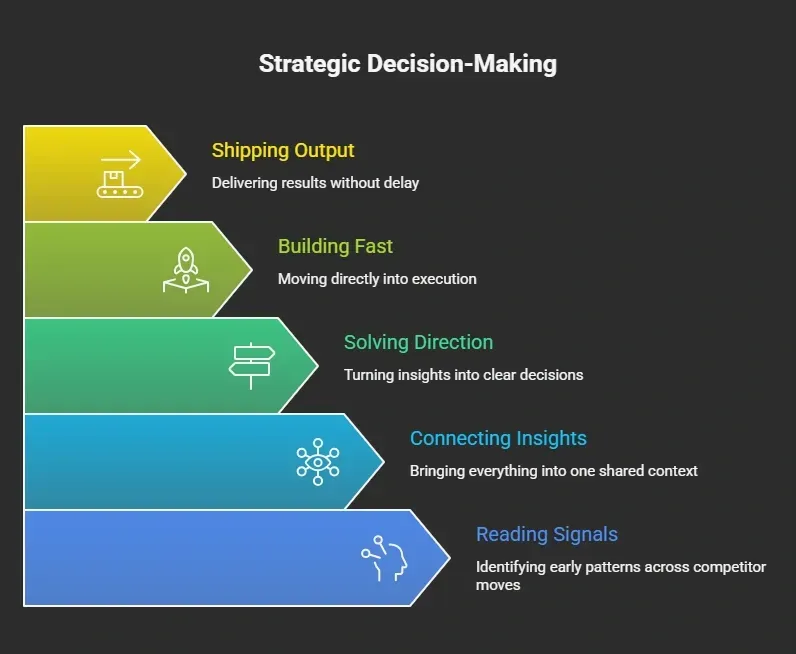 This shift matters because competitors move fast. Teams need a system that works in real time, not after the fact.
How Rocket Changes the Game?
That approach creates friction and delays. Rocket changes that by bringing everything into one flow where thinking, intelligence, and execution stay connected.
Here is what makes it different:
-
It is not a feed, so teams do not get lost in endless updates
-
It builds one structured brief from multiple signals for clear direction
-
It keeps everything in same shared context across research and build
-
It combines competitive monitoring layer with investigative research
-
It connects directly to execution, so teams can act on competitor moves instantly
Rocket.new handles everything together, which means teams move from insight to action without breaks. This is why it stands out as the first vibe solutioning platform, where vibe coding leads to real outcomes.
Three Capabilities That Change Everything
Research sits in one place, insights in another, and build happens somewhere else. Rocket fixes this by bringing three capabilities together in one flow, giving teams clarity from start to finish.
1. Investigative Research That Actually Connects Dots
Rocket can run investigative research across sources like job postings, product updates, and social media.
Instead of isolated insights, it creates a structured brief. That brief shows the strategic read clearly.
Teams do not need to run investigative research manually anymore. Rocket does it continuously.
2. Intelligence That Stays in Shared Context
The intelligence layer is not static. It evolves with the project.
Every signal sits in shared context. That means no confusion between research and build.
Teams always have the background for the call ready.
3. Vibe Coding That Leads to Real Builds
Vibe coding inside Rocket is not random code generation. It is connected to research and insights. So when teams build, they build production software that matches market needs.
These three capabilities work as one system. They connect investigative research, intelligence, and vibe coding into a single direction.
As a result, teams move faster, stay aligned, and build production software that actually matches what the market needs.
How Rocket Reads Competitor Signals Early?
Rocket reads early competitor signals by connecting small clues before they become public news.
Instead of treating each signal separately, it brings them into one flow so teams can understand what competitors may be planning next.
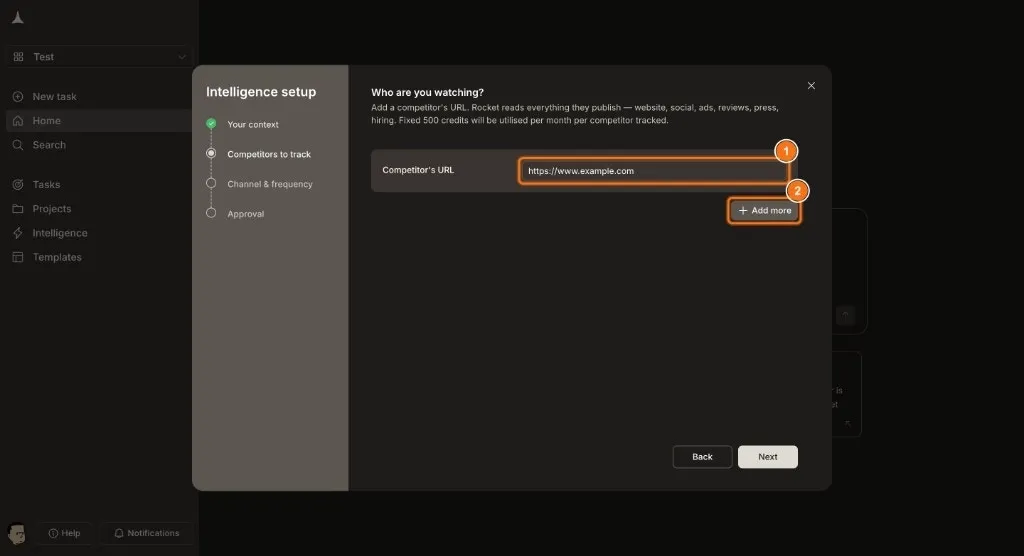
Step 1: Track Competitor Signals
Rocket tracks competitor signals across multiple sources.
-
LinkedIn post updates
-
Pricing change patterns
-
Hiring signals
-
Product tweaks
This forms the base of the competitive monitoring layer.
Step 2: Convert Signals into a Structured Brief
Rocket does not show raw data. It turns everything into one structured brief. That brief shows the full arc of what competitors are planning.
Step 3: Turn Insights into Action
From the structured brief, teams can directly build web apps or mobile apps. No switching tools. No delay.
This is where Rocket becomes more than just intelligence. It becomes execution.
This is where Rocket moves beyond tracking. It turns signals into a structured brief, connects that brief with action, and helps teams build without waiting for competitors to make the first move.
Old Way vs Rocket Way
This table highlights the difference between the slow way and a connected approach where everything stays aligned.
| Process Stage | Old Way | Rocket Way |
|---|---|---|
| Research | Scattered competitive research | Continuous investigative research |
| Context | No shared context | Same shared context |
| Output | Notes and reports | One structured brief |
| Build | Separate tools | One platform |
| Speed | Slow way | Real-time action |
The difference is not just in tools, but in flow. When research, context, and build stay connected, teams move faster and make better decisions without losing direction.
Rocket.new Intelligence Layer Explained
The intelligence layer in Rocket is where things start to connect clearly. It is not just about tracking updates. It works as a live system that reads signals and turns them into decisions that teams can act on.
Here is what it includes:
-
Continuous competitive intelligence that keeps tracking signals in real time
-
Real-time competitor moves tracking across multiple sources
-
Structured insights mapped directly to execution
-
Live deal awareness that highlights what is happening in the market
This is not passive tracking sitting in the background. It is active decision support that helps teams move with clarity and speed.
How Rocket Helps Teams Read Strategic Moves Early?
Rocket does exactly that by combining three elements.
-
Competitive monitoring layer
-
Investigative research
-
Vibe coding
When these work together, teams get a strategic read early. They do not wait for press releases. They act before that moment arrives.
What Teams Actually Experience?
Teams quickly notice one thing. The confusion is gone. There is no need to juggle tools or rewrite insights again and again.
Here’s what that experience looks like:
-
Everything stays in shared context from research to build
-
No switching between tools or losing track of insights
-
Clear direction while working on production software
-
Decisions feel aligned with real market signals
This is the difference between building randomly and building something worth building.
From Signals to Production Software
This is where Rocket stands apart from most tools. It does not stop at insights. It carries everything forward into actual builds.
Here’s how that flow works:
-
Signals move directly into structured outputs
-
Insights connect with execution without delays
-
Teams can build production grade apps from scratch to launch
-
Faster ship cycles with fewer blockers
Because everything is structured, teams are not guessing. They are building based on real signals that reflect what is happening in the market
Connecting Signals Before They Become News
Most teams still rely on separate tools and follow the slow way, which makes them miss early signals. By the time a pricing change or product launch becomes visible, it is already late. Teams end up reacting instead of leading, often building the wrong thing without clear direction.
Rocket changes this by bringing intelligence, research, and build into one platform. It turns signals into one structured brief and helps teams act fast. When context is shared, teams build production software that truly matches the market.
Try Rocket.new to move from scattered signals to clear action and start building what actually matters.
Table of contents
- -Why Most Teams Miss What Competitors are Doing?
- -What a Real Strategic Read Looks Like?
- -The Shift from Monitoring to Action
- -How Rocket Changes the Game?
- -Three Capabilities That Change Everything
- -1\. Investigative Research That Actually Connects Dots
- -2\. Intelligence That Stays in Shared Context
- -3\. Vibe Coding That Leads to Real Builds
- -How Rocket Reads Competitor Signals Early?
- -Step 1: Track Competitor Signals
- -Step 2: Convert Signals into a Structured Brief
- -Step 3: Turn Insights into Action
- -Old Way vs Rocket Way
- -Rocket.new Intelligence Layer Explained
- -How Rocket Helps Teams Read Strategic Moves Early?
- -What Teams Actually Experience?
- -From Signals to Production Software
- -Connecting Signals Before They Become News