
Rocket.new is transforming business reporting in 2026 by replacing slow quarterly reports with real-time insights, enabling faster decisions, stronger adaptability, and reduced strategic risk for modern organizations across competitive industries worldwide.
What if the competitive report you shared with leadership was already outdated before anyone finished reading it?
In 2026, product launches, pricing updates, AI releases, and messaging shifts happen within days, not quarters. Yet many businesses still rely on quarterly competitive reports that take weeks to prepare and quickly lose relevance.
According to Gartner, poor data quality costs organizations an average of $12.9 million every year, often because decisions are made using delayed or outdated information.
Instead of static reporting, Rocket.new helps businesses monitor market movement continuously, adapt faster, and make strategic decisions while opportunities still exist.
This blog will help readers understand why traditional competitive reporting is failing and how modern AI-driven intelligence platforms like Rocket enable faster and smarter strategic decisions.
The Quarterly Competitive Report: How It Actually Works
Most quarterly competitive reports follow the same slow process. A product manager, strategy analyst, or sales enablement lead spends weeks collecting information from scattered sources like competitor websites, G2 reviews, LinkedIn activity, product updates, and industry news.
After the research comes documentation, formatting, presentations, and internal reviews. By the time leadership finally sees the report, much of the information is already outdated.
During that delay, competitors may already be changing direction in ways your team cannot see yet:
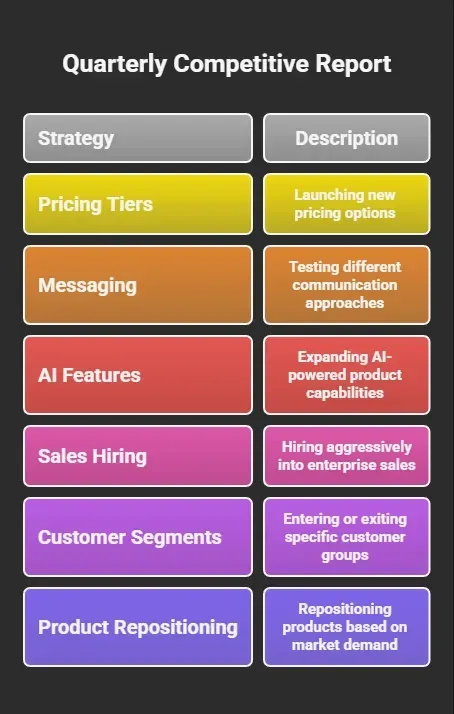 These shifts happen continuously, not quarterly. Traditional reports only capture a temporary snapshot of the market, while competitors continue moving in real time. As a result, teams often make strategic decisions using information that no longer reflects the current competitive landscape.
The Real Cost of Stale Competitive Data
Outdated competitive data creates problems far beyond delayed reporting. Sales teams enter demos using old battlecards, product teams prioritize features based on outdated assumptions, and marketing campaigns target positioning competitors already abandoned.
The decisions seem reasonable because the supporting data appears current even when it is not.
The impact spreads across the organization:
-
Sales teams respond to outdated competitor messaging
-
Product roadmaps miss recent market changes
-
Marketing campaigns target irrelevant positioning
-
Leadership makes strategy decisions using delayed insights
-
Teams react slower to competitor movement
Traditional quarterly reporting was built for slower markets.
Today, competitors change positioning, products, and strategy far too quickly for static reports to remain reliable. Teams that rely on delayed intelligence often react after the market has already moved.
What a Quarterly Cycle Misses Across Every Team
Here is a plain comparison of what competitive monitoring looks like at different cadences and what each approach actually delivers when it comes to real-time decision making:
| Approach | Update Frequency | Data Coverage | Actionable In |
|---|---|---|---|
| Quarterly report | Every 90 days | Manual spot checks | Often too late |
| Monthly digest | Every 30 days | Broader but delayed | Weeks after events |
| Real-time AI monitoring | Continuous | Automated, multi-source | Hours after events |
| Rocket.new Intelligence | Continuous | Automated, multi-source | Hours after events |
The gap is stark. By the time a quarterly report is ready to present, real-time AI tools have already processed dozens of meaningful competitor events and surfaced them to teams who could do something about them.
How Markets Now Move Faster Than Quarterly Cycles
Markets in 2026 move too quickly for quarterly reporting cycles to keep up. AI-powered development tools accelerate product launches, pricing systems allow overnight updates, and social platforms reveal messaging changes within hours.
Competitors can shift strategy, launch features, and reposition products long before traditional reports are updated.
A modern competitive cycle now looks like this:
-
A competitor launches a new AI feature
-
Pricing and packaging get updated overnight
-
Sales teams receive new positioning and pitch direction
-
Ads start targeting competitor weaknesses
-
Messaging shifts across websites and social channels
By the time many teams review their quarterly reports, the market has already changed. Modern competitive intelligence now depends on continuous monitoring, faster interpretation, and systems that deliver insights directly into decision-making workflows.
What the Community Is Saying About Quarterly Reports
Professionals across product, strategy, and research teams are increasingly questioning whether quarterly reporting still works in fast-moving markets. One recent LinkedIn Pulse article explained the issue clearly:
“Voice of Customer is no longer a feedback mechanism buried in a marketing team's quarterly report. It is a living diagnostic system.” Dr Asma Q., LinkedIn Pulse, April 2026 The Signals You’re Ignoring Are Costing You Millions
The core concern is simple: competitors now move faster than traditional reporting cycles. By the time many quarterly reports are reviewed, the market, messaging, and competitive landscape have already changed.
How Rocket.new Replaces Quarterly Reports
Rocket.new does not simply speed up quarterly reporting it replaces the entire process with continuous competitive intelligence. The platform combines AI-powered research, product building, and competitive monitoring inside one connected workspace. Instead of waiting months for static reports, teams receive ongoing intelligence that updates automatically as the market changes.
How Rocket.new Intelligence Works
Rocket.new starts with a simple setup process. Once competitors are added, the platform immediately begins monitoring signals across the market. Teams receive their first intelligence brief within 24 hours, followed by continuous updates delivered automatically inside the workspace.
There is no need for:
-
Manual competitor tracking
-
Repeated website checks
-
Spreadsheet-based monitoring
-
Quarterly review cycles
-
Separate research dashboards
Rocket.new continuously collects, organizes, and surfaces competitive insights in real time.
What Rocket.new Intelligence Monitors
Rocket.new tracks competitive activity across several key areas:
-
Website changes including pricing, features, and landing pages
-
Social activity, product announcements, and industry news
-
Customer reviews and shifts in sentiment across platforms
-
Advertising changes, messaging updates, and campaign positioning
-
Hiring signals that may indicate strategic expansion
These signals help teams identify competitor movement early often before it becomes obvious across the market.
Rocket.new vs. Traditional Competitive Monitoring Tools
Standalone tools like Crayon, Klue, and Kompyte focus mainly on monitoring. Rocket.new takes a broader approach by connecting intelligence directly with research, planning, and execution inside one system.
That creates a much tighter workflow:
-
Intelligence surfaces a competitor pricing change
-
Teams immediately analyze the impact inside Solve
-
Product or strategy responses move directly into Build
-
Decisions happen faster because research and execution stay connected
Instead of static reports reviewed every quarter, Rocket.new gives teams a continuously updated view of the market ready whenever product, strategy, or leadership decisions need to happen.
Why Continuous Intelligence Matters More Than Quarterly Reports
Quarterly competitive reports were built for a slower business environment where market changes happened gradually and research moved manually. In 2026, competitors can change pricing, launch features, shift messaging, and reposition products within days. Static reporting cycles can no longer keep pace with real-time market movement.
Rocket.new replaces delayed reporting with continuous competitive intelligence. Instead of waiting months for updates, teams receive ongoing insights that help them respond faster, make smarter decisions, and stay aligned with changing market conditions as they happen.
Want to move beyond outdated quarterly reporting? Explore how Rocket.new helps teams monitor competitors continuously and turn market signals into faster strategic action.
Table of contents
- -The Quarterly Competitive Report: How It Actually Works
- -The Real Cost of Stale Competitive Data
- -What a Quarterly Cycle Misses Across Every Team
- -How Markets Now Move Faster Than Quarterly Cycles
- -What the Community Is Saying About Quarterly Reports
- -How Rocket.new Replaces Quarterly Reports
- -How Rocket.new Intelligence Works
- -What Rocket.new Intelligence Monitors
- -Rocket.new vs. Traditional Competitive Monitoring Tools
- -Why Continuous Intelligence Matters More Than Quarterly Reports