
Rocket.new detects competitor signal clusters by connecting hiring changes, messaging updates, pricing shifts, and product launches across thousands of sources in one platform. Instead of relying on fragmented tools, teams get scored insights, shared project context, and faster decision-making from research to production.
Why Do Teams Keep Missing Competitor Moves?
What if your competitors shifted strategy weeks ago, and nothing in your stack connected the dots?
That is what happens when teams rely on fragmented data across services. 68% of B2B deals involve at least one direct competitor, yet most teams piece together competitive intelligence from disconnected tools. The gaps between those tools are where signal clusters hide.
The Problem with Tracking Competitors Across Too Many Tools
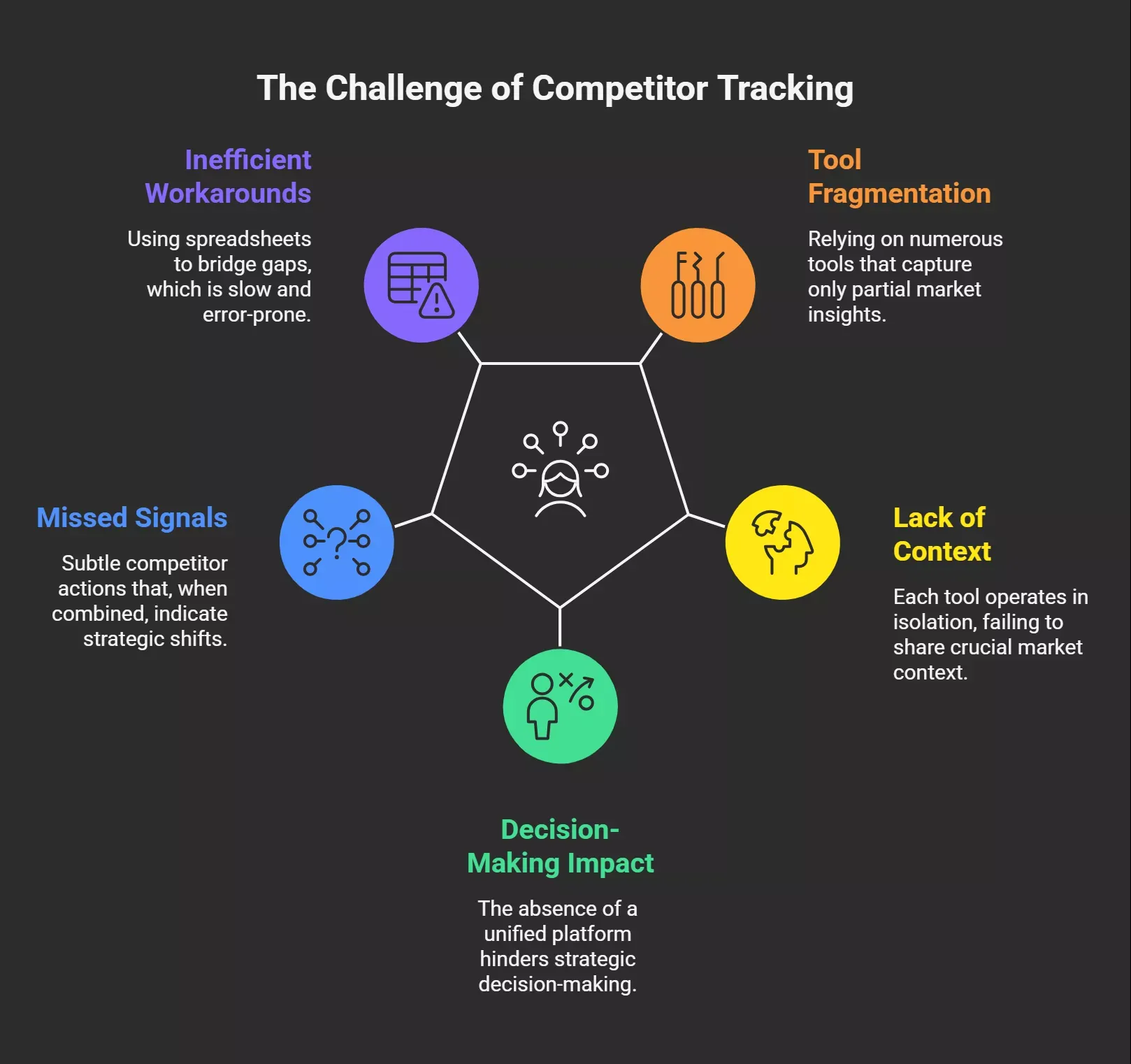
Why Tool Fragmentation Creates Blind Spots
- Most teams rely on 10 to 15 AI tools to track competitors, and each platform captures only a slice of the market.
- One watches pricing pages. Another monitors hiring signals. A third watches social media. None shares context.
- The cost goes beyond money. Decision-making suffers when teams move from research to strategy without a shared platform for building on what they learn.
What Gets Missing Between Tools
- A competitor posts new roles on LinkedIn. Their ad library shifts messaging. A product tweak appears on their site.
- Alone, none register. Together, they signal a strategy pivot.
- Solving these connections with other tools requires human expertise and speed. Teams work around this by building spreadsheets, but that is slow.
What Signal Clusters Look Like
Clusters vs. Single Changes
- A single pricing update tells you one thing. A signal cluster reveals a strategy.
- Clusters form when hiring shifts, messaging changes, and feature launches align across competitors weeks before an announcement.
- Teams building a project around a market opportunity need to catch these clusters early to prepare and act before competitors launch.
How Competitors Hide Their Plans
- Competitors hide their plans behind job postings, product tweaks, and partnership announcements.
- These micro-signals scatter across LinkedIn, Reddit, review sites, and competitor websites.
- Without a platform connecting this data, competitive analysis stays reactive instead of driving what teams are building.
How Rocket.new Detects Clusters Across Sources
Multi-Source Monitoring in One Continuous Flow
- The platform monitors real-time feeds across LinkedIn, Reddit, review sites, and competitor websites.
- Solve aggregates signals from over 1,000 sources into one view for the project.
- Rocket handles research, intelligence, and building inside one platform, so founders and teams move from solving a signal to building on it without switching services.
Signal Scoring That Cuts Through Noise
- The platform scores every signal: Impact x Urgency x Differentiation Gap.
- Each gets a strength rating (HIGH, MEDIUM, LOW) based on source quality and recency.
- Data from competitors is filtered for noise and merged to interpret context, giving the project team a clear picture.
Handling Conflicting Evidence
- Rocket does not average conflicting findings. It highlights contradictions to surface potential repositioning.
- What competitors say publicly versus their hiring patterns often reveals gaps in strategy.
Traditional CI vs. Rocket.new
| Capability | Traditional CI (Multiple Tools) | Rocket.new |
|---|---|---|
| Sources monitored | Siloed across 10-15 services | 1,000+, unified |
| Signal scoring | Manual analyst tagging | Automated: Impact x Urgency x Gap |
| Conflicting data | Averaged or ignored | Flagged as a strategic indicator |
| Research to building | Separate, context lost | Shared context, one flow |
| Speed to ship | Weeks of stitching | Minutes to a structured brief |
| Accessibility | Dedicated analyst required | Natural language input, AI handles research |
From Research to a Working App Without Starting Over
Vibe Solutioning: Context Over Code
- Vibe solutioning turns a question into a working app, focusing on context rather than code alone.
- The platform breaks questions into dimensions, and agents investigate in parallel for the project.
- The output is a brief, ready as background for the call or to feed into the build step for building.
Building with Full Context
- When founders start building from a Solve brief, the platform maintains persistent project memory.
- It supports Flutter for mobile apps and Next.js for web apps, giving teams production-grade output from the first generation.
- It supports component-level editing and full version history, so teams building a project can access any previous version.
- Teams that continue building on prior code get support for complex integrations and non-standard requirements.
When AI Stalls
- AI-only tools break at edge cases. Vibe coding pairs natural language with a dedicated success team to keep the project on track.
- AI only approaches cover most of the building work. The tricky logic gets solved by pairing automation with human review.
- Every project ships with production-grade output, not a decorative background demo. Rocket keeps the full project context through every iteration.
What People Are Saying
"Differentiated features are only 'differentiated' when you compare them to competitive alternatives." - April Dunford, positioning expert, via Visualping
This lines up with what makes Rocket.new different. Competitive intelligence disconnected from building is just data. Connecting market research to what users are building and delivering is where the strategy advantage lives.
How Rocket.new Handles Signal Clusters for Building Teams
Rocket.new connects research, competitive analysis, and code generation so teams can ship products matching market needs. Users building on Rocket get intelligence and code in the same project.
- Vibe-solutioning platform from question to plan to production code
- 25,000+ templates, free, covering web apps, mobile apps, SaaS, and dashboards
- Saves up to 80% tokens, cutting cost and speed to launch
- Flutter (mobile) and Next.js (web) for production output
- Collaboration with shared context across teams
- 3 Products, one platform: Solve, Build, and Intelligence
Use Cases for Catching and Acting on Clusters
- Founders prepare a launch monitor competitors' pricing, then start building a response within the same project.
- Strategy teams running competitor research feed intelligence into their build step without copying data across teams.
- Teams that prepare a call to action section for a pitch pull competitive data and start building the app.
- Users who rely on market research for decision-making use Intelligence as continuous input for every project.
Catching Clusters Before Competitors Act
How does Rocket.new catch a signal cluster that no single platform change would have revealed on its own?
By connecting research, building, and monitoring into one flow where every signal stays linked to the strategy it informs. Teams that rely on fragmented tools keep solving the same puzzle from scratch. Rocket gives them a path from signal to shipped product.
Sign up and turn scattered competitor signals into actionable products with Rocket.new’s unified intelligence and build workflow.
Table of contents
- -Why Do Teams Keep Missing Competitor Moves?
- -The Problem with Tracking Competitors Across Too Many Tools
- -Why Tool Fragmentation Creates Blind Spots
- -What Gets Missing Between Tools
- -What Signal Clusters Look Like
- -Clusters vs. Single Changes
- -
- -How Rocket.new Detects Clusters Across Sources
- -Multi-Source Monitoring in One Continuous Flow
- -Signal Scoring That Cuts Through Noise
- -Handling Conflicting Evidence
- -Traditional CI vs. Rocket.new
- -From Research to a Working App Without Starting Over
- -Vibe Solutioning: Context Over Code
- -Building with Full Context
- -When AI Stalls
- -What People Are Saying
- -How Rocket.new Handles Signal Clusters for Building Teams
- -Use Cases for Catching and Acting on Clusters
- -Catching Clusters Before Competitors Act