
Competitor job postings reveal hidden product roadmaps and strategic direction. Rocket.new tracks hiring spikes, signals, and combines them with patents, GitHub, and trademarks. The result: real-time intelligence that turns competitor moves into actionable product strategy.
What Competitor Job Postings Actually Reveal
What if you could read a competitor's product roadmap before they publish it?
That is what job postings do when you know how to decode them. CI team sizes grew 24% year over year, largely because companies realized hiring data is real data. Competitor job postings often reveal the skills and technologies that companies are prioritizing, which can inform your own hiring and development strategies.
Rocket.new built its Intelligence product around this concept, turning hiring signals into competitive intelligence that links directly to product-building decisions.
How Hiring Signals Predict a Product Launch
How Rocket Collects the Data
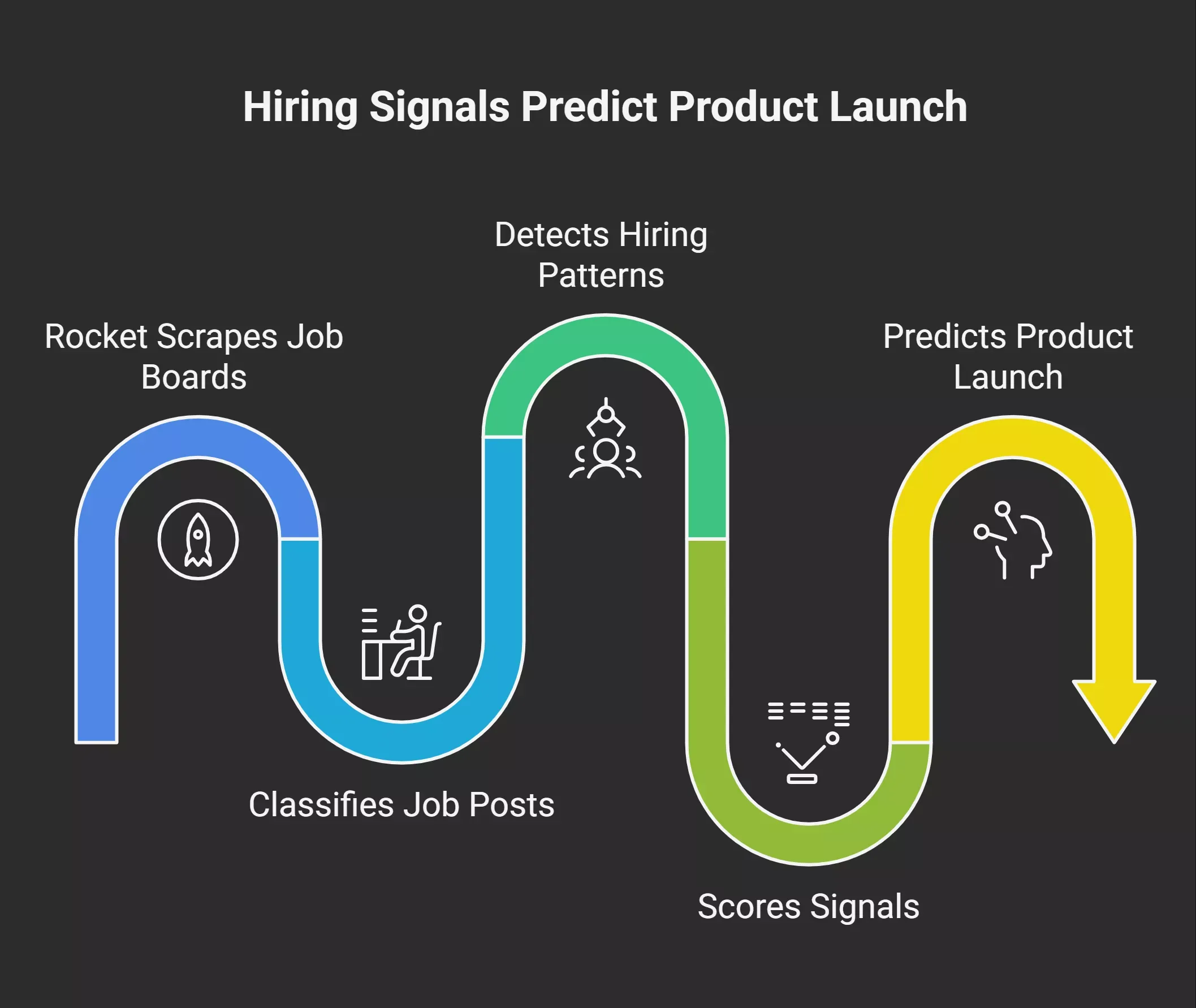
Rocket.new scrapes competitor job boards weekly and classifies each post by function to detect meaningful spikes. The platform uses proprietary web crawlers and real-time monitoring to track LinkedIn and other public career sites.
What Each Hiring Pattern Tells You
-
A spike in Machine Learning roles at one competitor signals an upcoming AI app release.
-
The platform watches for surges in certain job categories to infer strategic intent, such as Senior Account Executive hires indicating a push into enterprise markets.
-
Simultaneous hiring in Payments & Compliance Engineers suggests a move into financial services or new monetization models.
-
Hiring for security roles often acts as a precursor to the release of high-security or enterprise-grade tiers.
-
Adding people in segments like healthcare points to a planned industry expansion
How Signals Get Scored
Each signal gets an Intelligence Score based on its impact, urgency, and the gap between your feature priorities and your competitors' direction. This competitive intelligence scoring turns a guess about what competitors plan into a data-backed strategy.
Tracking Beyond Job Postings
Public Records That Reveal Product Roadmaps
Job postings are one data source. Rocket also monitors patent filings, GitHub commits, and trademark applications, which can reveal product roadmaps 18 to 24 months in advance.
| Signal Type | What It Reveals | Lead Time |
|---|---|---|
| Job postings | Hiring focus, tech stack shift | 3 to 6 months |
| Patent filings | R&D direction, development priorities | 12 to 24 months |
| GitHub activity | Code generation patterns, project focus | 1 to 3 months |
| Trademark filings | New product names, pricing strategy | 6 to 18 months |
Daily Briefs and Actionable Recommendations
The system reads patterns across public signals to spot pivots weeks before any announcement. Users get a structured brief every morning with competitor movements and built-in recommendations. These competitive intelligence insights feed directly into a user's backlog. That way, product building stays ahead of competitors rather than reacting months after a launch.
What People are Saying
"What are they hiring for? That reveals their next 6 months of strategy." - Boehner on DEV Community
This comment captures how Rocket handles intelligence: start with real data from hiring, pricing, and news, then turn it into decisions, not a decorative background report.
How Rocket.new Connects Intelligence to Product Building
The First Vibe Solutioning Platform
Rocket.new is the world's first vibe solutioning platform. It connects market research to code generation to competitive intelligence on one platform with shared context.
-
Vibe solutioning platform built for Solve, Build, and Intelligence
-
25,000+ templates library, free to use
-
Saves up to 80% tokens compared to starting code generation from scratch
-
Supports Flutter (mobile) and Next.js (web) for web apps and mobile apps
-
Collaboration is built in with unlimited team members
-
3 Products, One platform: Solve, Build, and Intelligence
Use Cases: From Intelligence to Execution
-
A competitor starts staffing for a payment integration. Rocket catches the signal, and you start creating a competing feature that same week
-
GitHub activity from a rival shows a framework switch. You track the shift in Intelligence, plan in Solve, and build your answer before they ship
-
Patent filings show a competitor's pricing shift. You use Solve for market research, then Build to launch landing pages and a prototype
Rocket is free to start with 20 credits. Paid plans run $25/month (Build), $250/month (Solve, Build), and $350/month (full platform). No per-seat pricing.
Turning Competitor Moves into Your Strategy
Most companies guess what competitors will launch next and miss the market by months. How does Rocket.new use competitor job postings to predict their next product launch?
It reads signals competitors cannot hide, scores them, and connects that intelligence to product building. Start with real-time data on Rocket and let research flow into execution.
Start using Rocket.new to turn competitor hiring signals into your next winning product strategy.
Table of contents
- -What Competitor Job Postings Actually Reveal
- -How Hiring Signals Predict a Product Launch
- -How Rocket Collects the Data
- -What Each Hiring Pattern Tells You
- -How Signals Get Scored
- -Tracking Beyond Job Postings
- -Public Records That Reveal Product Roadmaps
- -Daily Briefs and Actionable Recommendations
- -What People are Saying
- -How Rocket.new Connects Intelligence to Product Building
- -The First Vibe Solutioning Platform
- -Use Cases: From Intelligence to Execution
- -Turning Competitor Moves into Your Strategy