Building an app without backend experience is now achievable for anyone. AI-powered platforms handle servers, databases, and authentication automatically, turning ideas into production-ready products without writing a single line of backend code.
You have an idea for an app. Maybe it is a booking tool, a task tracker, or a personal project. Then you hit the backend question: servers, databases, APIs, authentication. For most people without a technical background, that is where the idea stops.
It does not have to. The landscape of app-building tools has shifted so dramatically that non developers are shipping real, working software every day.
This blog walks through every option available right now, from visual no-code platforms to AI-powered vibe coding tools, so you can find the path that fits your situation.
Why Does The Backend Feel Like A Wall?
For years, creating more than a static page meant dealing with servers, databases, API configurations, and authentication flows. That learning curve stopped most non developers from starting.
According to Computerworld (citing Gartner), 70% of new applications developed by enterprises now use low-code or no-code technologies. That kind of adoption signals something clear: people are building production apps without writing traditional code, and the tools keep getting better.
This guide breaks down your options for building an app without backend experience, from no code app builders to AI-powered full stack platforms, so you can pick the right tool for your situation.
What Does The Backend Actually Do?
Before picking a tool, it helps to understand what the backend handles. The backend is the part of your app that users never see directly, but it controls nearly everything that happens behind the user interface.
-
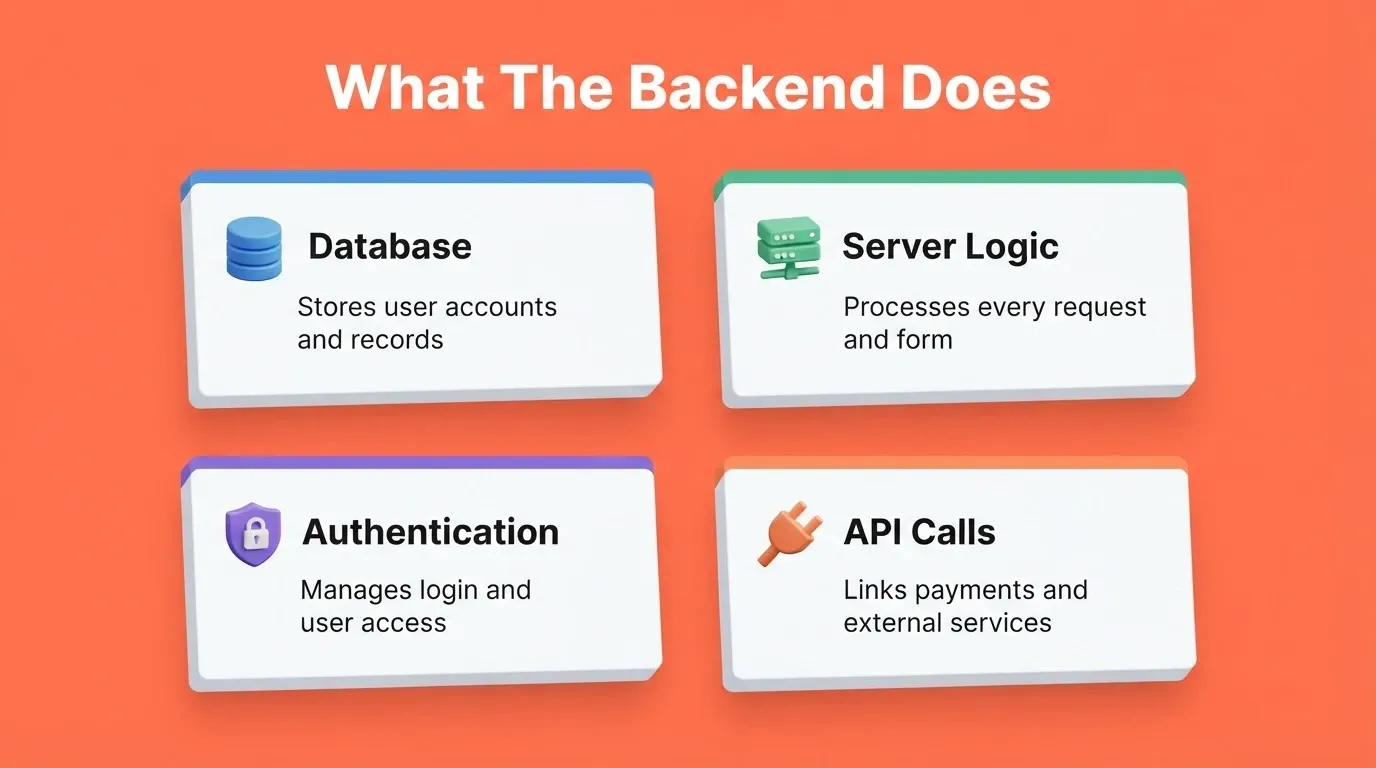
Server side logic processes requests when someone clicks a button, submits a form, or loads a page. Without it, your app is just a static screen with no real function.
-
Databases store data like user accounts, product listings, and transaction records. Fields in a database table use a primary key to give each record a unique identifier. When two tables need to connect data, a foreign key links one record to another.
-
User authentication controls who gets access. When users create accounts, log in, or reset passwords, that process runs on backend logic and backend setup configurations.
-
API calls let your app talk to other services. Payment systems, email providers, and analytics platforms all communicate through APIs protected by API keys.
-
Business logic defines the rules: what happens when a customer places an order, when inventory drops below a threshold, or when a data type needs validation before it gets stored.
Most of these backend tasks can now be handled automatically by no code tools and AI app builders. To understand what a no code app builder actually does at a technical level, that resource breaks it down clearly.
Read Further: What Is A No Code App Builder?
Can Non Developers Build A Full Stack App Today?
Yes, and it is happening at scale right now. A full stack app includes both the front end (what users see) and the back end (where data and logic live). Building one used to require software engineers across multiple platforms and frameworks. That is no longer the case.
According to the 2024 Stack Overflow Developer Survey, 76% of developers are now using or planning to use AI tools in their development process. The trend is even stronger among startups and solo founders who lack coding experience.
Here is what makes this possible today:
-
No code app builders give non developers visual tools to design screens, connect databases, and set up workflows without touching code.
-
AI app builders go a step further by generating the full stack app from a text description or prompt.
-
Pre-built backend services handle database, authentication, and storage so you focus on the user experience and not server side logic.
The learning curve for building a full stack web app has dropped significantly. Simple apps like a task tracker or booking system can reach production quality without a single line of handwritten code. What matters most is picking the right tool for your specific coding experience level.
Which No Code App Builders Handle Backend Logic?
Not all no code tools are built the same. Some only handle the front end, leaving you to figure out backend logic yourself. Others manage the entire process from user interface design to database to deployment.
Here is how the most popular platforms compare when it comes to handling backend logic:
| Platform | Backend Handling | Best For | Learning Curve | Deploy To Mobile |
|---|---|---|---|---|
| Bubble | Full backend with custom workflows | Complex app with custom logic | Medium-high | Web only (PWA) |
| Glide | Auto-generates backend from Google Sheets | Simple apps, internal tools | Low | Web and mobile |
| Adalo | Built-in database with relationships | Native mobile apps, task tracker apps | Medium | iOS and Android |
| FlutterFlow | Connects to Firebase or Supabase | Full stack apps across multiple platforms | Medium-high | iOS, Android, and Web |
| Rocket | AI-generated full stack with Supabase | Web apps, mobile apps, landing pages, internal tools | Low | Web, iOS, and Android |
A few things stand out from this comparison:
-
Bubble offers deep customization but requires time to learn its proprietary workflow system. Form submission and block logic configurations can feel overwhelming for beginners.
-
Glide works well for quick internal dashboards and task tracker projects, but it struggles with complex requirements that go past spreadsheet-based data.
-
Adalo and FlutterFlow target mobile apps specifically, but both require a medium understanding of database relationships and no code tools configuration.
The right tool depends on what kind of app you want to build and how much time you are willing to invest. For non technical people who want a working web app or mobile app fast, the platforms that auto-generate backend logic save the most time.
Read Further: Best No Code Mobile App Builders For Rapid AI-Based Builds
How Does Vibe Coding Change The Game For First-Time Builders?
Vibe coding is a newer approach that sits between traditional no code tools and full-on software development. You describe what you want in natural language, and an AI generates the code for you.
This is different from classic no code platforms because with vibe coding, real production-grade code gets created behind the scenes. You are not locked into a proprietary visual builder. The generated code is yours to keep, export, and customize with frontend development or backend tweaks.
Here is why that matters for someone without backend experience:
-
You can build apps that run full stack architecture (frontend, backend, database) from a single conversation.
-
The generated code follows industry standards, so a developer can review or extend it later.
-
You skip the part where you manually write code for API routes, database queries, and authentication flows.
-
Most tools handle deployment too, so your working app goes live in minutes.
One user in the Reddit r/nocode community shared their experience building a full stack app:
"I described my SaaS idea in two paragraphs and had a working app with user login, a dashboard, and Stripe payments within an hour. No frontend development or backend setup on my end at all."
The tool you pick determines whether you get a quick prototype or a real product that works reliably for real users. Not all vibe coding tools produce production-quality results. Some generate messy code, break on edge cases, or lack proper data management.
Vibe Coding Vs No Code: Key Differences
| Dimension | No Code Tools | Vibe Coding |
|---|---|---|
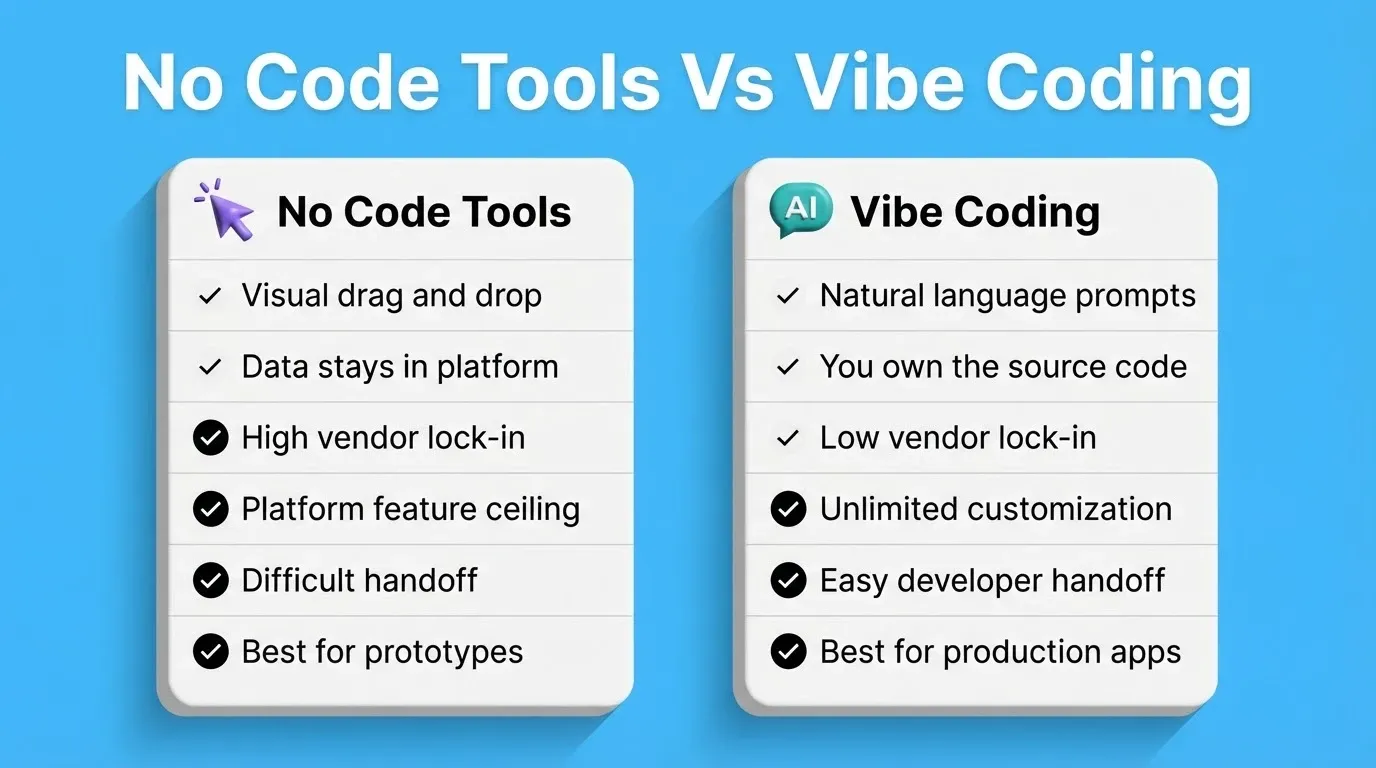
| How you build | Drag and drop visual interface | Natural language prompts |
| What you own | Your data inside the platform | Actual source code you can export |
| Vendor lock-in | High | Low |
| Customization ceiling | Limited to platform features | Unlimited (it is real code) |
| Developer handoff | Difficult | Easy |
| Best for | Simple internal tools, prototypes | Production apps with real users |
Why Rocket Is Built For App Building Without Backend Experience
The biggest problem with most no code app builders is that they hide the backend behind a visual layer, but you still need to configure it yourself. You drag a database block onto a canvas, manually set up table relationships, and spend hours figuring out why your API keys are not connecting to the right service.
Rocket skips that entire step. You describe what you want your app to do in plain language, and the backend gets built for you. A real, production-grade backend with Supabase powers your database, user authentication, and row-level security.
Here is what that looks like for someone without backend experience:
-
You type something like "I need a task tracker where teams can assign work, set due dates, and get notifications." Rocket generates the full stack app with the frontend, backend logic, and database schema already connected.
-
The generated code runs on Next.js for web and Flutter for native mobile apps. That means your app can ship to the Apple App Store, Android app stores, and the web from a single project.
-
You own every line of generated code. There is no vendor lock-in. If you want to hire a developer later to add features, they can pick up right where Rocket left off.
-
Every app ships with SEO-ready structure, WCAG accessibility compliance, and GDPR coverage built in by default.
Where other no code platforms stop at simple apps or landing pages, Rocket builds the kind of full stack app that would normally require dedicated developers and weeks of backend setup. 1.5 million people have tried Rocket across 180 countries.
Watch this walkthrough to see how Rocket handles the backend for both web and mobile from the same project:
What Rocket Generates Under The Hood
When you describe an app in Rocket, here is what gets created automatically:
-
Frontend: Next.js (web) or Flutter (mobile) with real design systems, dark/light theming, and responsive layouts.
-
Backend: Server-side logic, API routes, and business rules.
-
Database: Supabase PostgreSQL schema with proper table relationships and row-level security.
-
Authentication: Email/password, social login, and magic links via Supabase Auth.
-
Integrations: 25+ services including Stripe, Google Analytics, Mailchimp, and OpenAI connect with a single prompt.
-
Deployment: Staging and production environments with one-click launch and full version history.
Read Further: Best AI App Builder For Non Developers
Steps To Build Your First Working App
Getting from an idea to a working app does not need to be complicated. The general steps stay consistent for non developers regardless of which tool you choose.
-
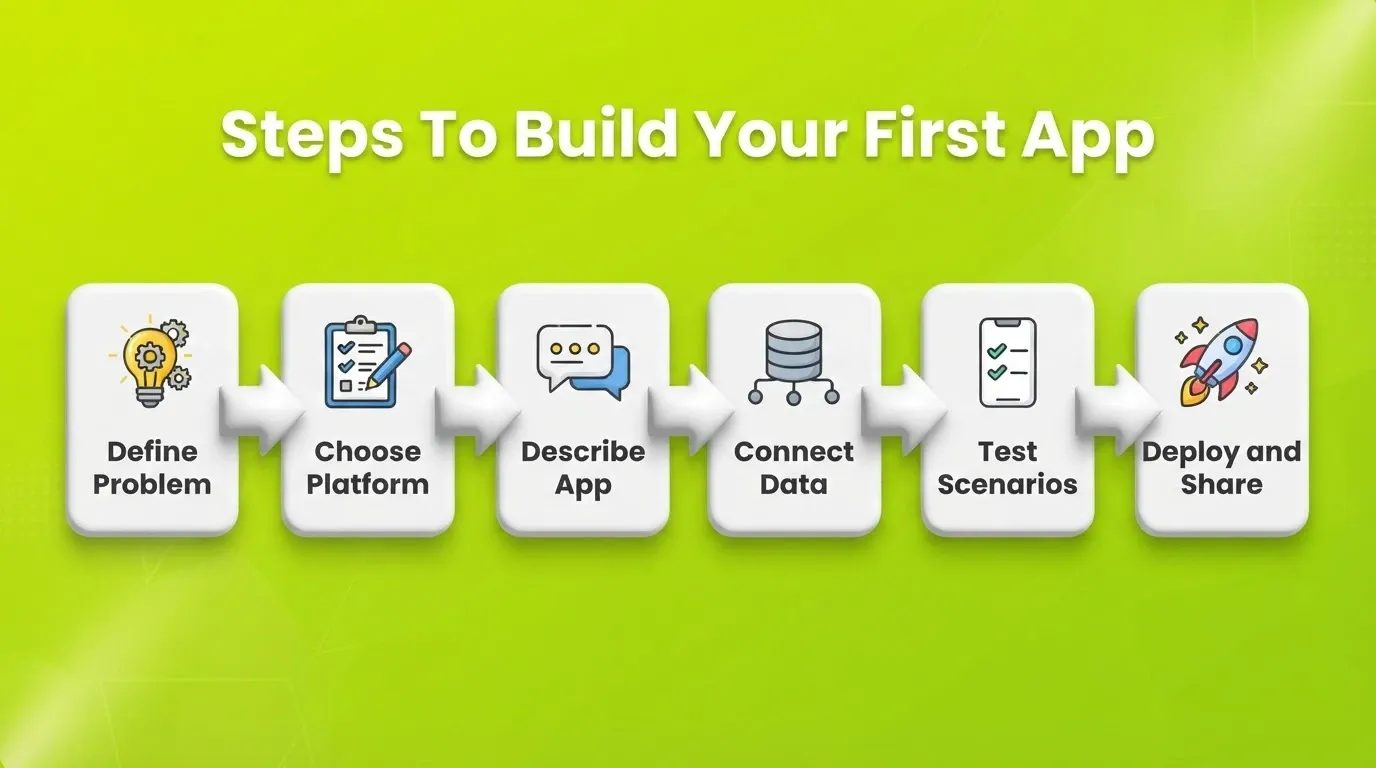
Start with a clear problem. Write down what your app needs to do in one or two sentences. A personal project like a task tracker or a budget manager is a great starting point.
-
Pick your platform. Based on your coding experience and goals, choose a tool. If you want a basic prototype quickly, visual builders work fine. For a full stack app with real users, pick a platform that handles backend setup automatically.
-
Describe or design your app. Type a prompt or sketch a wireframe. The best tools generate the user interface, database, and backend logic from this starting point.
-
Connect your data. Add your data sources, define fields, and set up relationships. User accounts and profiles get configured through these auto-generated systems.
-
Test with real scenarios. Open the app on mobile and desktop. Submit forms, trigger notifications, and test edge cases. Catch issues before your first app reaches real users.
-
Deploy and share. Push your app live. Collect feedback from real users and iterate based on what you learn.
For a complete walkthrough for building without code, this step-by-step resource covers each stage in more depth.
Mistakes That Trip Up First-Time Builders
Most tools let you build something in minutes. But shipping something that actually works well for real users takes a bit more thought.
Here are the patterns that trip up first-time builders:
-
Skipping the planning phase. Jumping straight into a platform without defining what your app needs to do is a bad idea. A quick outline saves hours of rework down the road.
-
Choosing a tool based on hype alone. What the tool depends on matters more than what it promises. A platform that works great for simple apps might fall apart when you need advanced API connections or complex backend logic.
-
Ignoring data structure. Not taking time to understand how tables relate to each other, how block logic controls app behavior, or how API keys connect services leads to fragile apps.
-
Trying to build everything at once. Start small. Get one core feature working before adding notifications, payments, or user roles.
-
Not testing with real scenarios. If your app looks great but crashes when users create accounts or submit forms, it is not ready. Most tools offer preview modes, so use them.
-
Ignoring security from the start. Even simple apps handle user data. Choose platforms that provide row-level security, encrypted connections, and proper authentication by default.
When the platform work is solid and your planning is clear, the entire process gets easier each time you ship something. New skills build on top of each other, and you understand concepts faster with each new project.
How To Choose The Right Tool For Your Situation
Not every app builder is right for every project. Here is a practical decision framework:
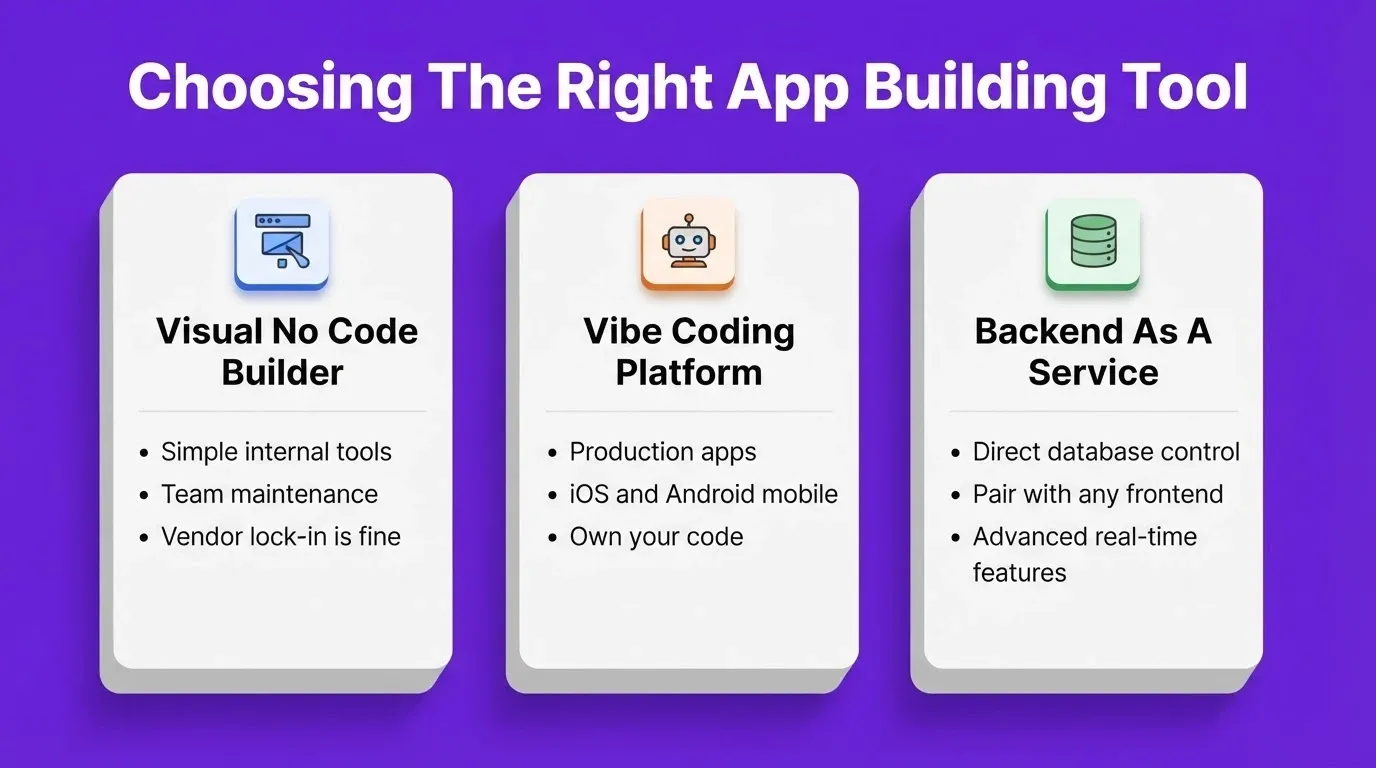
Choose a visual no code builder if:
-
You need a simple internal tool or dashboard fast.
-
Your team will maintain it without developer help.
-
Vendor lock-in is acceptable for your use case.
Choose a vibe coding platform if:
-
You want a production-ready app with real users.
-
You need mobile apps for iOS and Android.
-
You want to own your code and avoid vendor lock-in.
-
You plan to hire developers later to extend the app.
Choose a backend-as-a-service platform if:
-
You have some technical knowledge and want direct database control.
-
You are pairing it with a frontend framework or another builder.
-
You need advanced database features like real-time subscriptions or edge functions.
Read Further: How To Build Apps Without Coding: A Complete Guide
Building An App Without Backend Experience: The Path Forward
The barrier of building an app without backend experience is gone. No code platforms, vibe coding, and AI-powered app builders give you real paths to create working software, regardless of your technical background.
As AI tools continue to evolve, the gap between idea and shipped product will keep shrinking. The builders who move now, learn the tools, and ship real products will have a significant advantage as these platforms become even more capable.
You describe the problem. Rocket researches it, generates the full stack, and deploys it. Web apps, mobile apps, internal tools, production-grade from the first generation. Start building on Rocket.new and ship your first app today.
Table of contents
- -Why Does The Backend Feel Like A Wall?
- -What Does The Backend Actually Do?
- -Can Non Developers Build A Full Stack App Today?
- -Which No Code App Builders Handle Backend Logic?
- -How Does Vibe Coding Change The Game For First-Time Builders?
- -Vibe Coding Vs No Code: Key Differences
- -Why Rocket Is Built For App Building Without Backend Experience
- -What Rocket Generates Under The Hood
- -Steps To Build Your First Working App
- -Mistakes That Trip Up First-Time Builders
- -How To Choose The Right Tool For Your Situation
- -Building An App Without Backend Experience: The Path Forward