Most Figma files never ship as intended. Design handoff costs teams weeks of rework, miscommunication, and lost intent. The fix is not a better process. It is removing the process entirely.
Is the design-to-development handoff still broken?
Yes. And the numbers confirm it.
According to Figma's 2025 State of the Designer report, 91% of developers say design handoff processes need improvement. That is not a workflow problem. It is a structural gap between two mediums that do not speak the same language.
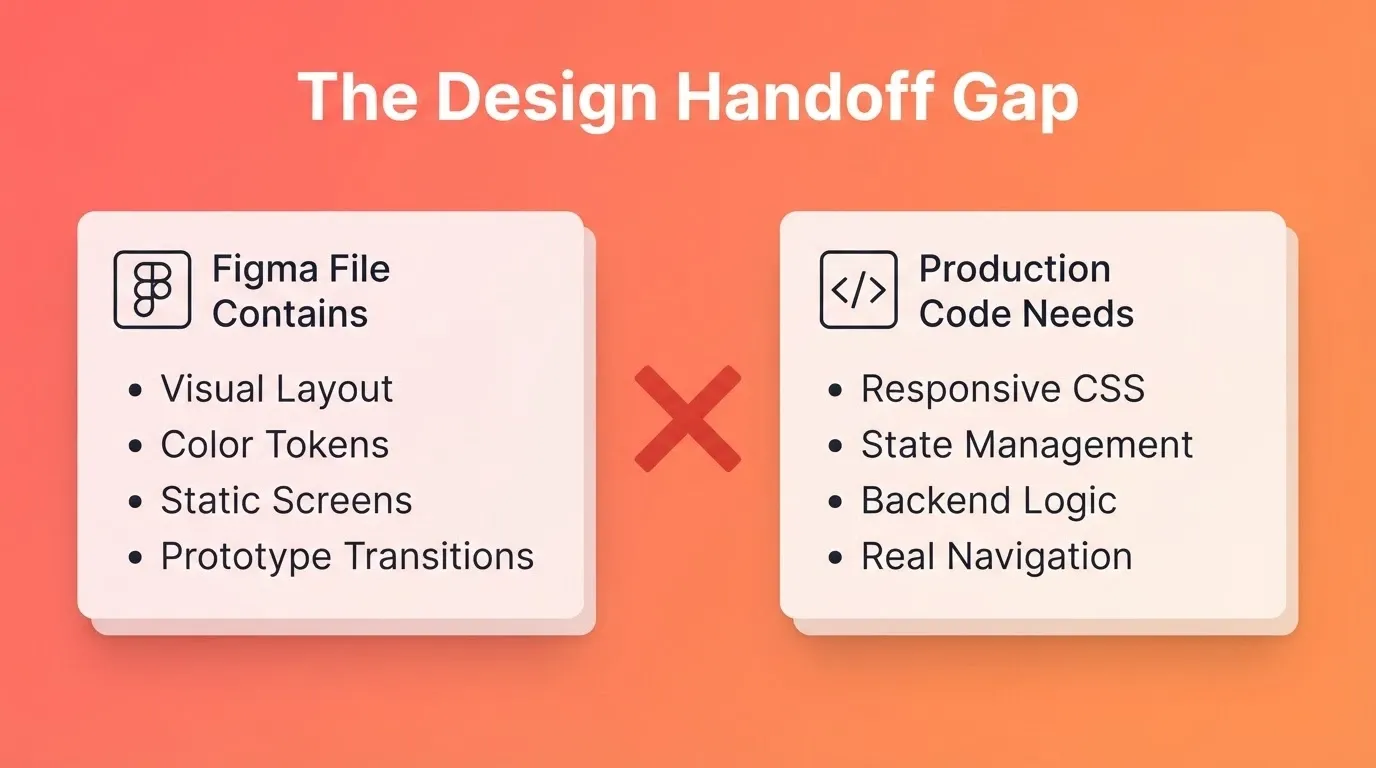
Figma files carry visual intent. Production code needs behavioral logic, responsive rules, state management, error handling, and backend connectivity. None of those exist in a Figma file. Every one of them gets invented by the developer, and every invention is a place where design intent gets lost.
This blog breaks down what actually happens between "the design is done" and "the app is live," why the standard fixes fall short, and how teams are closing that gap today.
What is Design Handoff, and Why Does It Keep Breaking?
Design handoff is the process of transferring a completed design to a development team so it can be built into a working product. In theory, it is a simple transfer of information. In practice, it is one of the most expensive friction points in any product team.
The handoff breaks because Figma and production code speak different languages. Figma captures what something should look like. Code has to define what it does, how it responds, and what happens when things go wrong.
The translation step between those two things is where weeks disappear.
For a full look at how this workflow plays out end-to-end, see Figma to Live App: How to Turn Designs into Functional Apps with AI.
The Eight Steps Nobody Budgets For
Here is what actually happens between "the design is done" and "the app is live." Most teams skip this in planning, but it is where the real cost hides.
-
The designer prepares specs, screenshots, and redlines from the Figma file
-
The dev team interprets the Figma designs and creates development tickets
-
Frontend developers write code to match the visual layout
-
Backend developers build data models, authentication, and API logic separately
-
QA reviews the build against the original Figma file
-
Designers review the build and send back feedback
-
Developers iterate and adjust based on that review
-
The cycle repeats until both sides agree the output is ready to ship
Manual handoff processes take 3 to 5 times longer than automated workflows. And 30 to 40 percent of development rework traces back to ambiguous or missing design specs.
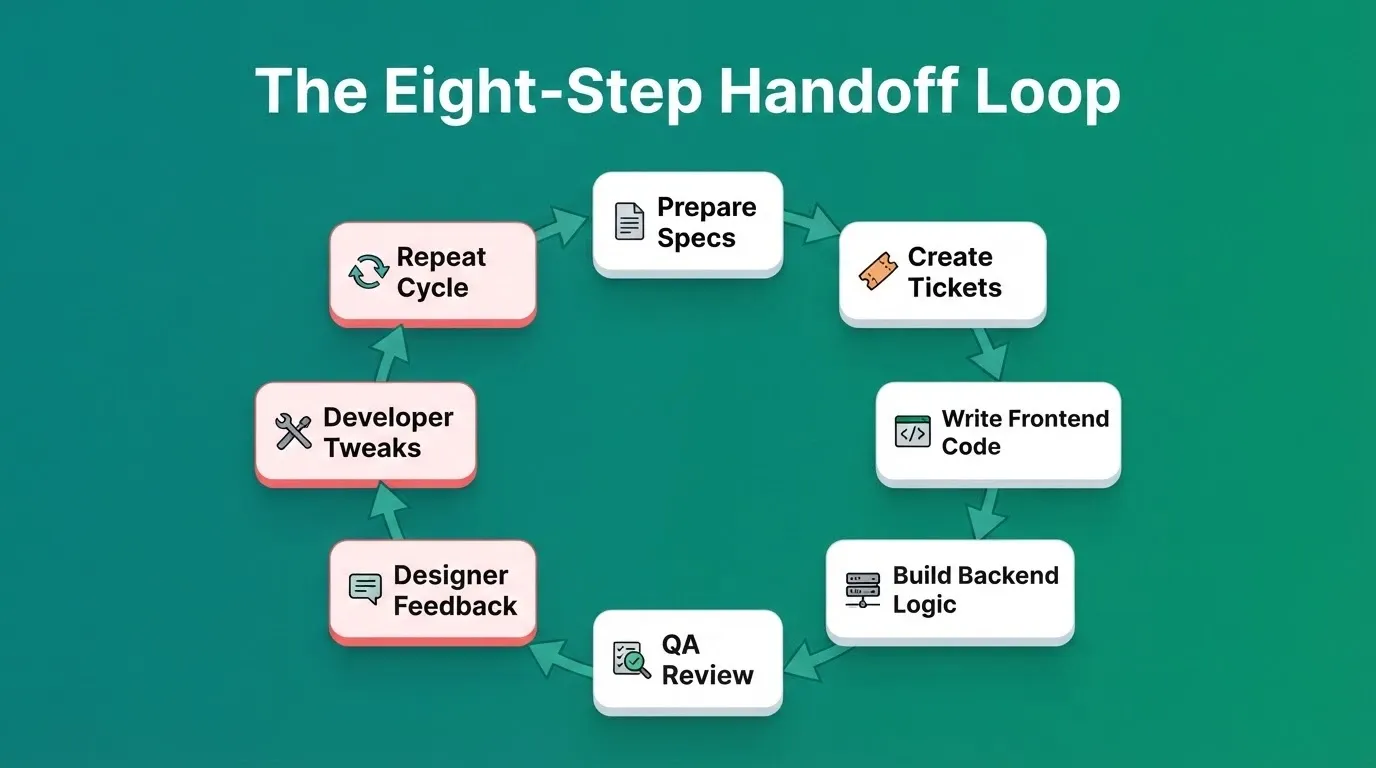
Here is what that loop looks like mapped out:
The traditional design-to-production loop. The red feedback cycle is where most projects lose weeks.
That red loop between feedback and QA is where most projects lose weeks. The Figma file has not changed, but the interpretation of it keeps shifting.
What Figma Files Actually Carry (And What They Don't)
This is the root of the problem. Figma is a strong design tool. It was never built to carry the full weight of production.
| What Figma Files Contain | What Production Code Needs |
|---|---|
| Visual layout and spacing | Responsive CSS and layout logic |
| Static screens | State management and interactions |
| Color and typography tokens | Design system tokens mapped to code |
| Figma components and variants | Reusable coded components |
| Prototype transitions | Real navigation and routing |
| Pixel-perfect mockups | Error handling and edge cases |
| Design intent | Backend logic, auth, and API calls |
Every row in that table is a translation step. Every translation step is a place where design intent gets lost and rework begins.
According to Figma's 2025 State of the Designer report, 84% of designers collaborate with developers at least weekly. Yet 52% of developers cite "differences in assumptions" as the top challenge. When collaboration is that frequent but friction stays that high, the tools in between are not doing enough.
How Do Figma Plugins Try to Fix This?
Figma plugins like Anima, Locofy, and TeleportHQ read your Figma components, auto layout settings, and frame structure. They then convert Figma designs into HTML, React, or React Native code.
Sounds like a fix. In practice, it is closer to a shortcut that creates more work later.
-
Hardcoded values instead of design tokens
-
No responsive logic for mobile, tablet, or varied screen sizes
-
Missing state management for forms, modals, and interactions
-
No backend connectivity for database, authentication, or API calls
-
Framework lock-in that makes switching between React, Vue, Angular, or Flutter painful
As one developer noted: "Design intent degrades not during handoff but before it, in real time, as non-designers with good intentions and write access make micro-decisions that collectively erode the design." (Workpage.dev, March 2026)
The codebase from a typical Figma plugin export requires a dev team to rebuild most of the app from scratch. That is not code generation. That is a screenshot with extra steps.
Three Approaches Compared
Not all design-to-code paths deliver the same result. Here is how the main approaches stack up:
| Approach | Time to Working App | Design Fidelity | Backend Logic | Responsive | Deployment |
|---|---|---|---|---|---|
| Traditional handoff | 2 to 8 weeks | High (if reviewed) | Manual build | Manual | Manual |
| Figma plugins (Anima, Locofy) | 1 to 3 days | Medium | None | Partial | Manual |
| AI app builder with Figma import | Minutes | High | Auto-generated | Built-in | One-click |
For a deeper look at how AI tools compare on output quality and framework support, see Build Apps from Figma with AI: Convert Designs into Apps.
Before You Import: Preparing Your Figma File
The quality of your Figma file directly affects the quality of the generated code. A well-organized file produces significantly better output than a flat, ungrouped one.
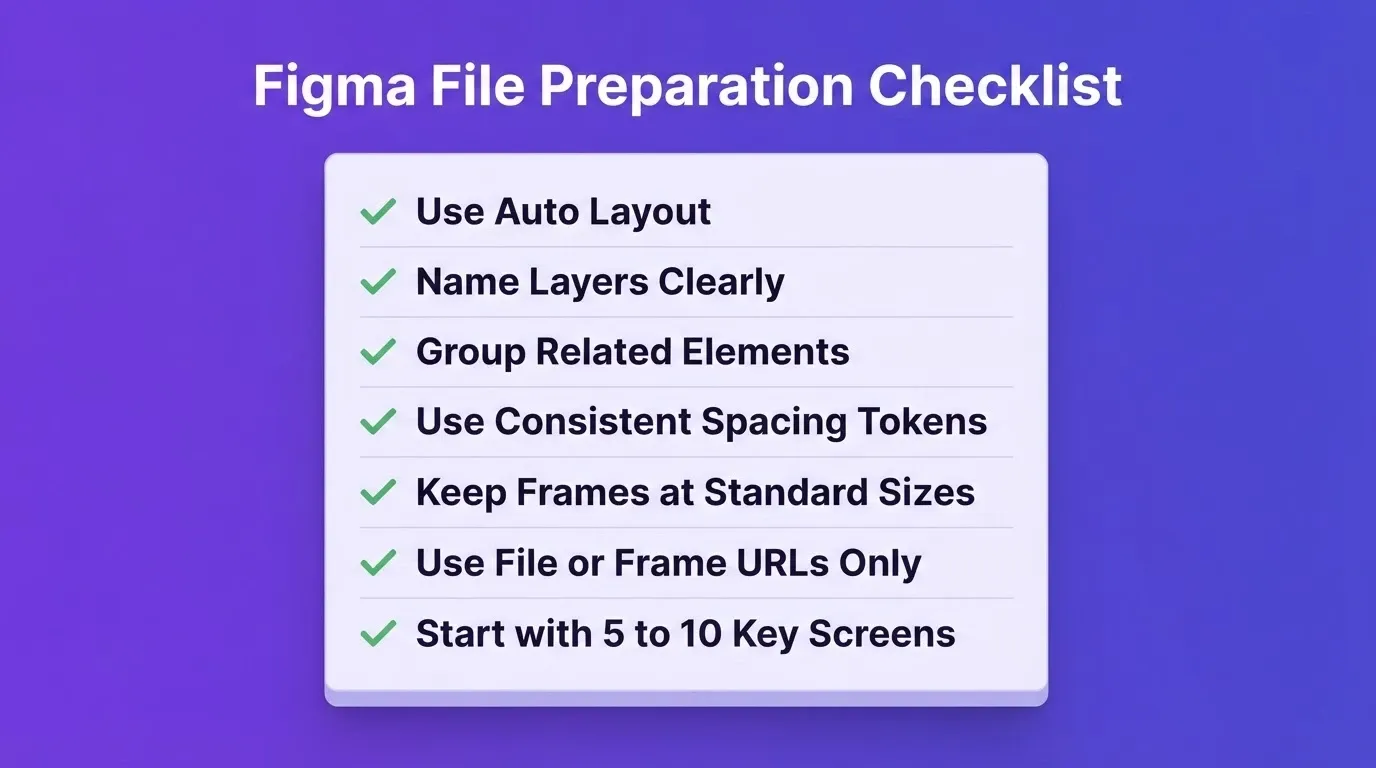
Checklist before importing:
-
Use auto layout throughout. It maps directly to responsive CSS and Flutter layouts.
-
Name your layers clearly. Descriptive names produce cleaner component identifiers in code.
-
Group related elements. Ungrouped or flattened elements may need manual cleanup after import.
-
Use consistent spacing tokens. Figma spacing values carry over to the generated design system.
-
Keep frames at standard sizes. Mobile frames should be between 200px and 800px wide.
-
Use file or frame URLs only. Prototype links are not supported for import.
-
Start with your 5 to 10 most important screens. Import incrementally, not all at once.
What If the Handoff Just Disappeared?
This is where the loop breaks.
Rocket reads your Figma file through its native Figma connector, connected via OAuth with no API key needed. It interprets the design system and generates a production-grade app with real code, real routing, and real backend logic. No spec documents. No ticket creation. No back-and-forth.
-
Typography, spacing, visual hierarchy, and color system carry over directly from the Figma file
-
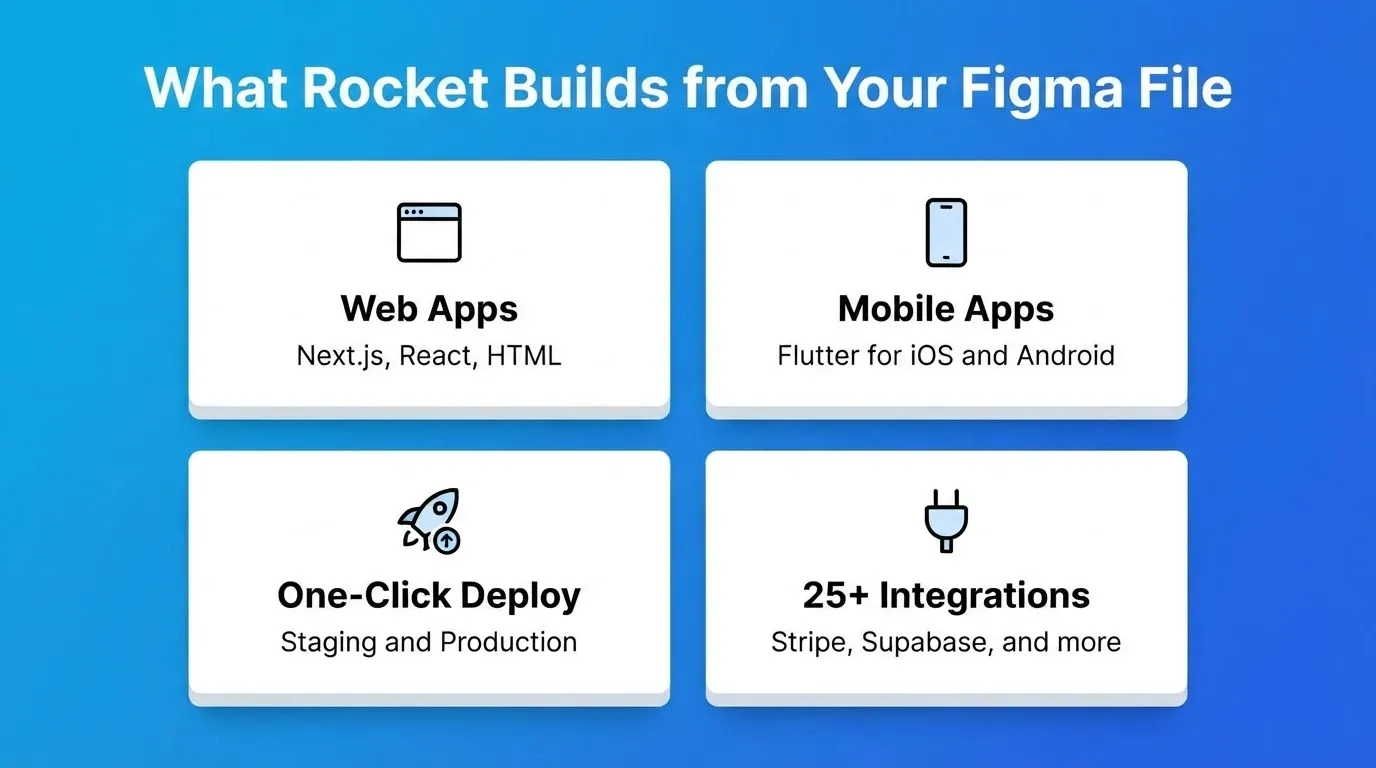
Rocket generates Next.js for web apps and Flutter for iOS and Android mobile apps
-
You can import up to 40 screens at a time and add more incrementally
-
Every build ships with SEO-ready structure, WCAG accessibility compliance, and GDPR coverage by default
-
After the first generation, refine through natural language chat, visual editing, or direct code access
The designer's file does not need to be translated. It becomes the source of truth the app is built from.
How Rocket Handles the Mobile App Case
For mobile, Rocket generates a complete Flutter app for iOS and Android. It is not a web wrapper. During import, you choose your state management approach based on your app's complexity:
| State Management | Best For |
|---|---|
| BLoC | Apps with complex data flows |
| GetX | Lightweight, fast builds |
| Provider | Simple and reliable for most apps |
| Riverpod | Flexible, scales well |
| None | Basic apps or prototypes |
Once generated, the Flutter app is ready for App Store and Google Play submission. Rocket generates a signed AAB bundle for Google Play or a build for App Store Connect.
How to Import a Figma Design into Rocket
Once your file is ready, the import takes minutes. Here is the step-by-step process:
-
Connect Figma. Click the
+button at the lower left of the chat input. Select "Add from Figma" and authorize via OAuth. Connect once and it is available across all tasks. -
Paste your Figma link. Copy the frame or file URL from Figma using Share, then Copy link. Paste it into the import dialog.
-
Select your frames. Choose up to 40 screens. Already-imported screens are marked so you can track progress.
-
Choose your tech stack. For web apps, pick Next.js, HTML, or React. For mobile, pick Flutter with your chosen state management.
-
Rocket generates your app. Rocket fetches assets, optimizes layers, and generates structured, readable code screen by screen. All status checks turn green when ready.
-
Review and compare. Use the Preview tab to see the generated app. Click the Figma icon in the top-right navbar to open your original design alongside the preview for a side-by-side comparison.
-
Refine in chat. Describe any differences and Rocket corrects them in plain language.
What Happens After the Import
Generating the app is the beginning, not the end. Here is what teams typically do after the first generation:
| Goal | What to Say in Rocket |
|---|---|
| Add interactivity | "Make the navigation links functional and add smooth page transitions." |
| Connect a database | "Connect Supabase and store form submissions in a contacts table." |
| Add authentication | "Add login and signup pages with email/password auth via Supabase." |
| Improve responsiveness | "Make the layout fully responsive. Stack the sidebar below the content on mobile." |
| Fix visual differences | "The hero section font size does not match my Figma design. Make it 48px bold." |
| Add dark mode | "Add a dark mode toggle that switches all colors to a dark theme." |
| Add payments | Connect Stripe directly. Rocket builds it into the existing codebase with full context. |
| Deploy to production | Click Launch to get a live URL instantly. Connect a custom domain or buy one through Rocket. |
Rocket connects to 25+ integrations including Stripe, Supabase, Google Analytics, Mailchimp, Mixpanel, Airtable, Notion, Linear, and more. Authenticate once and they flow into every build.
Every project includes full version history and one-click rollback. You can iterate freely without risk. Nothing built is ever gone.
For teams building data-driven products, see Figma to Database: How AI Can Turn UI Designs into Schemas to understand how your UI maps to a backend schema.
This 20-minute walkthrough shows the full workflow from Figma import to a deployed web and mobile app:
The Gap Between Design and Deployment Is Closing
The distance between a finished Figma file and a shipped product has compressed from weeks to minutes. The teams moving fastest are the ones who stopped treating design and development as separate phases.
1.5 million people have tried Rocket across 180 countries. You have the Figma file. The next step is the build.
For a full breakdown of what separates Figma-to-code platforms on output quality, framework support, and deployment, see Best Figma-to-Code AI Tools Compared.
This starter guide covers the basics in under 4 minutes:
From Figma Design to Working App, Without the Wait
The journey from Figma design to working app does not have to cost your team weeks of rework. Every layer of manual translation between design and code adds time, introduces errors, and erodes the original intent.
The tools that close this gap are not just faster. They are structurally different. They read your design system, generate production-grade code, and deploy without requiring a developer handoff at every step.
As AI code generation matures, first-generation output quality will keep improving. Teams that build this workflow now will ship faster, iterate more, and spend less time on translation.
Import your Figma file into Rocket.new and go from design to deployed app today.
Table of contents
- -What is Design Handoff, and Why Does It Keep Breaking?
- -The Eight Steps Nobody Budgets For
- -What Figma Files Actually Carry (And What They Don't)
- -How Do Figma Plugins Try to Fix This?
- -Three Approaches Compared
- -Before You Import: Preparing Your Figma File
- -What If the Handoff Just Disappeared?
- -How Rocket Handles the Mobile App Case
- -How to Import a Figma Design into Rocket
- -What Happens After the Import
- -The Gap Between Design and Deployment Is Closing
- -From Figma Design to Working App, Without the Wait