
Rocket.new, Claude Code, and Cursor serve different stages of development. This blog breaks down their pricing, features, and core differences to help you choose the right AI development platform.
Which AI development tool actually fits your workflow: Rocket.new, Claude Code, or Cursor?
The AI code tools market reached $9.35 billion in 2026, growing at 26.23% CAGR, according to Mordor Intelligence.
Three platforms define the space right now, each built around a different philosophy. One takes you from research to deployed product, one edits existing codebases from the terminal, and one accelerates coding inside an IDE. Your choice depends on where your work actually starts.
What are These Three AI Development Tools?
Before comparing pricing and features, it helps to understand what category each tool belongs to. Rocket, Claude Code, and Cursor solve fundamentally different problems. Comparing them on the same axis misses the point.
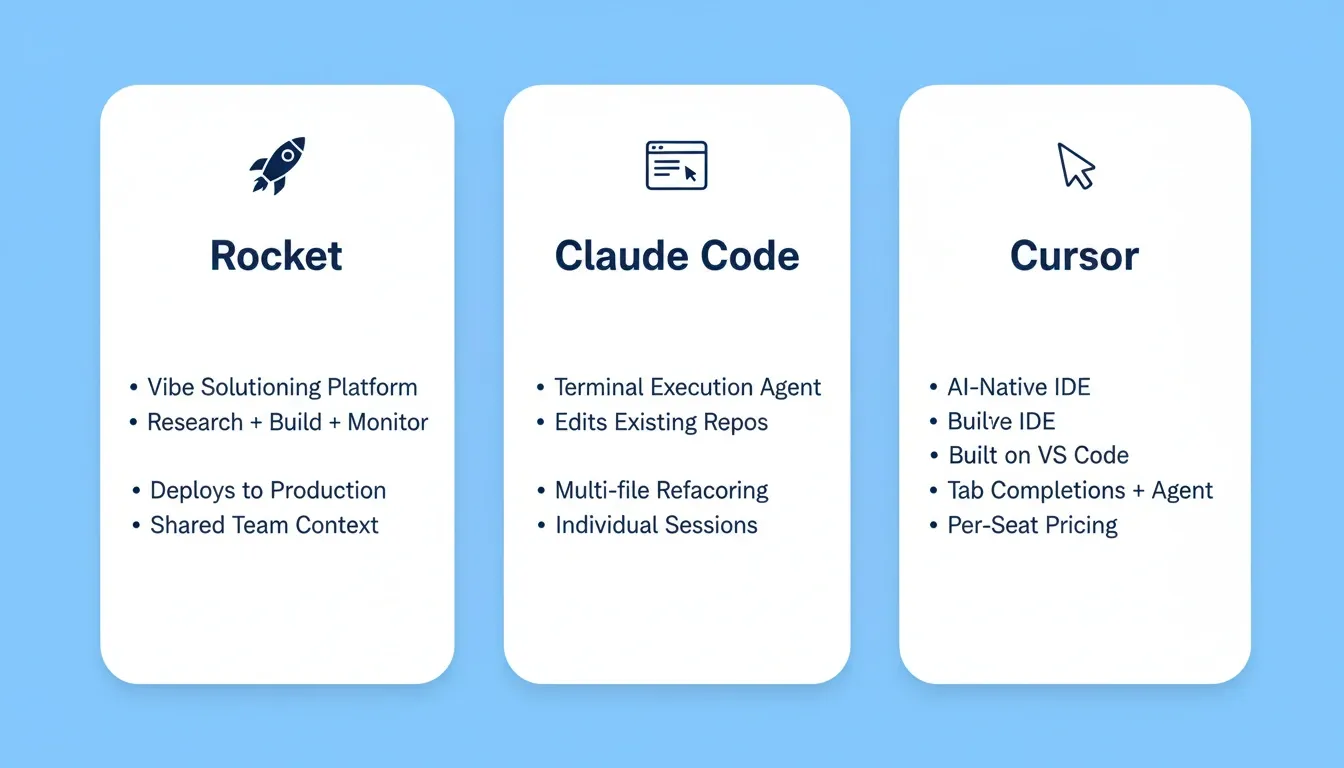
Rocket is a Vibe Solutioning platform, the first platform that combines strategic research (Solve), AI app building (Build), and competitive intelligence (Intelligence) into a single product with shared context. You describe what you need in plain language. Rocket then researches your market, designs the UX, generates production-ready code, and deploys it, all in one workflow. Web apps ship in Next.js; mobile apps in Flutter. 1.5 million people have tried Rocket across 180 countries, and Salesforce Ventures and Accel back it.
Claude Code is a terminal-based AI execution agent built by Anthropic. It reads your existing codebase, understands dependencies, and makes multi-file edits across your repository. It is not only a coding tool. Sales teams use it for prospecting workflows, PMs use it for PRDs, and marketers use it for content pipelines. However, it does not research whether your direction is right before you start. Every session is also individual, with no shared team memory.
Cursor is an AI-native IDE built on VS Code. It adds intelligent tab completions, agent mode for multi-step tasks, and cloud agents for background work. It is excellent at coding, and Rocket does not position itself as a better coding tool. Cursor serves the moment during the build. Rocket serves everything before, around, and through it.
Platform Category Comparison
| Dimension | Rocket | Claude Code | Cursor |
|---|---|---|---|
| Category | Vibe Solutioning platform | Terminal execution agent | AI-native IDE |
| Primary output | Deployed web/mobile apps | Code edits in existing repos | Code in AI-enhanced IDE |
| Input method | Natural language prompt | Terminal commands | IDE with chat panel |
| Deployment included | Yes, staging and production | No | No |
| Backend generation | Supabase, auth, APIs auto-wired | No (edits existing backends) | No |
| Hosting | Built-in with custom domains | Not applicable | Not applicable |
| Framework | Next.js (web), Flutter (mobile) | Any (works with existing code) | Any (IDE agnostic) |
| Pre-build intelligence | Yes, Solve research layer | No | No |
| Shared team memory | Yes, cross-task context | No, sessions are individual | No |
| Team collaboration | Shared workspaces, 3-level roles, per-user credit caps | GitHub integration | Team marketplace, shared rules |
| Integrations | 27 (Stripe, Supabase, Figma, OpenAI, Anthropic, and more) | MCP servers, CLI tools | MCPs, skills, hooks |
| Analytics built-in | Yes, visitors and Core Web Vitals | No | No |
| SEO/WCAG/GDPR by default | Yes, shipped as baseline | No | No |
| Code ownership | Full source download and GitHub sync | Your code stays local | Your code stays local |
How Does Rocket's Three-Pillar Architecture Work?
Understanding Rocket requires understanding its three pillars. No other platform in this comparison has anything like this architecture.
Pillar 1: Solve — Strategic Research Before You Build
Solve is Rocket's research engine. Before you write a single line of code, Solve validates your idea, sizes your market, runs competitive analysis, and answers complex business questions. Type any question in plain language and get back a structured, evidence-backed report built from live data, not a chatbot summary.
Every Solve task follows a clear pipeline. You ask a question, Solve decomposes it into parallel research streams, independent agents run simultaneously, and findings synthesize into a structured report. The report includes an executive summary, supporting evidence, and actionable recommendations. Solve covers nine intelligence types: market analysis, competitive teardowns, pricing strategy, product direction, investment analysis, GTM strategy, brand positioning, technical deep-dives, and more.
Neither Claude Code nor Cursor has anything equivalent. You bring your own research to both tools. Rocket generates it for you, inside the same platform where you build.
Pillar 2: Build — Production-Grade App Generation
Build is the AI app builder. Describe what you want and Rocket generates a fully functional app with UI, navigation, logic, and production-ready code. Most apps generate in 1 to 3 minutes.
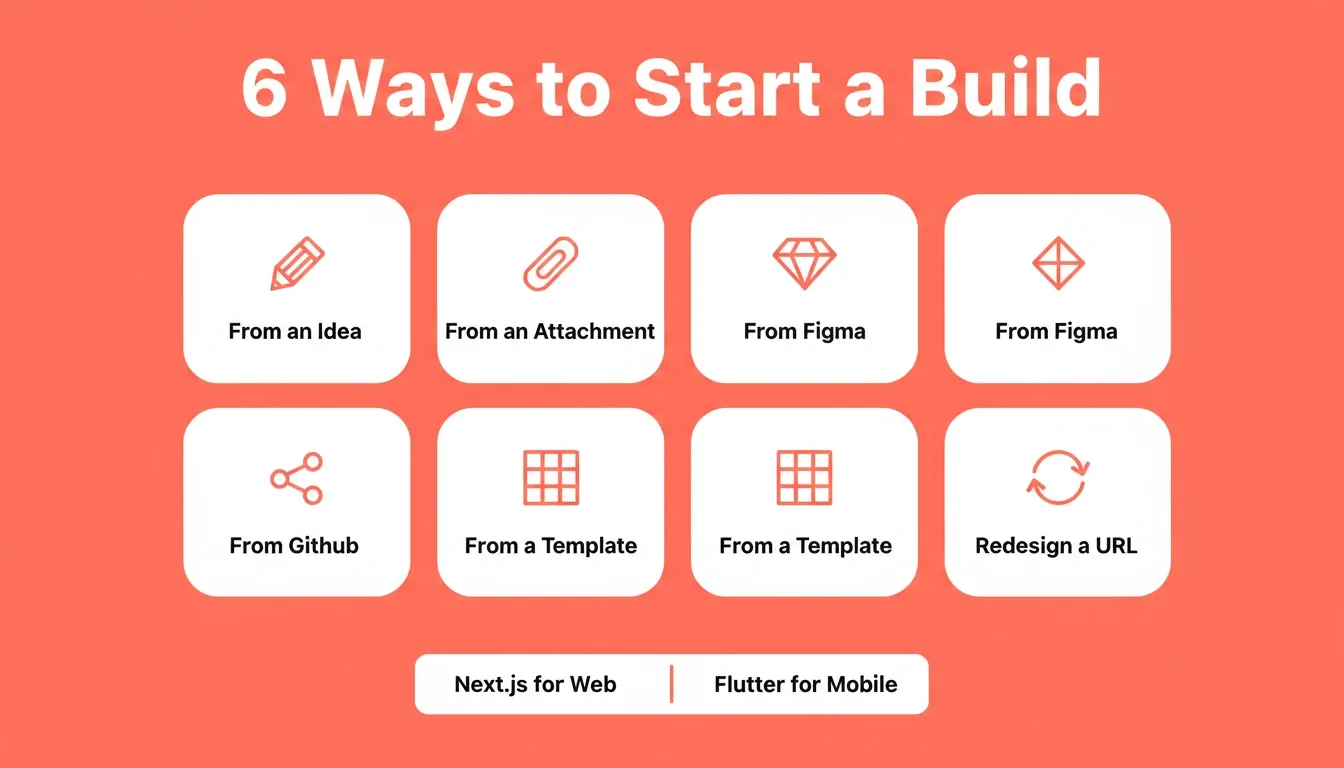
Six ways to start a build:
-
From an idea: plain language prompt; Rocket scores clarity and starts immediately or asks targeted questions
-
From an attachment: upload a screenshot, wireframe, PDF, spreadsheet, or CSV
-
From Figma: import a Figma design; Rocket converts it to working code, preserving typography, spacing, and color system
-
From GitHub: import an existing Next.js TypeScript repository and continue building with two-way sync
-
From a template: zero credits to start; browse by category (SaaS, landing page, e-commerce, and more)
-
Redesign: provide any live URL and Rocket reimagines the site using eight slash commands across three categories
Every build ships with SEO-ready structure, WCAG 2.1 AA accessibility compliance, GDPR and CCPA coverage, and performance optimization as the default baseline. After you ship, you get staging and production environments, full version history, one-click rollback, and built-in analytics tracking visitors, conversions, and Core Web Vitals.
Pillar 3: Intelligence — Continuous Competitor Monitoring
Intelligence monitors every public platform a competitor operates on, continuously, and interprets what signals mean for your business. Set it up once. It then delivers automated daily briefs, pricing change alerts, hiring spike signals, and trend alerts to a live dashboard in your sidebar.
Solve answers a question once. Intelligence watches for changes over time. The two work together: a Solve report can scope what you monitor, and Intelligence signals can trigger new Solve questions. Claude Code and Cursor have no equivalent monitoring capability.
Which Tool Fits Your Budget?
Pricing is where these platforms diverge most dramatically. Each uses a completely different model. What looks affordable at first can scale painfully as your team grows.
Rocket: Credit-Based, No Per-Seat Fees
Rocket uses a credit-based pricing model. One credit balance covers everything: Solve research, Build generation, and Intelligence monitoring. There is no separate billing for compute, storage, or hosting. All plans include unlimited team members, so adding collaborators never increases your bill.
Visit the Rocket pricing page for the full breakdown of plans and credit add-ons.
| Plan | Monthly Cost | Credits Included |
|---|---|---|
| Free | $0 | 20 one-time credits |
| Build | $25/month | 100 credits/month |
| Solve + Build | $50/month | 250 credits/month |
| Full Suite | $250/month | 1,500 credits/month |
| Intelligence add-on | $100/month per competitor | 500 credits/month per competitor |
Key credit mechanics: Unused credits roll over indefinitely on monthly plans. Credit add-ons are available separately and do not expire while your subscription is active. Per-user credit caps let you control consumption without restricting access.
Claude Code: Per-Subscription, Individual Sessions
Claude Code bundles with Anthropic's Claude subscriptions. Each developer needs their own plan. There is no shared team pool for individual plans.
| Plan | Monthly Cost | Notes |
|---|---|---|
| Pro | $20/month | Limited coding sprints |
| Max 5x | $100/month | Higher usage limits |
| Max 20x | $200/month | Power users |
| Team/Enterprise | Custom | Premium seats, shared billing |
Cursor: Per-Seat, Scales with Headcount
Cursor charges per user. Every new team member adds to your monthly bill.
| Plan | Monthly Cost | Notes |
|---|---|---|
| Hobby | $0 | Limited requests |
| Pro | $20/user/month | Full AI features |
| Teams | $40/user/month | Shared rules, marketplace |
| Enterprise | Custom | SSO, advanced controls |
True Cost at Team Scale
The AI code tools market is projected to hit $91.09 billion by 2035 at a 27.65% CAGR, according to Precedence Research. As AI development tools become standard, the pricing model you choose compounds over time.
| Team Size | Rocket | Claude Code | Cursor (Teams) |
|---|---|---|---|
| Solo developer | $25/month | $20/month | $20/month |
| Team of 5 | $50/month (flat) | $100/month | $200/month |
| Team of 10 | $50/month (flat) | $200/month | $400/month |
| Team of 20 | $50/month (flat) | $400/month | $800/month |
| Adding a designer | $0 extra | $20 extra/month | $40 extra/month |
With Rocket, adding ten designers, five developers, and three stakeholders keeps your monthly cost identical. Credits determine how much you build, not how many people collaborate. With Cursor, a 20-person engineering team pays $800/month before any usage-based charges. With Claude Code, each developer needs their own Max plan, since there is no shared team pool on individual plans.
What Can You Build — and How Fast?
Speed means different things for each platform. The real question is: how quickly do you go from an idea to something a user can interact with?
Rocket: From Prompt to Live URL in Minutes
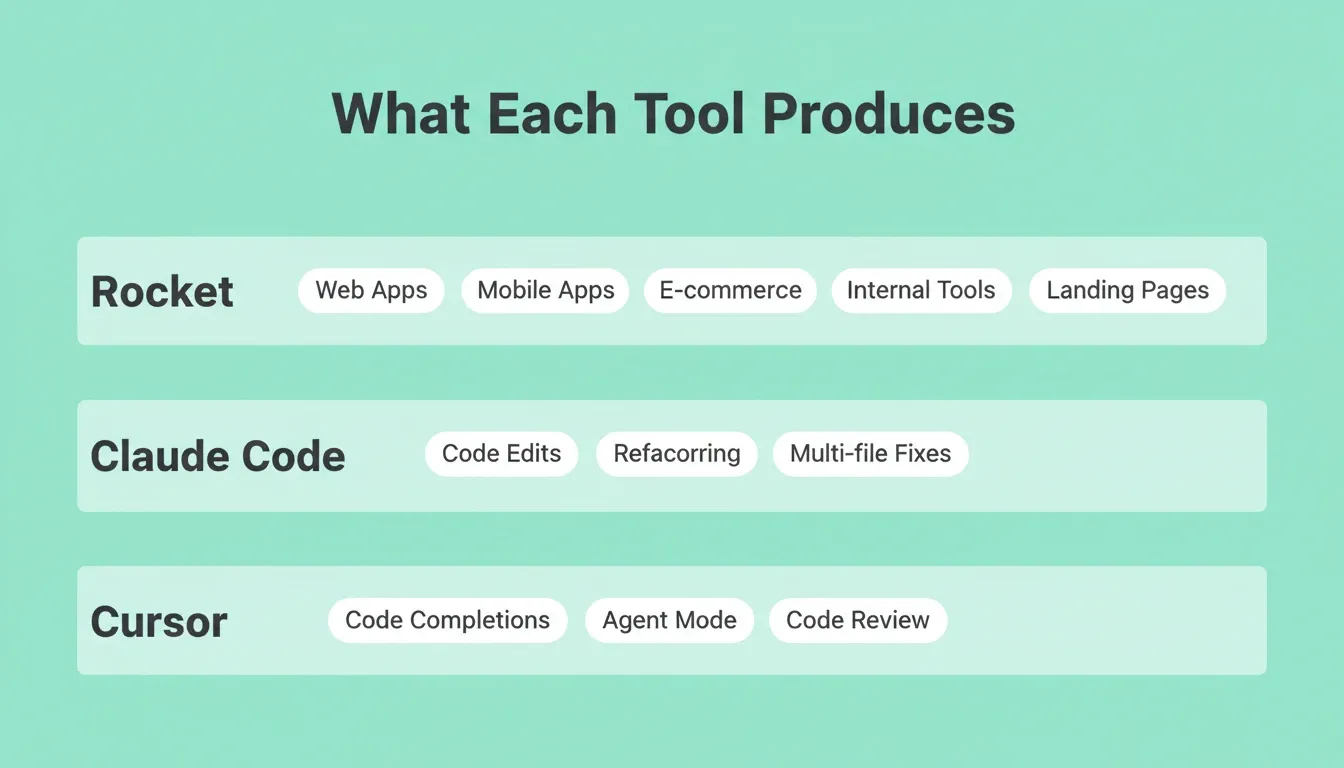
Rocket ships a deployed app from a single prompt in minutes. It handles frontend, backend, database schema, authentication, and hosting in one generation cycle. There is no context switching between tools. Explore the full range of what you can build with Rocket's AI app builder:
-
Web apps: SaaS dashboards, internal tools, marketplaces, AI-powered tools, customer portals
-
Mobile apps: iOS and Android apps built with Flutter, submitted directly to the App Store and Google Play
-
Landing pages: marketing sites, portfolio pages, and product launch pages with custom domains
-
E-commerce: full online stores with product listings, cart, checkout, and payment integrations
-
Internal tools: OKR trackers, customer health monitors, GDPR compliance dashboards, investor data rooms
-
Redesigns: transform any existing website using eight slash commands across three categories
Claude Code: Fast Within Existing Codebases
Claude Code works fast within existing codebases. It can refactor entire modules, write tests, and fix bugs across multiple files simultaneously. The dynamic workflows feature (running parallel subagents) launched in May 2026 and became popular for complex refactoring tasks. It does not create new projects from scratch with deployment, handle hosting, or provide a pre-build intelligence layer.
Cursor: Accelerated Coding Speed
Cursor accelerates coding speed through intelligent completions and agent mode. The Bugbot code review feature gets strong feedback from teams managing large repositories. You still architect the project, set up infrastructure, and manage deployment separately.
The Three Structural Differences
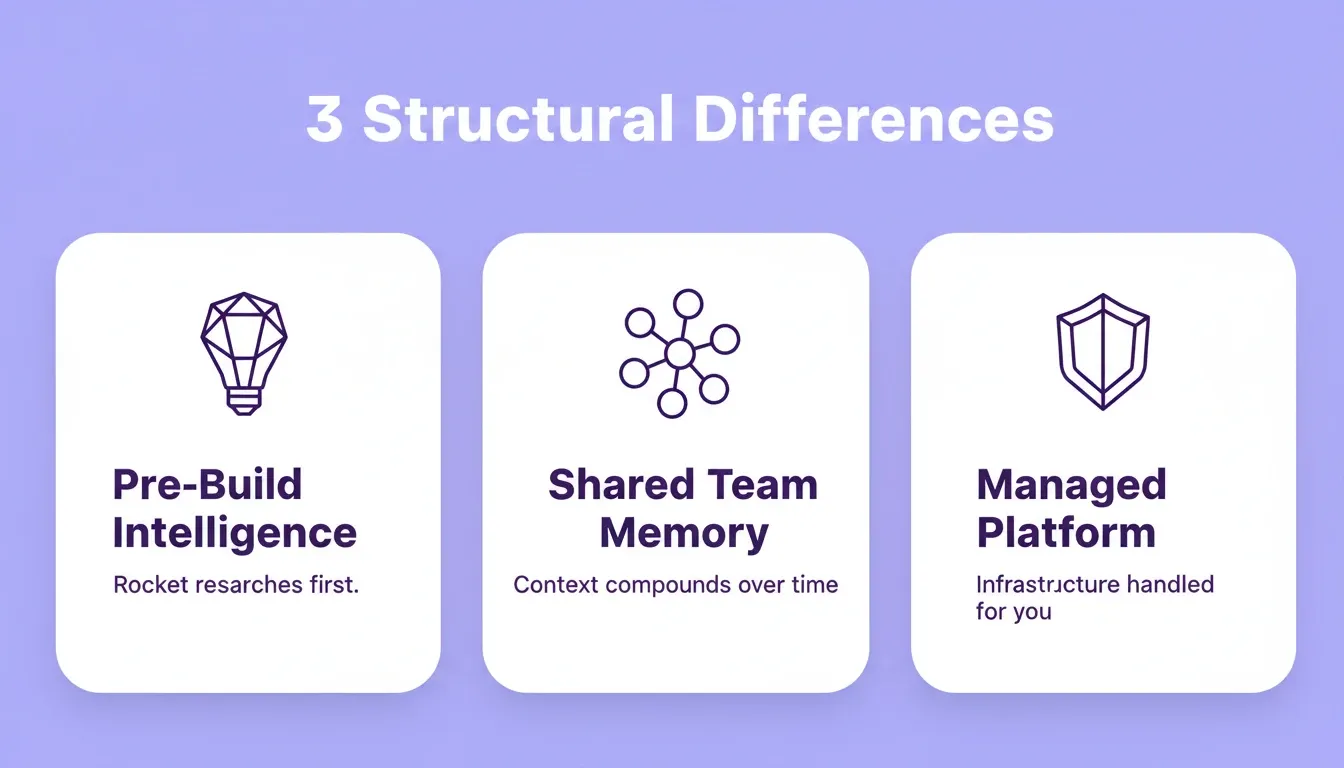
When you compare Rocket to Claude Code and Cursor, three architectural differences emerge. These are not feature gaps. They are fundamental design choices.
Difference 1: Pre-Build Intelligence
Claude Code executes what you direct it to execute. It does not research whether the direction is right, validate the market, or produce strategic intelligence before the work begins. Similarly, Cursor has no opinion on whether the code being written is worth writing.
In Rocket, Solve produces that intelligence and it flows directly into Build through shared context. The research that validated your idea becomes the foundation of what gets built, in the same platform, without re-explaining.
Difference 2: Shared Team Memory
Claude Code sessions are individual. There is no shared memory between sessions or team members. Cursor has no shared context architecture either. Coordination happens outside the tool.
In Rocket, every task in a project inherits the shared memory of everything the team has done. The Solve research from last week is available when Build starts today. Cross-task context means every task makes the next one smarter.
Difference 3: Managed Platform vs Self-Managed Infrastructure
Claude Code requires you to install it, configure your environment, manage API keys across providers, handle provider switching, and troubleshoot errors as usage scales. You become the system administrator of your own AI infrastructure. Cursor users similarly manage their own environment.
Rocket is a managed platform. The agentic system handles execution autonomously, performance is monitored continuously, and AI provider flexibility is built in with keys handled securely.
Rocket connects with 27 services through one-click workspace connectors: Stripe, Google Analytics, AdSense, Perplexity, Anthropic, Gemini, OpenAI, Supabase, PayPal, Postman, Cal.com, Google, Linear, Notion, Airtable, Mailchimp, Mixpanel, Typeform, Strapi, Directus, Tally, Brevo, Calendly, MailerLite, SendGrid, Twilio, and Resend. Authenticate once and they flow into every build.
Who is Each Tool Built For?
Rocket Serves Three User Types
The Builder: founders, developers, designers, and agencies who need to ship products. Rocket handles the full arc from idea validation to deployed product.
The Operator: product managers, sales teams, marketers, consultants, and investors who use Solve and Intelligence without ever building a customer-facing product. They run research, monitor competitors, and make decisions, all inside Rocket.
The Platform Consolidator: enterprise and scaled-stage teams replacing tool sprawl. Instead of separate tools for research, building, monitoring, analytics, and collaboration, everything runs in one shared-context system.
Claude Code Serves
Developers who already have a codebase and need a powerful execution agent. Non-engineers also use it for workflows beyond coding, including sales prospecting, PRD writing, and content pipelines. It assumes you already know what to build and have the infrastructure to run it.
Cursor Serves
Developers who live in VS Code and want AI-enhanced coding. It is excellent at its core function. It assumes you have already done the thinking and just need to write the code faster.
What are Developers Saying?
Community sentiment reveals how these tools perform in daily use across developer forums, social posts, and review sites.
-
Cursor users praise the tab completion speed and multi-file agent mode. The Bugbot code review feature gets strong feedback from teams managing large repositories.
-
Claude Code users highlight its deep codebase understanding. The dynamic workflows feature (running parallel subagents) launched in May 2026 and immediately became popular for complex refactoring tasks.
-
Rocket users consistently mention the "one-shot" experience. One user on X noted: "I just one-shotted a prompt using Rocket and I can't put into words how astronomically better it is than any other no-code AI tool. Actually made me question why I ever paid for Bolt, Lovable, V0 when this tool puts them all to shame."
According to Uvik's 2026 research, over 85% of North American developers have integrated AI code tools into their daily workflows.
Adoption is no longer experimental; it is the default. For a deeper look at how AI tools are reshaping development workflows, see how vibe coding is shaping next-gen workflows.
Can These Tools Work Together?
Yes, and some teams use them in combination. Rocket provides full source code download and two-way GitHub sync, so your code is never locked in. Some teams use Rocket to generate the initial application, then use Cursor or Claude Code to refine the exported codebase.
The platforms serve different stages of the development lifecycle. Rocket handles research, generation, deployment, and monitoring. Claude Code handles deep refactoring and multi-file editing in existing repos. Cursor handles day-to-day coding acceleration inside VS Code.
The Right AI Development Platform for What Comes Next
As the AI development tools market heads toward $91.09 billion by 2035, the question is not whether to use AI in your workflow. It is the tool that fits where your work actually starts. Cursor and Claude Code serve the coding step well.
Rocket.new vs Claude Code vs Cursor is ultimately a question of scope: if you need research, building, and monitoring in one place with no per-seat fees, Rocket covers the full arc.
Start building on Rocket.new for free, no credit card required, and your first project ships in minutes.
Table of contents
- -What are These Three AI Development Tools?
- -Platform Category Comparison
- -How Does Rocket's Three-Pillar Architecture Work?
- -Pillar 1: Solve — Strategic Research Before You Build
- -Pillar 2: Build — Production-Grade App Generation
- -Pillar 3: Intelligence — Continuous Competitor Monitoring
- -Which Tool Fits Your Budget?
- -Rocket: Credit-Based, No Per-Seat Fees
- -Claude Code: Per-Subscription, Individual Sessions
- -Cursor: Per-Seat, Scales with Headcount
- -True Cost at Team Scale
- -What Can You Build — and How Fast?
- -Rocket: From Prompt to Live URL in Minutes
- -Claude Code: Fast Within Existing Codebases
- -Cursor: Accelerated Coding Speed
- -The Three Structural Differences
- -Difference 1: Pre-Build Intelligence
- -Difference 2: Shared Team Memory
- -Difference 3: Managed Platform vs Self-Managed Infrastructure
- -Who is Each Tool Built For?
- -Rocket Serves Three User Types
- -Claude Code Serves
- -Cursor Serves
- -What are Developers Saying?
- -Can These Tools Work Together?
- -The Right AI Development Platform for What Comes Next