
Rocket.new generates full-stack apps from a text prompt with database, auth, and deployment included. Tempo Labs requires an existing React codebase and developer expertise. For teams shipping without prerequisites, Rocket.new is the more complete path.
Why do most AI coding tools still leave you assembling the final product yourself?
According to Stack Overflow's 2024 Developer Survey, 76% of developers are using or planning to use AI tools in their workflow. The demand is clear. But many of these tools only handle one piece of the puzzle: generating code snippets, suggesting completions, or scaffolding components.
They speed up typing. They don't ship products. That gap matters when you compare two fundamentally different approaches to AI-powered building.
One platform gives you a visual IDE layered on an existing codebase. The other generates a complete, deployable application from a text description. The difference determines whether you ship in minutes or weeks.
Key Definitions
Rocket.new is a vibe solutioning platform that combines three pillars in one workspace: Solve (AI-powered business and market research), Build (full-stack app generation from a text prompt), and Intelligence (continuous competitor monitoring). It generates production-ready Next.js web apps and Flutter mobile apps without requiring an existing codebase.
Tempo Labs is a visual IDE for React applications. It overlays AI-assisted design controls on top of a codebase you already own. It does not generate apps from scratch.
Vibe solutioning is the practice of using AI to research, build, and monitor a product in a single connected workflow, so findings from research flow directly into what gets built.
What Does Tempo Labs Offer for Development Teams?
Tempo Labs, a Y Combinator S23 company, positions itself as a visual IDE for React applications, with a clear focus on UI work and design-to-code workflows for React teams. Their founding team previously built Perpetua, scaling it from 5 to 300 employees before a $150M acquisition.
-
React-only framework support: Tempo works exclusively with React web apps and React Native mobile apps, with no support for other frameworks
-
Existing codebase requirement: You need a working project to bring into the tool; Tempo does not generate apps from scratch
-
Visual design panel: Offers Figma-like controls for adjusting layouts, typography, and styling on live code, helping designers and developers collaborate on React UI work
-
Figma integration: Tempo integrates with Figma designs for design-to-code conversion as a prototyping tool
-
Agent+ subscription service: A paid tier starting at $500/month where human engineers and AI agents design and ship 1-3 features daily for your existing product
-
Desktop IDE installation required: Tempo is a downloadable application, not a browser-based platform
The tool works well for established teams with active React codebases who want faster frontend iteration. For anyone starting from zero or working outside React, a prompt-based AI app builder offers a more practical path.
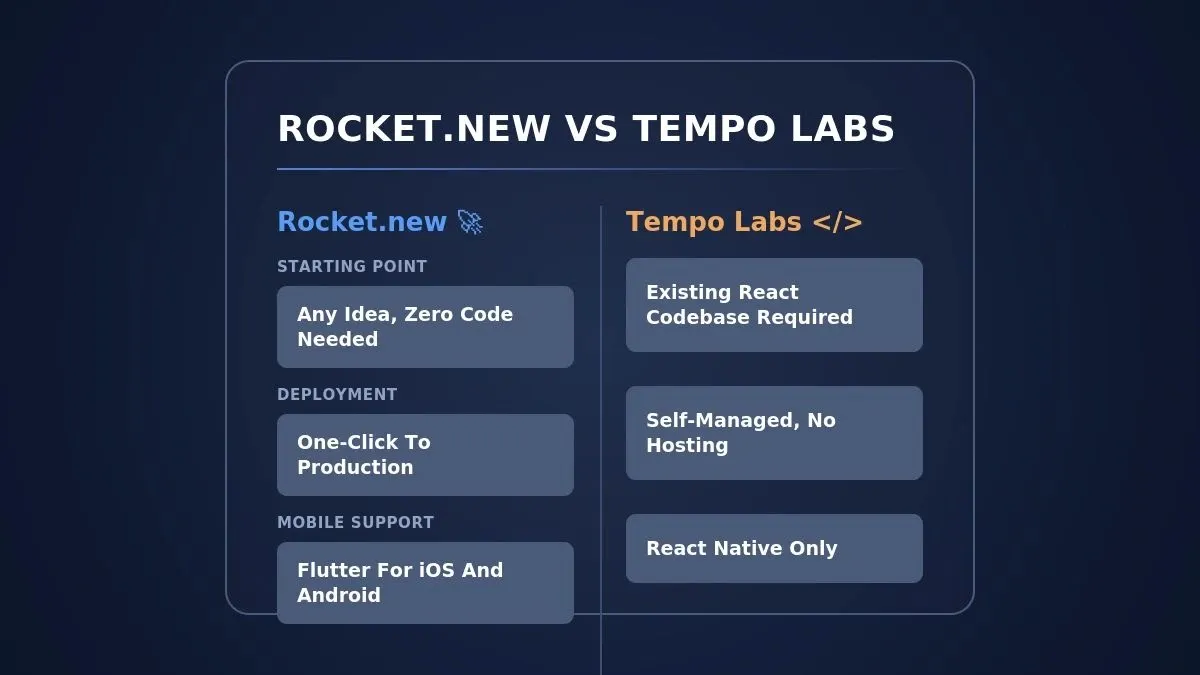
Rocket.new vs Tempo Labs: three critical differences at a glance
Why Is Speed the Critical Factor for an AI App Builder?
When evaluating AI development tools, speed isn't about code generation velocity alone. It's the total time from idea to a working, deployed product that real users can access.
According to GitHub's 2024 developer survey of 2,000 respondents across four countries, 97% of developers on enterprise teams have tried AI coding tools at work. And McKinsey's research on developer productivity found that AI tools can cut coding task time significantly, yet the bottleneck has simply shifted downstream.
With AI generating code faster, the new constraint is everything around it: deployment, database setup, authentication, payment integration, and hosting. A tool that generates React components still requires you to assemble them, configure infrastructure, and manage deployment yourself. For professional workflows, speed also depends on handling backend logic and the ability to connect with broader systems, not just reducing the time spent writing code.
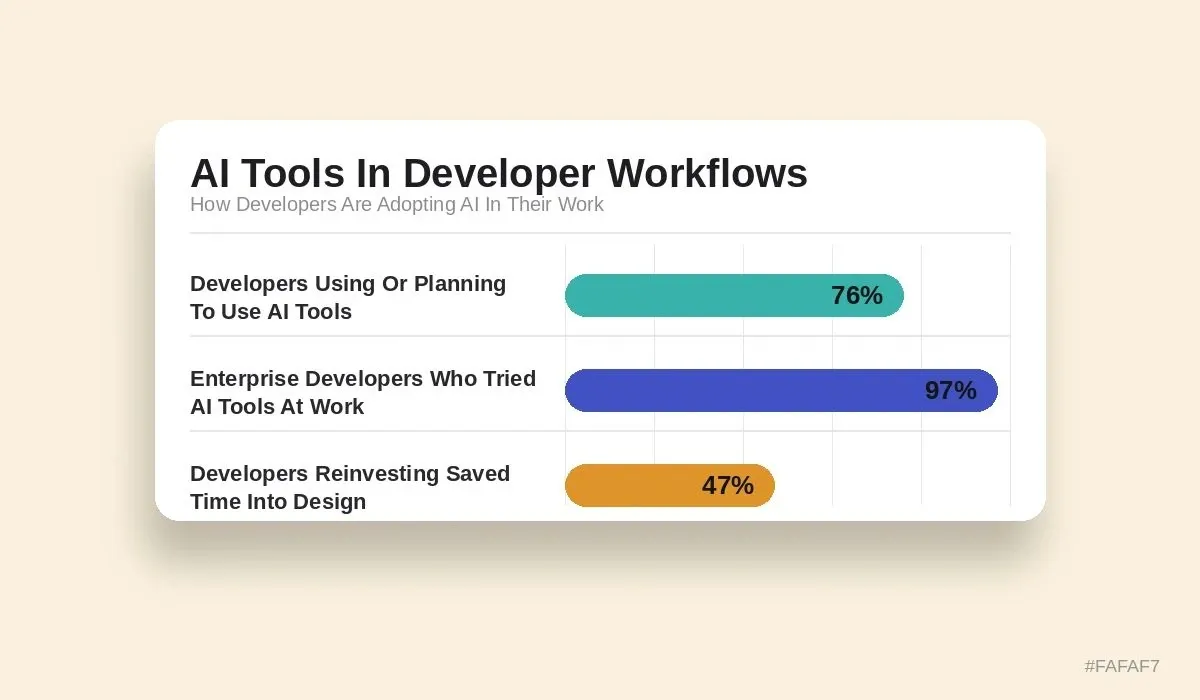
Key developer AI adoption statistics
Speed in 2026 means "idea to live app," not "prompt to code snippet." That distinction separates platforms offering production-grade code generation from developer-focused tools that still leave the last mile to you, and it also makes platform limitations more obvious in real workflows; for example, some tools such as Replit support over 50 programming languages for integration.
How Does Rocket.new Handle the Full App Building Workflow?
Rocket.new takes a fundamentally different approach from Tempo or other IDE-focused tools. Instead of augmenting your existing development environment, it replaces the entire workflow from idea to deployment. The Build pillar generates full-stack solutions with UI, navigation, frontend logic, backend services, and production-ready code.
-
Describe in plain language: Type what you want built: a SaaS dashboard, a mobile app, an internal tool. No existing codebase needed, no framework knowledge required.
-
Automatic architecture decisions: Rocket.new assigns Next.js for web and Flutter for mobile, sets up backend infrastructure, plans backend logic and database schemas, wires authentication, and connects payment processing without manual configuration; by comparison, Lovable integrates with Supabase for database and authentication, while Base44 includes a fully managed backend without external configuration
-
Live in approximately 3 minutes: Generation time dropped to around 3 minutes per the September 2025 changelog
-
Iterate through conversation: After generation, users can edit in chat, in the visual editor, or through direct code changes for more control while Rocket.new maintains full context of every prior decision
-
26+ integrations at generation time: Stripe, Supabase, Google Analytics, OpenAI, Notion, Airtable, and more wire into your app based on what you described to help teams integrate external services into real apps
-
One-click deployment: Staging and production environments from day one, custom domain support, and built-in analytics
Beyond building, Rocket.new includes Solve, a strategic research tool that helps teams validate what's worth building before writing a single line of code.
From a plain-language prompt to a live production app in approximately 3 minutes
Side-by-Side Feature Comparison
Comparing these two platforms becomes clearer when capabilities sit next to each other. The core distinction shows up in the first row: Rocket.new can take ideas from early prototypes to production grade applications, while Tempo augments applications that already exist.
| Feature | Rocket.new | Tempo Labs |
|---|---|---|
| Generate apps from text prompt | Yes | No (requires existing codebase) |
| Mobile app support | Flutter (iOS + Android) | React Native only |
| Framework flexibility | Next.js + Flutter | React/React Native only |
| Database and auth built-in | Supabase, automatic | No built-in database |
| One-click deployment | Yes (staging + production) | No (IDE only, no hosting) |
| Figma import | Yes | Yes (Figma plugin) |
| Free plan | Yes (20 credits, no time limit) | No (Agent+ starts at $500/month) |
| Pre-built templates | 25,000+ | None |
| Strategic research | Yes (Solve) | No |
| Code export and github sync | Yes (GitHub 2-way sync, Next.js/TypeScript) | Yes (works on your repo) |
| GDPR/CCPA compliance tools | Yes (generated for your app) | Not documented |
Base44 and Lovable both provide built-in hosting with shareable URLs from the first generation, while Replit offers native deployment with always-on hosting for applications.
Rocket.new also includes continuous competitor monitoring via Intelligence, which watches competitors across nine signal pillars including website changes, hiring, pricing, and product releases. No other AI builder offers ongoing competitive analysis alongside the build workflow.
Where Rocket.new Outperforms in Real-World Projects
The comparison table tells part of the story. The full picture emerges when you look at what happens after initial generation.
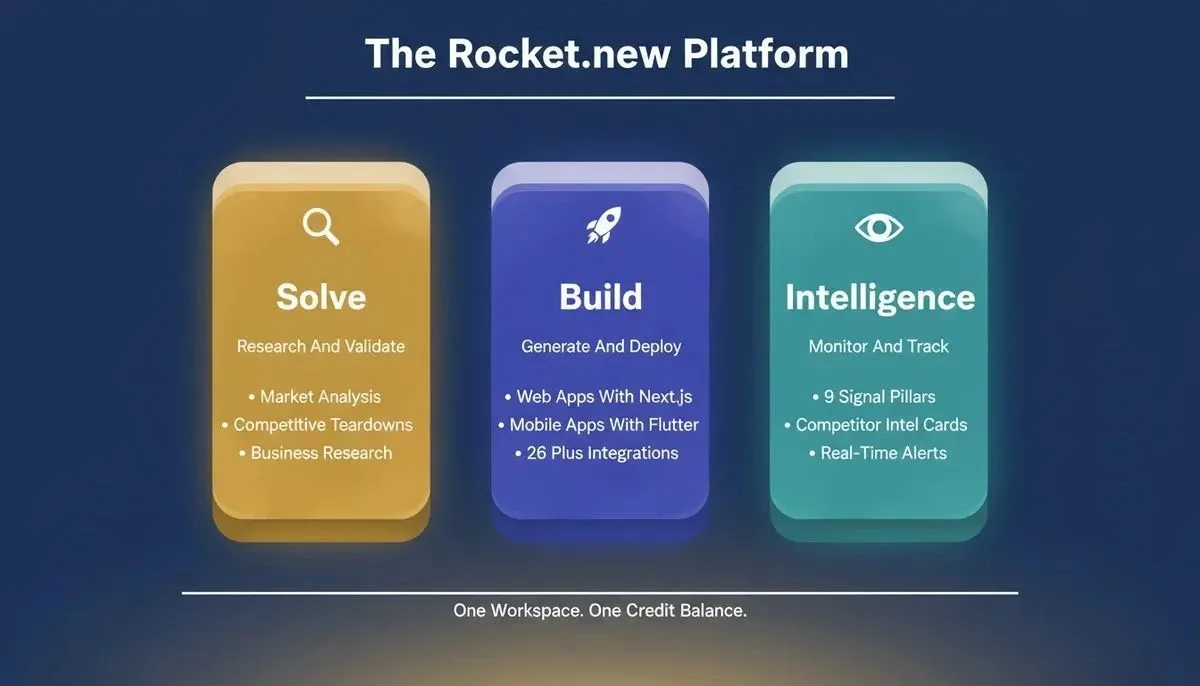
Rocket.new's three-pillar platform: Solve, Build, and Intelligence in one workspace
Rocket.new combines research, building, and monitoring in one workspace so findings from Solve flow directly into what gets built, and Intelligence keeps you aware of what competitors are shipping across the full development workflow. Other tools handle one step and hand everything else back to you, even if Lovable includes built-in deployment with a shareable URL from the first generation.
Every decision, file, and research output lives in your project. When you start a new task, Rocket.new already knows everything from previous work via cross-task context, which matters on complex multi-file work because the platform carries full-project context forward. No re-explaining context across disconnected tools.
Output includes intentional typography, real visual hierarchy, dark/light theming, and staggered animations. The result looks like a design team spent weeks on it, not minutes on a prompt.
Rocket.new supports workspace members with editor and viewer roles, project-level access controls, task-level sharing, and audit logs. SSO is available as a login option on account creation; enterprise-specific controls are available via the sales team.
Rocket.new's compliance and privacy feature generates GDPR and CCPA cookie banners, privacy policies, and data handling controls for apps you build on the platform. This is a feature for your generated apps, not a certification held by Rocket.new the company.
Teams that have compared Rocket.new with other AI builders consistently report the same pattern: other tools add incremental speed to an existing workflow, while Rocket.new replaces the workflow entirely. Some builders are optimized for internal tools or landing pages, while Rocket.new also supports production use cases at scale. See how it compares to other leading platforms.
What Real Builders Think About Both Platforms
User sentiment tells you what marketing pages won't. Here is what actual builders are saying about their experience.
*"I just one-shotted a prompt using @rocketdotnew, and I can't put into words how astronomically better it is than any other no-code AI tool. Actually made me question why I ever paid for Bolt, Lovable, V0, a0, etc when this tool puts them all to shame. Incredibly impressed, wow." - *Mia Williams (@miatravls)
1.5 million users across 180 countries have tried Rocket.new, with consistent feedback highlighting one-prompt app generation as the standout feature.
Tempo's Y Combinator profile describes the tool as optimized for "serious software companies" shipping production-grade software, which narrows its audience significantly compared with solo founders and other builders who need speed over setup. Rocket.new is not just a low-code tool: it reduces how much code you need to write without requiring React expertise, and AI app builders have created demand for simpler end-to-end workflows.
Community feedback consistently points to the same conclusion. When the goal is "idea toidea-to-liveRocket.new removes more friction than any IDE-based approach.
Your Next AI App Starts With a Better Platform
Choosing between an IDE overlay for your existing React project and a full-stack generation platform comes down to where you are today and where you want to be tomorrow. If you already have a mature codebase and a team of React engineers, Tempo adds incremental value.
If you want to go from concept to deployed product without prerequisites, Rocket.new provides that path. The teams shipping fastest in 2026 aren't the ones with the most sophisticated development environments. They're the ones who removed the most steps between "I have an idea" and "users are using it."
Explore Rocket.new's full template library to see what you can build and launch today.
Stop wrestling with IDE overlays and React prerequisites. Rocket.new takes your idea and turns it into a deployed, production-ready application in minutes. Start building on Rocket.new for free and see the difference yourself.
Table of contents
- -Key Definitions
- -What Does Tempo Labs Offer for Development Teams?
- -Why Is Speed the Critical Factor for an AI App Builder?
- -How Does Rocket.new Handle the Full App Building Workflow?
- -Side-by-Side Feature Comparison
- -Where Rocket.new Outperforms in Real-World Projects
- -What Real Builders Think About Both Platforms
- -Your Next AI App Starts With a Better Platform