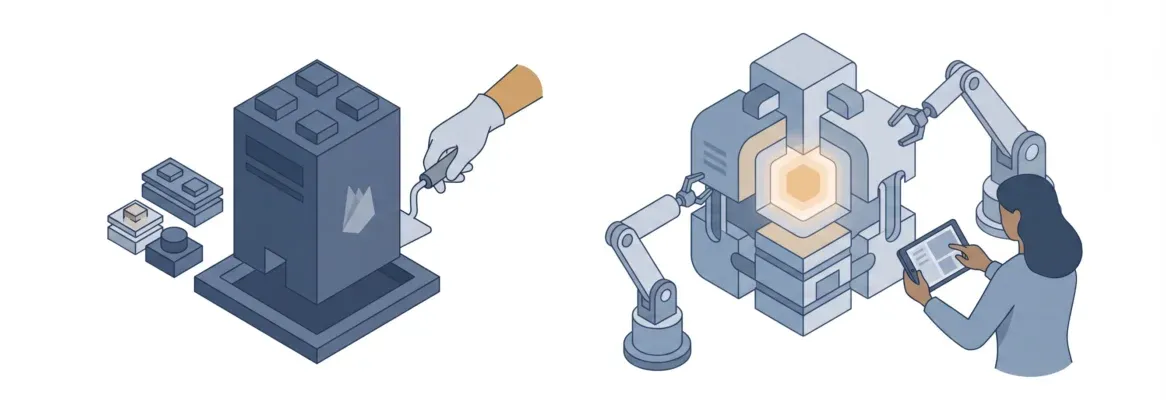
Rocket and PearAI serve different moments in product development. PearAI accelerates code editing inside a familiar IDE. Rocket covers the complete arc: research, build, deploy, and monitor, all inside one platform with shared context.
What does it take to ship a full-stack application with AI?
That question separates code editors from build platforms.
1.5 million people have tried Rocket across 180 countries. The pattern is consistent: teams that start with the right platform ship faster and spend less time assembling infrastructure.
This blog breaks down where PearAI and Rocket differ, what each tool is built for, and how to choose based on what you need to deliver.
What Sets AI App Builders Apart in Practice?
Not all AI-powered development tools serve the same purpose. The market has split into two distinct categories: code editors that assist with writing, and vibe solutioning platforms that handle the full arc from idea to live product.
Code editors with AI add autocomplete, chat-based agents, and inline suggestions to an existing IDE. They speed up the writing step, but leave architecture, deployment, and iteration to you. Vibe solutioning platforms handle the complete journey. They validate the idea, generate a working application with real UI, logic, and databases, deploy it, and monitor what matters after launch.
The deciding factor is not which tool writes cleaner code. It is whether you need a faster way to write code or a faster way to ship a product.
How Does PearAI Approach Application Development?
PearAI positions itself as "The AI Code Editor for Your Next Project." It is built on a VSCode fork with AI features layered on top. PearAI is backed by Y Combinator and is available as a desktop download.
-
PearAI Router automatically selects the highest-performing AI model for coding tasks. It removes the need to manage multiple subscriptions.
-
PearAI Agent (powered by Roo Code and Cline) is an autonomous coding agent that writes features and fixes bugs.
-
PearAI Chat (powered by Continue) provides codebase-aware AI assistance with
@codebasecontext. -
PearAI Creator, designed for generating new projects from scratch, is listed as "Coming Soon."
-
PearAI Login and PearAI Launch (deployment via Netlify) are also marked "Coming Soon" on their website.
PearAI serves developers who want AI-assisted coding within a familiar editor. Several of its full-stack capabilities remain unreleased, and none of its current features address pre-build research or post-launch monitoring.
Where Full-Stack Capabilities Actually Matter
The real test for any AI development tool comes when you move beyond writing code into shipping a complete product.
According to Stack Overflow's 2024 developer survey, 76% of developers are using or planning to use AI tools in their workflow. Yet 45% of professional developers say current AI tools are bad at handling complex tasks. 63% cite "AI tools lack context of codebase" as a top challenge when using code assistants at work.
Full-stack needs include database design, API integration, authentication flows, responsive design, performance tuning, and hosting. A code editor addresses none of these natively. When the scope of work extends past individual files, a code editor reaches its ceiling.
Can a Code Editor Replace a Complete Build Platform?
No, unless you are willing to assemble everything else yourself.
A code editor accelerates the typing and debugging phase. It does not replace the thinking that happens before code exists. Market validation, competitive analysis, feature prioritization, and architecture decisions all happen outside the editor. It also does not handle what comes after: deployment, monitoring, and iteration based on real usage data.
"You quickly reach a threshold where explaining and getting the AI to do what you want is actually harder than doing it. What happens if your LLM built app has a bug and the AI does not get it?" EZ-E on Hacker News
For teams building production applications, the gap between "write code faster" and "ship a complete product" is measured in weeks of additional setup work.
What Rocket Covers: Three Pillars, One Platform
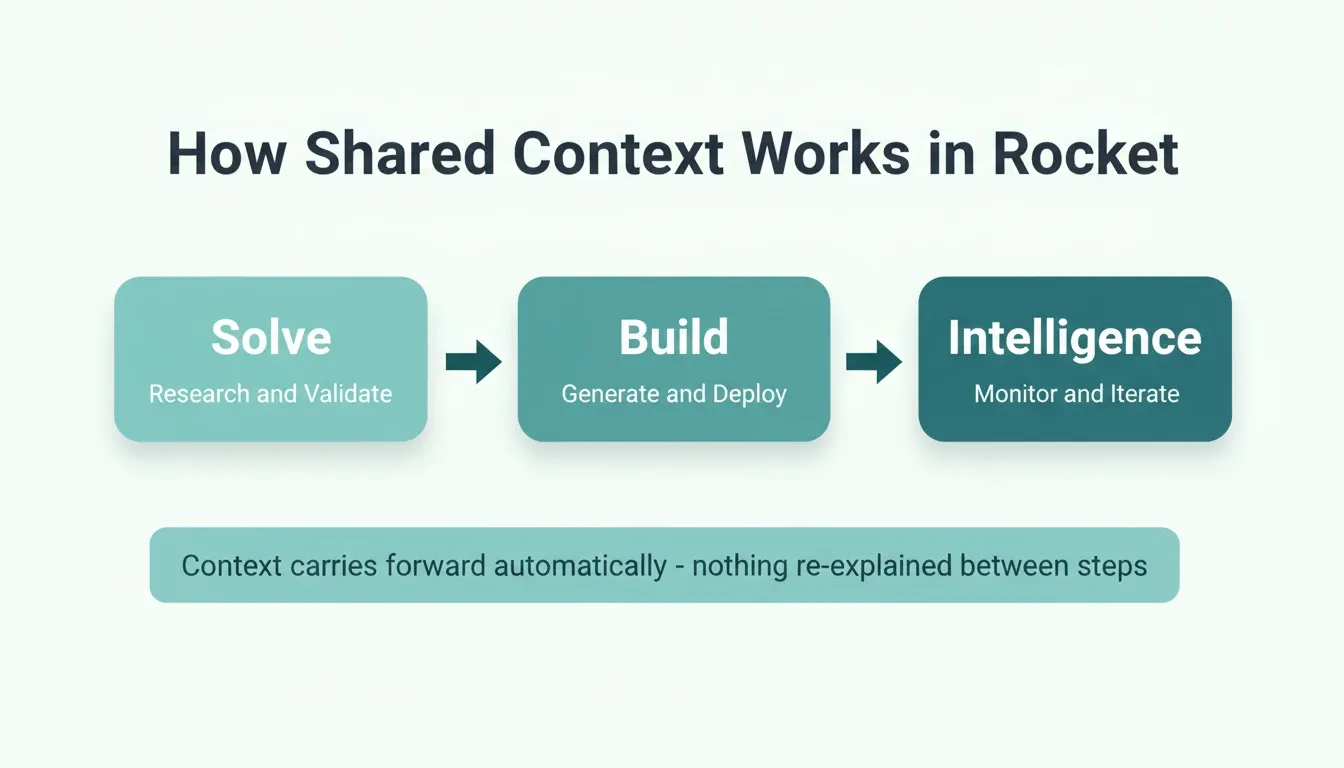
Rocket is the world's first vibe solutioning platform. Research, build, and monitor all happen in one workspace where context carries forward automatically. Each pillar works independently. Use one, two, or all three depending on what you need. You can explore how full-stack AI building works in practice before diving into each pillar below.
Pillar 1: Solve — Research Before You Build
Solve turns any business question into a structured report with data, insights, and actionable recommendations. Use it to validate ideas, run market research, create product requirement documents, analyze competitors, or map pricing strategy.
Two modes are available. Light Solve returns a fast conversational answer. Full Solve decomposes complex prompts into parallel research streams. It typically takes around 45 minutes and produces a complete, exportable deliverable in PDF or PPT format.
The output does not sit in a separate document. It flows directly into your Build task as context, so the first generation already reflects genuine product thinking.
Pillar 2: Build — Production-Grade Generation
Describe what you want in plain language. Rocket plans the architecture, writes production-ready code, and shows a live preview when done. Most apps generate in 1 to 3 minutes.
What you can build:
| App Type | Examples |
|---|---|
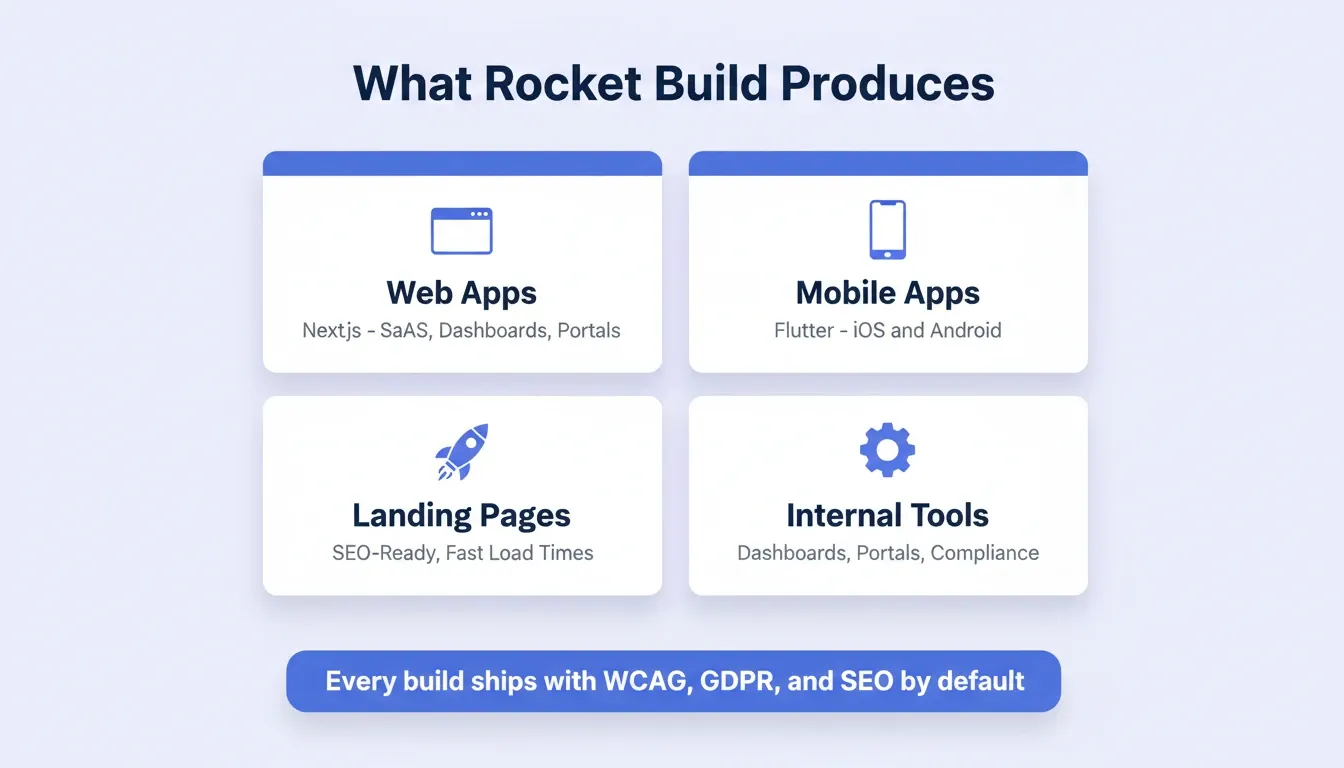
| Web apps | SaaS dashboards, internal tools, marketplaces, customer portals |
| Mobile apps | iOS and Android from a single Flutter codebase, App Store and Google Play ready |
| Landing pages | Marketing sites, portfolios, conversion pages with built-in SEO |
| E-commerce | Product catalogs, checkout flows, payment integrations |
| Internal tools | OKR trackers, compliance dashboards, investor data rooms |
Web apps are built in Next.js. Mobile apps are built in Flutter with real design systems, dark/light theming, and fluid navigation. Every build ships with SEO-ready structure, WCAG accessibility compliance, and GDPR coverage by default. These are the baseline, not optional extras.
You can start a build in six ways: from a plain-language description, from an uploaded attachment, from a Figma file, from a GitHub repository, from a template at zero credits, or via Redesign from an existing URL using eight slash commands.
After generation, iterate through Chat, Visual Edit, or direct code editing. There is no change limit. 25+ integrations connect directly into every build: Stripe, Supabase, Google Analytics, Notion, Linear, Airtable, Mailchimp, Mixpanel, PayPal, Twilio, SendGrid, and more. Authenticate once and they flow into every build automatically.
For a deeper look at how vibe coding connects to full-stack app development, this guide covers the complete workflow.
Pillar 3: Intelligence — Continuous Competitive Monitoring
Intelligence monitors every public platform a competitor operates on, continuously, and interprets what signals mean for your business. Set it up once with a wizard that collects your business context, competitor URLs, and notification preferences.
Intelligence then delivers daily, weekly, or monthly briefs automatically to a live dashboard in your sidebar. It surfaces pricing changes, new feature announcements, hiring spikes, ad spend shifts, and review sentiment changes. It does not just show what changed. It tells you what it means for your next product decision.
PearAI has no equivalent capability.
The Compound Context Architecture
Every other AI tool starts from zero each session. Rocket is built on the opposite architecture.
Add your context once: pitch decks, market research, brand guidelines, customer interview transcripts, and competitive analyses. Every task that follows already knows everything. The tenth task knows everything the first nine established. This inheritance is automatic. There is no re-explaining and no re-uploading.
What this eliminates in practice: Without shared context, strategy research sits in one tool, the PRD lives in a document, and the build task starts from a blank prompt. That creates three handoffs and three context compressions. In Rocket, the research, the PRD, and the build task are in the same project. Every step inherits the full context of every prior step.
PearAI sessions are individual. Each conversation starts fresh, with no mechanism for context to carry between sessions or team members.
Shared Context and Team Collaboration
Building products is rarely a solo activity. How tools handle team workflows and accumulated knowledge directly impacts delivery speed.
| Feature | PearAI | Rocket |
|---|---|---|
| Team workspaces | Not available | Three-level role-based access (Admin, Creator, Viewer) |
| Shared context | Per-session only | Persistent across all tasks and team members |
| Built-in deployment | Coming Soon (Netlify) | One-click with staging and production environments |
| Custom domain | Not available | Automatic DNS setup or manual configuration |
| Built-in analytics | Not available | Visitors, conversions, Core Web Vitals |
| Mobile app generation | Not available | Flutter apps for iOS and Android |
| Database integration | Manual setup | Supabase integration built in |
| Post-launch monitoring | Not available | Continuous competitive intelligence |
| Pre-build research | Not available | Solve (Light and Full modes) |
| WCAG and GDPR compliance | Manual | Shipped by default on every build |
Solo developers can work around collaboration limitations. Teams cannot.
From Research to Deployment: A Single Workflow
The most significant architectural difference between these tools is workflow continuity. Rocket connects every phase of product development through shared context.
According to GitHub's research on AI adoption, 97% of enterprise developers have used AI coding tools. But organizations still struggle to operationalize AI across the full development lifecycle. Rocket eliminates handoff gaps. Research from Solve informs Build, which informs Intelligence monitoring, which informs the next iteration. Nothing is re-explained between steps.
PearAI operates session by session. Each conversation starts fresh without accumulated project knowledge.
PearAI's session-based, manual workflow versus Rocket's connected, intelligence-first pipeline from research to monitoring
When context carries forward across every task, the tenth generation is smarter than the first.
When PearAI Makes Sense
Honest evaluation requires acknowledging where PearAI fits.
PearAI is a reasonable choice if you are a developer already working inside VSCode, you know exactly what to build, you have your own deployment pipeline, and you want AI assistance specifically for the coding phase. The PearAI Router's automatic model selection is a genuine convenience for developers managing multiple AI subscriptions.
PearAI is not the right fit if you need to validate an idea before building, want deployment included, require team collaboration with shared context, need mobile app generation, or want post-launch monitoring without adding another tool.
The gap widens for non-technical founders, product managers, and teams where multiple people need to collaborate on the same product. For a broader look at how context depth separates AI platforms, this comparison covers the key differences.
Who Should Use Rocket
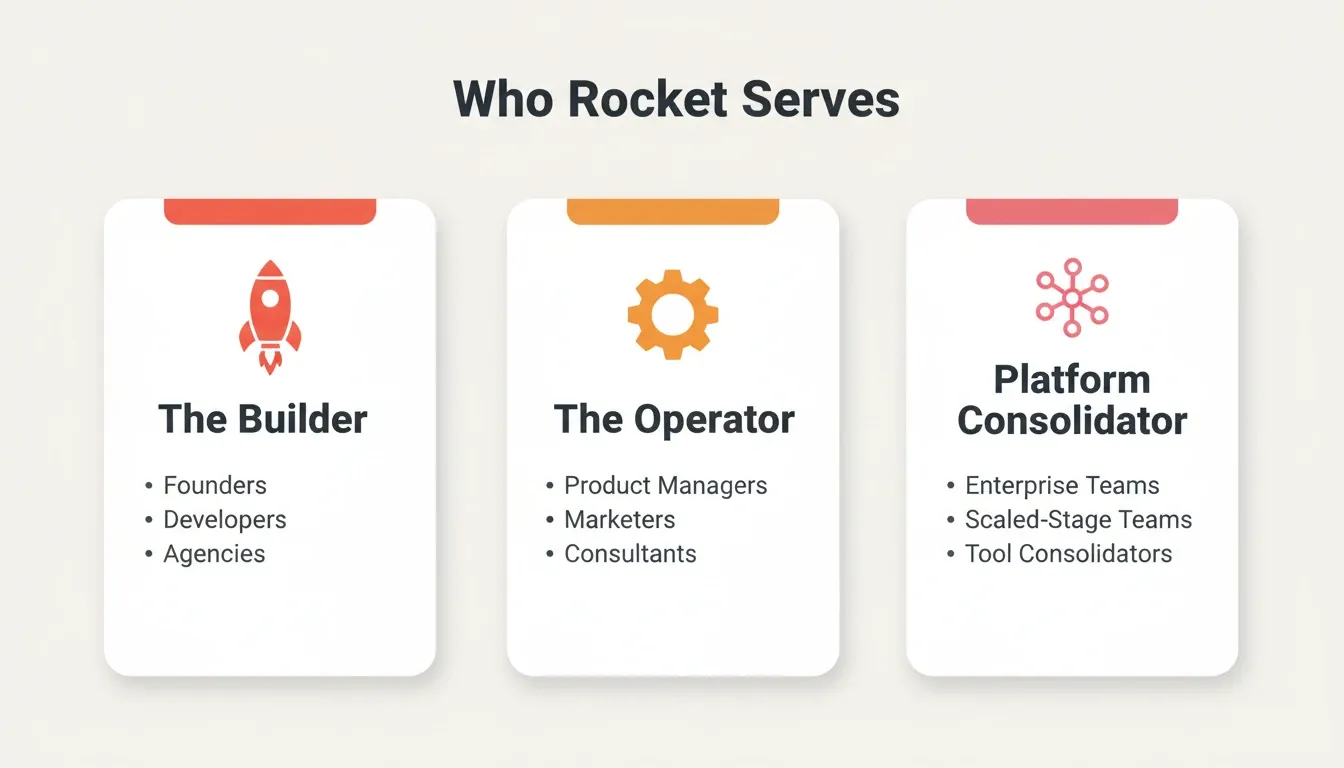
Rocket serves three distinct user types, each experiencing the platform differently.
The Builder includes founders, developers, and agencies shipping products. They use Solve to validate direction, Build to generate production-grade apps, and Intelligence to stay ahead of competitors after launch.
The Operator includes product managers, sales teams, marketers, and consultants. They use Solve and Intelligence without building a customer-facing product. Competitive research, market analysis, PRD generation, and deal briefs are all possible without writing a single line of code.
The Platform Consolidator includes enterprise and scaled-stage teams replacing tool sprawl. One platform replaces the separate research tool, the code editor, the deployment service, the analytics dashboard, and the competitive intelligence subscription.
The Platform You Choose Determines What You Ship
The Rocket.new vs PearAI comparison comes down to one question: where does your work actually start? PearAI is a capable code editor for developers who already have the thinking done. Rocket is built for the full arc, from the first question to a live, monitored product.
As AI development tools continue to mature, platforms that connect research, building, and intelligence in a single shared-context system will define how the fastest teams operate. The thinking before the build is not a step you skip. It is the step that determines whether everything after it is worth doing.
Start your next full-stack application on Rocket and go from idea to live product in one session.
Table of contents
- -What Sets AI App Builders Apart in Practice?
- -How Does PearAI Approach Application Development?
- -Where Full-Stack Capabilities Actually Matter
- -Can a Code Editor Replace a Complete Build Platform?
- -What Rocket Covers: Three Pillars, One Platform
- -Pillar 1: Solve — Research Before You Build
- -Pillar 2: Build — Production-Grade Generation
- -Pillar 3: Intelligence — Continuous Competitive Monitoring
- -The Compound Context Architecture
- -Shared Context and Team Collaboration
- -From Research to Deployment: A Single Workflow
- -When PearAI Makes Sense
- -Who Should Use Rocket
- -The Platform You Choose Determines What You Ship