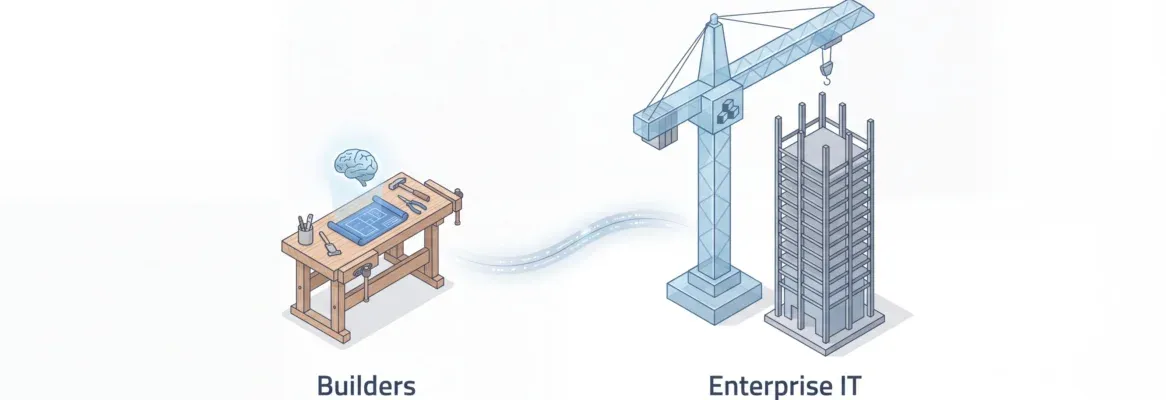
Rocket.new turns a text prompt, Figma file, or existing GitHub repo into a production-ready full-stack app with backend, auth, and mobile. Nordcraft is a visual, component-based builder for websites and developer-led projects. Your project type decides everything.
Why do two AI-powered platforms that both promise speed end up serving completely different builders?
The answer comes down to what each tool actually generates.
One produces full-stack web and mobile apps with backend logic, user authentication, database schema, and payment integrations from a single natural language prompt.
The other gives developers and designers a visual website builder with an AI agent, complete CSS control, and an open-source runtime on GitHub.
According to the Nordcraft 2.0 announcement, their AI agent runs up to 6x faster than Claude Code for website-building tasks. Rocket's AI-powered app builder takes a different approach entirely: describe what you want to build in plain language, and the platform generates production-ready code, a backend, and a deployable app in minutes.
So which one fits your next project? The answer depends on whether you are building an app or a website.
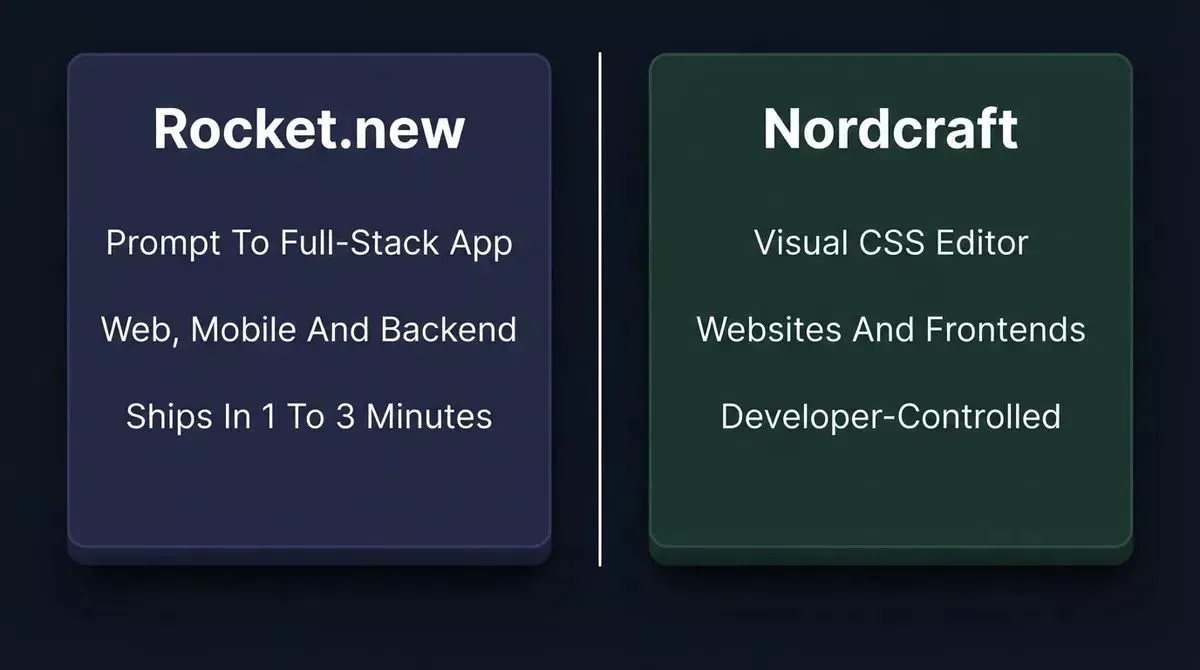 Two platforms, two different jobs: full-stack app generation vs visual website building.
The AI App Builder vs Visual Web Builder Confusion
Most people searching "Rocket.new vs Nordcraft" are confused for a good reason: both platforms use AI, both promise faster building, and both let you ship without a full development team. But they solve fundamentally different problems, and picking the wrong one will cost you time.
The low-code and no-code market is growing rapidly, and the number of tools claiming to be "AI builders" has multiplied. The confusion comes from how both tools are marketed: Rocket.new is described as an AI builder, and Nordcraft is described as an AI-assisted visual builder.
Rocket.new is an AI app generator. You describe what you want, and it produces a working, deployable application with a frontend, backend, database, and integrations.
Nordcraft is a visual development environment. You build a website or frontend by editing components, CSS properties, and logic directly, with an AI agent available to help scaffold or explain.
What is Rocket.new?
Rocket.new is an AI-powered app builder that uses natural language prompts to generate production-ready web and mobile applications from a single prompt, a Figma file, or an existing GitHub repository.
It also includes research (Solve) and competitor monitoring (Intelligence) tools that share the same credit balance, so you can validate an idea before you build it.
You describe what you want to build, and Rocket generates a working, deployable product, not a mockup. That makes it useful for quick app generation, rapid prototyping, and idea testing without writing code.
- Web applications are built in Next.js.
- Mobile applications are built in Flutter, so one codebase can target iOS and Android.
- Every project starts with a solid baseline of semantic HTML, a heading hierarchy, form labels, and responsive layouts.
Accessibility (WCAG 2.1 AA), SEO, and privacy features such as GDPR and CCPA consent flows are not added automatically: you request them in chat or with built-in slash commands such as /Improve Accessibility Audit and /Implement Privacy Compliance.
After generation, you refine through three modes: Chat (natural language), Visual Edit (click any element), or Code (direct source access).
There is no fixed cap on the number of edits, but every generation consumes credits based on your app's complexity and the number of screens generated. One click on Launch publishes a web app to a staging URL, and the Production tab connects a custom domain (paid plan).
Every build saves a version, so you can compare changes and roll back. On paid plans, you can download the full project as a .zip file at any stage. This workflow is strong for building production-ready apps, though more complex production apps may still require engineering review before launch.
What you can build with Rocket.new
- Web apps: SaaS products, dashboards, internal tools, marketplaces, customer portals, AI-powered apps
- Mobile apps: iOS and Android apps from a single Flutter codebase, with an APK download for Android testing and a path to the App Store and Google Play
- Websites: Conversion-focused landing pages and multi-page websites at production quality
- E-commerce: Product catalogs, checkout flows, and an online store with payment integrations
- Internal tools: OKR trackers, admin panels, compliance tools, investor data rooms
Integrations
Rocket connects to 25+ services that flow into generation, including Stripe, Razorpay, Google Analytics, Supabase, OpenAI, Anthropic, Gemini, Mailchimp, Mixpanel, Airtable, Linear, Notion, Twilio, Resend, and more. Some connectors, such as Supabase, GitHub, and Google, are connected once at the workspace level and shared across all tasks.
Others, such as Stripe, are connected per task. For services without a native connector (PayPal, for example), Rocket's API importer accepts Postman collections, cURL commands, and OpenAPI/Swagger specs.
Rocket.new's Discord community is also an active support channel for users. 1.5 million people have tried Rocket across 180 countries, from solopreneurs to enterprise teams.
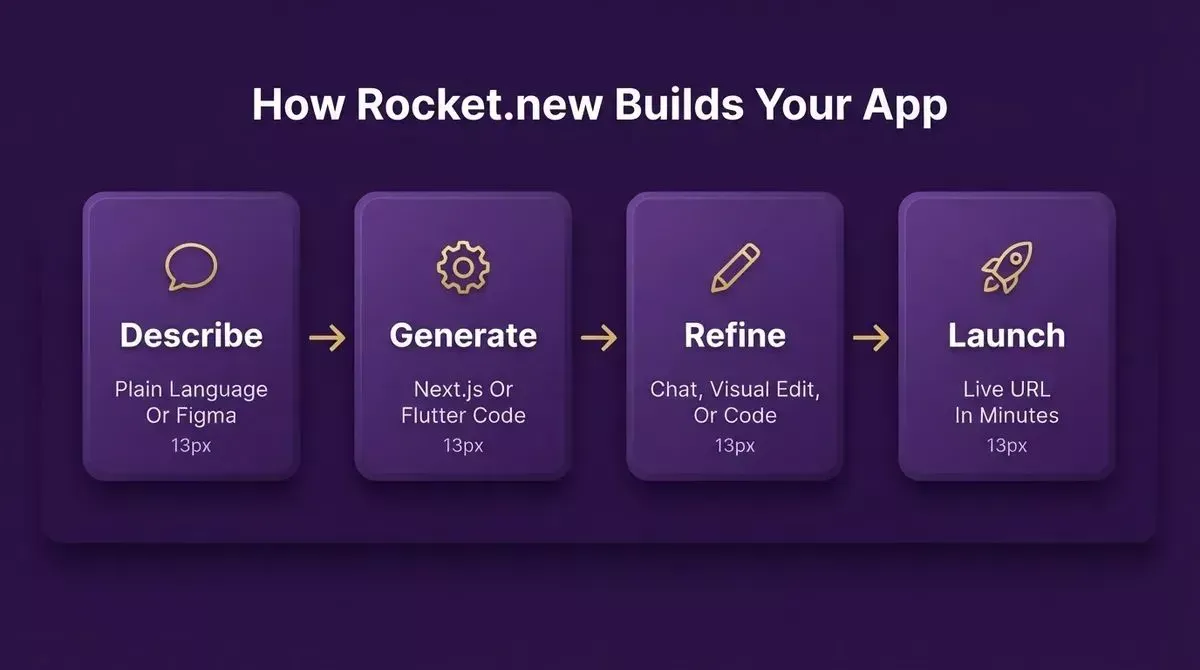 From prompt to production: most apps generate in 1 to 3 minutes.
What is Nordcraft?
Nordcraft is a visual, component-based website builder designed for developers and designers who want code-level control without writing everything from scratch. It is not an app generator. It is a professional frontend environment where you build and refine every detail visually, with an AI agent available to help.
Nordcraft gives you full CSS control with 50+ unit types, a CSS keyframe animation editor, conditional styles, and design variables. Its AI agent helps scaffold projects, add features, or explain logic, but the primary workflow is hands-on visual editing, not prompt-to-output generation.
Key Nordcraft capabilities:
- Component-based visual editor with complete CSS property control
- Git-like version control with branching, branch previews, and change history
- Server-side rendering, edge hosting, and web components export for self-hosting
- Open-source runtime under Apache 2.0 license
- Unlimited collaborators on all plans, including the free tier
- API and GraphQL connections to bring your own backend or CMS
Nordcraft does not generate a backend, database schema, or authentication system. You bring your own backend through API or GraphQL connections. It has no native mobile app generation and produces responsive web pages and web applications for the browser only.
Side-by-Side Comparison
This table maps the seven dimensions that matter most when choosing between an AI app generator and a visual website builder, and works as a quick feature comparison for teams deciding between app-building and website-building workflows.
| Dimension | Rocket.new | Nordcraft |
|---|---|---|
| Input method | Plain language prompt, Figma file, GitHub repo, attachments (screenshots, PDFs, spreadsheets) | Visual editor canvas, AI agent for scaffolding |
| Output type | Full-stack web app, Flutter mobile app, website, internal tool | Website, frontend web application |
| Backend and database | Supabase connector: Rocket generates schema, auth, storage, and edge function code once you link a Supabase project | Bring your own via API or GraphQL |
| Mobile app support | Flutter iOS and Android apps; APK download on paid plans; store submission via Xcode (App Store) or Flutter tooling (Google Play) | No native mobile app generation |
| Code ownership | Source code download (.zip) and two-way GitHub sync for Next.js TypeScript projects, both on paid plans | Web components export, open-source self-hosting |
| Learning curve | Low: non-technical users can ship from a description | Moderate to high: developer-focused, CSS-first |
| Pricing model | Credit-based: one credit balance for Build, Solve, and Intelligence | Per-project: pay per hosted project |
Rocket.new suits builders who need a complete application stack. Nordcraft suits developers and studios who want maximum visual control over a website or frontend project.
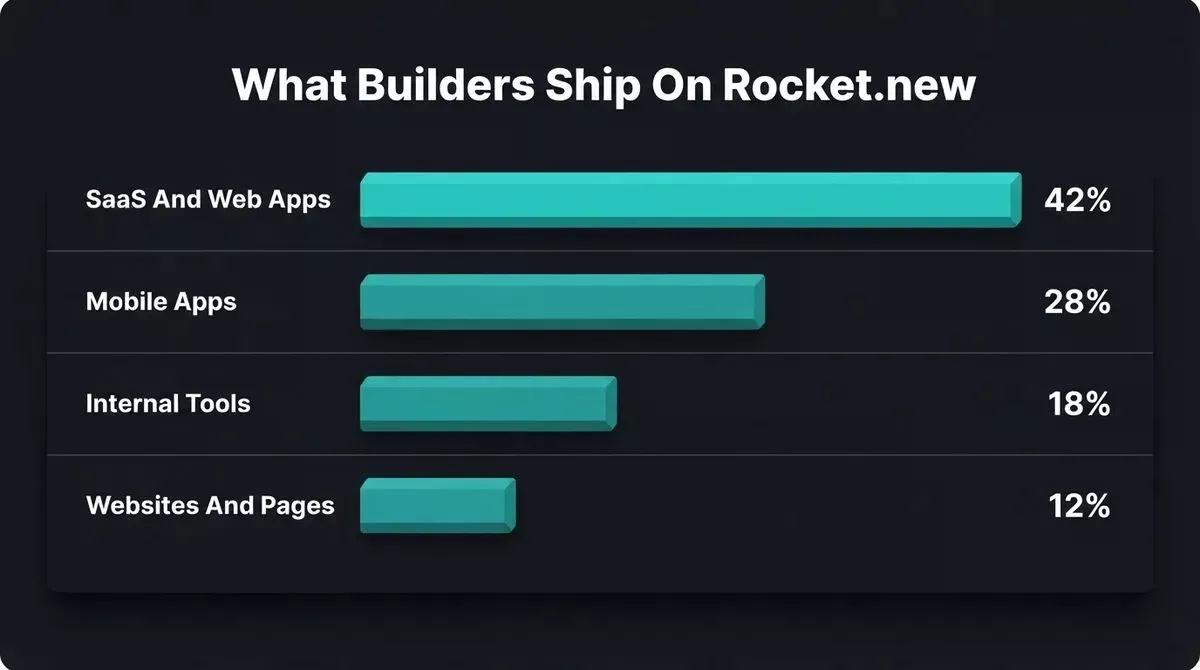 Build distribution on Rocket.new: applications and mobile apps account for the majority of what gets shipped.
Best Use Cases for Rocket.new
Rocket.new is built for anyone who needs a working application, not just a website. The platform covers the build arc from the first prompt to a live product with backend logic, user accounts, and payment processing.
SaaS MVPs and Startups
Describe your product idea, and Rocket generates the application, including screens, navigation, and integrations, in minutes. Connect Supabase for the database and authentication, Stripe for billing, and Resend for transactional email.
It's especially well-suited to simple prompts for app creation and rapid prototyping when founders want an AI-powered app or lightweight apps before committing engineering resources. Most founders use it to validate an idea before committing to a development team.
Rocket also offers a free plan at $0 per month with 20 one-time credits and no time limit. It can build production-ready websites, landing pages, web apps, and mobile apps, and no credit card is required to start. Extra credit packs are available on paid plans. Because pricing is credit-based, teams should keep an eye on credit usage as their projects grow.
Dashboards and Internal Tools
Build OKR trackers, customer health monitors, admin panels, compliance tools, and investor data rooms. Rocket connects natively to Mixpanel, Airtable, Linear, and Notion so your internal tools can pull live data from day one.
Mobile Apps for iOS and Android
Rocket generates Flutter apps from the same prompt workflow used for web apps. You can share a web preview instantly and, on paid plans, download a signed APK for Android testing. Publishing to the stores takes a few extra steps outside Rocket: the App Store needs an Apple Developer account ($99/year) and a Mac with Xcode, while Google Play needs a Play Developer account ($25 one-time) and Flutter installed to build the app bundle. In both cases, you export the code from Rocket first.
E-commerce Stores
Generate product catalogs, checkout flows, and Stripe payment integrations in a single session, then connect a database, email, and analytics as needed.
Existing Codebase Continuation
Rocket's GitHub import brings in an existing Next.js TypeScript repository and continues building it in chat, with changes syncing back to your codebase. No starting over, no rebuilding what already exists. Developer-led teams may still have stronger code quality expectations when reviewing generated code over time.
Explore full-stack app generation to see the full range of what ships.
For production-style web apps specifically, some teams may also compare Rocket.new with Vercel v0.
Best Use Cases for Nordcraft
Nordcraft is built for design-led web projects where visual precision is the primary goal. It is the right tool when the output is a website or frontend application, not a full-stack product with its own backend.
Marketing and Brand Sites
Nordcraft's full CSS control, keyframe animation editor, and 50+ unit types make it ideal for studios building pixel-perfect marketing pages, portfolios, and content-driven sites where every spacing decision matters.
Professional Developer Collaboration
Nordcraft's unlimited collaborators model and Git-like branching make it a strong fit for agencies and design teams where multiple people need to work on the same project without seat-based pricing restrictions.
Design-heavy Web Applications
When your project is primarily frontend, such as a CMS-driven site, a content platform, or a web application where you already have a backend, Nordcraft gives you more visual control than any code-first framework.
Open-source and Self-hosted Projects
Nordcraft's Apache 2.0 runtime means you can host the output on your own infrastructure for free. For teams with strong opinions about vendor independence, this is a meaningful advantage.
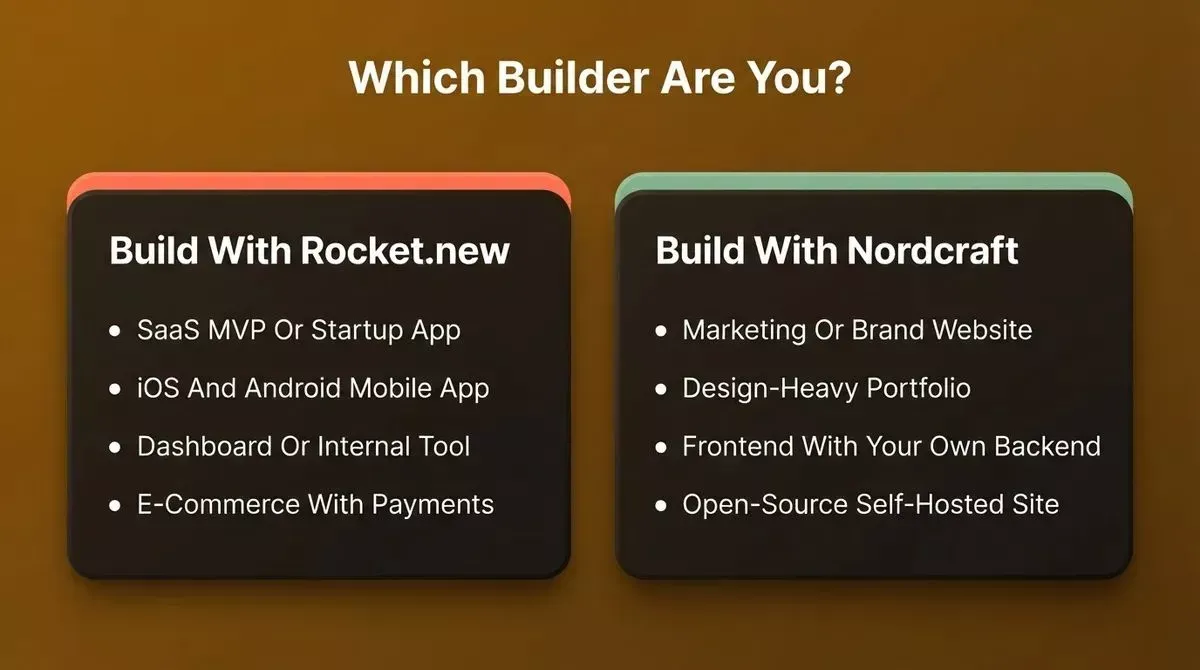 Use case self-selection: applications and mobile products belong in Rocket.new; design-led websites belong in Nordcraft.
Pricing Snapshot
Both platforms offer a free tier. The billing models are structurally different and reflect who each platform was built for.
| Plan | Rocket.new | Nordcraft |
|---|---|---|
| Free | 20 one-time credits, no credit card required | All editor features, Nordcraft branding, fair-use requests |
| Paid entry | From $25 per month (Pro plan, 100 credits per month) | $9 per month per project (Pro plan) |
| Higher tiers | Rocket at $50 per month (250 credits) and Booster at $250 per month (1,500 credits) | Not applicable |
| AI usage | Credits included in the subscription; extra credit packs on paid plans | AI credits sold separately: 200 for $10, 500 for $25 |
| Mobile builds | APK download included with paid plans | Not available |
| Custom domain | Included on paid plans | Included on Pro plan per project |
| Self-hosting | Source code download (.zip) and GitHub sync on paid plans | Free via open-source runtime |
| Enterprise | Contact Sales for SSO, data localization, premium support, and onboarding; unlimited team members on every plan | Custom billing, 99.99% SLA, priority support |
Rocket.new charges based on what you build.
It uses a credit-based model: a single balance covers app generation, research, and competitor monitoring, and usage depends on complexity. A landing page uses relatively few credits, while a CRM dashboard with filters, analytics, and roles uses considerably more.
Subscription credits roll over month to month while your plan is active (on yearly plans they reset at renewal), and generation pauses if the balance reaches zero until you add credits or your next cycle begins. Paid plans use per-workspace pricing with unlimited team members and no per-seat fees.
Nordcraft charges based on what you host.
Per-project billing scales predictably for agencies managing many client sites, and the unlimited collaborators model removes seat-cost concerns for larger teams.
For solo builders testing ideas, both free tiers let you start without paying anything. For teams scaling production applications, Rocket.new's credit model covers the build-and-deploy cycle in one workflow, but heavier projects should budget credits accordingly.
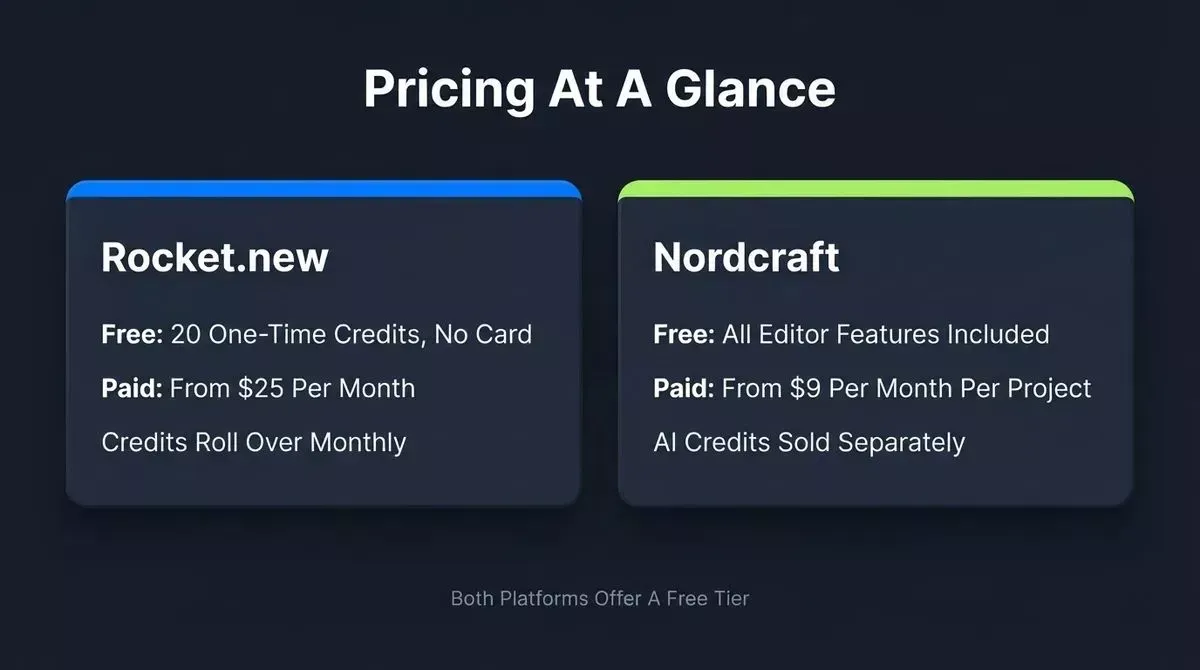 Two different billing philosophies: pay for what you generate vs pay for what you host.
Verdict: Which One Should You Choose?
The decision comes down to one question: are you building an application or a website?
If your project needs a database, user authentication, backend logic, payment processing, or a native mobile app, Rocket.new covers all of that from a single prompt and is the better fit when you want AI-powered tools for full-stack app development across web and mobile.
If your project is a marketing site, portfolio, or design-heavy frontend where you already manage your own backend, Nordcraft gives you more visual control over the output and is the better fit for website-focused visual editing.
For solo founders and product teams building applications that need backend logic and mobile support, Rocket.new fits because it generates the full stack in one workflow, making it a strong option for users coming from no-code tools who want minimal setup and a faster path from natural language prompts to a live app.
For agencies and designers building websites where every pixel matters, Nordcraft gives more control over the visual output.
When comparing Rocket.new against other visual development platforms, the pattern holds: when you need a complete application with a backend across multiple platforms, not just a frontend, Rocket.new is the stronger choice. Browse ready-made templates to see full-stack app examples, SaaS starters, and mobile app templates you can start from right now.
Rocket is the better fit for scalable AI systems and enterprise integrations, while Nordcraft remains stronger for frontend visual control.
"I want AI to do my laundry and dishes so that I can do art and writing, not for AI to do my art and writing so that I can do my laundry and dishes." - Joanna Maciejewska, as cited by the Nordcraft team
That sentiment captures why both platforms exist. Rocket automates the full stack so builders can focus on their product idea. Nordcraft automates the repetitive parts so designers can focus on creative expression.
Try Rocket Free: Start From a Simple Prompt
If your project needs backend logic, a database, user auth, payments, a native mobile app, or fast landing pages, Rocket.new is the platform built for exactly that. 1.5 million people have tried Rocket across 180 countries, from solopreneurs validating their first idea to enterprise teams running strategy and execution on the same platform.
Start building for free, with no credit card required and no coding required. Start from a simple prompt, see how AI generates a working app in minutes, and decide from there.
Table of contents
- -The AI App Builder vs Visual Web Builder Confusion
- -What is Rocket.new?
- -What you can build with Rocket.new
- -Integrations
- -What is Nordcraft?
- -Side-by-Side Comparison
- -Best Use Cases for Rocket.new
- -SaaS MVPs and Startups
- -Dashboards and Internal Tools
- -Mobile Apps for iOS and Android
- -E-commerce Stores
- -Existing Codebase Continuation
- -Best Use Cases for Nordcraft
- -Marketing and Brand Sites
- -Professional Developer Collaboration
- -Design-heavy Web Applications
- -Open-source and Self-hosted Projects
- -Pricing Snapshot
- -Verdict: Which One Should You Choose?
- -Try Rocket Free: Start From a Simple Prompt