Builder.io is a visual layer for apps that already exist. Rocket.new generates full-stack apps from scratch. The decision comes down to one question: do you already have a production codebase?
Builder raised $67M in April 2026 to build what they called "the first collaborative AI development platform where entire teams build together with agents." Then, five months later, they renamed both their products.
Here is what has not changed through any of the pivots or renames: Builder generates zero backend code. No database. No authentication. No server.
It is a visual layer that sits on top of codebases that already exist. If you are evaluating Rocket.new vs Builder.io full-stack app development, the first question that matters is whether you already have a production codebase.
What Builder.io Actually Does in 2026 (Post-Renaming)
Builder gives non-developers visual editing access to existing React and Next.js codebases. The company positions itself as a collaborative AI development platform for enterprise teams.
On September 10, 2026, CEO Steve Sewell announced that the company was renaming both of its products. The old names did not clearly describe what each product offered.
-
Fusion became Builder Code: the AI-powered visual IDE for teams building on real production code.
-
Publish became Builder Content: the visual CMS for content teams managing and personalizing web experiences.
-
Nothing about pricing, packaging, or functionality changed. Existing agreements stayed valid, and the rename carried no impact on workflows.
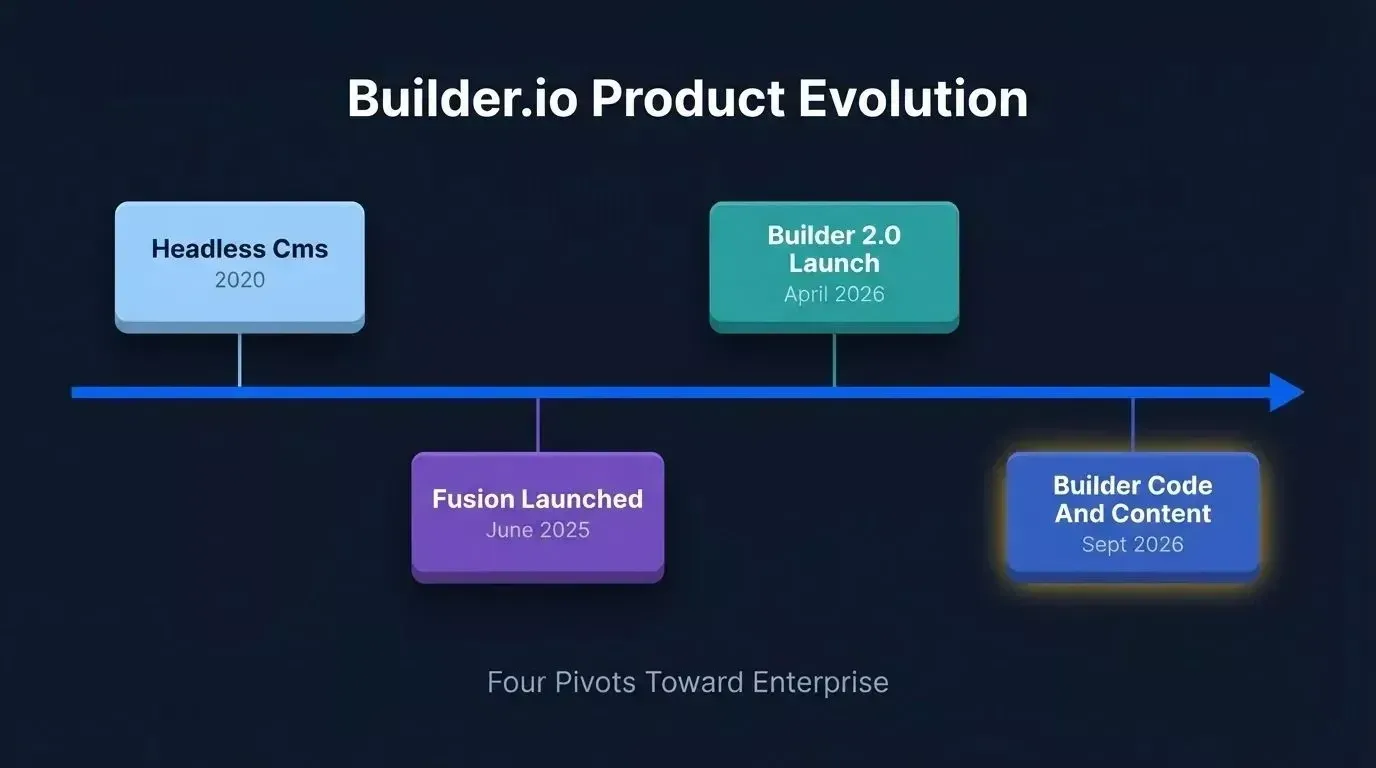
Builder has undergone four major pivots in six years, each one pointing further toward enterprise.
From Fusion and Publish to Code and Content
Builder Code now clearly signals a prompt-based coding environment where developers, designers, and product managers collaborate on the same codebase. Builder Content signals structured content management with AI-powered tools for live editing, preview, scheduling, and personalization.
Builder 2.0 (April 2026) introduced simultaneous editing for PMs, designers, and engineers with real-time visibility, parallel agent execution, and AI-powered PR review. For large, cross-functional teams already in production, this collaboration model is difficult to replicate elsewhere.
The company's SOC 2 Type II compliance badge, enterprise security page, and role-based permissions all point the product toward large organizations rather than solo builders.
The Founding Question: Do You Already Have a Codebase?
This is the decision tree entry point. Everything else in this comparison follows from the answer to one question.
Do you already have a production Next.js or React codebase?
Builder platform full value requires a specific setup sequence before any non-developer can independently edit a page:
-
An existing Next.js, React, Vue, Svelte, Angular, or Qwik project
-
SDK installation and framework configuration
-
Manual registration of existing components
-
Content management layer configuration
-
Marketing team training on the visual editor
Builder works best when teams already have reusable components and real components in the codebase for the visual layer to map onto.
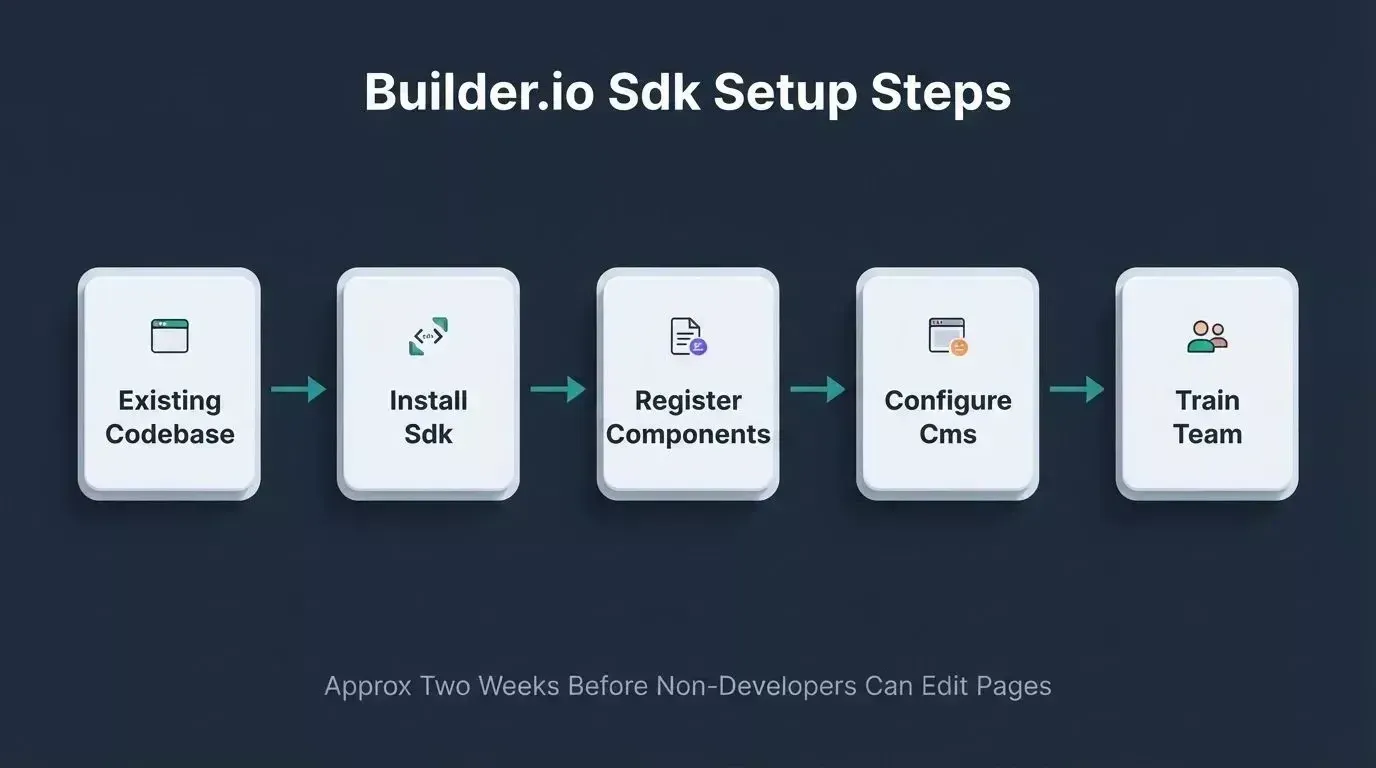
The SDK setup sequence takes approximately two weeks of engineering time before a non-developer can independently edit a single page.
For many teams, this setup takes one to three weeks of engineering time. That investment makes sense when you have a complex existing codebase and need to give non-technical teams speed. It aligns better with a product team than a solo builder because it depends on the team's workflow around that existing codebase. It does not make sense when you are starting from zero.
If you have a production app with a mature design system, Builder adds tremendous value. If you are starting from zero, it adds overhead with nothing to layer onto.
What Builder Generates vs What Rocket Generates
This is the clearest line in the comparison. The two platforms produce fundamentally different outputs.
Builder.io output:
-
React, Next.js, or Vue frontend component code
-
Content records in Builder's JSON schema
-
Visual page layouts from registered component blocks
-
Figma-to-component mappings (via Visual Copilot)
Rocket.new output:
-
Next.js frontend with server components, API routes, and responsive layouts
-
Supabase PostgreSQL database with schema and row-level security
-
Authentication system generated by default
-
Stripe payment integration
-
Flutter mobile app for iOS and Android
-
Deployment pipeline with staging, custom domains, and HTTPS
Builder.io's own community forum confirms the scope: "Builder is not designed to create web services or microservices."
There is no database layer, no authentication system, no server-side logic, and no API route generation. The backend of your application is your responsibility.
For teams building a new full-stack application from scratch, Rocket's backend architecture generates everything in one pass, no setup required before you can start.
Visual Copilot: Builder.io's Strongest Argument
Builder.io's Visual Copilot is the most sophisticated Figma-to-code tool in the market for one specific scenario: teams with mature design systems and existing component libraries, where Figma design files need to map cleanly into existing code components.
What makes it technically differentiated:
-
Design-system-aware component mapping. Visual Copilot maps Figma components to your existing registered code components, generating component-reusing code rather than duplicated markup; that matters even more when teams are extending existing codebases in production and want maintainable code.
-
Bidirectional Figma sync. Design changes can merge without overwriting code edits, allowing design and engineering to iterate in parallel.
-
Real data binding during generation. API connections wire into generated components during Figma import, not as a post-processing step.
For companies with years of production code and a mature component library, component drift is a real problem. Visual Copilot is the best solution on the market for this specific issue.
For teams starting from scratch, converting Figma designs to production code is a different problem. Builder platform is stronger when those design assets need to align with shared components, while Rocket imports Figma files for rapid prototyping and can turn them into a working app without relying on a pre-existing component library.
The CMS Situation: What Changed in 2026
Builder Content is now enterprise-only for all new customers since January 2026.
The self-serve Basic, Growth, and Pro tiers no longer exist for new signups. Accessing the headless CMS requires a sales conversation with no published pricing, and Builder Content is aimed at teams managing landing pages and marketing pages with dynamic content, not teams seeking a general app builder.
Teams evaluating Builder for content management will need to initiate a sales process to get pricing, timelines, and contract terms before they can begin using the product. That enterprise process is also where collaboration features and broader collaboration tools are typically scoped. Rocket's pricing is fully self-serve and published at every tier.
Pricing: Per-Seat vs Flat
The pricing models reflect the different audiences each platform serves.
| Plan | Builder Code | Rocket |
|---|---|---|
| Free | $0, 60 monthly credits, 15 daily cap, admin-only roles | $0, 20 credits, one-time |
| Entry paid | Pro: $24/user/month, 500 credits | $25/month flat, unlimited seats |
| Mid tier | Team: $40/user/month, 500 credits | $50/month flat, unlimited seats |
| High tier | Enterprise: custom, sales required | Booster: $250/month flat, unlimited seats |
| CMS access | Enterprise-only, sales required for new customers | Not a CMS platform |
| Additional credits | $25 per 500 credits | Included in plan |
For broader pricing comparison context, token-based competitors like Bolt advertise a Free tier with 1M tokens per month, a Pro plan at $25/month with 10M tokens, and a Teams plan at $30/member/month billed monthly.
Agent credit opacity: Builder defines credits as "a fixed dollar value" but does not publish what that value is. The actual cost of intensive AI use on Builder Code is unknowable without a sales conversation.
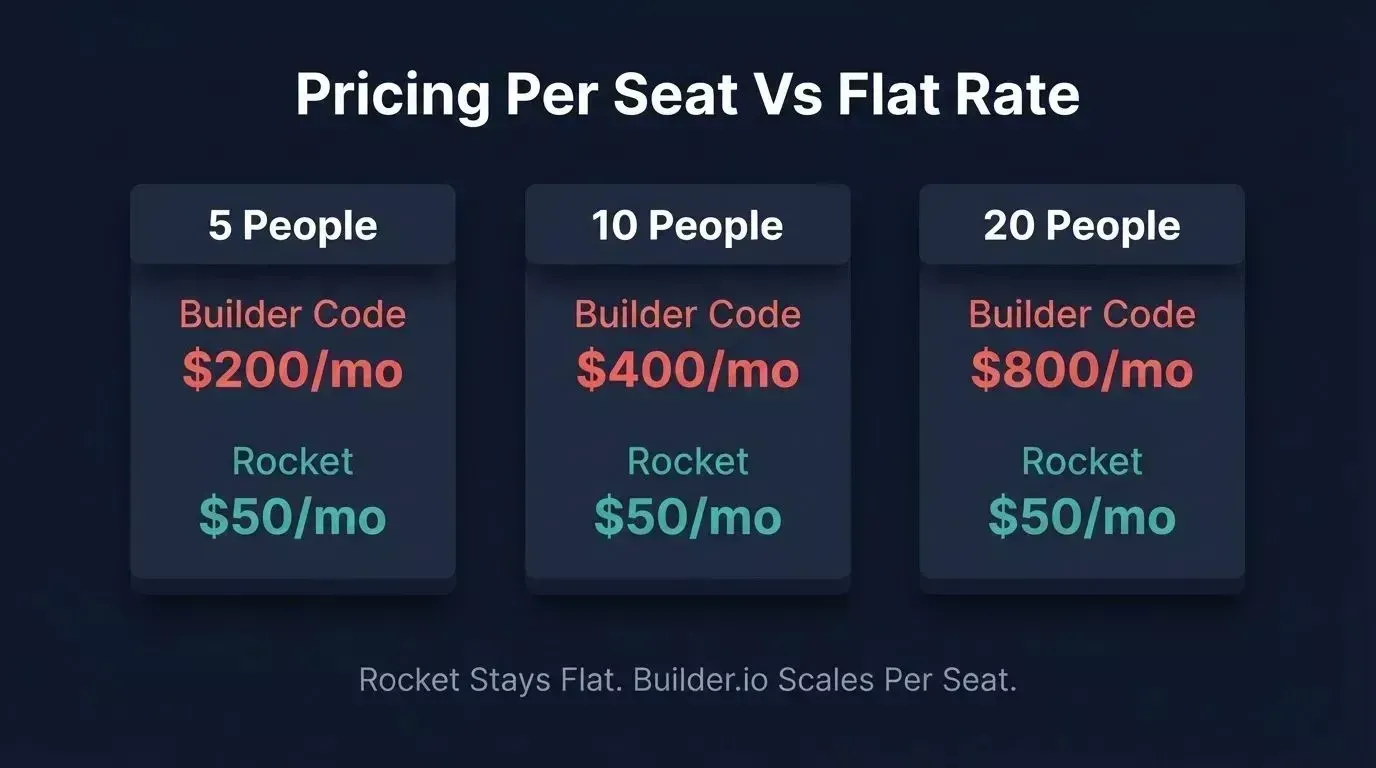
A 20-person team on Builder Code Team pays $800/month for builder access alone, before any CMS cost. Rocket stays at $50/month regardless of headcount.
Seat scaling is the critical difference in this pricing comparison.
A 10-person team on Builder Code Team pays $400/month. A 20-person team pays $800/month. Rocket does not move with headcount; the same $50/month covers a team of 20 as it does a team of two.
How Rocket Generates a Full-Stack App From One Prompt
Rocket is an AI app builder for app building that generates full-stack applications from a natural language description.
You describe what you want to build, and the platform generates the frontend UI, backend logic, database schema, authentication system, and deployment configuration in one session, so you can go from prompt to custom code without manually writing code for the initial stack.
-
Web apps ship in Next.js with server components, API routes, responsive layouts, and SEO-ready structure with WCAG accessibility compliance and GDPR coverage by default, plus instant deployment to Netlify or custom domains and seamless integration with backend services already configured in the generated stack.
-
Mobile apps ship in Flutter: a single Flutter codebase produces both iOS and Android applications with real design systems, dark and light theming, and fluid navigation.
-
Supabase powers the backend: database tables, row-level security, authentication flows, and file storage connect automatically during the build.
-
25+ connections ship with every build: Stripe, Google Analytics, Anthropic, OpenAI, Mailchimp, and 20 more services authenticate once and flow into every project.
*"Rocket.new allows users to create full production-ready apps from natural-language prompts." — *Analytics India Magazine
1.5 million people across 180 countries have tried Rocket. The platform is backed by Salesforce Ventures and Accel. The full production workflow runs from first description to a deployed, live product in one platform for internal tools as well as customer-facing products.
Side-by-Side Feature Comparison
| Feature | Builder (Code + Content) | Rocket |
|---|---|---|
| Web app generation | Frontend visual editing only | Full-stack Next.js from prompt |
| Mobile app generation | Not supported | Flutter for iOS and Android |
| Backend and database | Not included, bring your own | Supabase built in with schema and auth |
| Authentication | Not included | Generated by default |
| Deployment | Not included | One-click staging and production |
| Figma import | Design-system-aware Figma-to-component code | Figma designs to working full-stack apps |
| AI agents | AI coding agents for front end only | Natural language prompts for full stack |
| GitHub sync | Full git workflow with a connected GitHub repository or GitHub repo | Two-way GitHub sync |
| Custom domains | Not included | Built-in with HTTPS |
| Pricing model | Per user per month | Per workspace, unlimited team members |
| Design system | Reuses your registered components | Generates design systems automatically |
| Content management | Builder Content (enterprise CMS, sales required) | Not a CMS platform |
| MCP server | Builder Content MCP for agentic content workflows | Not applicable |
| Existing codebase | Required | Not required |
| Visual editor | Drag-and-drop editing to view layouts from registered components | Not included |
| Target user | Teams with existing production codebases | Teams building new applications |
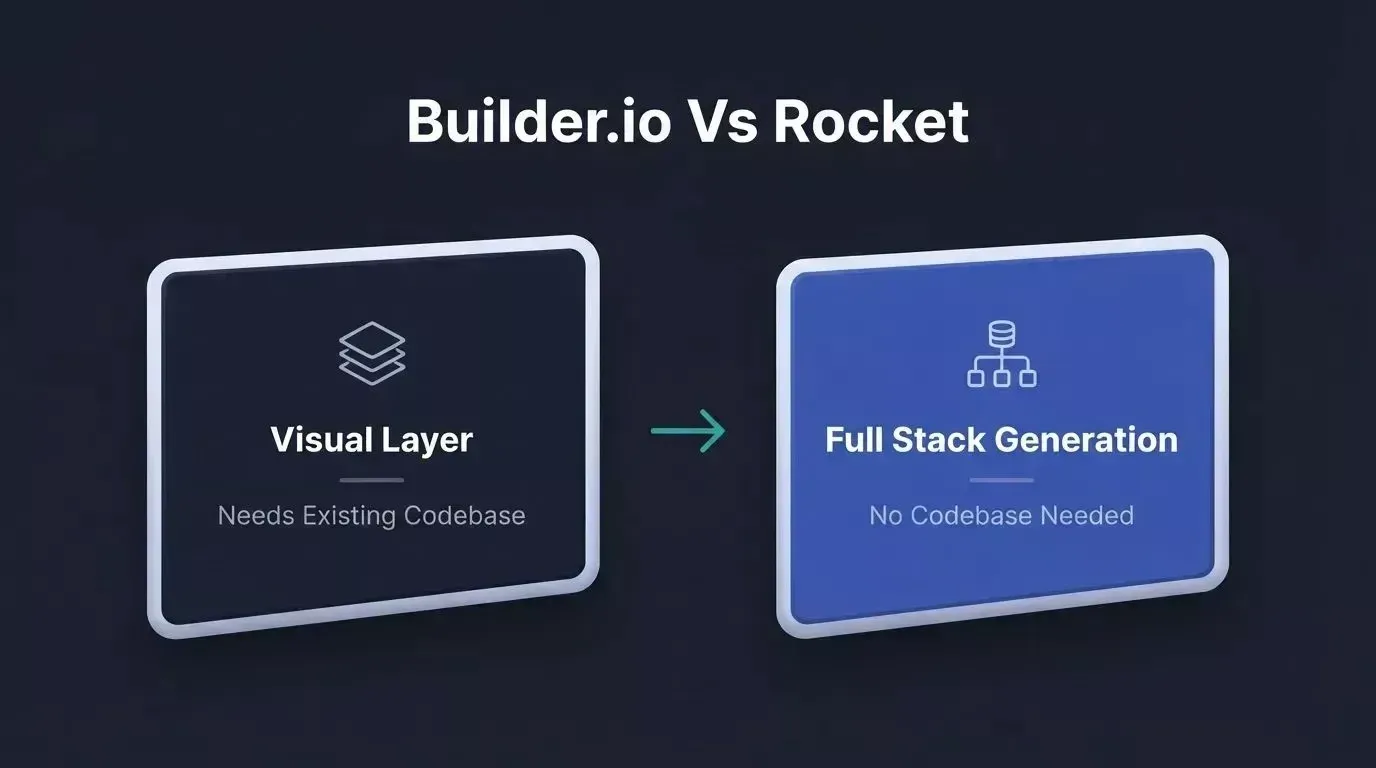
Builder adds a visual editor on top of apps that already exist, while Rocket is built to get you to a deployed app faster from a description.
Where Builder Platform Is the Right Tool
Builder is genuinely best-in-class for a specific scenario. If your situation matches the following, Builder is worth serious evaluation:
-
Large teams with existing React or Next.js production codebases that need to give content teams direct front-end editing access without opening a PR
-
Content operations teams publishing 50+ landing pages or marketing pages per month who need editor autonomy and built-in A/B testing
-
Companies with mature design systems where component drift between Figma and production code is a real problem
-
Organizations that have already invested in a component library and need to preserve that investment
-
Enterprise teams that can absorb per-seat pricing and need SOC 2 Type II compliance, RBAC, SSO, custom Docker images, enterprise-grade security, audit logs, and version control
If your team already has a production app, Builder.io alternatives are worth comparing before committing to the enterprise pricing conversation.
Where Rocket Is the Right Tool
Rocket is the right choice when the product you want to build does not yet exist:
-
Teams building a new full-stack product from scratch with no existing codebase, especially when rapid prototyping matters and there is no engineering setup phase
-
Founders who need backend, mobile, and frontend from one generation without managing separate infrastructure
-
Teams where per-seat pricing would compound as headcount grows: flat-rate workspace pricing is a meaningful cost advantage at scale, especially for a solo builder or small team before headcount grows
-
Builders who need research (Solve), competitive monitoring (Intelligence), and AI tools in the same workflow as the build
-
Agencies generating complete applications for clients from prompts, Figma files, or briefs
The Decision Framework
The comparison resolves to four questions. Answer them in order.
Are you managing content for an existing app? Builder Content may be the right answer, but be prepared for an enterprise sales conversation with no published pricing.
Are you building a new product? Rocket is the starting point, no codebase required, no per-seat fees, and the full stack ships from one prompt.
Final Verdict
Builder is the most sophisticated visual development layer for existing enterprise React codebases. Visual Copilot is genuinely best-in-class for design-system-aware Figma-to-code. If you have a production app, a mature component library, and a content team that needs editor autonomy, Builder delivers real operational value. Just be prepared for the enterprise pricing conversation and the two-week engineering setup before that value is accessible.
Rocket is the right choice for building a new full-stack application from scratch. Mobile-first products, teams who want predictable flat-rate pricing on a complete stack, and builders who want research and competitive intelligence in the same workflow as the build will find Rocket the faster, more complete option.
Build your full-stack app from scratch with Rocket.new, no codebase required, no per-seat fees. Free to start.
Table of contents
- -What Builder.io Actually Does in 2026 (Post-Renaming)
- -From Fusion and Publish to Code and Content
- -The Founding Question: Do You Already Have a Codebase?
- -What Builder Generates vs What Rocket Generates
- -Visual Copilot: Builder.io's Strongest Argument
- -The CMS Situation: What Changed in 2026
- -Pricing: Per-Seat vs Flat
- -How Rocket Generates a Full-Stack App From One Prompt
- -Side-by-Side Feature Comparison
- -Where Builder Platform Is the Right Tool
- -Where Rocket Is the Right Tool
- -The Decision Framework
- -Final Verdict