
Rocket.new enables teams to build full apps collaboratively using AI prompts with no coding required. Replit is better suited for developer teams needing full control, coding workflows, and multi-language support. Choose Rocket.new for speed and simplicity, or Replit for structured, code-first collaboration.
What actually separates these two platforms for team workflows?
When choosing between Rocket.new and Replit for teams, which is better for collaborative development comes down to one divide: does your team build apps, or write code that builds apps?
92% of developers already use AI tools at work or in their personal time. So choosing the right platform is no longer about whether to adopt AI. It is about which one fits the job your team actually does.
Rocket.new generates full web apps and mobile apps from a single prompt. Replit gives engineers a full IDE to write code with AI layered on top. Both are AI-driven app builders. Both have an AI agent and a free tier. The workflows differ completely. Among app builders, these two platforms represent opposite ends of the AI abstraction spectrum.
So, which is the right tool? Let's break it down.
What Each Platform Actually is
Both platforms use AI to help teams ship faster. But the abstraction sits in very different places.
Rocket.new: The AI-Powered App Generator
Rocket.new is an AI-powered app builder that converts natural language into production-ready applications with no coding required. Non-developers and fast-moving teams describe what they want in plain text and get a working, deployed app back in minutes.
It covers web applications, mobile apps, and internal tools through prompt-to-app generation alone. There is no environment to configure and no manual coding involved in the standard workflow.
It is a vibe coding platform at its core. The platform handles code generation, logic, and deployment for you. Overall, Rocket.new excels at turning ideas into clickable prototypes in minutes, focusing on speed and accessibility.
Replit: The Full Cloud IDE
Replit is a browser-based IDE that wraps a complete development environment around a collaborative code editor, serving as the development hub for teams.
Experienced developers use it for everyday tasks across 50-plus programming languages, including multi-language projects with mixed tech stacks.
Replit AI adds AI features on top: AI assistance, inline suggestions, debugging tools, and version control all inside one platform.
Dev teams that want to own their codebases use Replit for complex enterprise applications requiring long-term maintenance.
Key Features: Replit vs Rocket.new at a Glance
Here is a direct comparison of key features across both platforms. As app builders go, the gap in approach is significant.
| Feature | Rocket.new | Replit |
|---|---|---|
| AI app builder | Prompt-to-app, full generation | AI assistance on hand-written code |
| Mobile apps | Flutter (native mobile apps) | Limited mobile support |
| Web apps | Next.js, full-stack | Yes, multi-language |
| Real-time collaboration | Built-in | Multiplayer mode |
| Git/source control | Yes | Yes, Git |
| Code export | Yes, full code download | Full code access at all times |
| In-browser IDE | No | Yes |
| Supported languages | Flutter, Next.js | 50+ |
| Custom domains | Yes, on paid plans | Yes, on paid plans |
| Free tier | Yes, prompt-to-app included | Yes, 1 published app limit |
| Paid plans | From $25/month | From $20/month |
| Deployment tools | One-click | Configurable |
So, Rocket.new leads on speed and prompt-to-app delivery. Replit leads in code control and language breadth.
How the AI Works on Each Platform
The AI capabilities look similar on paper but produce very different day-to-day results.
Replit AI: Code Assistance Inside the IDE
Replit AI acts as a cloud IDE AI agent inside the development platform, providing live code help on existing code: suggesting edits, catching bugs, and generating new features.
The AI-assisted coding model means developers write code by hand and let Replit AI fill gaps, improve code quality, and speed up output. The platform runs on models including Claude Code and GPT-4o, with usage billed from a monthly credit pool.
Replit's Core plan delivers $25 in monthly credits consumed by Agent usage at variable rates, making total costs difficult to predict. Some active teams report spending far beyond their base plan.
Rocket.new AI: Full App Generation From Prompts
Rocket.new takes an AI app generator approach rather than an AI-assisted development model.
You submit natural language prompts, and the platform's AI builds the complete generated code for you. No code editing loop is required between prompt and deployment.
This approach is what makes Rocket.new one of the best Replit alternatives for teams where speed to launch matters more than touching the generated codebase directly.
Code Quality and Who Controls the Code
Code quality is where these two platforms split most clearly.
Replit gives dev teams full control and direct visibility into every line, with workflows built around code reviews, pull requests, and maintainability over time. Engineers can enforce code quality standards because they write and review everything.
Replit is better suited for projects that will be maintained beyond the initial build due to its full development environment.
The generated code from Rocket.new targets are working, deployable, and have fast output quality. For non-technical founders validating an idea, that trade-off is often fine at launch.
The key constraint here is directional. Your generated codebase from Rocket.new can move into any IDE. But existing code from Replit cannot be imported into Rocket.new AI generation system.
Collaborative Development Workflows
Both platforms support teams, but the collaboration model is completely different.
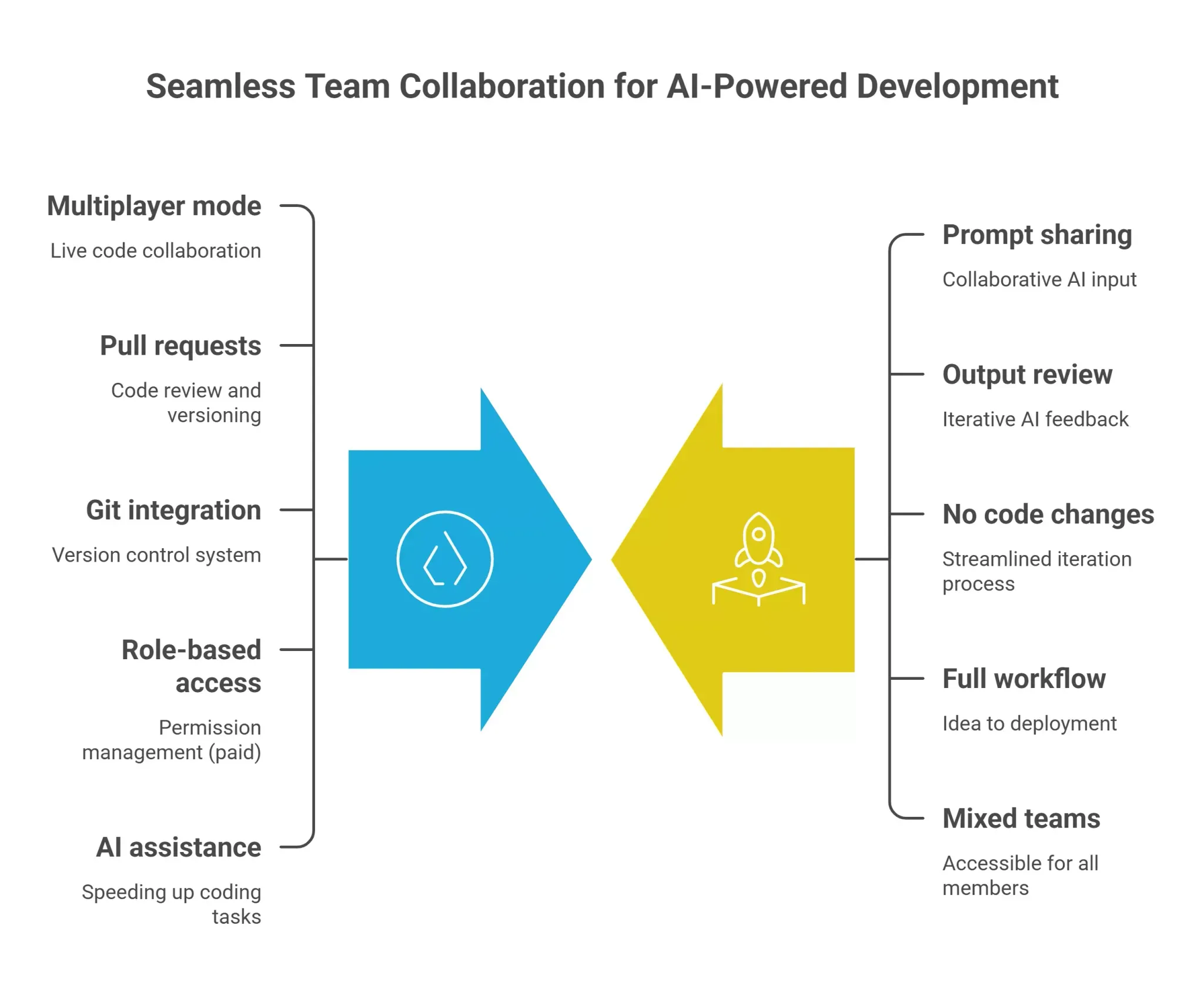
Replit's Multiplayer mode enables real-time collaboration on live code, with pull requests for code reviews and version control through Git. Role-based access is available on paid plans.
For full-stack projects where dev teams write code together with AI assistance, this is a structured setup that mirrors standard coding workflows with speed gains from Replit AI.
Rocket.new builds collaboration into the AI-assisted development loop itself. Teams share prompts, review outputs, and iterate without touching the underlying code.
One platform covers idea, AI generation, and deployment with no context-switching. This makes Rocket.new the stronger pick in Replit vs Rocket.new comparisons where the team mixes technical and non-developer members.
Pricing: Replit vs Rocket.new
Pricing is where the difference becomes concrete for teams comparing paid plans.
| Category | Rocket.new | Replit |
|---|---|---|
| Pricing Model | Fixed, token-based pricing with predictable usage | Effort-based pricing (credits consumed per task) |
| Free Tier Access | Generous free tier with real prompt-to-app capability and AI tools access | Limited free tier with restricted AI and usage |
| Free Tier Limits | No single-app cap, no link expiry, enough tokens to test full concepts | Only 1 published app, deployment links expire after 30 days |
| AI Usage in Free Plan | Full access to an AI-powered app generation from prompts | Replit AI is available only in trial mode |
| Starting Paid Plan | $25/month (Personal plan) | $20/month (Core plan billed annually) |
| What Paid Plan Includes | 5M rollover tokens, private projects, full code download, AI generation | $25 monthly credits covering AI, hosting, storage, and data transfer |
| Usage Predictability | Highly predictable due to fixed token allocation and rollover system | Unpredictable due to credit consumption per action/task |
| Overage Costs | Controlled usage via tokens; easier to manage and forecast | Automatic pay-as-you-go once credits are exhausted |
| Cost Efficiency at Scale | Typically, 30–50% cheaper for teams building frequently | Costs increase quickly with heavy AI usage and agent loops |
| AI Cost Structure | Optimized via templates and structured generation (fewer wasted tokens) | Credits consumed even for failed or repeated AI attempts |
| Deployment Costs | Included in platform flow with no hidden usage spikes | Included but deducted from the shared credit pool |
| Best For Budgeting | Teams needing consistent, predictable monthly costs | Developers are okay with variable billing based on usage |
| Overall Value | High value for frequent builders and full app generation workflows | Better for light usage and experimental coding sessions |
Key Takeaway
-
Rocket.new offers predictable, token-based pricing with rollover, making it ideal for founders and non-developers, pricing scalable with real value in its free tier, and lower cost at scale.
-
Replit provides flexibility but introduces billing uncertainty, especially for teams relying heavily on AI. Replit's pricing structure can lead to higher costs for projects that require extensive use of the AI Agent due to variable credit consumption.
For teams building regularly and shipping products, Rocket.new delivers better cost control and long-term value.
Who Does Each Platform Serve Best
Non-Developers, Founders, and Fast Dev Teams
Rocket.new is built for non-developers and teams that need to ship without a traditional coding workflow.
The vibe coding approach, rapid prototyping support, and fast app generation bring the time from idea to live product down dramatically. Mobile applications via Flutter and web apps via Next.js are both covered under one roof, with zero environment setup required.
Landing pages, internal dashboards, MVPs, and complex apps are all reachable for users with no coding background.
Engineers on Complex, Long-Running Projects
Replit suits teams where engineers need direct control over production-ready software that will be maintained and scaled.
The platform handles daily coding tasks, AI assistance, and development across dozens of programming languages. Teams building autonomous development systems prefer Replit's advanced features for the long haul.
What People Are Saying
On Reddit, a user in the r/vibecoding community shared their experience building with Rocket.new:
"Rocket.new is surprisingly smooth for creating internal tools. The AI agent setup saves me hours of boilerplate work and the vibe coding interface is pretty addictive."- Source
This matches what most teams find when they move away from manual build cycles. Rocket.new removes the steps between idea and shipping. Rocket.new's community is expected to grow as the platform matures.
How Rocket.new Handles Collaborative App Development
For teams running a Replit vs. Rocket.new comparison and weighing speed against codebase ownership, Rocket.new delivers a single build environment from concept to a deployed application, without tool-switching.
It is not just an AI app builder. It is a full AI-powered vibe solutioning platform with AI generation and one-click deployment built in together.
Key features:
Here are the features Rocket.new brings to collaborative team development:
-
Vibe-solutioning platform, from prompt to production-ready applications
-
25,000+ templates library, free to use, to save time on every build
-
Saves up to 80% of tokens compared to prompting from scratch
-
Supports Flutter for mobile apps and Next.js for web apps
-
Collaboration features and custom domains are included in higher plans
Use cases where Rocket.new fits teams:
-
Building landing pages, web apps, and dashboards without a full development environment
-
Mixed teams working without technical bottlenecks
-
Rapid prototyping before committing engineering resources
-
Founders who need production apps fast, with a downloadable codebase for later customization
Which Platform is Right for Your Team?
In the replit vs. Rocket.new decision, the answer comes down to one question: does your team need code control or app speed?
Rocket.new fits teams that want to move from idea to a working app in hours, skip traditional development setup, and keep costs predictable with a token-based pricing model.
Replit fits teams where engineers code directly for demanding projects, need pull requests and code reviews, and want long-term ownership of their codebase. Both have a free tier and shared-credit billing. The difference is how much your team wants to control the code that comes out.
Table of contents
- -What Each Platform Actually is
- -Rocket.new: The AI-Powered App Generator
- -Replit: The Full Cloud IDE
- -Key Features: Replit vs Rocket.new at a Glance
- -How the AI Works on Each Platform
- -Replit AI: Code Assistance Inside the IDE
- -Rocket.new AI: Full App Generation From Prompts
- -Code Quality and Who Controls the Code
- -Collaborative Development Workflows
- -Pricing: Replit vs Rocket.new
- -Key Takeaway
- -Who Does Each Platform Serve Best
- -Non-Developers, Founders, and Fast Dev Teams
- -Engineers on Complex, Long-Running Projects
- -What People Are Saying
- -How Rocket.new Handles Collaborative App Development
- -Which Platform is Right for Your Team?