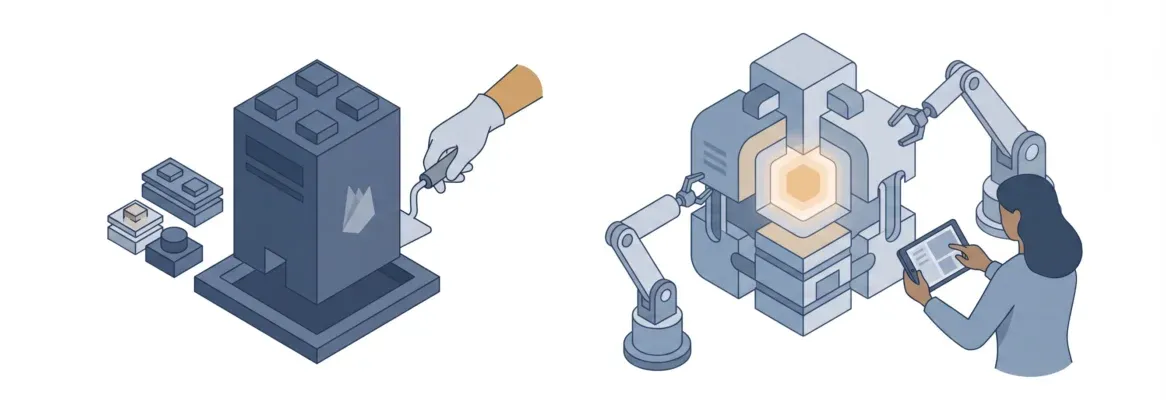
Rocket.new builds full-stack apps from a single prompt, making it ideal for fast product launches. Windsurf AI is designed for developers who want deep AI assistance inside a coding environment. Choose Rocket.new for speed and simplicity, or Windsurf AI for control and advanced coding workflows.
What is the real difference between an AI app builder and an AI code editor?
Both use AI. Both promise faster software delivery. But they serve different users, solve different problems, and produce very different results. Understanding that gap makes the choice obvious.
The direct answer: Rocket.new takes you from natural language to a deployed, production-ready product. Windsurf AI is an AI-powered development environment built for developers who write code every day and want a smart coding assistant inside their existing workflow.
Choosing between them comes down to what you are actually trying to build, and who is doing the building.
What Vibe Coding Really Means in 2026
Vibe coding has moved from developer Twitter into mainstream product culture. Instead of writing code manually, you describe what you want in natural language, and AI generates the code for you. That shift has changed who can build apps and how fast they can do it.
- According to the 2025 Stack Overflow Developer Survey, 51% of professional developers now use AI tools daily, and that number keeps rising across 2026.
- Over 76% of developers are already using or planning to use AI coding tools in their workflow.
Vibe coding tools allow users
- Vibe coding tools are designed for users who want to go from idea to a live app using natural-language prompts alone rather than traditional code.
- Significantly reducing manual coding.
The trend toward end-to-end app creation driven entirely by natural language is already well underway.
Not all vibe coding tools are built the same. In 2026, they were divided into two distinct types:
- Full-stack AI app builders take a natural language prompt and produce a complete product, including frontend, backend, APIs, and deployment.
- AI-assisted coding tools sit inside a developer's existing workflow and accelerate code generation without automating the entire build.
Rocket.new belongs in the first category. Windsurf AI belongs firmly in the second.
Overall, the AI tool ecosystem is maturing rapidly, with monthly updates bringing meaningful improvements and expanding free tiers.
Rocket.new: The Full-Stack AI App Builder
Rocket.new is a vibe solutioning platform powered by an AI-powered multi-agent pipeline. It does not generate code snippets for you to paste somewhere. It generates complete products.
You describe your app in natural language, and the platform builds the frontend, backend logic, database connections, and deployment pipeline without requiring any technical background from you. For non-developers, founders, and small teams, this is the most direct path from idea to working product available in 2026.
How it Converts Natural Language Prompts into a Working Product
The path from idea to deployed product at Rocket.new follows a clear flow. You type a prompt describing your app idea. Rocket.new's AI agents break the build into parallel tasks across the product layers. Frontend, backend logic, quality checks, and deployment run simultaneously. The result is a fully deployed live app, not a prototype sitting in a preview window.
Rocket.new also accepts more than a written description as a starting point. You can import a Figma design and convert it directly into working code, paste a URL to reimagine or recreate an existing site, upload a screenshot or wireframe, or choose from over 25,000 production-ready templates.
What Rocket.new Actually Builds
Rocket.new covers a broad range of product types:
- Full-stack web apps with authentication, payments, and database connections
- Internal tools for operations, CRM workflows, and team dashboards
- Landing pages with hosting, design, and custom domains included
- Mobile apps built on Flutter for iOS and Android app stores
- Complete web applications for SaaS products, e-commerce, and customer portals
Rocket.new generates frontend, backend, and database structure from simple descriptions, allowing you to build a complete app in minutes. It connects to over 29 services, including Stripe, Supabase, and OpenAI, supporting full-stack application development without requiring engineering expertise from your team.
The Specialized AI Agents Behind Every Build
Rocket.new uses specialized AI agents that work in parallel across different stages of every build. One agent handles component generation, layout, and code generation. One manages backend logic and API wiring. One validates the AI-generated code before deployment. One handles performance optimization at the build level.
This multi-agent model produces better code quality and production-ready code than single-model generation because each AI agent reviews the output of the others before anything reaches you. Rocket.new allows users to click and tweak elements directly in a visual editor. For non-developers who cannot review the code themselves, this built-in validation matters enormously.
Tech Stack and Framework Compatibility
Framework compatibility matters for long-term use. Rocket.new builds web apps on Next.js, one of the most widely used production web frameworks. Mobile output targets both iOS and Android app stores through Flutter. You own the code with no vendor lock-in.
Rocket.new's Free Tier
Getting started costs nothing. The free tier gives access to the core vibe coding flow with no credit card required. The free plan covers natural language prompts, AI-generated code output, component generation, and basic app building. Paid plans unlock greater build volume, custom domains, and expanded AI features for larger projects.
For solo founders validating a concept, the free tier is enough to produce a real, deployable product.
What Rocket.new Does Not Do
Rocket.new is not a line-by-line AI coding assistant for developers who want precision control over every file. Professional developers wanting IDE-level help should look at tools built for that purpose. Rocket.new is optimized for shipping complete apps fast, not for guided AI-assisted coding sessions inside an existing codebase.
Windsurf AI: The AI-Powered Development Environment
Windsurf AI, built by Codeium, is an AI-powered development environment that puts AI at the center of a full-featured code editor. It is an AI-first code editor rebuilt around an agentic AI system called Cascade, not a plugin on top of VS Code.
The Cascade Agent: Windsurf's Core Feature
Cascade reads your entire codebase, not just the open file. It plans multi-file editing across large repositories with genuine context awareness. It runs terminal commands, handles code generation at scale, installs packages, and iterates on errors automatically.
This makes Windsurf AI behave less like a suggestion engine and more like an AI assistant that actually understands what you are building at the project level.
What Windsurf AI Does Well
Windsurf is strongest in the kind of work experienced developers do every day on real codebases:
- Cross-file editing that respects existing patterns and architecture
- Generated code that aligns with your repository structure
- Autonomous task planning for multi-step development work
- Full context awareness of the entire project, not just the current file
Windsurf integrates directly with popular IDEs and version control systems, enhancing collaboration among developers. Its AI assistant provides context-aware suggestions, improving the reliability of code generation. Windsurf is noted for its ability to maintain code quality across multiple files, making it suitable for larger projects.
Pricing After March 2026
Windsurf moved to a quota-based system in March 2026. The free tier provides 25 monthly credits. New subscribers pay $20 per month. Higher tiers reset daily and weekly usage quotas for predictable spending. Heavy AI coding sessions will hit the quota ceiling quickly.
Enterprise Features
For teams in regulated industries, Windsurf's enterprise features stand out among AI tools. FedRAMP, HIPAA, and ITAR compliance certifications are already in place. Role-based access control covers larger development teams. Unlimited users are available on enterprise plans. Enterprise-grade security meets the requirements of financial services, healthcare, and government teams.
Agent Mode and Autonomous Execution
Windsurf's agent mode takes the platform beyond autocomplete. It plans the approach before generating any code, handles backend setup tasks, runs debugging cycles, and self-corrects. Turbo Mode lets Cascade execute terminal commands without prompting for approval at each step.
What Windsurf AI Does Not Do
Windsurf is a code editor with AI capabilities. It is not an app builder. Deployment and hosting are not handled natively. Custom domains and production delivery require connecting external services. Non-developers without a programming background will find the workflow too technical to navigate productively.
Head-to-Head Feature Comparison
| Feature | Rocket.new | Windsurf AI |
|---|---|---|
| Primary user | Non-developers, founders, teams | Developers who code daily |
| Core type | Full-stack AI app builder | AI-first code editor |
| Vibe coding approach | Prompt to complete product | AI-assisted coding inside the IDE |
| Backend setup | Fully automated | Manual with AI assistance |
| Visual editor | Yes, built-in | No |
| Custom domains | Yes, included | Not native |
| App stores output | Yes, Flutter for iOS and Android | Not built-in |
| Free tier | Yes, completely free to start | Yes, 25 monthly credits |
| Multi-file editing | Managed by parallel AI agents | Cascade-driven across files |
| Version control | Built into the build flow | Native git integration |
| Enterprise features | Enterprise-grade security | FedRAMP/HIPAA/ITAR certified |
| Coding knowledge needed | None required | Required |
| Language support | Next.js, Flutter | Multiple programming languages |
Code Quality: What Each Platform Produces
Code quality is where both platforms diverge most. Both use AI, but the output differs in structure, control, and purpose.
Rocket.new
Rocket.new's AI agents validate AI-generated code before it reaches deployment. These agents check each other's output for consistency and errors. Performance optimization happens at the build level, not as a manual step afterward. The target is production-ready code, not just a working preview.
Windsurf AI
Windsurf produces generated code that slots into your existing project. Cascade reads the repository before generating, so the AI assistant maintains consistency with your existing patterns. Code quality improves when the underlying codebase follows clear conventions. For experienced developers with strong discipline in their codebase, Windsurf's context-aware output integrates cleanly into what already exists.
Both platforms share the same challenge every Vibe coding tool faces. AI coding tools are capable of handling a higher percentage of boilerplate and scaffolding effectively. Products with layered complex business logic still need human review and judgment.
Code quality degrades as products grow without architectural guidance. Vibe coding eliminates manual coding on boilerplate. It does not replace the need for engineering judgment on harder problems.
Who Gets the Most From Windsurf AI
- Non-developers and first-time builders find Rocket.new the most direct path from idea to working product. No coding knowledge or programming background is required at any step. Natural language prompts drive the entire process, designed for people who think in outcomes, not folder structures and package managers.
- Solopreneurs and small startup teams without engineering staff get real leverage from Rocket.new. Backend setup happens automatically, full-stack apps come out of a single prompt-driven build session, and the entire workflow runs in the browser with minimal setup needed.
- Teams building internal tools find a clear use case in Rocket.new's AI-powered build pipeline. Approval flows, data dashboards, and operations workflows all fit, with API connections and database wiring handled automatically.
- Rapid prototypers benefit from real, deployable products, not throwaway mockups. Functional prototypes allow real user feedback before larger investment, and build cycles that would normally take weeks, to be compressed into hours.
- Builders launching web presence get landing pages with hosting, design, and domain configuration included, while web apps come with backend logic, authentication, and payment integrations built in.
Claude Code and Other AI Tools Worth Knowing
- Claude Code is a terminal-based coding agent from Anthropic that runs from the command line without an IDE or visual interface. It handles agentic coding sessions across large repositories, reading and editing files via natural language commands, with the model context protocol extending its reach into external services, databases, and APIs.
- Claude Code sits in a different lane from AI app builders and IDEs, it's built for experienced developers who want agentic depth at the command line level. Many use it alongside other tools; some pair it with Rocket.new for complex agentic sessions, while using Rocket.new to ship complete web apps without engineering overhead.
- Cursor is an AI-first code editor widely used by developers who prefer staying in a VS Code environment. Cursor integrates seamlessly with GitHub and existing workflows to accelerate end-to-end development.
- Emergent provides full system control without exposing technical complexity, allowing users to understand, modify, and extend backend behavior as needed.
- GitHub Copilot remains the most widely adopted AI coding tool across enterprise teams.
- Lovable targets rapid prototyping for non-developers who want quick web apps with minimal setup.
Which Tool Fits Your Skill Level, and Which Tool Fits Your Goal?
The real question behind Rocket.new vs. Windsurf AI isn't just which platform is better, it's two questions running together:
Choose Rocket.new If You Want to Ship Fast
- Best when the goal is a working product with minimal setup and no programming background required
- The free tier is genuine, and paid plans are reasonably priced
- The multi-agent build process produces production-ready code through an AI-powered pipeline
- Custom domains make the final product feel complete and professional from day one
Choose Windsurf AI If You Want to Code Smarter
- Best when the goal is coding faster inside an existing developer workflow
- Offers deep AI assistance at the codebase level for complex, layered application logic
- Most valuable for experienced developers who want AI depth without leaving their environment

In practice, they're not competing
In most real teams, these tools coexist rather than replace each other. Developers who use Windsurf for daily AI coding often reach for Rocket.new when they need to build something full-stack and complete, without the usual setup overhead.
The One Question That Decides It
Are you building a product, or are you writing code that eventually becomes a product?
- Rocket.new handles the first.
- Windsurf AI handles the second.
Table of contents
- -What Vibe Coding Really Means in 2026
- -Rocket.new: The Full-Stack AI App Builder
- -How it Converts Natural Language Prompts into a Working Product
- -What Rocket.new Actually Builds
- -The Specialized AI Agents Behind Every Build
- -Tech Stack and Framework Compatibility
- -Rocket.new's Free Tier
- -What Rocket.new Does Not Do
- -Windsurf AI: The AI-Powered Development Environment
- -The Cascade Agent: Windsurf's Core Feature
- -What Windsurf AI Does Well
- -Pricing After March 2026
- -Enterprise Features
- -Agent Mode and Autonomous Execution
- -What Windsurf AI Does Not Do
- -Head-to-Head Feature Comparison
- -Code Quality: What Each Platform Produces
- -Rocket.new
- -Windsurf AI
- -Who Gets the Most From Windsurf AI
- -Claude Code and Other AI Tools Worth Knowing
- -Which Tool Fits Your Skill Level, and Which Tool Fits Your Goal?
- -Choose Rocket.new If You Want to Ship Fast
- -Choose Windsurf AI If You Want to Code Smarter
- -The One Question That Decides It