WooCommerce suits content-led WordPress stores with deep SEO needs. Rocket.new is built for custom commerce products, subscriptions, marketplaces, and native mobile apps, where the plugin stack becomes overhead. Real WooCommerce costs run $1,500-$18,000/year.
Choosing between Rocket.new vs WooCommerce in 2026 means choosing between three fundamentally different models: legacy open-source infrastructure, managed SaaS, and AI-generated custom commerce.
WooCommerce is the right choice for content-led catalog stores where editorial SEO drives discovery.
Rocket is the right choice for founders building commerce products, subscription platforms, marketplaces, booking apps, and native mobile stores where the WordPress plugin stack would be overhead, not infrastructure.
WooCommerce is free in the same way a house is free if someone gives you the land. The plugin stack, the managed hosting, the developer retainer, the security suite, the payment processing fees; by the time a real business runs on WooCommerce, it spends $1,500 to $18,000 a year. Automattic knows this.
In July 2026, they launched Woo Express Pro at $79/month; a managed WooCommerce tier that bundles what self-hosted stores have been paying separately for years. The "free" platform is becoming a subscription. Which means the question is not "WooCommerce vs paid platforms." It is "which platform fits the store I am actually building?"
What WooCommerce Actually Is (And What It's Not)
WooCommerce is a plugin, not a platform. It extends WordPress, which was built as a content management system, not a commerce engine. This architectural reality is both its greatest strength and its most significant constraint.
When your business model is content-led, when buying guides, recipe pages, long-form reviews, and editorial content drive product discovery, WooCommerce is genuinely best-in-class. The native WordPress CMS gives you granular URL control, unlimited content types, schema markup customization, and deep Yoast/Rank Math integration. For brands where organic search is the primary acquisition channel, that ceiling matters.
But WooCommerce was never designed as an app framework. The moment your commerce requirements extend beyond a product catalog with a checkout, subscription billing with custom logic, a marketplace with seller accounts, a booking platform with availability calendars, or web apps, you are asking WordPress to be something it was not built to be.
The foundational distinction: WooCommerce builds a store. Rocket.new builds a commerce product.
A store has products, a cart, checkout, and order management. A commerce product has custom business logic, user accounts with roles, custom data models, and mobile apps. Rocket.new is built to turn natural language prompts into a real app with no coding required, so the better choice depends on the store you are actually building.
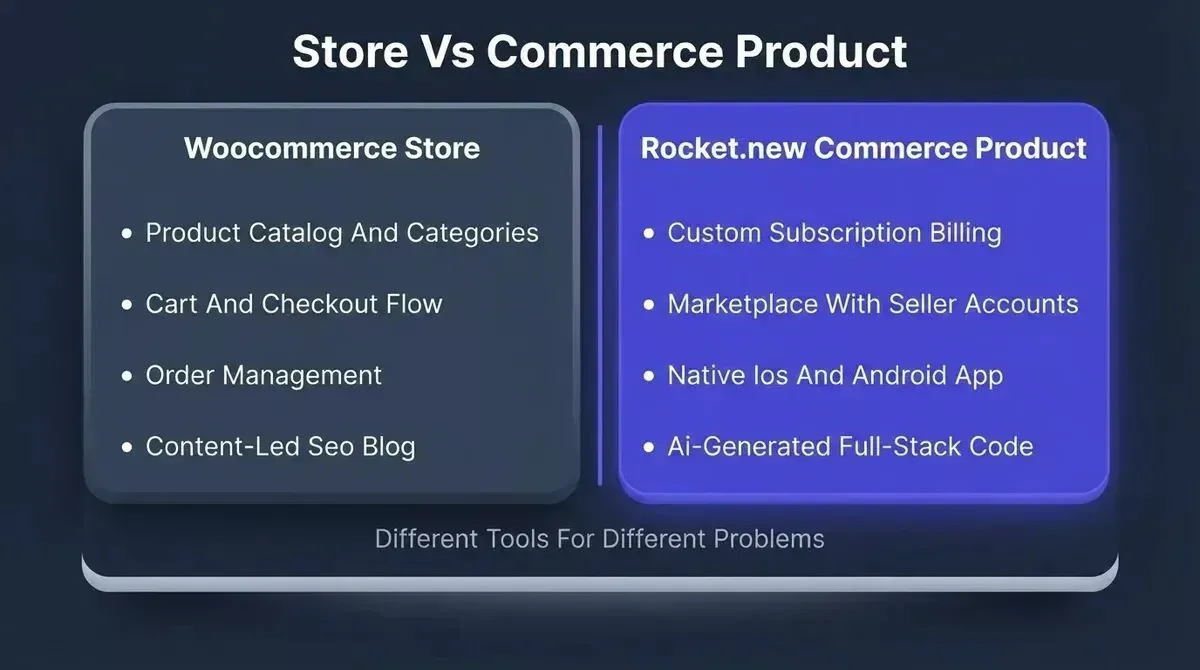
Store vs Commerce Product: the distinction that determines which platform is right for you.
The Hidden Costs of "Free" WooCommerce in 2026
The WooCommerce pricing page says "$0 platform fee." That line is technically accurate and practically misleading. Here is what a real WooCommerce store actually costs, layer by layer.
Hosting, Infrastructure, and Web Performance
WooCommerce requires separate hosting because it is a self-hosted plugin, not a managed platform. Shared hosting plans start around $25 per month, but any store with real traffic needs managed WordPress hosting for acceptable site loading times and a faster website.
Hosting quality also affects Core Web Vitals, overall web performance, and your PageSpeed performance score, and speed remains a Google ranking factor, so a slow store can lose both traffic and sales.
-
Managed hosting from providers like WP Engine, Kinsta, or Cloudways runs $30 to $350 per month depending on traffic, storage, and performance tiers
-
Store owners need to configure server settings, PHP versions, database optimization, and CDN setup, or pay someone who can
-
But WooCommerce was never designed as an app framework, so once you need a real app or custom web apps, WordPress is being stretched beyond its original model
-
A one-second delay in page load time can reduce conversions, making hosting a direct performance investment
That’s the architectural split: WooCommerce gives you flexibility, but Rocket.new is built to generate the initial product from natural language prompts with no coding required.
Plugins and Extensions
A bare WooCommerce install handles basic product pages and checkout. A real store needs plugins for nearly everything else, and acceptable load time is not just a UX issue: slow stores hurt conversions and search visibility.
-
WP Rocket is the most popular caching plugin for WooCommerce, priced at $59 per year for a single site, and without a caching plugin like WP Rocket, performance is often unacceptable for commerce. Its powerful features can save time, and that includes lazy loading for a faster website; faster loading times also support Core Web Vitals, improve the PageSpeed performance score, and matter because speed is a Google ranking factor.
-
Beyond WP Rocket, stores typically install plugins for email marketing ($49-$199/year), advanced shipping ($79-$199/year), subscription billing ($199-$299/year), and security ($99-$299/year), with the right stack depending on a store's specific needs.
-
Each plugin adds cost, configuration time, and potential conflicts; ten active paid plugins can easily reach $1,000 to $3,000 per year, so users should favor battle-tested tools from teams with a solid track record. WP Rocket is generally fully compatible with common themes, plugins, and hosts, but 57% of consumers abandon sites loading over 3 seconds, and faster loading times improve search rankings and customer satisfaction.
Payment Processing
WooCommerce does not charge its own transaction fees, which is a real advantage over Shopify. But payment processing still costs money through your chosen gateway.
-
WooPayments charges approximately 2.50-2.90% plus $0.30 per transaction, comparable to Stripe's standard pricing
-
International selling, currency conversion, and multi-gateway setups each require their own plugins at additional cost
Developer and Maintenance Overhead
Self-hosted software means self-managed security, updates, and troubleshooting. WooCommerce does not fix itself when things break.
-
WordPress core updates, WooCommerce updates, theme updates, and plugin updates all happen on different schedules, and any update can break compatibility with another component
-
Developer retainers for WooCommerce maintenance typically cost $500 to $2,000 per month for active stores, covering security patches, bug fixes, plugin conflicts, and speed improvements
-
Security is a constant concern; WordPress is the most targeted CMS on the web, requiring dedicated security plugins, SSL management, and regular vulnerability scanning
The Real Cost at Scale
According to WooCommerce's own pricing page, hosting alone runs $25 to $350 per month, and each extension adds $29 to $299 per year. Annual costs quietly reach $1,500 to $18,000 for a real business. WooCommerce's own cost guide shows approximately $89,500 per year at $2M GMV when all layers are included.
The July 2026 launch of Woo Express Pro at $39-$79/month is Automattic quietly admitting that the DIY model does not work for most of its customer base. It is a more bundled offer, but like other all-in-one ecommerce tools, convenience does not automatically make the total cost low.
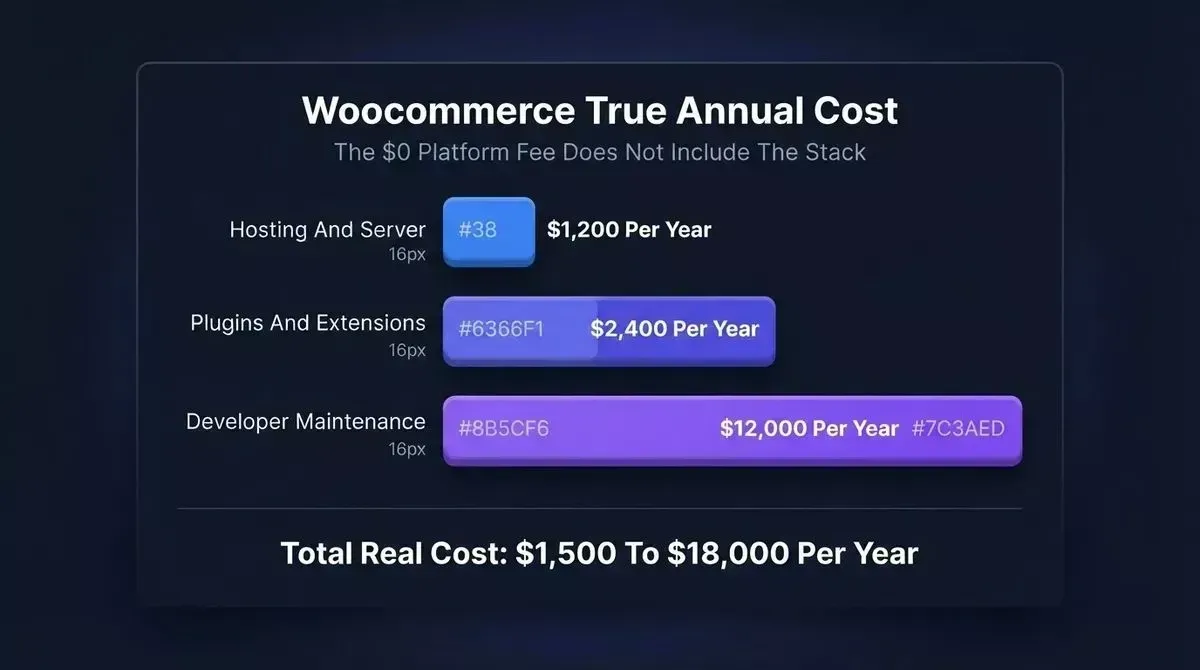
WooCommerce's real annual cost: the "$0 platform fee" does not include the stack beneath it.
| GMV Range | WooCommerce Annual Cost | Rocket.new Annual Cost |
|---|---|---|
| $0-$50K | $1,500-$5,000 (hosting + plugins + maintenance) | $300 (Pro plan, all-inclusive) |
| $50K-$500K | $8,000-$25,000 (scaled hosting + dev retainer + plugins) | $1,200-$3,000 (Booster plan, all-inclusive) |
| $500K+ | $25,000-$89,500+ (enterprise hosting + team + security) | Custom - flat rate, no per-transaction fees |
That difference carries into ownership too: Rocket.new reserves code export and similar controls for its paid plans, while custom WooCommerce builds often end in a messy developer handoff because store logic is spread across themes, plugins, and hosting configuration.
WooCommerce 2026: What Changed, What Broke, What's Better
WooCommerce is not standing still. The 2026 releases include genuinely significant architectural improvements, and some of the most disruptive breaking changes the platform has seen in years.
What Improved
WooCommerce 9.0, released in July 2026, delivered real infrastructure upgrades. HPOS (High-Performance Order Storage) is now mandatory, replacing the legacy post-based order system with a dedicated database table architecture. Native GraphQL support arrived, enabling headless commerce builds without third-party plugins. Block Checkout 2.0 shipped with improved performance and extensibility.
What Broke
The mandatory HPOS migration and the deprecation of the WC_Data layer caused compatibility failures across millions of active stores. Stores running 15 or more plugins discovered that a significant portion of their stack was incompatible with WooCommerce 9.0. Store owners faced a choice: delay the update and run on outdated software, or update and debug a cascade of plugin failures.
WooCommerce store count declined 7.4% year-over-year while Shopify grew 20.9% in the same period. The platform's market share is contracting as the maintenance burden drives smaller stores toward managed alternatives.
The Legal Context
In January 2026, WooCommerce Inc. was added as a named defendant in the ongoing Automattic/WP Engine lawsuit. The litigation involves governance questions about the WordPress ecosystem that remain unresolved. For businesses making multi-year platform commitments, the governance uncertainty is worth monitoring.
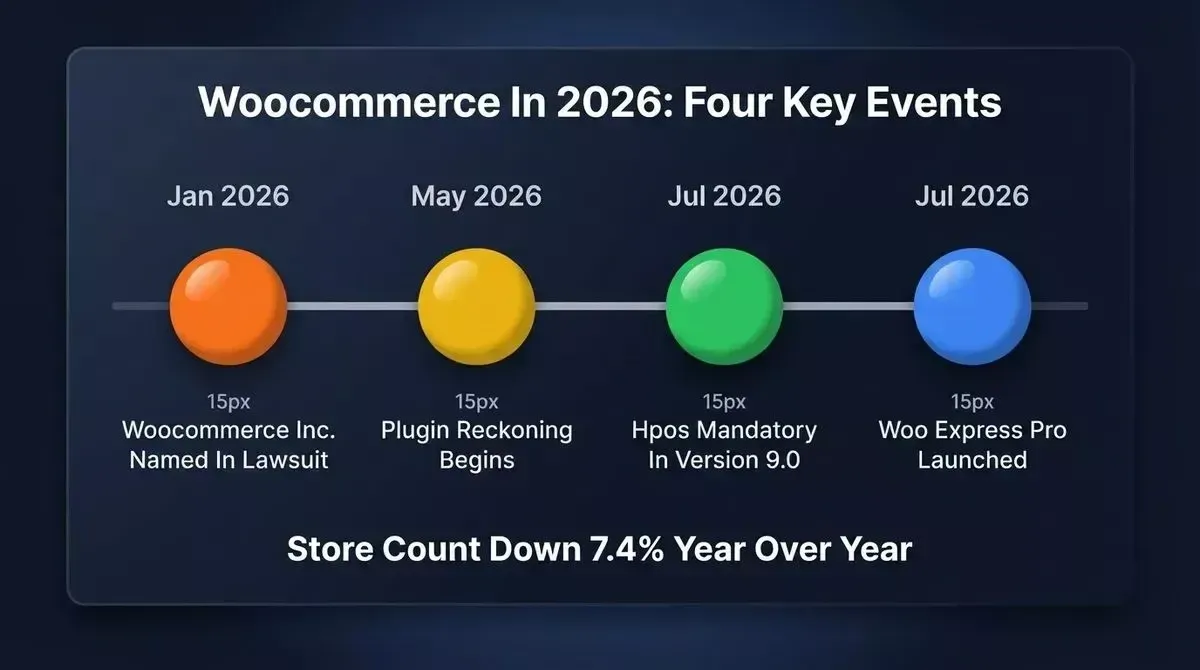
Four major WooCommerce events in 2026 that every store owner should understand before committing to the platform.
What Rocket.new Builds That WooCommerce Can't
Rocket.new is not a WooCommerce competitor in the traditional sense. It is a different category of tool for a different category of problem.
Native Apps: Flutter Mobile Apps
WooCommerce is a web platform. Building native iOS and Android apps on top of WooCommerce requires hiring separate mobile developers, choosing a mobile framework, and maintaining two separate codebases. The WooCommerce mobile app by Automattic is a store management tool for owners. It does not give customers a native shopping experience.
Rocket.new generates Flutter mobile apps for iOS and Android from the same project as your web app. One description, one build, and you have apps ready for both the App Store and Google Play.
Custom Commerce Products
Subscription SaaS with billing logic, marketplaces with seller accounts and split payments, booking platforms with availability calendars; these are commerce products, not stores. WooCommerce can approximate some of these through plugin stacking, but the architecture fights you at every step.
Rocket.new generates these from a description, with the full stack, frontend, backend, database, auth, Stripe, and mobile, produced in a single generation.
AI-Native Architecture
WooCommerce's AI features are third-party add-ons. AI Product Recommendations costs $78 per year plus your OpenAI API key, per the WooCommerce Marketplace. Rocket.new's AI generation is foundational. It is not a feature bolted onto the platform; it is the mechanism by which the platform produces code.
Its AI capabilities are still scoped to generation workflows rather than broad general-purpose AI. Projects run on PostgreSQL with no artificial row limits. Full source code download is available on paid plans, and unused credits expire at month-end.
Zero Maintenance Overhead
No WordPress updates to manage. No plugin conflicts to debug. No HPOS migration to plan. Rocket.new handles infrastructure so builders focus on their product. The platform is fully managed; the same architecture that generates your app also keeps it running.
Head-to-Head Comparison
| Factor | WooCommerce | Rocket.new |
|---|---|---|
| Platform type | WordPress plugin (self-hosted) | AI-native full-stack builder |
| Build time to first store | Days to weeks | Minutes (prompt to deployed app) |
| Tech stack | PHP/MySQL/WordPress | Next.js + Flutter (production-grade) |
| Native mobile app | No - requires separate development | Yes - Flutter iOS + Android from same project |
| AI features | Third-party plugins ($78+/year + API key) | Foundational - AI generates the entire app |
| Maintenance | Continuous - updates, conflicts, security | Zero - fully managed platform |
| SEO ceiling | Very high - native WordPress CMS, Yoast, full URL control | Good - production Next.js, fast by default |
| Extension ecosystem | 900+ extensions, 20+ years of plugins | AI-generated features on demand |
| Code ownership | Open source, but tangled in WordPress architecture | Full source export + GitHub sync |
| Transaction fees | 0% platform fee | 0% platform fee |
| Annual cost (growth store) | $1,500-$18,000 | $300-$3,000 (all-inclusive) |
| Pricing model | Variable - hosting + plugins + maintenance | Flat monthly subscription |
The Commerce Scenarios: Who Should Choose What
The right platform is determined by the commerce scenario, not by which platform has more features. Here are the six scenarios that cover most real decisions.
Scenario 1: Content-Driven Retail Brand with 500+ SKUs and an Editorial Blog
Choose WooCommerce. This is WooCommerce's highest-ceiling use case. Native WordPress CMS, granular URL control, Yoast integration, unlimited content types, and editorial-to-product internal linking architecture. WooCommerce's SEO infrastructure is genuinely irreplaceable for brands where organic search drives product discovery.
Scenario 2: SaaS Product with Subscription Billing and a Member Dashboard
Choose Rocket.new. Subscription billing with custom logic, member accounts with role-based access, a dashboard with user-specific data; this is a commerce product, not a store. WooCommerce can approximate it through plugin stacking, but the architecture creates fragility.
Scenario 3: Local Business Building a Booking Platform with a Mobile App
Choose Rocket.new. Availability calendars, appointment scheduling, payment collection, and a native mobile app for customers. WooCommerce has no native path to this. Rocket.new generates the full stack, including Flutter mobile apps, from a single project.
Scenario 4: Marketplace Connecting Buyers and Sellers
Choose Rocket.new. With no coding required to generate the initial booking app and mobile experience, vendor dashboards, split payments, seller account management, and custom workflows are the core of a marketplace. It also makes it easier to handle variants without creating separate products. WooCommerce's marketplace plugins add significant complexity and cost.
Scenario 5: High-GMV Store Needing Granular SEO Control
Choose WooCommerce. At high GMV with an established organic traffic base, WooCommerce's SEO ceiling justifies the maintenance overhead. Full control over URL structure, schema markup, and content-commerce integration is worth the investment for stores where SEO is the primary growth lever.
Scenario 6: Founder Validating a Commerce Idea Fast with No Developer
Choose Rocket.new. Prompt to deploy a commerce product with Stripe, auth, product catalog, and mobile in minutes. No domain configuration, no hosting setup, no plugin stack to manage.
SEO and Content: WooCommerce's Strongest Hand
WordPress's content model gives WooCommerce a structural SEO advantage that no AI-first builder currently matches. Every product page, category page, and blog post shares the same URL architecture, internal linking model, and content type system. You can create buying guides that link directly to product pages with exact-match anchor text, while the generated starting point functions more like a template founders can refine in a visual editor before involving developers.
The technical SEO capabilities are equally strong. Yoast SEO and Rank Math integrate natively with WooCommerce to provide schema markup, breadcrumb control, canonical URL management, and XML sitemap generation.
Because site speed is a confirmed ranking factor, teams can also tune themes, hosting, and caching to improve Core Web Vitals alongside crawlability. URL structure is fully customizable. You can create /shop/category/subcategory/product hierarchies that match your keyword architecture exactly.
The honest caveat: this SEO ceiling requires configuration. You are not getting WooCommerce's SEO advantages by default. You need a developer who understands WordPress SEO, a properly configured Yoast or Rank Math setup, and ongoing maintenance. The ceiling is high, but reaching it takes work.
Building a Commerce Product vs Running a Store
A store has products, a cart, checkout, and order management. The commerce logic is standard: add to cart, enter shipping address, pay, receive confirmation. WooCommerce is purpose-built for this pattern, and it executes it well.
A commerce product has custom business logic that goes beyond the standard store pattern. A subscription platform needs billing cycles, dunning management, and subscriber dashboards. A marketplace needs seller accounts, commission rules, and split payment logic. A branded mobile app needs push notifications, offline access, and native iOS and Android interactions.
WooCommerce can approximate some of these through plugin stacking, but the architecture creates compounding problems. WooCommerce 9.0's breaking changes hit hardest on stores running 15 or more plugins; exactly the stores that had built the most custom commerce logic. Rocket.new starts from the commerce product model, generating the custom data model, business logic, user account system, and mobile app as a unified codebase.
Migration, Lock-In, and Long-Term Risk
Both platforms have lock-in risks, but they are different in character.
WooCommerce Lock-In
WooCommerce is technically open source, but practical lock-in happens through the plugin ecosystem. Your store logic lives across dozens of plugins, subscription rules in one plugin, shipping logic in another, membership tiers in a third. Migrating means rebuilding every piece of custom logic, not just moving data.
Database schemas are tied to WordPress's architecture: product data, order history, and customer records live in a WordPress database structure that does not map cleanly to other systems. According to Wikipedia, WooCommerce has attracted popularity partly because of its extensions ecosystem, but that same ecosystem creates fragmentation risk when governance is contested.
Rocket.new Lock-In
Rocket.new provides full source code export and GitHub sync for every project. You can download production-ready Next.js or Flutter code, push it to your own repository, and continue development with any developer or agency. The code is standard: Next.js for web, Flutter for mobile, deployable on any hosting infrastructure.
Why Rocket.new Fits the Modern Commerce Builder
The comparison between these platforms ultimately comes down to what you are building. If you need a WordPress blog with a shopping cart, WooCommerce is purpose-built for that. If you need a commerce product: a subscription platform, a marketplace, a booking system, or a branded mobile shopping app. Rocket.new is where that idea becomes a production app, with full source code download available on paid plans.
-
Full-stack generation from a single prompt: Describe your commerce idea with natural language prompts, and Rocket.new generates frontend, backend logic, database, authentication, and Stripe payment processing
-
Native mobile apps from the same project: Generate Flutter apps for iOS and Android alongside your web apps, no separate mobile development team required
-
Built-in performance, not bolted-on patches: Every generated app includes the speed features that WooCommerce stores pay WP Rocket and other caching plugins to provide
-
Zero maintenance overhead: No WordPress updates to manage, no plugin conflicts to debug, no security patches to apply, and far less coding required
-
Predictable flat pricing: One monthly line item versus WooCommerce's variable stack of hosting, plugins, and maintenance costs
Nils-Fredrik Winther-Kaland, CEO of Maksimer agency, said on WooCommerce's pricing page: "WooCommerce offers unmatched control over both costs and capabilities. Unlike rigid SaaS platforms, we can tailor every part of the stack." That control is real, but it requires a team, a budget, and ongoing technical labor to maintain.
Rocket.new flips the model. Instead of assembling a stack from plugins and configuring each piece, you describe what you want and ship a complete commerce product. If you use GitHub sync, developer handoff is also cleaner than WooCommerce's plugin-based customizations because the project lives in standard Next.js or Flutter code.
From a single description to a live commerce product, web, iOS, and Android in one build.
Final Verdict
WooCommerce is the right platform for content-led commerce, established retail with deep catalog needs, and businesses where SEO is the primary acquisition channel. Its 900+ extension ecosystem, native WordPress CMS, and zero transaction fees make it the best choice for stores where editorial content drives product discovery.
Rocket.new is the right platform for custom commerce products, mobile-first commerce, subscription and marketplace models, and founders who want to ship without a plugin stack. The AI-native architecture, native Flutter mobile app generation, zero maintenance overhead, and predictable flat pricing make it the best choice for commerce products where the business logic is custom.
The question is not which platform is better. It is which platform fits the commerce product you are actually building.
Ready to build your custom commerce product without the plugin overhead? Start building on Rocket.new for free: Stripe, auth, and mobile included, no plugins required.
Table of contents
- -What WooCommerce Actually Is (And What It's Not)
- -The Hidden Costs of "Free" WooCommerce in 2026
- -Hosting, Infrastructure, and Web Performance
- -Plugins and Extensions
- -Payment Processing
- -Developer and Maintenance Overhead
- -The Real Cost at Scale
- -WooCommerce 2026: What Changed, What Broke, What's Better
- -What Improved
- -What Broke
- -The Legal Context
- -What Rocket.new Builds That WooCommerce Can't
- -Native Apps: Flutter Mobile Apps
- -Custom Commerce Products
- -AI-Native Architecture
- -Zero Maintenance Overhead
- -Head-to-Head Comparison
- -The Commerce Scenarios: Who Should Choose What
- -Scenario 1: Content-Driven Retail Brand with 500+ SKUs and an Editorial Blog
- -Scenario 2: SaaS Product with Subscription Billing and a Member Dashboard
- -Scenario 3: Local Business Building a Booking Platform with a Mobile App
- -Scenario 4: Marketplace Connecting Buyers and Sellers
- -Scenario 5: High-GMV Store Needing Granular SEO Control
- -Scenario 6: Founder Validating a Commerce Idea Fast with No Developer
- -SEO and Content: WooCommerce's Strongest Hand
- -Building a Commerce Product vs Running a Store
- -Migration, Lock-In, and Long-Term Risk
- -WooCommerce Lock-In
- -Rocket.new Lock-In
- -Why Rocket.new Fits the Modern Commerce Builder
- -Final Verdict